Ch. 20
Properties & Changes in Matter
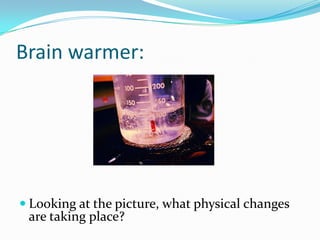
Brain warmer:


 Looking at the picture, what physical changes
 are taking place?
Today’s Essential Questions:


 1) What are chemical properties?
 2) What are the differences between physical and
 chemical changes?
Goals for today:

 Goal #1- Recognize and list chemical properties by
 viewing power point and note-taking.

 Goal #2- Differentiate and classify physical and
 chemical changes through an on-line lab.
Review of Physical Properties
 Color & Shape
 Length & Mass
 Volume & Density
 Melting & Boiling Point
 States of Matter
 Attraction to magnets


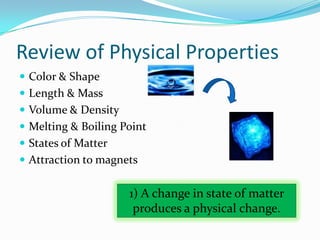
                     1) A change in state of matter
                      produces a physical change.
Chemical Properties
 2) What is a chemical         property?
Any characteristic that gives a substance the ability to
 undergo a change that results in a NEW substance.


 3) What is a chemical         change?
A change in the identity of a substance due to the
  chemical properties of a substance.
Overview of Chemical Properties
 Flammability
 Ability to react with:
    Oxygen
    Electricity
    Light
    Water
    Heat
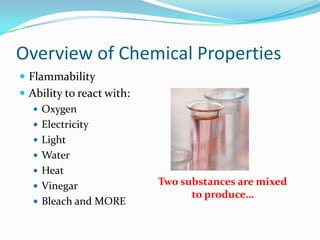
    Vinegar               Two substances are mixed
                                 to produce…
    Bleach and MORE
Chemical Property-Flammability
 4) Flammability- the ability of something to catch
  fire or produce flames

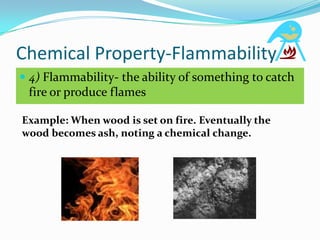
Example: When wood is set on fire. Eventually the
wood becomes ash, noting a chemical change.
Chemical Property:
Ability to React with Oxygen
 5) Ability to React with Oxygen


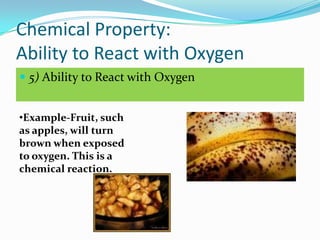
•Example-Fruit, such
as apples, will turn
brown when exposed
to oxygen. This is a
chemical reaction.
Chemical Property:
Ability to React with
 6) Electricity
 7) Light
 8) Water
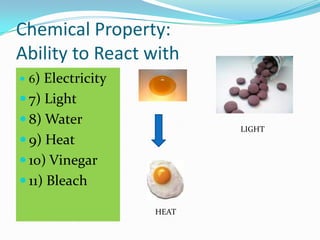
                          LIGHT
 9) Heat
 10) Vinegar
 11) Bleach

                   HEAT
How to tell:
Is it a physical or chemical change?
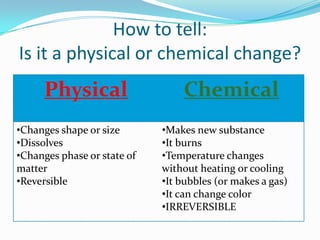
      Physical                   Chemical
•Changes shape or size       •Makes new substance
•Dissolves                   •It burns
•Changes phase or state of   •Temperature changes
matter                       without heating or cooling
•Reversible                  •It bubbles (or makes a gas)
                             •It can change color
                             •IRREVERSIBLE
Check for Understanding
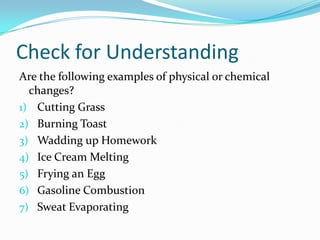
Are the following examples of physical or chemical
  changes?
1) Cutting Grass
2) Burning Toast
3) Wadding up Homework
4) Ice Cream Melting
5) Frying an Egg
6) Gasoline Combustion
7) Sweat Evaporating

Physical & chemical changes oh my

  • 1.
    Ch. 20 Properties &Changes in Matter
  • 2.
    Brain warmer:  Lookingat the picture, what physical changes are taking place?
  • 3.
    Today’s Essential Questions: 1) What are chemical properties?  2) What are the differences between physical and chemical changes?
  • 4.
    Goals for today: Goal #1- Recognize and list chemical properties by viewing power point and note-taking.  Goal #2- Differentiate and classify physical and chemical changes through an on-line lab.
  • 5.
    Review of PhysicalProperties  Color & Shape  Length & Mass  Volume & Density  Melting & Boiling Point  States of Matter  Attraction to magnets 1) A change in state of matter produces a physical change.
  • 6.
    Chemical Properties  2)What is a chemical property? Any characteristic that gives a substance the ability to undergo a change that results in a NEW substance.  3) What is a chemical change? A change in the identity of a substance due to the chemical properties of a substance.
  • 7.
    Overview of ChemicalProperties  Flammability  Ability to react with:  Oxygen  Electricity  Light  Water  Heat  Vinegar Two substances are mixed to produce…  Bleach and MORE
  • 8.
    Chemical Property-Flammability  4)Flammability- the ability of something to catch fire or produce flames Example: When wood is set on fire. Eventually the wood becomes ash, noting a chemical change.
  • 9.
    Chemical Property: Ability toReact with Oxygen  5) Ability to React with Oxygen •Example-Fruit, such as apples, will turn brown when exposed to oxygen. This is a chemical reaction.
  • 10.
    Chemical Property: Ability toReact with  6) Electricity  7) Light  8) Water LIGHT  9) Heat  10) Vinegar  11) Bleach HEAT
  • 11.
    How to tell: Isit a physical or chemical change? Physical Chemical •Changes shape or size •Makes new substance •Dissolves •It burns •Changes phase or state of •Temperature changes matter without heating or cooling •Reversible •It bubbles (or makes a gas) •It can change color •IRREVERSIBLE
  • 12.
    Check for Understanding Arethe following examples of physical or chemical changes? 1) Cutting Grass 2) Burning Toast 3) Wadding up Homework 4) Ice Cream Melting 5) Frying an Egg 6) Gasoline Combustion 7) Sweat Evaporating