8. Changes to materials
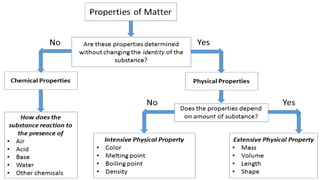
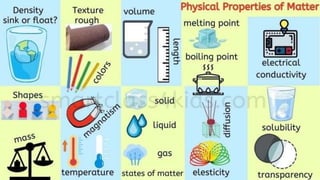
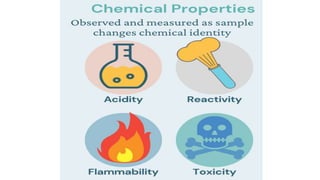
Properties of materials
Chemical changes
• In a chemical change, new substances are formed.
• For example,
when iron and sulfur are heated together, they form a new substance
(a compound called iron sulfide).
Iron + sulfur 🡪 iron(II) sulfide
• The iron and the sulfur have reacted together to form a new substance.
A chemical reaction has taken place. The iron atoms have combined and
bonded with the sulfur atoms.
• The reactants (the substances that react together) are the iron and the
sulfur.
• The products are the new substances made in the reaction. In this
reaction, there is only one product – iron(II) sulfide.
8.1 a Reaction of metals with oxygen
• In some chemical reactions, a substance breaks apart to make new
substances.
• For example, water can be split apart to form oxygen and
hydrogen.
Water 🡪 oxygen + hydrogen
• Chemical reactions happen everywhere.
• They happen inside plants when they grow and when they decay.
• Chemical reactions happen inside your body to keep you alive, for
example, when you digest food.
Burning
• Burning is a chemical reaction. When a substance burns, the substance reacts
with the oxygen in the air. Sometimes ashes are formed. The ashes contain
new substances. The new substances in the ashes are oxides.
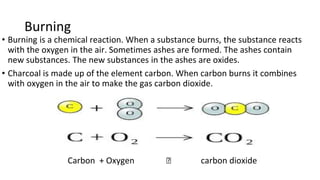
• Charcoal is made up of the element carbon. When carbon burns it combines
with oxygen in the air to make the gas carbon dioxide.
Carbon + Oxygen 🡪 carbon dioxide
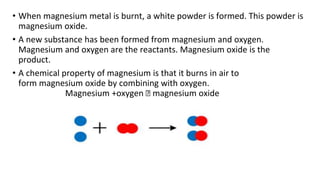
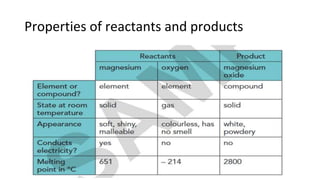
• When magnesium metal is burnt, a white powder is formed. This powder is
magnesium oxide.
• A new substance has been formed from magnesium and oxygen.
Magnesium and oxygen are the reactants. Magnesium oxide is the
product.
• A chemical property of magnesium is that it burns in air to
form magnesium oxide by combining with oxygen.
Magnesium +oxygen 🡪 magnesium oxide
Properties of reactants and products
8.1 b Reaction of metals with water
• Some substances react very violently with water.
Potassium (a metal) is very soft and can be cut with a knife.
This is a physical property.
Potassium is so reactive that it has to be stored under oil to
prevent it reacting with the water vapour in the air. This is a
chemical property.
Potassium + water 🡪 potassium hydroxide + hydrogen
When a very small piece of potassium is placed in a large
trough of water, hydrogen gas is given off. The reaction produces
so much heat that the gas burns.
https://www.youtube.com/watch?v=M8Eovgaa2QE
• Some substances do not react with water at all. Eg: Gold, silver
and platinum.
8.1 c Reaction of metal with acid
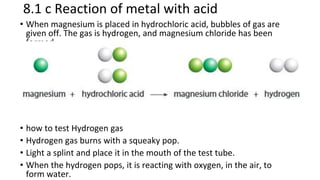
• When magnesium is placed in hydrochloric acid, bubbles of gas are
given off. The gas is hydrogen, and magnesium chloride has been
formed.
• how to test Hydrogen gas
• Hydrogen gas burns with a squeaky pop.
• Light a splint and place it in the mouth of the test tube.
• When the hydrogen pops, it is reacting with oxygen, in the air, to
form water.
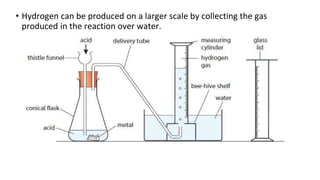
• Hydrogen can be produced on a larger scale by collecting the gas
produced in the reaction over water.
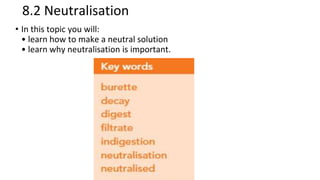
8.2 Neutralisation
• In this topic you will:
• learn how to make a neutral solution
• learn why neutralisation is important.
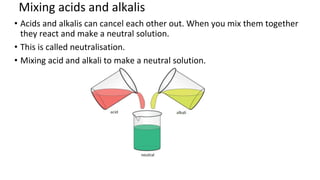
Mixing acids and alkalis
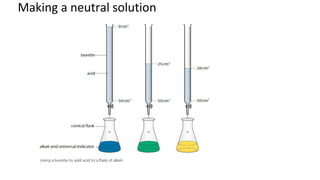
• Acids and alkalis can cancel each other out. When you mix them together
they react and make a neutral solution.
• This is called neutralisation.
• Mixing acid and alkali to make a neutral solution.
Making a neutral solution
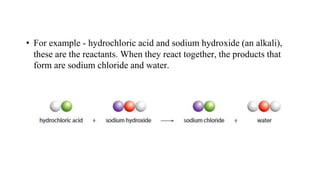
• For example - hydrochloric acid and sodium hydroxide (an alkali),
these are the reactants. When they react together, the products that
form are sodium chloride and water.
Rainbow neutralization reaction
• https://www.youtube.com/watch?v=7mbQpeFOoLE
Neutralisation in everyday life
• Indigestion - When your stomach produces too much Hydrochloric acid, you
have indigestion.
• There are many medicines that can help. They are all alkalis and they
neutralise the acid. These medicines are called antacids.
• Toothpaste
There are millions of bacteria in your mouth. The bacteria produce acid when
they feed on the pieces of food in your mouth. Toothpaste contains alkali and
this helps to neutralise the acid.
• Neutralising lakes
Acid rain changes the pH of the lakes, rivers and ponds. The plants and animals
that live in the lakes cannot live in acid conditions. Alkalis should be added into
the lakes to neutralise the acid.
• Growing crops
In some areas, the soil is very acidic and plants do not grow well. Farmers spread
lime on the soil to neutralise the acid so that the plants can grow better.
• Homework - Testing the pH of the soil.
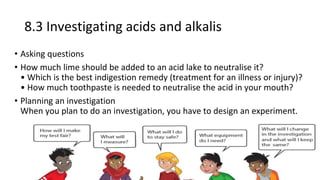
8.3 Investigating acids and alkalis
• Asking questions
• How much lime should be added to an acid lake to neutralise it?
• Which is the best indigestion remedy (treatment for an illness or injury)?
• How much toothpaste is needed to neutralise the acid in your mouth?
• Planning an investigation
When you plan to do an investigation, you have to design an experiment.
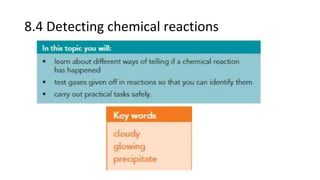
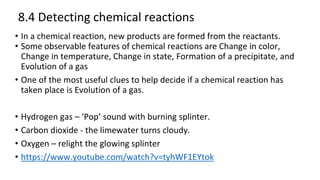
8.4 Detecting chemical reactions
• In a chemical reaction, new products are formed from the reactants.
• Some observable features of chemical reactions are Change in color,
Change in temperature, Change in state, Formation of a precipitate, and
Evolution of a gas
• One of the most useful clues to help decide if a chemical reaction has
taken place is Evolution of a gas.
• Hydrogen gas – ‘Pop’ sound with burning splinter.
• Carbon dioxide - the limewater turns cloudy.
• Oxygen – relight the glowing splinter
• https://www.youtube.com/watch?v=tyhWF1EYtok
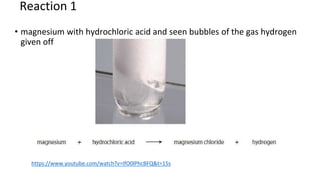
Reaction 1
• magnesium with hydrochloric acid and seen bubbles of the gas hydrogen
given off
https://www.youtube.com/watch?v=IfO0lPhcBFQ&t=15s
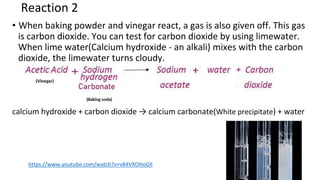
Reaction 2
• When baking powder and vinegar react, a gas is also given off. This gas
is carbon dioxide. You can test for carbon dioxide by using limewater.
When lime water(Calcium hydroxide - an alkali) mixes with the carbon
dioxide, the limewater turns cloudy.
calcium hydroxide + carbon dioxide → calcium carbonate(White precipitate) + water
https://www.youtube.com/watch?v=v84VXOHoGlI
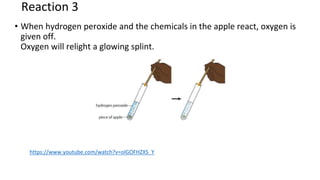
Reaction 3
• When hydrogen peroxide and the chemicals in the apple react, oxygen is
given off.
Oxygen will relight a glowing splint.
https://www.youtube.com/watch?v=olGOFHZXS_Y
Other chemical reactions clues
• Reactant ‘disappears’ - When magnesium ribbon reacts with acid, hydrogen
is produced and the magnesium ribbon ‘disappears’.
• Colour change - Gently heating black copper oxide with sulfuric acid produces
a blue solution of copper sulfate. https://www.youtube.com/watch?v=joTW3iqLceg
• Heat is produced - When potassium is placed in water, hydrogen gas is given
off. The reaction produces so much heat the hydrogen burns.
potassium + water 🡪 potassium hydroxide + hydrogen
https://www.youtube.com/watch?v=p9qkzjeIEbM
• Change in pH - When you neutralise an alkali, there is a change in pH. It is
called a neutralisation reaction.
sodium hydroxide + hydrochloric acid → sodium chloride + water
https://www.youtube.com/watch?v=qh7h_WJAv5M
https://www.youtube.com/watch?v=IfO0lPhcBFQ&t=15s
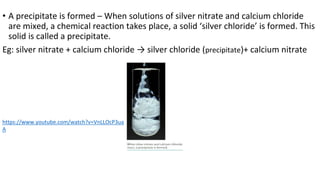
• A precipitate is formed – When solutions of silver nitrate and calcium chloride
are mixed, a chemical reaction takes place, a solid ‘silver chloride’ is formed. This
solid is called a precipitate.
Eg: silver nitrate + calcium chloride → silver chloride (precipitate)+ calcium nitrate
https://www.youtube.com/watch?v=VnLLOcP3ua
A
Project:
• Moving dangerous chemicals
• Refer page no. 290.
• Max. marks :20
• Due on: Next Friday
The End

8. changes to materials [Autosaved].pptx

  • 1.
    8. Changes tomaterials
  • 2.
  • 5.
    Chemical changes • Ina chemical change, new substances are formed. • For example, when iron and sulfur are heated together, they form a new substance (a compound called iron sulfide). Iron + sulfur 🡪 iron(II) sulfide • The iron and the sulfur have reacted together to form a new substance. A chemical reaction has taken place. The iron atoms have combined and bonded with the sulfur atoms. • The reactants (the substances that react together) are the iron and the sulfur. • The products are the new substances made in the reaction. In this reaction, there is only one product – iron(II) sulfide.
  • 6.
    8.1 a Reactionof metals with oxygen • In some chemical reactions, a substance breaks apart to make new substances. • For example, water can be split apart to form oxygen and hydrogen. Water 🡪 oxygen + hydrogen • Chemical reactions happen everywhere. • They happen inside plants when they grow and when they decay. • Chemical reactions happen inside your body to keep you alive, for example, when you digest food.
  • 7.
    Burning • Burning isa chemical reaction. When a substance burns, the substance reacts with the oxygen in the air. Sometimes ashes are formed. The ashes contain new substances. The new substances in the ashes are oxides. • Charcoal is made up of the element carbon. When carbon burns it combines with oxygen in the air to make the gas carbon dioxide. Carbon + Oxygen 🡪 carbon dioxide
  • 8.
    • When magnesiummetal is burnt, a white powder is formed. This powder is magnesium oxide. • A new substance has been formed from magnesium and oxygen. Magnesium and oxygen are the reactants. Magnesium oxide is the product. • A chemical property of magnesium is that it burns in air to form magnesium oxide by combining with oxygen. Magnesium +oxygen 🡪 magnesium oxide
  • 9.
  • 10.
    8.1 b Reactionof metals with water • Some substances react very violently with water. Potassium (a metal) is very soft and can be cut with a knife. This is a physical property. Potassium is so reactive that it has to be stored under oil to prevent it reacting with the water vapour in the air. This is a chemical property. Potassium + water 🡪 potassium hydroxide + hydrogen When a very small piece of potassium is placed in a large trough of water, hydrogen gas is given off. The reaction produces so much heat that the gas burns. https://www.youtube.com/watch?v=M8Eovgaa2QE • Some substances do not react with water at all. Eg: Gold, silver and platinum.
  • 11.
    8.1 c Reactionof metal with acid • When magnesium is placed in hydrochloric acid, bubbles of gas are given off. The gas is hydrogen, and magnesium chloride has been formed. • how to test Hydrogen gas • Hydrogen gas burns with a squeaky pop. • Light a splint and place it in the mouth of the test tube. • When the hydrogen pops, it is reacting with oxygen, in the air, to form water.
  • 12.
    • Hydrogen canbe produced on a larger scale by collecting the gas produced in the reaction over water.
  • 13.
    8.2 Neutralisation • Inthis topic you will: • learn how to make a neutral solution • learn why neutralisation is important.
  • 14.
    Mixing acids andalkalis • Acids and alkalis can cancel each other out. When you mix them together they react and make a neutral solution. • This is called neutralisation. • Mixing acid and alkali to make a neutral solution.
  • 15.
  • 16.
    • For example- hydrochloric acid and sodium hydroxide (an alkali), these are the reactants. When they react together, the products that form are sodium chloride and water.
  • 17.
    Rainbow neutralization reaction •https://www.youtube.com/watch?v=7mbQpeFOoLE
  • 18.
    Neutralisation in everydaylife • Indigestion - When your stomach produces too much Hydrochloric acid, you have indigestion. • There are many medicines that can help. They are all alkalis and they neutralise the acid. These medicines are called antacids. • Toothpaste There are millions of bacteria in your mouth. The bacteria produce acid when they feed on the pieces of food in your mouth. Toothpaste contains alkali and this helps to neutralise the acid. • Neutralising lakes Acid rain changes the pH of the lakes, rivers and ponds. The plants and animals that live in the lakes cannot live in acid conditions. Alkalis should be added into the lakes to neutralise the acid. • Growing crops In some areas, the soil is very acidic and plants do not grow well. Farmers spread lime on the soil to neutralise the acid so that the plants can grow better. • Homework - Testing the pH of the soil.
  • 19.
    8.3 Investigating acidsand alkalis • Asking questions • How much lime should be added to an acid lake to neutralise it? • Which is the best indigestion remedy (treatment for an illness or injury)? • How much toothpaste is needed to neutralise the acid in your mouth? • Planning an investigation When you plan to do an investigation, you have to design an experiment.
  • 20.
  • 21.
    8.4 Detecting chemicalreactions • In a chemical reaction, new products are formed from the reactants. • Some observable features of chemical reactions are Change in color, Change in temperature, Change in state, Formation of a precipitate, and Evolution of a gas • One of the most useful clues to help decide if a chemical reaction has taken place is Evolution of a gas. • Hydrogen gas – ‘Pop’ sound with burning splinter. • Carbon dioxide - the limewater turns cloudy. • Oxygen – relight the glowing splinter • https://www.youtube.com/watch?v=tyhWF1EYtok
  • 22.
    Reaction 1 • magnesiumwith hydrochloric acid and seen bubbles of the gas hydrogen given off https://www.youtube.com/watch?v=IfO0lPhcBFQ&t=15s
  • 23.
    Reaction 2 • Whenbaking powder and vinegar react, a gas is also given off. This gas is carbon dioxide. You can test for carbon dioxide by using limewater. When lime water(Calcium hydroxide - an alkali) mixes with the carbon dioxide, the limewater turns cloudy. calcium hydroxide + carbon dioxide → calcium carbonate(White precipitate) + water https://www.youtube.com/watch?v=v84VXOHoGlI
  • 24.
    Reaction 3 • Whenhydrogen peroxide and the chemicals in the apple react, oxygen is given off. Oxygen will relight a glowing splint. https://www.youtube.com/watch?v=olGOFHZXS_Y
  • 25.
    Other chemical reactionsclues • Reactant ‘disappears’ - When magnesium ribbon reacts with acid, hydrogen is produced and the magnesium ribbon ‘disappears’. • Colour change - Gently heating black copper oxide with sulfuric acid produces a blue solution of copper sulfate. https://www.youtube.com/watch?v=joTW3iqLceg • Heat is produced - When potassium is placed in water, hydrogen gas is given off. The reaction produces so much heat the hydrogen burns. potassium + water 🡪 potassium hydroxide + hydrogen https://www.youtube.com/watch?v=p9qkzjeIEbM • Change in pH - When you neutralise an alkali, there is a change in pH. It is called a neutralisation reaction. sodium hydroxide + hydrochloric acid → sodium chloride + water https://www.youtube.com/watch?v=qh7h_WJAv5M https://www.youtube.com/watch?v=IfO0lPhcBFQ&t=15s
  • 26.
    • A precipitateis formed – When solutions of silver nitrate and calcium chloride are mixed, a chemical reaction takes place, a solid ‘silver chloride’ is formed. This solid is called a precipitate. Eg: silver nitrate + calcium chloride → silver chloride (precipitate)+ calcium nitrate https://www.youtube.com/watch?v=VnLLOcP3ua A
  • 27.
    Project: • Moving dangerouschemicals • Refer page no. 290. • Max. marks :20 • Due on: Next Friday
  • 28.