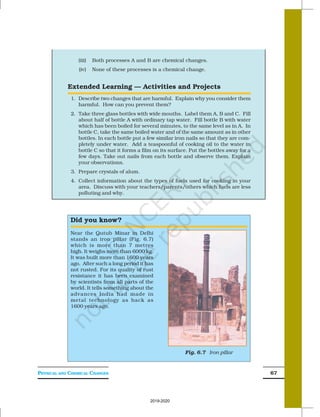
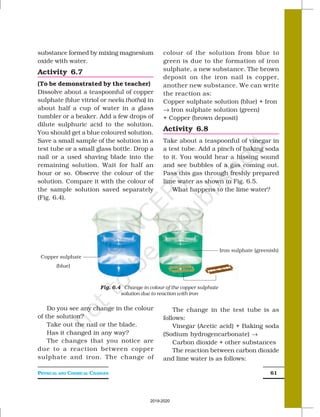
Physical and chemical changes can be distinguished based on whether new substances are formed. A physical change alters a substance's physical properties but does not create new materials, while a chemical change produces one or more new substances through chemical reactions. Examples provided demonstrate that rusting of iron, burning of magnesium, and reactions of copper sulfate are chemical changes, while cutting of paper and melting of ice are physical changes. Crystallization is identified as a physical change that forms pure substances from their solutions.
![SCIENCE
60
light (Fig. 6.3). When it is completely
burnt it leaves behind a powdery ash.
Does the ash look like the
magnesium ribbon?
The change can be represented by
the following equation:
Magnesium (Mg) + Oxygen (O2
) →
Magnesium oxide (MgO)
Fig. 6.3 Magnesium ribbon burning
atmosphere for some time. In the
kitchen, a wet iron pan (tawa) often gets
rusted if left in that state for some time.
Rust is not iron. It is different from iron
on which it gets deposited.
Let us consider a few more changes
where new substances are formed.
Activity 6.6
(To be demonstrated by the teacher)
CAUTION
It is dangerous to look for long at the
burning magnesium ribbon. The
teachers should advise children not
to stare at the burning ribbon.
Get a small piece of a thin strip or
ribbon of magnesium. Clean its tip with
sandpaper. Bring the tip near a candle
flame. It burns with a brilliant white
Collect the ash and mix it with a
small amount of water. Stir the mixture
(aqueous solution) well. Test the mixture
with blue and red litmus papers.
Does the mixture turn red litmus
blue?
Does the mixture turn blue litmus
red?
On the basis of this test, how do you
classify the aqueous solution — acidic
or basic?
On dissolving the ash in water it
forms a new substance. This change can
be written in the form of the following
equation:
Magnesium oxide (MgO) + Water
(H2
O) → Magnesium hydroxide [Mg(OH)2
]
As you have already learnt in
Chapter 5,magnesiumhydroxideisabase.
So, magnesium oxide is a new substance
formed on burning of magnesium.
Magnesium hydroxide is another new
The equations here are different from
those in mathematics. In equations
of this kind, the arrow implies
‘becomes’. No attempt should be made
to balance chemical equations at this
stage.
2019-2020](https://image.slidesharecdn.com/cbse-class-7-ncert-science-book-physical-and-chemical-changes-chapter-6-221014141627-c1e6bfb4/85/CBSE-Class-7-NCERT-Science-Book-Physical-and-Chemical-Changes-chapter-6-pdf-3-320.jpg)
![SCIENCE
62
Carbon dioxide (CO2
) + Lime water
[Ca(OH)2
] → Calcium Carbonate
(CaCO3
) + Water (H2
O)
When carbon dioxide is passed
through lime water, calcium carbonate
is formed, which makes lime water milky.
The turning of lime water into milky is a
standard test of carbon dioxide. You will
use it in Chapter 10 to show that the air
we breathe out is rich in carbon dioxide.
In Activities 6.6–6.8, you saw that
in each change one or more new
substances were formed. In Activity 6.6,
the ash was the new substance formed
when magnesium was burnt in air. In
Activity 6.7, the reaction of copper
sulphate with iron produced iron
sulphate and copper. Both of these are
new substances. Copper was deposited
on the shaving blade of iron. In Activity
6.8, vinegar and baking soda together
produced carbon dioxide, which turned
lime water milky. Can you name the new
substance formed in this reaction?
A change in which one or more
new substances are formed is called a
chemical change. A chemical change
is also called a chemical reaction.
Chemical changes are very important
in our lives. All new substances are
formed as a result of chemical changes.
For example, digestion of food in our
body, ripening of fruits, fermentation of
grapes, etc., happen due to series of
chemical changes. A medicine is the end
product of a chain of chemical reactions.
Useful new materials, such as plastics
and detergents, are produced by
chemical reactions. Indeed, every new
material is discovered by studying
chemical changes.
We have seen that one or more new
substances are produced in a chemical
change. In addition to new products,
the following may accompany a chemical
change:
n Heat, light or any other radiation
(ultraviolet, for example) may be given
off or absorbed.
n Sound may be produced.
n A change in smell may take place or
a new smell may be given off.
n A colour change may take place .
n A gas may be formed.
Let us look at some examples.
You saw that burning of magnesium
ribbon is a chemical change. Burning
of coal, wood or leaves is also a chemical
change. In fact, burning of any
substance is a chemical change.
Burning is always accompanied by
production of heat.
Fig. 6.5 Set up to pass gas through lime water
Vinegar +
Baking soda
Carbon
dioxide
Lime
water
2019-2020](https://image.slidesharecdn.com/cbse-class-7-ncert-science-book-physical-and-chemical-changes-chapter-6-221014141627-c1e6bfb4/85/CBSE-Class-7-NCERT-Science-Book-Physical-and-Chemical-Changes-chapter-6-pdf-5-320.jpg)