Cheetah
Historically ranging throughout most of Sub-Saharan Africa and extending eastward into the
Middle East and to central India, the cheetah is now distributed mainly in small, fragmented
populations in central Iran and southern, eastern and northwestern Africa.
Courtesy :IUCN
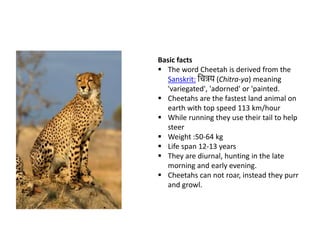
Basic facts
 The word Cheetah is derived from the
Sanskrit: चित्रय (Chitra-ya) meaning
'variegated', 'adorned' or 'painted.
 Cheetahs are the fastest land animal on
earth with top speed 113 km/hour
 While running they use their tail to help
steer
 Weight :50-64 kg
 Life span 12-13 years
 They are diurnal, hunting in the late
morning and early evening.
 Cheetahs can not roar, instead they purr
and growl.
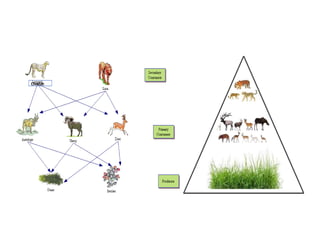
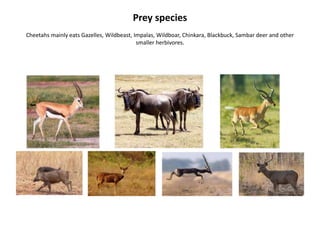
Prey species
Cheetahs mainly eats Gazelles, Wildbeast, Impalas, Wildboar, Chinkara, Blackbuck, Sambar deer and other
smaller herbivores.
What was the distribution of cheetahs in India?
 Historically, Asiatic cheetahs had a
very wide distribution in India.
 There are authentic reports of
their occurrence from as far north
as Punjab to Tirunelveli district in
southern Tamil Nadu, from Gujarat
and Rajasthan in the west to
Bengal in the east.
 Most of the records are from a belt
extending from
 Gujarat passing through
Maharashtra, Madhya Pradesh,
Uttar Pradesh, Chhattisgarh,
Jharkhand and Odisha.
 There is also a cluster of reports
from southern Maharashtra
extending to parts of Karnataka,
Telangana, Kerala and Tamil Nadu.
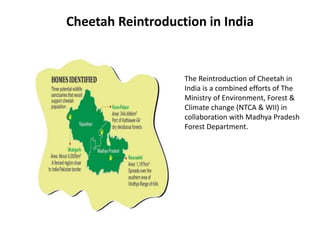
Cheetah Reintroduction in India
The Reintroduction of Cheetah in
India is a combined efforts of The
Ministry of Environment, Forest &
Climate change (NTCA & WII) in
collaboration with Madhya Pradesh
Forest Department.
• Why Cheetah Reintroduction in India ?
• Large carnivores are keystone species in the ecosystems where they
inhabit. Their loss may provoke an imbalance at several levels of the
ecosystem.
• The Cheetah is only species extinct from the historical times.
• Bring back cheetahs will provide better management and
restoration of wildlife habitats (Grasslands. Scrublands and open
forest ecosystem).
• The cheetah has been the evolutionary natural section force that
shaped adaption of high speed prey species such as antelopes and
gazelles.
• The animal charismatic in its own right, therefore, it has special
significance for the National conservation ethics and ethos.

Cheetah reintroduction.pptx

  • 4.
  • 5.
    Historically ranging throughoutmost of Sub-Saharan Africa and extending eastward into the Middle East and to central India, the cheetah is now distributed mainly in small, fragmented populations in central Iran and southern, eastern and northwestern Africa. Courtesy :IUCN
  • 6.
    Basic facts  Theword Cheetah is derived from the Sanskrit: चित्रय (Chitra-ya) meaning 'variegated', 'adorned' or 'painted.  Cheetahs are the fastest land animal on earth with top speed 113 km/hour  While running they use their tail to help steer  Weight :50-64 kg  Life span 12-13 years  They are diurnal, hunting in the late morning and early evening.  Cheetahs can not roar, instead they purr and growl.
  • 8.
    Prey species Cheetahs mainlyeats Gazelles, Wildbeast, Impalas, Wildboar, Chinkara, Blackbuck, Sambar deer and other smaller herbivores.
  • 9.
    What was thedistribution of cheetahs in India?  Historically, Asiatic cheetahs had a very wide distribution in India.  There are authentic reports of their occurrence from as far north as Punjab to Tirunelveli district in southern Tamil Nadu, from Gujarat and Rajasthan in the west to Bengal in the east.  Most of the records are from a belt extending from  Gujarat passing through Maharashtra, Madhya Pradesh, Uttar Pradesh, Chhattisgarh, Jharkhand and Odisha.  There is also a cluster of reports from southern Maharashtra extending to parts of Karnataka, Telangana, Kerala and Tamil Nadu.
  • 10.
    Cheetah Reintroduction inIndia The Reintroduction of Cheetah in India is a combined efforts of The Ministry of Environment, Forest & Climate change (NTCA & WII) in collaboration with Madhya Pradesh Forest Department.
  • 11.
    • Why CheetahReintroduction in India ? • Large carnivores are keystone species in the ecosystems where they inhabit. Their loss may provoke an imbalance at several levels of the ecosystem. • The Cheetah is only species extinct from the historical times. • Bring back cheetahs will provide better management and restoration of wildlife habitats (Grasslands. Scrublands and open forest ecosystem). • The cheetah has been the evolutionary natural section force that shaped adaption of high speed prey species such as antelopes and gazelles. • The animal charismatic in its own right, therefore, it has special significance for the National conservation ethics and ethos.