CHEETAH
Aflah Mahesa Agni (01)
Carmelia Nabila
Permatasari (04)
Jihan Nur Sinta (08)
Nur Fa’iza Raihanah Masita
(13)
General Statement
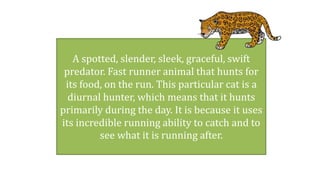
A spotted, slender, sleek, graceful, swift
predator. Fast runner animal that hunts for
its food, on the run. This particular cat is a
diurnal hunter, which means that it hunts
primarily during the day. It is because it uses
its incredible running ability to catch and to
see what it is running after.
Cheetahs are created with speed. They can
accelerate from 0 to 60 mph in 3.4 seconds
and can reach 65 mph when chasing their
favourite antelope prey. When running,
cheetahs use their tail to steer, like a rudder
for a boat. Cheetahs are the only big cat that
can turn in mid-air while sprinting. Their life
span are around 10 to 20 years.
Cheetah’s diet
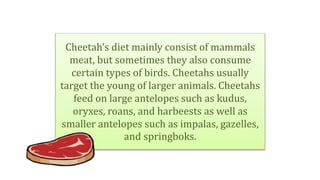
Cheetah’s diet mainly consist of mammals
meat, but sometimes they also consume
certain types of birds. Cheetahs usually
target the young of larger animals. Cheetahs
feed on large antelopes such as kudus,
oryxes, roans, and harbeests as well as
smaller antelopes such as impalas, gazelles,
and springboks.
Cheetahs often trip and knock down their
prey, then try to bite of the neck of its prey
to cut off the air supply. Once the target die,
they will drag it to an isolated area and eat it
as fast as possible to drop the risk of being
found by other predators.
As for Asiatic cheetahs, they prey on
gazelles, wild goat, sheep and hare in the
arid region of Iran, the Kavir Desert.
Sometime they also hunt domestic livestock
because of scarcity, and it is also one of the
reason why Asian cheetahs are now
endangered.
Cheetah IS HUNTING the prey
population
In a 1900 cencus, the cheetahs population was
around 100.000. Today, only 9000 remain in
Africa. Their population decreased 30% over
the last 18 years, only 7500 adults remain in the
wild. With less prey and habitat, and pursued by
hunters, the cheetahs are at a high risk of
axtinction.
Cheetahs are mostly found in sub-
Saharan Africa and in eastern and
southern African parks. Some of
the animals can still be found in
southern Algeria, northern Niger
and Iran. They like dry, open
grasslands where they can pick up
speed to kill prey. Cheetahs
habitat is now only 25% of its
former size.
HABITAT
TAKING CARE OF
THEIR YOUNGER
Cheetahs are very good mothers, caring for their
young until the cubs reach maturity, usually
between 2 and 3. Cheetahs are ordinarily solitary
animals, preferring to venture about their own
unless caring for cubs. Cheetah cubs suckle their
mother for up to 3 months but will begin to eat
some meat when they are as young as 3 weeks.
The mortality rate for cheetahs cubs in the wild is
about 70 percent, while it is only 20 percent for
those under human care. Approximately 50 to
75% of cubs die within a month.
CONSERVING CHEETAH IN ASIA AND
A
S
I
A
In 2001, the Iranian government collaborated with
the Cheetah conservation Fund, the IUCN,
Phantera, United Nation Development
Programme (UNDP), and the Wildlife Conservation
Society on the Conservation of Asiatic Cheetah
Project (CACP) to protect the natural habitat of the
Asiatic cheetah and its prey, to ensure that
development projects do not hamper its survival,
and to highlight the plight of the Asiatic cheetah. Iran
declared 31 August as National Cheetah Day in 2006.
A
F
R
I
C
A
The Range Wide Conservation Program for
Cheetah and African Wild Dogs (RWCP), the
brainchild of Sarah Durant and Rosie
Woodroffe (of the Zoological Society of
London), was started in 2007 with the
primary aim of ensuring better
conservation measures for the cheetah and
the wild dog .
Interactin
g with
Human
and
History
The cheetah in general shows no hostility toward human beings,
probably due to its sociable nature. This might be a reason why the
cheetah can be easily tamed, as it has been since antiquity. During
the New Kingdom (16th to 11th centuries BC), cheetahs were
common pet animals for the royalty, who decorated the animals
with beautiful collars and leashes. The earliest depiction of
cheetahs from eastern Asia dates back to the Tang Dynasty (7th to
10th centuries AD); paintings depict tethered cheetahs as well as
cheetahs mounted on horses. Chinese emperors would use
cheetahs, as well as caracals, as gifts.
THANK U AND SEE
U

Cheetah

  • 1.
  • 2.
    Aflah Mahesa Agni(01) Carmelia Nabila Permatasari (04) Jihan Nur Sinta (08) Nur Fa’iza Raihanah Masita (13)
  • 3.
  • 4.
    A spotted, slender,sleek, graceful, swift predator. Fast runner animal that hunts for its food, on the run. This particular cat is a diurnal hunter, which means that it hunts primarily during the day. It is because it uses its incredible running ability to catch and to see what it is running after.
  • 5.
    Cheetahs are createdwith speed. They can accelerate from 0 to 60 mph in 3.4 seconds and can reach 65 mph when chasing their favourite antelope prey. When running, cheetahs use their tail to steer, like a rudder for a boat. Cheetahs are the only big cat that can turn in mid-air while sprinting. Their life span are around 10 to 20 years.
  • 6.
  • 7.
    Cheetah’s diet mainlyconsist of mammals meat, but sometimes they also consume certain types of birds. Cheetahs usually target the young of larger animals. Cheetahs feed on large antelopes such as kudus, oryxes, roans, and harbeests as well as smaller antelopes such as impalas, gazelles, and springboks.
  • 8.
    Cheetahs often tripand knock down their prey, then try to bite of the neck of its prey to cut off the air supply. Once the target die, they will drag it to an isolated area and eat it as fast as possible to drop the risk of being found by other predators.
  • 9.
    As for Asiaticcheetahs, they prey on gazelles, wild goat, sheep and hare in the arid region of Iran, the Kavir Desert. Sometime they also hunt domestic livestock because of scarcity, and it is also one of the reason why Asian cheetahs are now endangered.
  • 10.
  • 11.
  • 12.
    In a 1900cencus, the cheetahs population was around 100.000. Today, only 9000 remain in Africa. Their population decreased 30% over the last 18 years, only 7500 adults remain in the wild. With less prey and habitat, and pursued by hunters, the cheetahs are at a high risk of axtinction.
  • 13.
    Cheetahs are mostlyfound in sub- Saharan Africa and in eastern and southern African parks. Some of the animals can still be found in southern Algeria, northern Niger and Iran. They like dry, open grasslands where they can pick up speed to kill prey. Cheetahs habitat is now only 25% of its former size. HABITAT
  • 15.
  • 16.
    Cheetahs are verygood mothers, caring for their young until the cubs reach maturity, usually between 2 and 3. Cheetahs are ordinarily solitary animals, preferring to venture about their own unless caring for cubs. Cheetah cubs suckle their mother for up to 3 months but will begin to eat some meat when they are as young as 3 weeks. The mortality rate for cheetahs cubs in the wild is about 70 percent, while it is only 20 percent for those under human care. Approximately 50 to 75% of cubs die within a month.
  • 17.
  • 18.
    A S I A In 2001, theIranian government collaborated with the Cheetah conservation Fund, the IUCN, Phantera, United Nation Development Programme (UNDP), and the Wildlife Conservation Society on the Conservation of Asiatic Cheetah Project (CACP) to protect the natural habitat of the Asiatic cheetah and its prey, to ensure that development projects do not hamper its survival, and to highlight the plight of the Asiatic cheetah. Iran declared 31 August as National Cheetah Day in 2006.
  • 19.
    A F R I C A The Range WideConservation Program for Cheetah and African Wild Dogs (RWCP), the brainchild of Sarah Durant and Rosie Woodroffe (of the Zoological Society of London), was started in 2007 with the primary aim of ensuring better conservation measures for the cheetah and the wild dog .
  • 20.
  • 21.
    The cheetah ingeneral shows no hostility toward human beings, probably due to its sociable nature. This might be a reason why the cheetah can be easily tamed, as it has been since antiquity. During the New Kingdom (16th to 11th centuries BC), cheetahs were common pet animals for the royalty, who decorated the animals with beautiful collars and leashes. The earliest depiction of cheetahs from eastern Asia dates back to the Tang Dynasty (7th to 10th centuries AD); paintings depict tethered cheetahs as well as cheetahs mounted on horses. Chinese emperors would use cheetahs, as well as caracals, as gifts.
  • 23.