Presented by:
Roll No: 7701-7704-7734-7736-7739-7750
5th semester Morning
 Introduction
 Fermentation in food processing
 History
 Types of fermentation
 Cheese
 Microbes Associated with cheese
fermentation
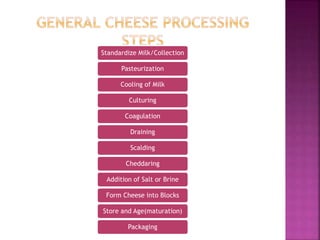
 General cheese processing steps
 Types of Cheeses
 Advantages and disadvantages of Cheese
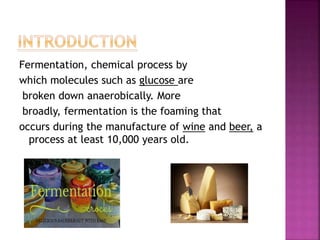
Fermentation, chemical process by
which molecules such as glucose are
broken down anaerobically. More
broadly, fermentation is the foaming that
occurs during the manufacture of wine and beer, a
process at least 10,000 years old.
converting carbohydrates to alcohol
or organic acids using
microorganisms like yeasts or bacteria
under anaerobic conditions.
Louis Pasteur in the 19th century used the
term fermentation in a narrow sense to
describe the changes brought about
by yeasts and other microorganisms growing
in the absence of air (anaerobically); he also
recognized that ethyl alcohol and carbon
dioxide are not the only products of
fermentation.
Fermentation:
Archaeologists have discovered that as far back as
6000 BC cheese had been made from cow's and
goat's milk and stored in tall jars. Egyptian tomb
murals of 2000 BC show butter and cheese being
made
Most authorities consider that cheese was first
made in the Middle East.
lactic acid fermentation:
1857, Louis Pasteur
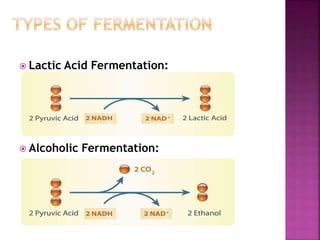
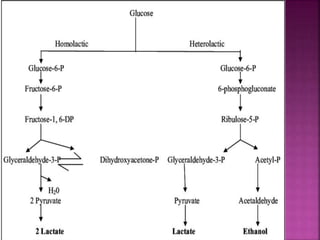
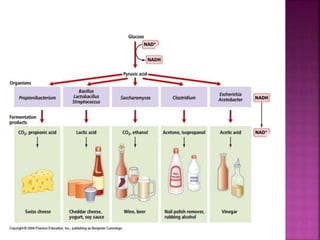
 Lactic Acid Fermentation:
 Alcoholic Fermentation:
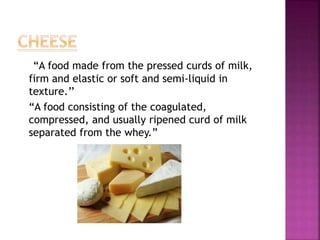
“A food made from the pressed curds of milk,
firm and elastic or soft and semi-liquid in
texture.’’
“A food consisting of the coagulated,
compressed, and usually ripened curd of milk
separated from the whey.”
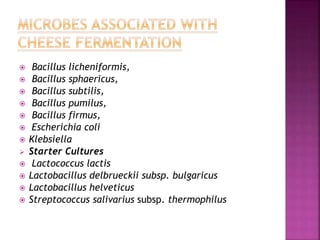
 Bacillus licheniformis,
 Bacillus sphaericus,
 Bacillus subtilis,
 Bacillus pumilus,
 Bacillus firmus,
 Escherichia coli
 Klebsiella
 Starter Cultures
 Lactococcus lactis
 Lactobacillus delbrueckii subsp. bulgaricus
 Lactobacillus helveticus
 Streptococcus salivarius subsp. thermophilus
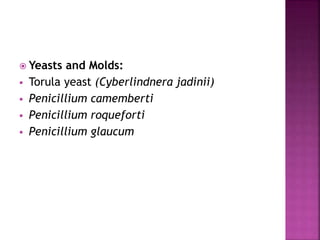
 Yeasts and Molds:
 Torula yeast (Cyberlindnera jadinii)
 Penicillium camemberti
 Penicillium roqueforti
 Penicillium glaucum
Standardize Milk/Collection
Pasteurization
Cooling of Milk
Culturing
Coagulation
Draining
Scalding
Cheddaring
Addition of Salt or Brine
Form Cheese into Blocks
Store and Age(maturation)
Packaging
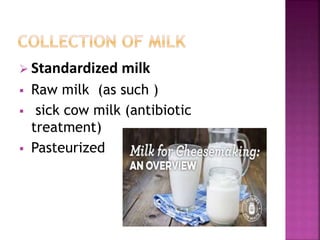
 Standardized milk
 Raw milk (as such )
 sick cow milk (antibiotic
treatment)
 Pasteurized
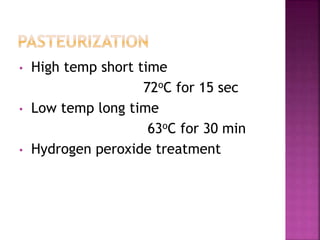
• High temp short time
72oC for 15 sec
• Low temp long time
63oC for 30 min
• Hydrogen peroxide treatment
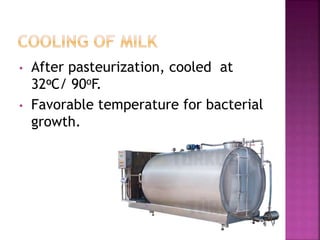
• After pasteurization, cooled at
32oC/ 90oF.
• Favorable temperature for bacterial
growth.
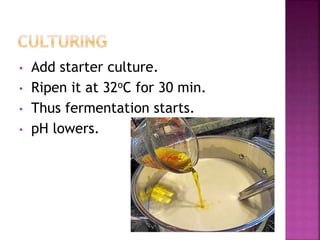
• Add starter culture.
• Ripen it at 32oC for 30 min.
• Thus fermentation starts.
• pH lowers.
• Starter culture is small amount of
bacteria ,added in milk to start
ripening by lowering the pH.
• Torula yeast brick ,
limberger cheese.
• Penicillium roqueforti blue
cheese
• Lactic acid produced.
• Addition of rennet.
• Rennet contain enzyme chymosin
which convert k-casien into para-k-
casien and glycomacropeptide.
• Leave it for 30 min for firm
coagulation.
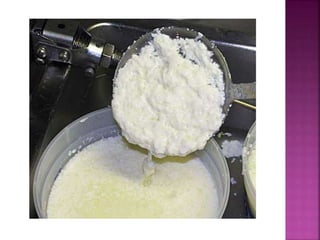
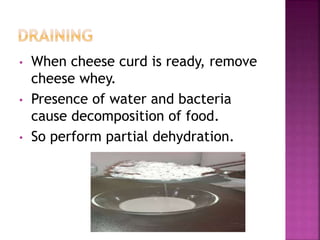
• When cheese curd is ready, remove
cheese whey.
• Presence of water and bacteria
cause decomposition of food.
• So perform partial dehydration.
• Temperature is raised to 39oC/
102oF.
• The curd is cut into small cubes
'scald' the curd particles.
• Cheese whey is expressed from the
particles.
 The curds are allowed to set until they reach a
pH of about 6.4
 Loaves" of curds are cut. After ten minutes, the
loaves are turned over and stacking begins
 Every ten minutes when the loaves must be
turned over, they are stacked. This step uses the
weight of the loaves upon each other to help
expel additional moisture. The first time this
occurs, two loaves are stacked together. The
next time, the loaves are turned, and two stacks
of two are put together.
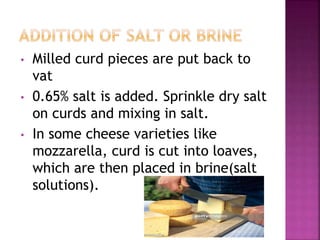
• Milled curd pieces are put back to
vat
• 0.65% salt is added. Sprinkle dry salt
on curds and mixing in salt.
• In some cheese varieties like
mozzarella, curd is cut into loaves,
which are then placed in brine(salt
solutions).
The salted curd pieces are placed in
cheese hoops and pressed into
blocks to form the cheese
 The pressed blocks of cheese are either
bound with muslin-like cloth,
or waxed or vacuum packed in plastic bags to
be stored for maturation
 Depending on the variety, cheese can be
aged from several months to several years.
• Store it in vacuum packed or
airtight plastic bag.
Several types on the basis of:
1. Length of aging (cheese maturation)
2. Texture
3. Making method
4. Fat content
5. Milk source
1. Soft Cheese:
 Soft, smooth, creamy texture
 No heating and pressing
 50-80% moisture content
 Uses:
 As a spread on bread and crackers
 Usually not for cooking
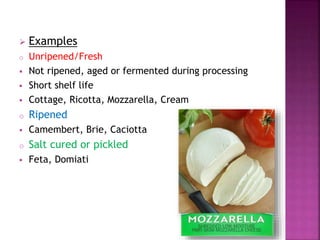
 Examples
o Unripened/Fresh
 Not ripened, aged or fermented during processing
 Short shelf life
 Cottage, Ricotta, Mozzarella, Cream
o Ripened
 Camembert, Brie, Caciotta
o Salt cured or pickled
 Feta, Domiati
2. Semi-soft Cheese
 More firm and compact
 39-50% moisture content
 Can be used for cooking purposes
 Examples
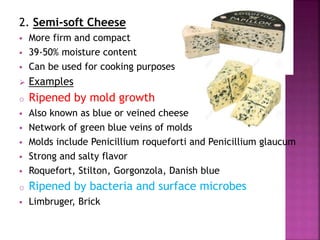
o Ripened by mold growth
 Also known as blue or veined cheese
 Network of green blue veins of molds
 Molds include Penicillium roqueforti and Penicillium glaucum
 Strong and salty flavor
 Roquefort, Stilton, Gorgonzola, Danish blue
o Ripened by bacteria and surface microbes
 Limbruger, Brick
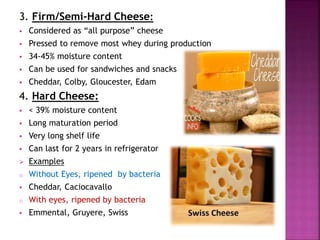
3. Firm/Semi-Hard Cheese:
 Considered as “all purpose” cheese
 Pressed to remove most whey during production
 34-45% moisture content
 Can be used for sandwiches and snacks
 Cheddar, Colby, Gloucester, Edam
4. Hard Cheese:
 < 39% moisture content
 Long maturation period
 Very long shelf life
 Can last for 2 years in refrigerator
 Examples
o Without Eyes, ripened by bacteria
 Cheddar, Caciocavallo
o With eyes, ripened by bacteria
 Emmental, Gruyere, Swiss
5. Very Hard Cheese:
 13-34% moisture content
 Very long aging period
 Can be upto 2 years
 Examples
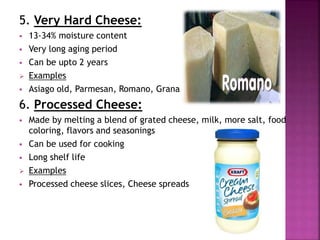
 Asiago old, Parmesan, Romano, Grana
6. Processed Cheese:
 Made by melting a blend of grated cheese, milk, more salt, food
coloring, flavors and seasonings
 Can be used for cooking
 Long shelf life
 Examples
 Processed cheese slices, Cheese spreads
 Many advantages as follow
 Nutritional Value:
 Contains vitamins such as A, B6, C, D, E, K
 Other vitamins include Thiamin, Riboflavin,
Niacin.
 Dental Care:
 High Calcium
 Low lactose
 Raise pH of plaque offers protection against
dental cavities.
 Bone Health:
 Enriched in vitamin B, A, D
 Also contains calcium, magnesium, zinc
 Strengthen bones and cartilage
 Healthy for children and women (particularly
lactating women)
 Controlling Hypertension:
 low fat cheeses such as Cottage, Feta,
Ricotta are good for hypertension patients
 Reduced Risk of Osteoporosis:
 In post menopausal women
 As cheese is enriched in vitamins, calcium
and protein
 Omega 3 fatty acids:
 Found in cheeses made from cow milk
 Healthy for cardiovascular system and brain
 Enhance blood formation
 Strengthens liver
 Facilitate absorptions of nutrients
 Cardiovascular problems:
 Cheese contains large amount of saturated
fat
 High intake of saturated fats increase
Cholesterol
 Results in increase risk of cardiovascular
diseases, obesity, diabetes
 Allergies, intolerances, sensitivities:
 Persons sensitive to casein protein develops
allergies
 Fresh cheeses like mozzarella triggers
reaction in persons with lactose intolerance
 Kidney Disorders:
 Phosphorus in high quantities
 Harmful for persons having kidney diseases
 Prostate cancer:
 High calcium causes prostate cancer
 Neonatal infection and death:
 Cheese promotes growth of Listeria bacteria
 L.monocytogenes cause serious infections in
infants and pregnant woman

Cheese (1)

  • 1.
    Presented by: Roll No:7701-7704-7734-7736-7739-7750 5th semester Morning
  • 2.
     Introduction  Fermentationin food processing  History  Types of fermentation  Cheese  Microbes Associated with cheese fermentation  General cheese processing steps  Types of Cheeses  Advantages and disadvantages of Cheese
  • 3.
    Fermentation, chemical processby which molecules such as glucose are broken down anaerobically. More broadly, fermentation is the foaming that occurs during the manufacture of wine and beer, a process at least 10,000 years old.
  • 4.
    converting carbohydrates toalcohol or organic acids using microorganisms like yeasts or bacteria under anaerobic conditions. Louis Pasteur in the 19th century used the term fermentation in a narrow sense to describe the changes brought about by yeasts and other microorganisms growing in the absence of air (anaerobically); he also recognized that ethyl alcohol and carbon dioxide are not the only products of fermentation.
  • 5.
    Fermentation: Archaeologists have discoveredthat as far back as 6000 BC cheese had been made from cow's and goat's milk and stored in tall jars. Egyptian tomb murals of 2000 BC show butter and cheese being made Most authorities consider that cheese was first made in the Middle East. lactic acid fermentation: 1857, Louis Pasteur
  • 6.
     Lactic AcidFermentation:  Alcoholic Fermentation:
  • 7.
    “A food madefrom the pressed curds of milk, firm and elastic or soft and semi-liquid in texture.’’ “A food consisting of the coagulated, compressed, and usually ripened curd of milk separated from the whey.”
  • 10.
     Bacillus licheniformis, Bacillus sphaericus,  Bacillus subtilis,  Bacillus pumilus,  Bacillus firmus,  Escherichia coli  Klebsiella  Starter Cultures  Lactococcus lactis  Lactobacillus delbrueckii subsp. bulgaricus  Lactobacillus helveticus  Streptococcus salivarius subsp. thermophilus
  • 11.
     Yeasts andMolds:  Torula yeast (Cyberlindnera jadinii)  Penicillium camemberti  Penicillium roqueforti  Penicillium glaucum
  • 12.
    Standardize Milk/Collection Pasteurization Cooling ofMilk Culturing Coagulation Draining Scalding Cheddaring Addition of Salt or Brine Form Cheese into Blocks Store and Age(maturation) Packaging
  • 13.
     Standardized milk Raw milk (as such )  sick cow milk (antibiotic treatment)  Pasteurized
  • 14.
    • High tempshort time 72oC for 15 sec • Low temp long time 63oC for 30 min • Hydrogen peroxide treatment
  • 15.
    • After pasteurization,cooled at 32oC/ 90oF. • Favorable temperature for bacterial growth.
  • 16.
    • Add starterculture. • Ripen it at 32oC for 30 min. • Thus fermentation starts. • pH lowers.
  • 17.
    • Starter cultureis small amount of bacteria ,added in milk to start ripening by lowering the pH. • Torula yeast brick , limberger cheese. • Penicillium roqueforti blue cheese
  • 18.
    • Lactic acidproduced. • Addition of rennet. • Rennet contain enzyme chymosin which convert k-casien into para-k- casien and glycomacropeptide. • Leave it for 30 min for firm coagulation.
  • 20.
    • When cheesecurd is ready, remove cheese whey. • Presence of water and bacteria cause decomposition of food. • So perform partial dehydration.
  • 21.
    • Temperature israised to 39oC/ 102oF. • The curd is cut into small cubes 'scald' the curd particles. • Cheese whey is expressed from the particles.
  • 22.
     The curdsare allowed to set until they reach a pH of about 6.4  Loaves" of curds are cut. After ten minutes, the loaves are turned over and stacking begins  Every ten minutes when the loaves must be turned over, they are stacked. This step uses the weight of the loaves upon each other to help expel additional moisture. The first time this occurs, two loaves are stacked together. The next time, the loaves are turned, and two stacks of two are put together.
  • 23.
    • Milled curdpieces are put back to vat • 0.65% salt is added. Sprinkle dry salt on curds and mixing in salt. • In some cheese varieties like mozzarella, curd is cut into loaves, which are then placed in brine(salt solutions).
  • 24.
    The salted curdpieces are placed in cheese hoops and pressed into blocks to form the cheese
  • 25.
     The pressedblocks of cheese are either bound with muslin-like cloth, or waxed or vacuum packed in plastic bags to be stored for maturation  Depending on the variety, cheese can be aged from several months to several years.
  • 26.
    • Store itin vacuum packed or airtight plastic bag.
  • 27.
    Several types onthe basis of: 1. Length of aging (cheese maturation) 2. Texture 3. Making method 4. Fat content 5. Milk source
  • 28.
    1. Soft Cheese: Soft, smooth, creamy texture  No heating and pressing  50-80% moisture content  Uses:  As a spread on bread and crackers  Usually not for cooking
  • 29.
     Examples o Unripened/Fresh Not ripened, aged or fermented during processing  Short shelf life  Cottage, Ricotta, Mozzarella, Cream o Ripened  Camembert, Brie, Caciotta o Salt cured or pickled  Feta, Domiati
  • 30.
    2. Semi-soft Cheese More firm and compact  39-50% moisture content  Can be used for cooking purposes  Examples o Ripened by mold growth  Also known as blue or veined cheese  Network of green blue veins of molds  Molds include Penicillium roqueforti and Penicillium glaucum  Strong and salty flavor  Roquefort, Stilton, Gorgonzola, Danish blue o Ripened by bacteria and surface microbes  Limbruger, Brick
  • 31.
    3. Firm/Semi-Hard Cheese: Considered as “all purpose” cheese  Pressed to remove most whey during production  34-45% moisture content  Can be used for sandwiches and snacks  Cheddar, Colby, Gloucester, Edam 4. Hard Cheese:  < 39% moisture content  Long maturation period  Very long shelf life  Can last for 2 years in refrigerator  Examples o Without Eyes, ripened by bacteria  Cheddar, Caciocavallo o With eyes, ripened by bacteria  Emmental, Gruyere, Swiss
  • 32.
    5. Very HardCheese:  13-34% moisture content  Very long aging period  Can be upto 2 years  Examples  Asiago old, Parmesan, Romano, Grana 6. Processed Cheese:  Made by melting a blend of grated cheese, milk, more salt, food coloring, flavors and seasonings  Can be used for cooking  Long shelf life  Examples  Processed cheese slices, Cheese spreads
  • 33.
     Many advantagesas follow  Nutritional Value:  Contains vitamins such as A, B6, C, D, E, K  Other vitamins include Thiamin, Riboflavin, Niacin.  Dental Care:  High Calcium  Low lactose  Raise pH of plaque offers protection against dental cavities.
  • 34.
     Bone Health: Enriched in vitamin B, A, D  Also contains calcium, magnesium, zinc  Strengthen bones and cartilage  Healthy for children and women (particularly lactating women)  Controlling Hypertension:  low fat cheeses such as Cottage, Feta, Ricotta are good for hypertension patients
  • 35.
     Reduced Riskof Osteoporosis:  In post menopausal women  As cheese is enriched in vitamins, calcium and protein  Omega 3 fatty acids:  Found in cheeses made from cow milk  Healthy for cardiovascular system and brain  Enhance blood formation  Strengthens liver  Facilitate absorptions of nutrients
  • 36.
     Cardiovascular problems: Cheese contains large amount of saturated fat  High intake of saturated fats increase Cholesterol  Results in increase risk of cardiovascular diseases, obesity, diabetes  Allergies, intolerances, sensitivities:  Persons sensitive to casein protein develops allergies  Fresh cheeses like mozzarella triggers reaction in persons with lactose intolerance
  • 37.
     Kidney Disorders: Phosphorus in high quantities  Harmful for persons having kidney diseases  Prostate cancer:  High calcium causes prostate cancer  Neonatal infection and death:  Cheese promotes growth of Listeria bacteria  L.monocytogenes cause serious infections in infants and pregnant woman