Beak Trimming:
Hot Blade vs. IRBT
Taylor Reed
Summer 2016
Pecking
• Two supported theories of cause
• Redirected ground pecking from foraging
• Redirected dust bathing pecking
• Combination of different STRESSES lead to pecking
• Learned behavior
• Seen more at the end of the lighting day (8-14 hours after lights come on) in
medium heavy brown strains
Poor Feather Cover Consequences
*feathering on back and vent are best indicators of overall feather score
• Higher feed intake
• ~16% more in winter weather
• lower egg production during colder (<20C) temperatures
• Food per dozen eggs was 27.5% better in well feathered birds
• Some studies show reduced body weight at 40 weeks and end of lay
• 46% higher energy requirement and 27% higher feed consumption at 64.4C
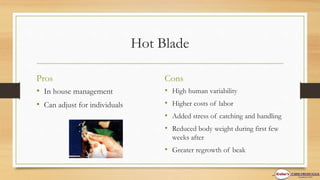
Hot Blade
Pros
• In house management
• Can adjust for individuals
Cons
• High human variability
• Higher costs of labor
• Added stress of catching and handling
• Reduced body weight during first few
weeks after
• Greater regrowth of beak
Infrared Beak Treatment
Pros
• No in house labor or time
• Automated, precise adjustments
• Reduced stress of handling
• Gradual change in beak
• No open wounds or infection
• Fewer abnormalities in adult beaks
• Less pain and nerve damage?
Cons
• Possible stressor to vaccinate and
trim at same time
• No adjusting on individual basis
• Machinery is very complex
Factors to Consider
• Costs
• Current and future
• Uniformity
• Production
• Pecking
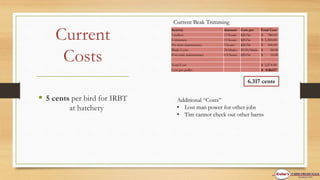
Current
Costs
 5 cents per bird for IRBT
at hatchery
Current Beak Trimming
Activity Amount Cost per Total Cost
3 pullers 13 hours $20/hr $ 780.00
5 trimmers 13 hours $20/hr $ 1,300.00
Pre-trim maintenance 5 hours $20/hr $ 100.00
Blade Costs 24 blades $3.50/blade $ 84.00
Post-trim maintenance 0.5 hours $20/hr $ 10.00
Total Cost $ 2,274.00
Cost per pullet $ 0.06317
Additional “Costs”
• Lost man power for other jobs
• Tim cannot check out other barns
6.317 cents
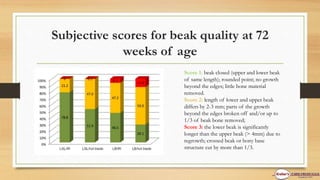
Subjective scores for beak quality at 72
weeks of age
Score 1: beak closed (upper and lower beak
of same length); rounded point; no growth
beyond the edges; little bone material
removed.
Score 2: length of lower and upper beak
differs by 2-3 mm; parts of the growth
beyond the edges broken off and/or up to
1/3 of beak bone removed;
Score 3: the lower beak is significantly
longer than the upper beak (> 4mm) due to
regrowth; crossed beak or bony base
structure cut by more than 1/3.
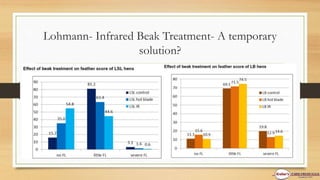
Lohmann- Infrared Beak Treatment- A temporary
solution?
Lohmann Study
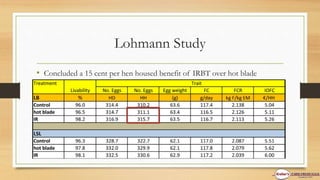
• Concluded a 15 cent per hen housed benefit of IRBT over hot blade
Poor Beak Trim Consequences
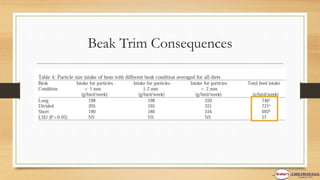
• A 1982 study shows significantly lower food intake for shorter beaks
compared to longer beaks
• Forks and shovels reduce ability to pick up food
• Decrease feed efficiency
• Consume less large particles with smaller beaks
• Limit production potential
Beak Trim Consequences
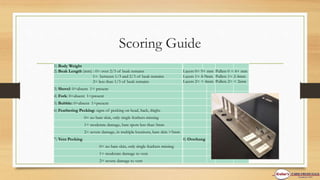
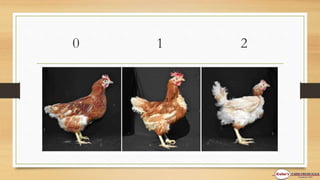
Scoring Guide
1) Body Weight
2) Beak Length (mm) : 0= over 2/3 of beak remains Layers 0= 9+ mm Pullets 0 = 4+ mm
1= between 1/3 and 2/3 of beak remains Layers 1= 4-9mm Pullets 1= 2-4mm
2= less than 1/3 of beak remains Layers 2= < 4mm Pullets 2= < 2mm
3) Shovel: 0=absent 1= present
4) Fork: 0=absent 1=present
5) Bubble: 0=absent 1=present
6) Feathering Pecking: signs of pecking on head, back, thighs
0= no bare skin, only single feathers missing
1= moderate damage, bare spots less than 5mm
2= severe damage, in multiple locations, bare skin >5mm
7) Vent Pecking 8) Overhang
0= no bare skin, only single feathers missing
1= moderate damage to vent
2= severe damage to vent
0 1 2
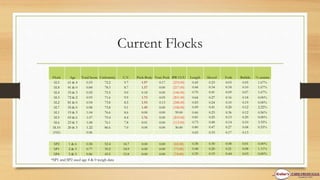
Current Flocks
*SP1 and SP2 used age 4 & 0 weigh data
Flock Age Total Score Uniformity C.V. Peck-Body Vent Peck BW O/U Length Shovel Fork Bubble % untrim
SL5 61 & 4 0.53 72.2 9.7 1.97 0.17 (233.00) 0.45 0.23 0.03 0.05 1.67%
SL8 41 & 0 0.84 78.3 8.7 1.57 0.00 (217.00) 0.44 0.34 0.18 0.10 1.67%
SL4 33 & 3 0.92 75.5 9.0 0.18 0.00 (146.00) 0.70 0.41 0.09 0.07 1.67%
SL3 72 & 2 0.93 71.6 9.9 1.73 0.05 (201.00) 0.64 0.27 0.16 0.18 0.00%
SL2 81 & 0 0.94 73.8 8.5 1.93 0.13 (248.00) 0.83 0.24 0.10 0.19 0.00%
SL7 55 & 0 0.98 73.8 9.1 1.49 0.00 (198.00) 0.49 0.41 0.20 0.12 2.22%
SL1 19 & 3 1.04 76.6 8.6 0.00 0.00 39.00 0.66 0.23 0.36 0.12 0.56%
SL9 69 & 6 1.07 79.4 8.4 1.76 0.00 (203.00) 0.81 0.25 0.13 0.29 0.00%
SL6 23 & 3 1.08 76.1 7.8 0.01 0.00 (113.00) 0.73 0.48 0.14 0.10 3.33%
SL10 20 & 3 1.22 86.6 7.0 0.00 0.00 30.00 0.80 0.47 0.27 0.08 0.55%
AVG 0.96 0.65 0.33 0.17 0.13
SP2 1 & 6 0.58 52.4 14.7 0.00 0.00 (65.00) 0.38 0.30 0.08 0.01 0.00%
SP1 2 & 3 0.77 39.2 18.9 0.00 0.00 (73.00) 0.48 0.20 0.21 0.08 1.11%
SP4 5 & 3 0.86 43.5 15.8 0.00 0.00 (74.00) 0.39 0.19 0.44 0.03 0.00%
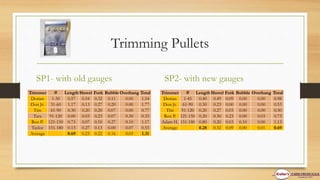
Trimming Pullets
SP1- with old gauges SP2- with new gauges
Trimmer # LengthShovel Fork BubbleOverhang Total
Dorian 1-30 0.57 0.54 0.32 0.11 0.00 1.54
Don Jr. 31-60 1.17 0.13 0.27 0.20 0.00 1.77
Tim 61-90 0.30 0.20 0.20 0.07 0.00 0.77
Tara 91-120 0.00 0.03 0.23 0.07 0.30 0.33
Ron P. 121-150 0.73 0.07 0.10 0.27 0.10 1.17
Taylor 151-180 0.13 0.27 0.13 0.00 0.07 0.53
Average 0.69 0.23 0.22 0.16 0.03 1.31
Trimmer # Length Shovel Fork Bubble Overhang Total
Dorian 1-45 0.40 0.49 0.09 0.00 0.00 0.98
Don Jr. 61-90 0.30 0.23 0.00 0.00 0.00 0.53
Tim 91-120 0.20 0.27 0.03 0.00 0.00 0.50
Ron P. 121-150 0.20 0.30 0.23 0.00 0.03 0.73
Adam H. 151-180 0.80 0.20 0.03 0.10 0.00 1.13
Average 0.28 0.32 0.09 0.00 0.01 0.69
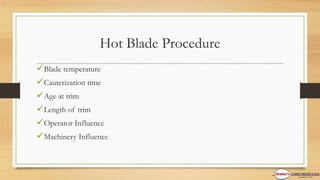
Hot Blade Procedure
Blade temperature
Cauterization time
Age at trim
Length of trim
Operator Influence
Machinery Influence
Blade Temperature
• Goal of 1200F ±50F
• Dull red color to the blade
• Thermocouple to measure every hour
Cauterization Time
• 2+ seconds
• Machine automated
• Hold on until blade has come all the way back up
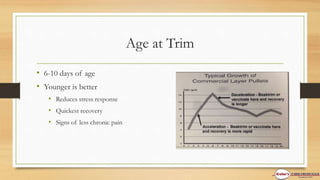
Age at Trim
• 6-10 days of age
• Younger is better
• Reduces stress response
• Quickest recovery
• Signs of less chronic pain
Length of Trim
• American Humane standards- no more than 1/3 beak can be removed
• Beak should be about 4mm post-trim
• Leave 2 nickels, remove one nickel
Operator Influence
• Rate of 15 birds per minute
• Sit while trimming
• 5 minute break every hour
• Standardized training program
• Train more people to reduce operator fatigue
Machinery Influence
• Standard operating procedures
• Sharp blades
• Change every 3000 chicks
• Remove beak residue with wire brush every 30 minutes
• Gauge holes not enlarged
• Blade flush with back of gauge
Beak Angle
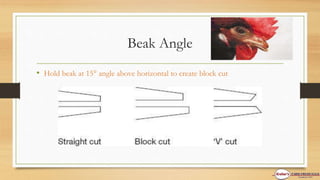
• Hold beak at 15 angle above horizontal to create block cut
Suggested Improvement Costs
• Replace gauges
• $6-9/gauge
• Replace blades every 1500-3000 birds
• $3.50/blade
• Thermocouple to measure blade temperature
• $145
Possible Stressors and Changes
Heat Stress Earlier or seasonal transfer to diurnal
temperature
Changes in feed too quickly More gradual changes in feed
Lack of foraging opportunities Put whole grains, straw, or grass shavings
into the litter
Change from pullet floor to layer house
caged in
Let birds out earlier after transition to layer
house
Exposure to natural light after rearing in
light-proof house
Block light from entering vents
Alternatives/Additives
• Beak blunting
• Abrasive in bottom of feed trough (only shortens beak 1mm compared to untrimmed)
• Non Slip Tape 3M-
• Enrichment devices
• Foraging material- straw, grass in litter
• White string (polypropylene twine) is most effective
• $35
Community

Beak Trimming

  • 1.
    Beak Trimming: Hot Bladevs. IRBT Taylor Reed Summer 2016
  • 2.
    Pecking • Two supportedtheories of cause • Redirected ground pecking from foraging • Redirected dust bathing pecking • Combination of different STRESSES lead to pecking • Learned behavior • Seen more at the end of the lighting day (8-14 hours after lights come on) in medium heavy brown strains
  • 3.
    Poor Feather CoverConsequences *feathering on back and vent are best indicators of overall feather score • Higher feed intake • ~16% more in winter weather • lower egg production during colder (<20C) temperatures • Food per dozen eggs was 27.5% better in well feathered birds • Some studies show reduced body weight at 40 weeks and end of lay • 46% higher energy requirement and 27% higher feed consumption at 64.4C
  • 4.
    Hot Blade Pros • Inhouse management • Can adjust for individuals Cons • High human variability • Higher costs of labor • Added stress of catching and handling • Reduced body weight during first few weeks after • Greater regrowth of beak
  • 5.
    Infrared Beak Treatment Pros •No in house labor or time • Automated, precise adjustments • Reduced stress of handling • Gradual change in beak • No open wounds or infection • Fewer abnormalities in adult beaks • Less pain and nerve damage? Cons • Possible stressor to vaccinate and trim at same time • No adjusting on individual basis • Machinery is very complex
  • 6.
    Factors to Consider •Costs • Current and future • Uniformity • Production • Pecking
  • 7.
    Current Costs  5 centsper bird for IRBT at hatchery Current Beak Trimming Activity Amount Cost per Total Cost 3 pullers 13 hours $20/hr $ 780.00 5 trimmers 13 hours $20/hr $ 1,300.00 Pre-trim maintenance 5 hours $20/hr $ 100.00 Blade Costs 24 blades $3.50/blade $ 84.00 Post-trim maintenance 0.5 hours $20/hr $ 10.00 Total Cost $ 2,274.00 Cost per pullet $ 0.06317 Additional “Costs” • Lost man power for other jobs • Tim cannot check out other barns 6.317 cents
  • 8.
    Subjective scores forbeak quality at 72 weeks of age Score 1: beak closed (upper and lower beak of same length); rounded point; no growth beyond the edges; little bone material removed. Score 2: length of lower and upper beak differs by 2-3 mm; parts of the growth beyond the edges broken off and/or up to 1/3 of beak bone removed; Score 3: the lower beak is significantly longer than the upper beak (> 4mm) due to regrowth; crossed beak or bony base structure cut by more than 1/3.
  • 9.
    Lohmann- Infrared BeakTreatment- A temporary solution?
  • 10.
    Lohmann Study • Concludeda 15 cent per hen housed benefit of IRBT over hot blade
  • 11.
    Poor Beak TrimConsequences • A 1982 study shows significantly lower food intake for shorter beaks compared to longer beaks • Forks and shovels reduce ability to pick up food • Decrease feed efficiency • Consume less large particles with smaller beaks • Limit production potential
  • 12.
  • 13.
    Scoring Guide 1) BodyWeight 2) Beak Length (mm) : 0= over 2/3 of beak remains Layers 0= 9+ mm Pullets 0 = 4+ mm 1= between 1/3 and 2/3 of beak remains Layers 1= 4-9mm Pullets 1= 2-4mm 2= less than 1/3 of beak remains Layers 2= < 4mm Pullets 2= < 2mm 3) Shovel: 0=absent 1= present 4) Fork: 0=absent 1=present 5) Bubble: 0=absent 1=present 6) Feathering Pecking: signs of pecking on head, back, thighs 0= no bare skin, only single feathers missing 1= moderate damage, bare spots less than 5mm 2= severe damage, in multiple locations, bare skin >5mm 7) Vent Pecking 8) Overhang 0= no bare skin, only single feathers missing 1= moderate damage to vent 2= severe damage to vent
  • 14.
  • 15.
    Current Flocks *SP1 andSP2 used age 4 & 0 weigh data Flock Age Total Score Uniformity C.V. Peck-Body Vent Peck BW O/U Length Shovel Fork Bubble % untrim SL5 61 & 4 0.53 72.2 9.7 1.97 0.17 (233.00) 0.45 0.23 0.03 0.05 1.67% SL8 41 & 0 0.84 78.3 8.7 1.57 0.00 (217.00) 0.44 0.34 0.18 0.10 1.67% SL4 33 & 3 0.92 75.5 9.0 0.18 0.00 (146.00) 0.70 0.41 0.09 0.07 1.67% SL3 72 & 2 0.93 71.6 9.9 1.73 0.05 (201.00) 0.64 0.27 0.16 0.18 0.00% SL2 81 & 0 0.94 73.8 8.5 1.93 0.13 (248.00) 0.83 0.24 0.10 0.19 0.00% SL7 55 & 0 0.98 73.8 9.1 1.49 0.00 (198.00) 0.49 0.41 0.20 0.12 2.22% SL1 19 & 3 1.04 76.6 8.6 0.00 0.00 39.00 0.66 0.23 0.36 0.12 0.56% SL9 69 & 6 1.07 79.4 8.4 1.76 0.00 (203.00) 0.81 0.25 0.13 0.29 0.00% SL6 23 & 3 1.08 76.1 7.8 0.01 0.00 (113.00) 0.73 0.48 0.14 0.10 3.33% SL10 20 & 3 1.22 86.6 7.0 0.00 0.00 30.00 0.80 0.47 0.27 0.08 0.55% AVG 0.96 0.65 0.33 0.17 0.13 SP2 1 & 6 0.58 52.4 14.7 0.00 0.00 (65.00) 0.38 0.30 0.08 0.01 0.00% SP1 2 & 3 0.77 39.2 18.9 0.00 0.00 (73.00) 0.48 0.20 0.21 0.08 1.11% SP4 5 & 3 0.86 43.5 15.8 0.00 0.00 (74.00) 0.39 0.19 0.44 0.03 0.00%
  • 16.
    Trimming Pullets SP1- withold gauges SP2- with new gauges Trimmer # LengthShovel Fork BubbleOverhang Total Dorian 1-30 0.57 0.54 0.32 0.11 0.00 1.54 Don Jr. 31-60 1.17 0.13 0.27 0.20 0.00 1.77 Tim 61-90 0.30 0.20 0.20 0.07 0.00 0.77 Tara 91-120 0.00 0.03 0.23 0.07 0.30 0.33 Ron P. 121-150 0.73 0.07 0.10 0.27 0.10 1.17 Taylor 151-180 0.13 0.27 0.13 0.00 0.07 0.53 Average 0.69 0.23 0.22 0.16 0.03 1.31 Trimmer # Length Shovel Fork Bubble Overhang Total Dorian 1-45 0.40 0.49 0.09 0.00 0.00 0.98 Don Jr. 61-90 0.30 0.23 0.00 0.00 0.00 0.53 Tim 91-120 0.20 0.27 0.03 0.00 0.00 0.50 Ron P. 121-150 0.20 0.30 0.23 0.00 0.03 0.73 Adam H. 151-180 0.80 0.20 0.03 0.10 0.00 1.13 Average 0.28 0.32 0.09 0.00 0.01 0.69
  • 17.
    Hot Blade Procedure Bladetemperature Cauterization time Age at trim Length of trim Operator Influence Machinery Influence
  • 18.
    Blade Temperature • Goalof 1200F ±50F • Dull red color to the blade • Thermocouple to measure every hour
  • 19.
    Cauterization Time • 2+seconds • Machine automated • Hold on until blade has come all the way back up
  • 20.
    Age at Trim •6-10 days of age • Younger is better • Reduces stress response • Quickest recovery • Signs of less chronic pain
  • 21.
    Length of Trim •American Humane standards- no more than 1/3 beak can be removed • Beak should be about 4mm post-trim • Leave 2 nickels, remove one nickel
  • 22.
    Operator Influence • Rateof 15 birds per minute • Sit while trimming • 5 minute break every hour • Standardized training program • Train more people to reduce operator fatigue
  • 23.
    Machinery Influence • Standardoperating procedures • Sharp blades • Change every 3000 chicks • Remove beak residue with wire brush every 30 minutes • Gauge holes not enlarged • Blade flush with back of gauge
  • 24.
    Beak Angle • Holdbeak at 15 angle above horizontal to create block cut
  • 25.
    Suggested Improvement Costs •Replace gauges • $6-9/gauge • Replace blades every 1500-3000 birds • $3.50/blade • Thermocouple to measure blade temperature • $145
  • 26.
    Possible Stressors andChanges Heat Stress Earlier or seasonal transfer to diurnal temperature Changes in feed too quickly More gradual changes in feed Lack of foraging opportunities Put whole grains, straw, or grass shavings into the litter Change from pullet floor to layer house caged in Let birds out earlier after transition to layer house Exposure to natural light after rearing in light-proof house Block light from entering vents
  • 27.
    Alternatives/Additives • Beak blunting •Abrasive in bottom of feed trough (only shortens beak 1mm compared to untrimmed) • Non Slip Tape 3M- • Enrichment devices • Foraging material- straw, grass in litter • White string (polypropylene twine) is most effective • $35
  • 28.

Editor's Notes

  • #3 - Once it occurs it his difficult to stop
  • #6 Study done by a Canadian professor to investigate what was occurring with brown beaks IRBT treated and could not recreate poor results seen on farms Machinery is very complex and Nova-Tech has been working to train hatcheries
  • #9 -
  • #10 Experiment done with whites and browns, 1/3 HB, 1/3 IRBT, 1/3 control Measure feather cover, production parameters, and quality of beak treatment (shovels)
  • #14 - Score when weigh, 180 birds per barn
  • #16 No correlation between beak score and flock uniformity, pecking behavior, or body weight from this data Used as basis for IRBT trial
  • #26 - Created detailed standard operating procedures for maintenance and trimming
  • #27 Feed changes in summer as grow own crops Change to diurnal sooner (younger) or make it seasonal so in the summer everyone changes to diurnal
  • #29 Interviews in community Last question how do you see Krehers interacting in the community Nothing but good things to say