Robin P. Mathew
India is an agricultural country, hence dairy science is of great
economic importance
Dairy Science:
production and marketing of milks and its
products
•This course is about the study of
milk and milk-derived food products
from a food science perspective.
• It focuses on the biological,
chemical, physical, and microbiological
aspects of milk and on the
technological (processing) aspects of
the transformation of milk into its
various consumer products, viz.
•beverages,
•fermented products,
•concentrated and dried products,
•butter and ice cream.
NDDB
AMUL
Vargese Kurien
(Milkman of India)
GCMMF
Excellent Hi-
breeds Cows and
buffaloes (milch
animals)
Dairy processing:
• Milk – Highly perishable, hence needs to be
processed or converted into different stable milk
products immediately after collection.
•Filtration
•Cooling
•Chilling
•Clarification
•Pasteurization
•Freezing
Filtration:
•Removes suspended foreign particles from milk by process of
straining.
•Efficiency depends on pore size of filter or strainer.
•Muslin cloth is used either in single or multiple layers depending on
condition of milk
•Filtration should be carried out at 37o C
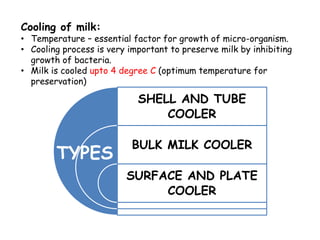
Cooling of milk:
• Temperature – essential factor for growth of micro-organism.
• Cooling process is very important to preserve milk by inhibiting
growth of bacteria.
• Milk is cooled upto 4 degree C (optimum temperature for
preservation)
SHELL AND TUBE
COOLER
BULK MILK COOLER
SURFACE AND PLATE
COOLER
TYPES
Types of coolers:
a) Shell and tube cooler:
b) Bulk milk cooler
c) Surface and plate cooler
c) Chilling of Milk
•Chilling of milk means rapid cooling of raw milk to
sufficiently low temperature usually 2-4o C so that the
growth of micro-organisms present in milk is checked.
Following equipment is used for chilling of milk:
1. Immersion tank
2. Roto freeze
Clarification
Pasteurization
• Holding method
Milk heated upto a
temperature of 62.8o C
for 30 minutes.
This method is mainly
used by the dairy
industry for preparing
milk for making starter
cultures in the
processing of cheese,
yogurt, buttermilk and
ice cream mixtures.
• (HTST) High Temperature Short Time method
•Most common method for pasteurization is HTST method
•Uses metal plates and hot water to raise milk
temperature to a minimum of 72o C for 16 sec followed by
rapid cooling.
• Immediate bottling, continuous operation and automatic
controls are the advantages which make it economical.
• (UHTT) Ultra High Temperature Treatment method
•Heating milk to a minimum of 138o C for 2 sec, using
commercially sterile equipments and filling it under
aseptic condition in the hermetically (airtight) sealed
packaging.
• The product is termed “Shelf stable”
• It does not need refrigeration until exposed to air.
•Aseptic operation as per guidelines of FDA (Food and
Drug Administration).
Freezing
Freezing point ranges
from -0.64oC to -
0.49oC
Shelf life can be
extended upto 3-6
months.
Synthesis of Milk
Composition of milk
•Mammary secretion
•Milk is a balanced mixture of proteins, fats,
carbohydrates, salts and water co-existing as emulsion –
aqueous phase
• Oily phase is made up of fat which is known as – butter
fat
•Aqueous phase contains proteins like casein and other
water soluble proteins like Lactalbumin and
Lactoglobulin, sugar , lactose, mineral salts and vitamins
•Milk is of two types,
One containing fats and other having “non-fatty solids”
also called – “Solids Not Fat”(SNF)

Dairy science

  • 1.
  • 2.
    India is anagricultural country, hence dairy science is of great economic importance Dairy Science: production and marketing of milks and its products
  • 3.
    •This course isabout the study of milk and milk-derived food products from a food science perspective. • It focuses on the biological, chemical, physical, and microbiological aspects of milk and on the technological (processing) aspects of the transformation of milk into its various consumer products, viz. •beverages, •fermented products, •concentrated and dried products, •butter and ice cream.
  • 4.
    NDDB AMUL Vargese Kurien (Milkman ofIndia) GCMMF Excellent Hi- breeds Cows and buffaloes (milch animals)
  • 5.
    Dairy processing: • Milk– Highly perishable, hence needs to be processed or converted into different stable milk products immediately after collection. •Filtration •Cooling •Chilling •Clarification •Pasteurization •Freezing
  • 6.
    Filtration: •Removes suspended foreignparticles from milk by process of straining. •Efficiency depends on pore size of filter or strainer. •Muslin cloth is used either in single or multiple layers depending on condition of milk •Filtration should be carried out at 37o C
  • 7.
    Cooling of milk: •Temperature – essential factor for growth of micro-organism. • Cooling process is very important to preserve milk by inhibiting growth of bacteria. • Milk is cooled upto 4 degree C (optimum temperature for preservation) SHELL AND TUBE COOLER BULK MILK COOLER SURFACE AND PLATE COOLER TYPES
  • 8.
    Types of coolers: a)Shell and tube cooler:
  • 9.
  • 10.
    c) Surface andplate cooler
  • 11.
    c) Chilling ofMilk •Chilling of milk means rapid cooling of raw milk to sufficiently low temperature usually 2-4o C so that the growth of micro-organisms present in milk is checked. Following equipment is used for chilling of milk: 1. Immersion tank 2. Roto freeze
  • 13.
  • 14.
    Pasteurization • Holding method Milkheated upto a temperature of 62.8o C for 30 minutes. This method is mainly used by the dairy industry for preparing milk for making starter cultures in the processing of cheese, yogurt, buttermilk and ice cream mixtures.
  • 15.
    • (HTST) HighTemperature Short Time method •Most common method for pasteurization is HTST method •Uses metal plates and hot water to raise milk temperature to a minimum of 72o C for 16 sec followed by rapid cooling. • Immediate bottling, continuous operation and automatic controls are the advantages which make it economical.
  • 16.
    • (UHTT) UltraHigh Temperature Treatment method •Heating milk to a minimum of 138o C for 2 sec, using commercially sterile equipments and filling it under aseptic condition in the hermetically (airtight) sealed packaging. • The product is termed “Shelf stable” • It does not need refrigeration until exposed to air. •Aseptic operation as per guidelines of FDA (Food and Drug Administration).
  • 17.
    Freezing Freezing point ranges from-0.64oC to - 0.49oC Shelf life can be extended upto 3-6 months.
  • 18.
  • 19.
    Composition of milk •Mammarysecretion •Milk is a balanced mixture of proteins, fats, carbohydrates, salts and water co-existing as emulsion – aqueous phase • Oily phase is made up of fat which is known as – butter fat •Aqueous phase contains proteins like casein and other water soluble proteins like Lactalbumin and Lactoglobulin, sugar , lactose, mineral salts and vitamins •Milk is of two types, One containing fats and other having “non-fatty solids” also called – “Solids Not Fat”(SNF)