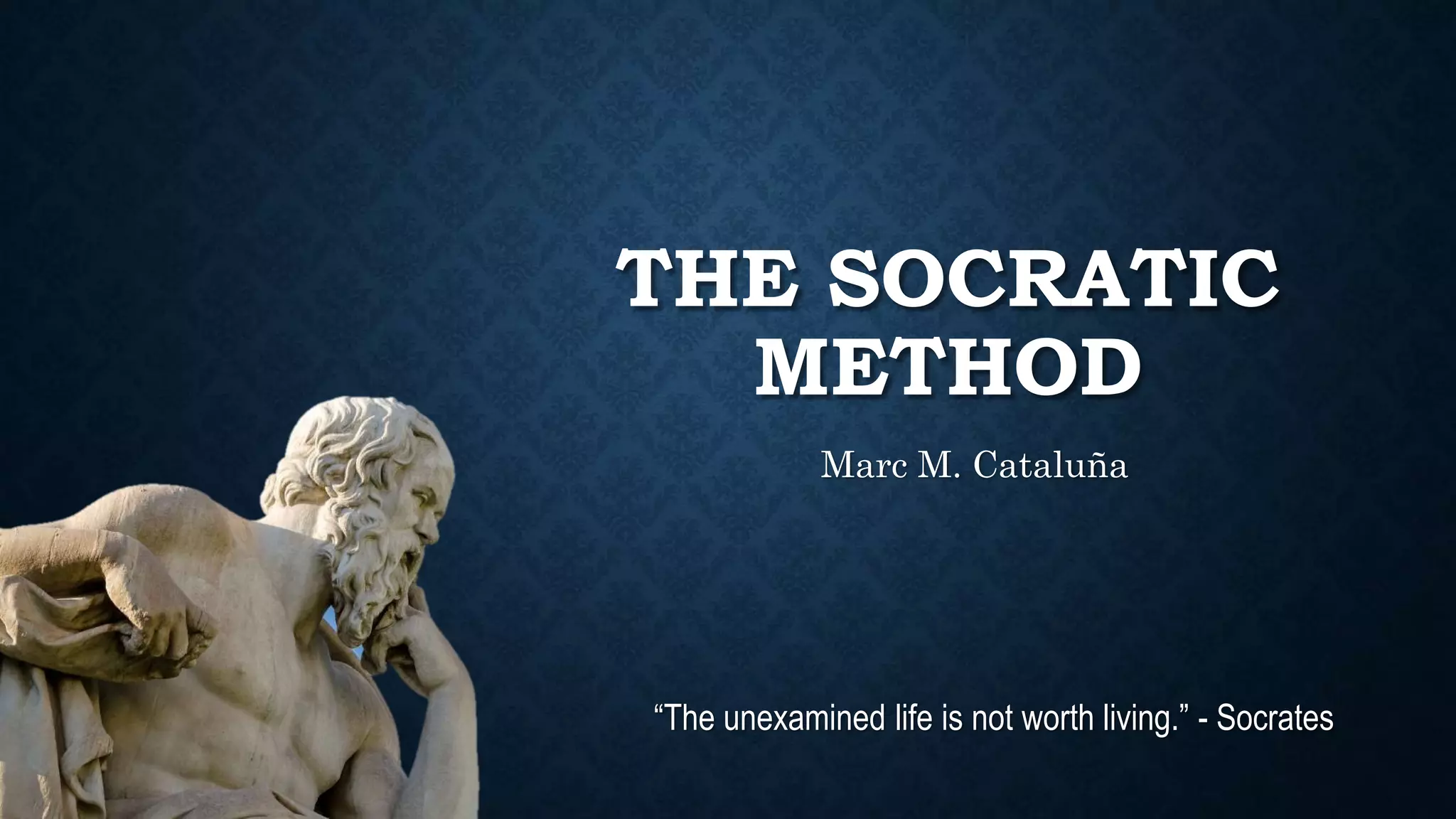
THE SOCRATIC
METHOD
Marc M. Cataluña
“The unexamined life is not worth living.” - Socrates
OBJECTIVES
By the end of this lecture, the students will be able to:
• Understand the teachings of Socrates and the Socratic Method
• Identify the uses of the Socratic method in society.
• The students will learn how to apply the Socratic method in everyday
life.
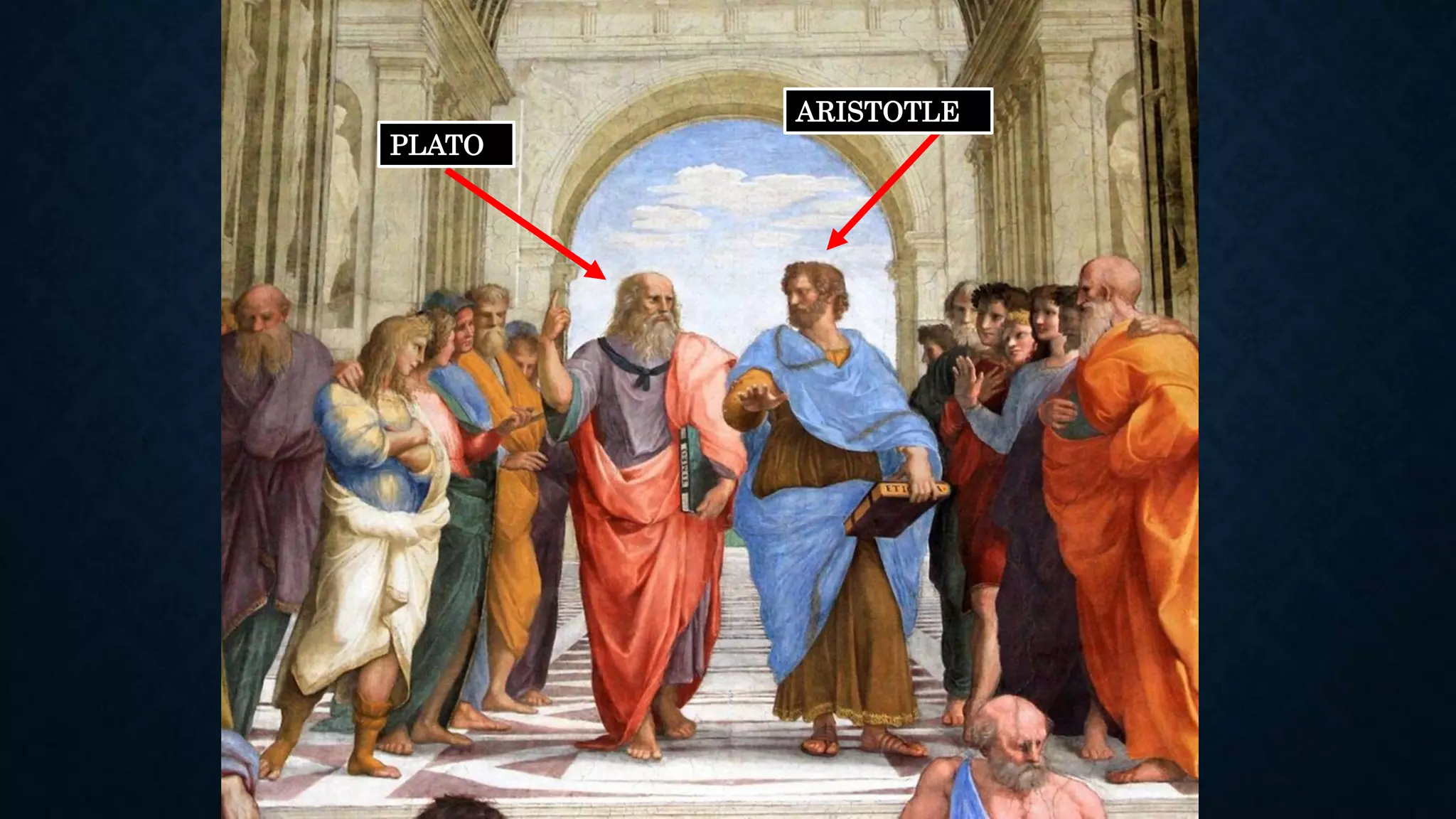
PLATO
ARISTOTLE
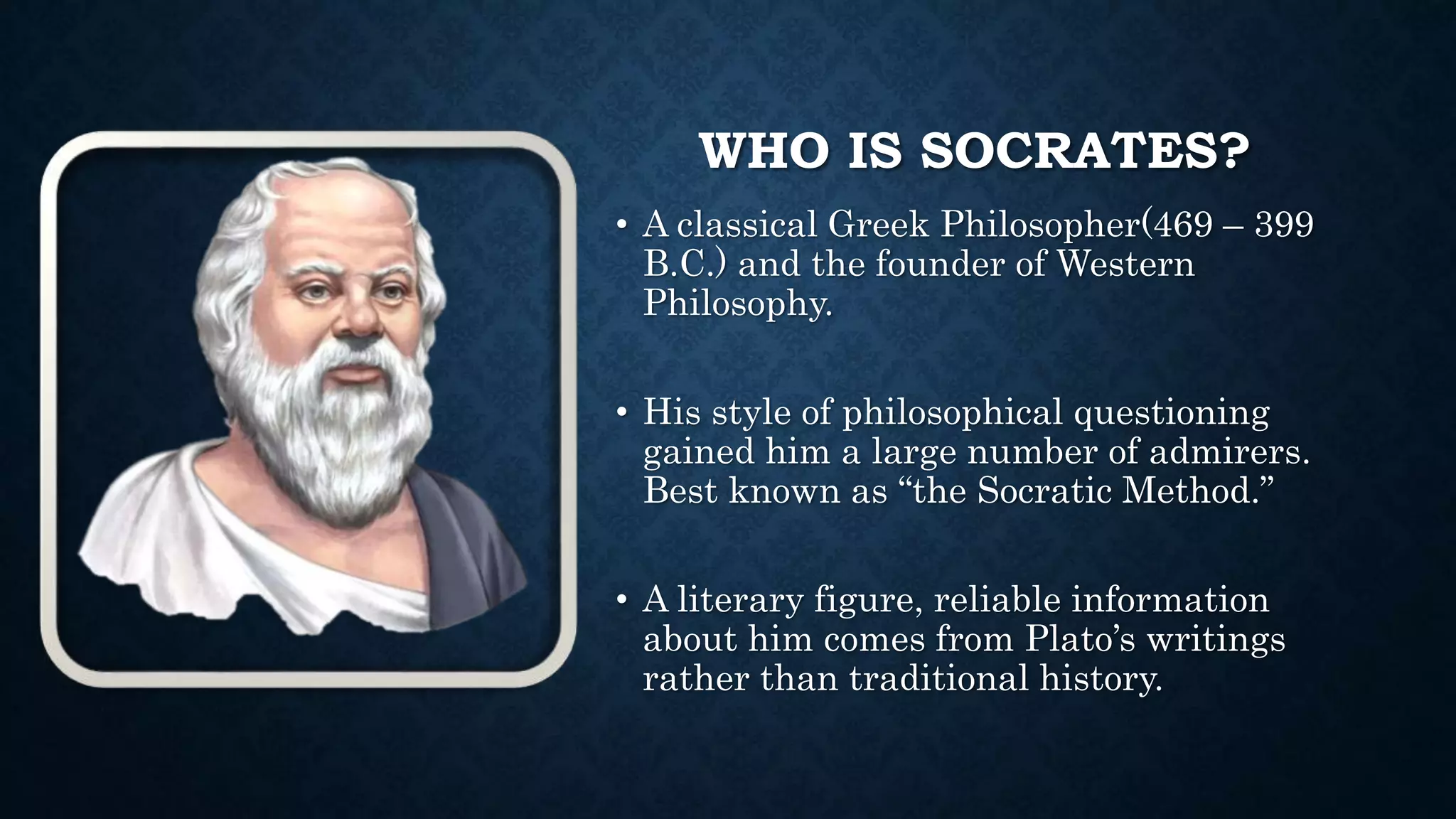
WHO IS SOCRATES?
• A classical Greek Philosopher(469 – 399
B.C.) and the founder of Western
Philosophy.
• His style of philosophical questioning
gained him a large number of admirers.
Best known as “the Socratic Method.”
• A literary figure, reliable information
about him comes from Plato’s writings
rather than traditional history.
THE SOCRATIC METHOD
• Also known as method of Elencus, or Socratic
debate.
• A series of questions are posed to help a person or
group to determine their underlying beliefs and the
extent of their knowledge.
• is a negative method of hypothesis elimination, in
that better hypotheses are found by steadily
identifying and eliminating those which lead to
contradictions.
PURPOSE
• Engages students by arousing curiosity.
• Enable learning to be a participatory
experience.
• Encourages critical (i.e. higher order) thinking
and problem solving skills.
• “A meaningful question is as good as the right
answer.”
PROCESS
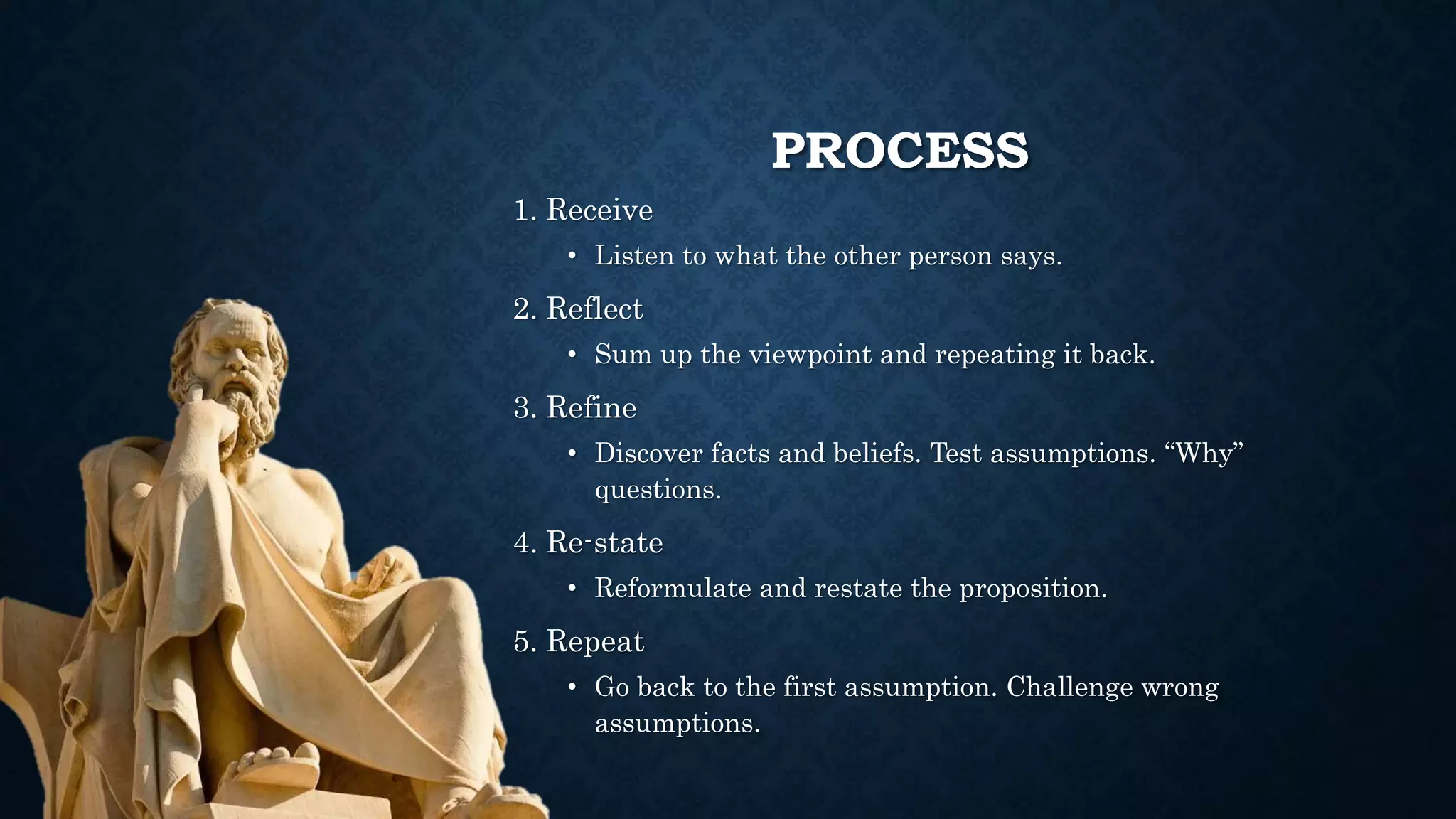
1. Receive
• Listen to what the other person says.
2. Reflect
• Sum up the viewpoint and repeating it back.
3. Refine
• Discover facts and beliefs. Test assumptions. “Why”
questions.
4. Re-state
• Reformulate and restate the proposition.
5. Repeat
• Go back to the first assumption. Challenge wrong
assumptions.
ROLE PLAY
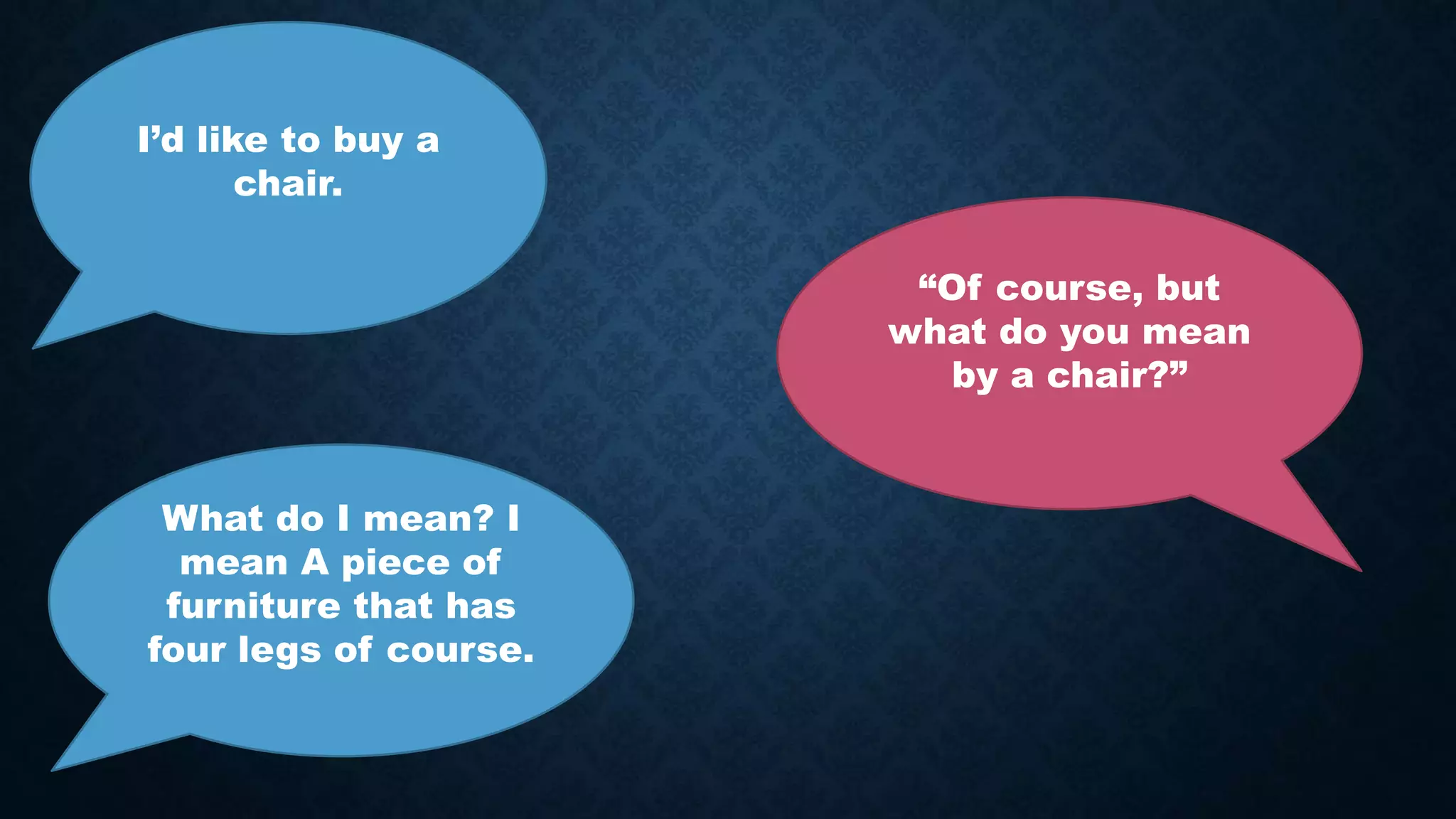
I’d like to buy a
chair.
“Of course, but
what do you mean
by a chair?”
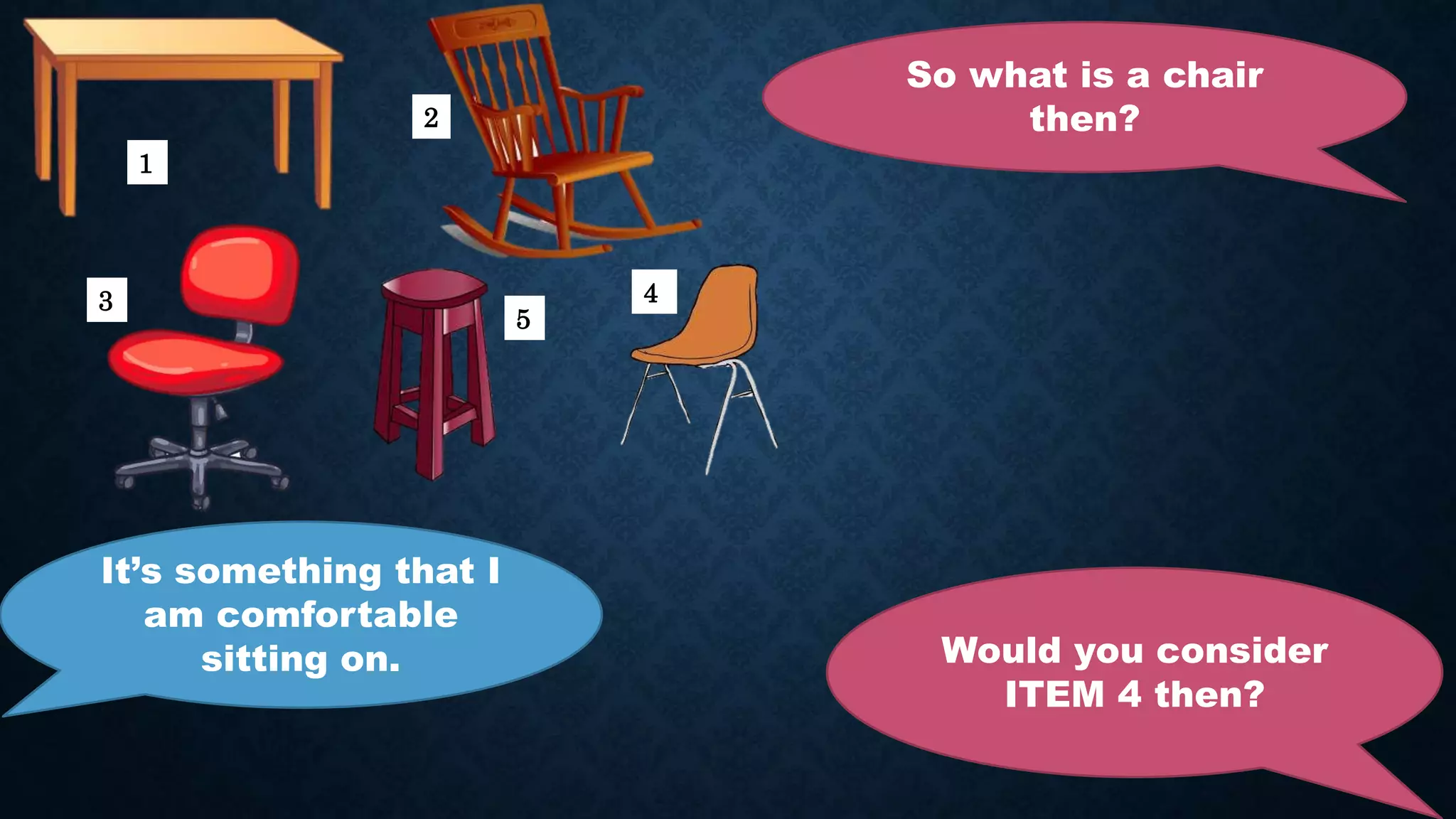
What do I mean? I
mean A piece of
furniture that has
four legs of course.
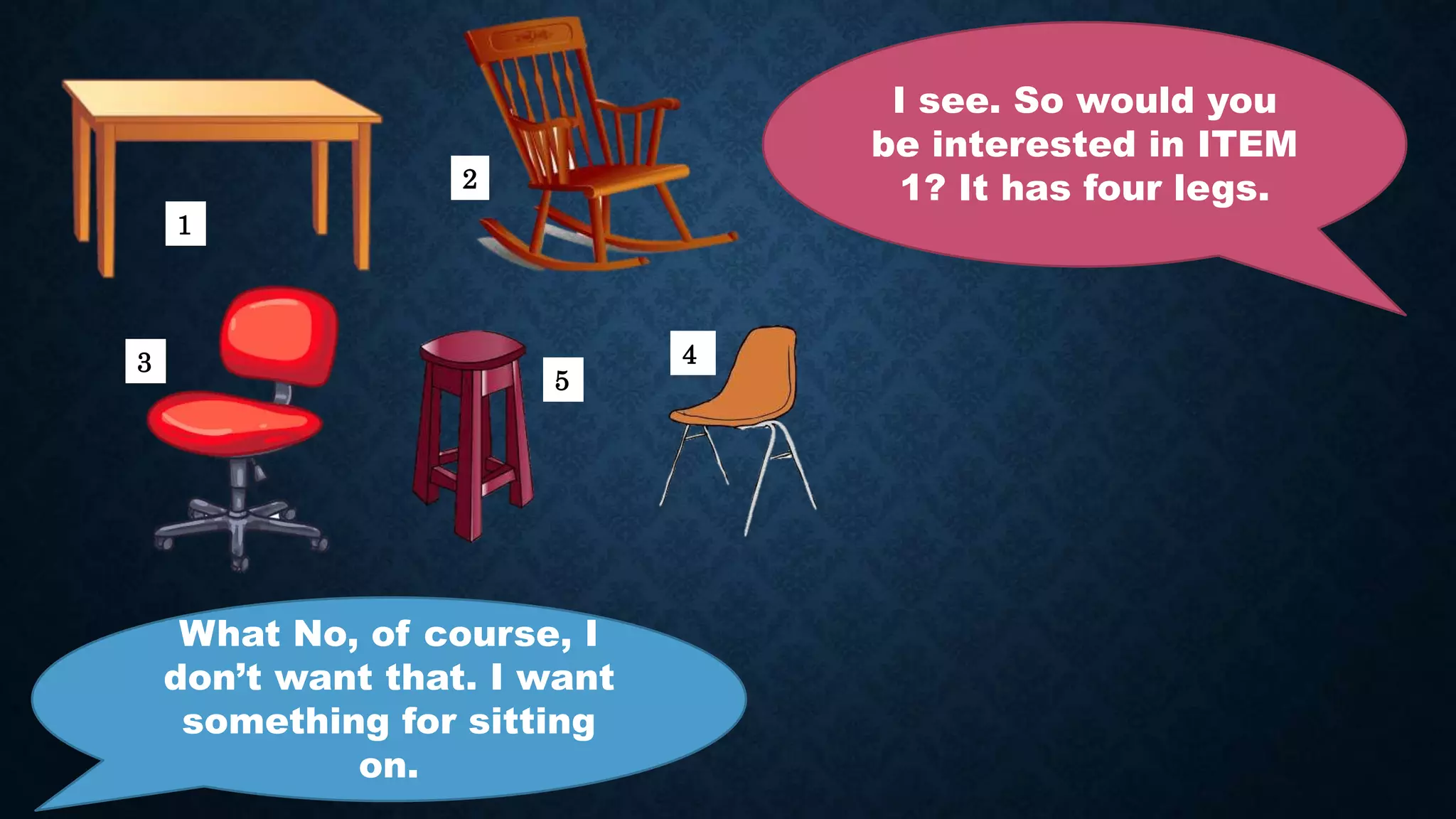
I see. So would you
be interested in ITEM
1? It has four legs.
What No, of course, I
don’t want that. I want
something for sitting
on.
1
2
3
5
4
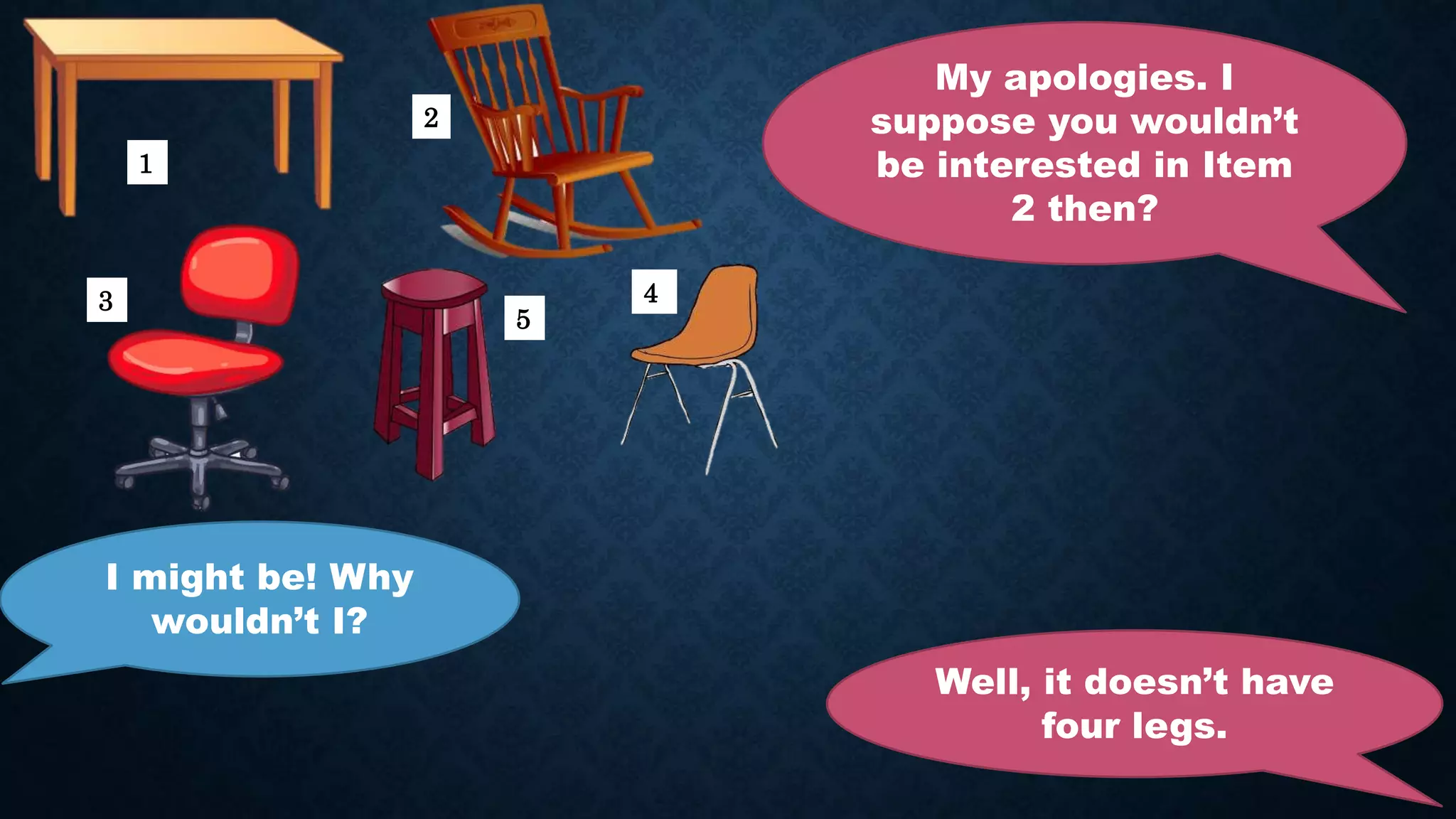
My apologies. I
suppose you wouldn’t
be interested in Item
2 then?
I might be! Why
wouldn’t I?
1
2
3
5
4
Well, it doesn’t have
four legs.
So what is a chair
then?
It’s something that I
am comfortable
sitting on.
1
2
3
5
4
Would you consider
ITEM 4 then?
ANY QUESTIONS?
“Strong minds discuss ideas, average minds
discuss events, weak minds discuss
people.” - Socrates
TEST 1: UNSCRAMBLE THESE WORDS
WHAT IS THE OTHER TERM FOR SOCRATIC METHOD? L E C N S E U
LISTENING TO WHAT THE OTHER PERSON SAYS. I V R C E E E
DISCOVER FACTS AND BELIEFS. TEST ASSUMPTIONS. I N R F E E
SUM UP THE VIEWPOINT AND REPEATING IT BACK. C T R E E L F
GO BACK TO THE FIRST ASSUMPTION. E E A P R T
TEST 1: UNSCRAMBLE THESE WORDS
WHAT IS THE OTHER TERM FOR SOCRATIC METHOD? ELENCUS
LISTENING TO WHAT THE OTHER PERSON SAYS. RECEIVE
DISCOVER FACTS AND BELIEFS. TEST ASSUMPTIONS. REFINE
SUM UP THE VIEWPOINT AND REPEATING IT BACK. REFLECT
GO BACK TO THE FIRST ASSUMPTION. REPEAT

Presentation2.pptx

  • 1.
    THE SOCRATIC METHOD Marc M.Cataluña “The unexamined life is not worth living.” - Socrates
  • 2.
    OBJECTIVES By the endof this lecture, the students will be able to: • Understand the teachings of Socrates and the Socratic Method • Identify the uses of the Socratic method in society. • The students will learn how to apply the Socratic method in everyday life.
  • 3.
  • 4.
    WHO IS SOCRATES? •A classical Greek Philosopher(469 – 399 B.C.) and the founder of Western Philosophy. • His style of philosophical questioning gained him a large number of admirers. Best known as “the Socratic Method.” • A literary figure, reliable information about him comes from Plato’s writings rather than traditional history.
  • 7.
    THE SOCRATIC METHOD •Also known as method of Elencus, or Socratic debate. • A series of questions are posed to help a person or group to determine their underlying beliefs and the extent of their knowledge. • is a negative method of hypothesis elimination, in that better hypotheses are found by steadily identifying and eliminating those which lead to contradictions.
  • 8.
    PURPOSE • Engages studentsby arousing curiosity. • Enable learning to be a participatory experience. • Encourages critical (i.e. higher order) thinking and problem solving skills. • “A meaningful question is as good as the right answer.”
  • 9.
    PROCESS 1. Receive • Listento what the other person says. 2. Reflect • Sum up the viewpoint and repeating it back. 3. Refine • Discover facts and beliefs. Test assumptions. “Why” questions. 4. Re-state • Reformulate and restate the proposition. 5. Repeat • Go back to the first assumption. Challenge wrong assumptions.
  • 10.
  • 11.
    I’d like tobuy a chair. “Of course, but what do you mean by a chair?” What do I mean? I mean A piece of furniture that has four legs of course.
  • 12.
    I see. Sowould you be interested in ITEM 1? It has four legs. What No, of course, I don’t want that. I want something for sitting on. 1 2 3 5 4
  • 13.
    My apologies. I supposeyou wouldn’t be interested in Item 2 then? I might be! Why wouldn’t I? 1 2 3 5 4 Well, it doesn’t have four legs.
  • 14.
    So what isa chair then? It’s something that I am comfortable sitting on. 1 2 3 5 4 Would you consider ITEM 4 then?
  • 15.
    ANY QUESTIONS? “Strong mindsdiscuss ideas, average minds discuss events, weak minds discuss people.” - Socrates
  • 16.
    TEST 1: UNSCRAMBLETHESE WORDS WHAT IS THE OTHER TERM FOR SOCRATIC METHOD? L E C N S E U LISTENING TO WHAT THE OTHER PERSON SAYS. I V R C E E E DISCOVER FACTS AND BELIEFS. TEST ASSUMPTIONS. I N R F E E SUM UP THE VIEWPOINT AND REPEATING IT BACK. C T R E E L F GO BACK TO THE FIRST ASSUMPTION. E E A P R T
  • 17.
    TEST 1: UNSCRAMBLETHESE WORDS WHAT IS THE OTHER TERM FOR SOCRATIC METHOD? ELENCUS LISTENING TO WHAT THE OTHER PERSON SAYS. RECEIVE DISCOVER FACTS AND BELIEFS. TEST ASSUMPTIONS. REFINE SUM UP THE VIEWPOINT AND REPEATING IT BACK. REFLECT GO BACK TO THE FIRST ASSUMPTION. REPEAT

Editor's Notes

  • #4 The school of Athens, Painted by Raphael between 1509 and 1511
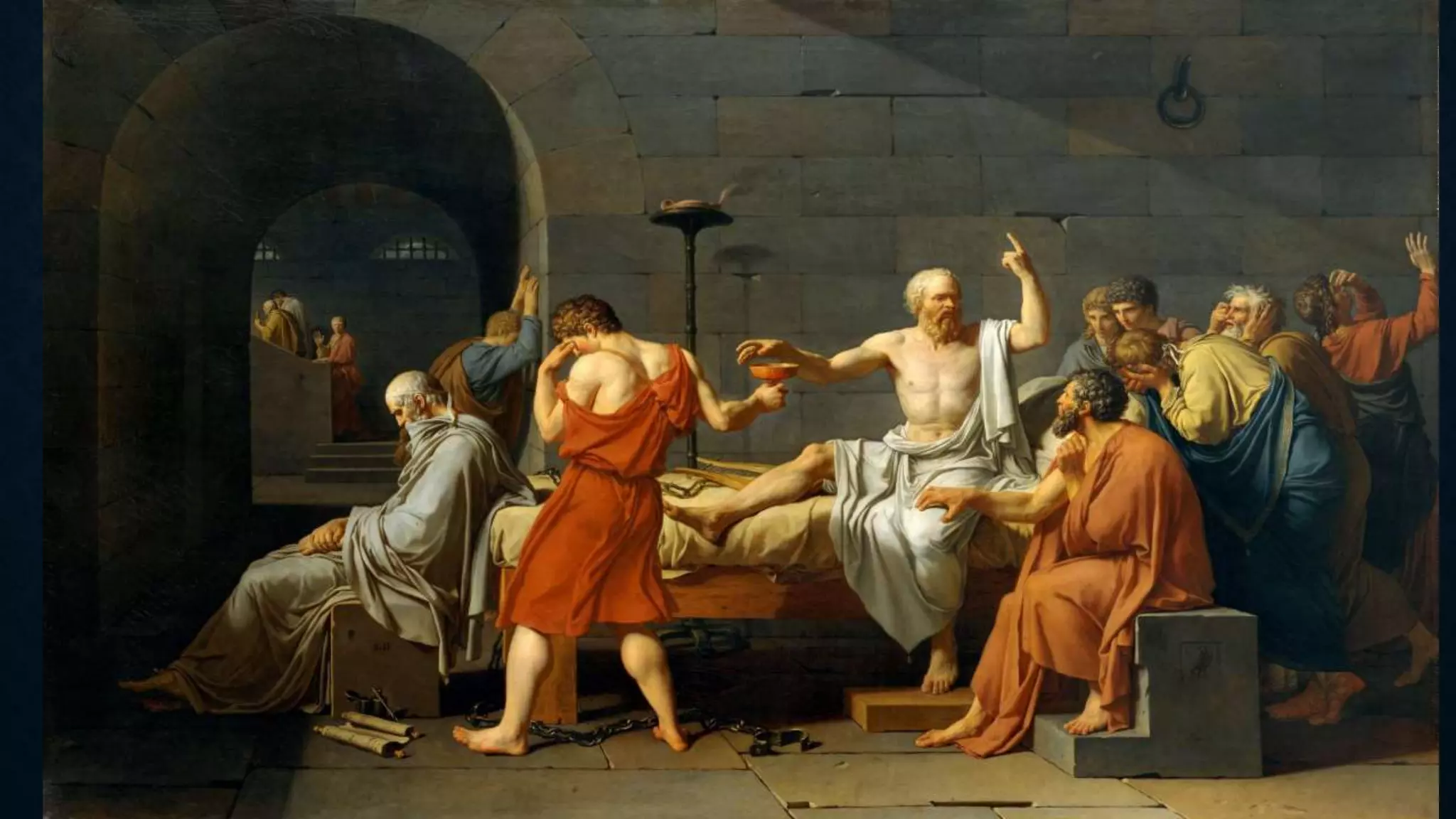
  • #5 The first philosopher First person to clearly know when a point was proved to be true or not. First person to practice logic. Socrates did not produce any written material during his lifetime, so his philosophical thought is only known through the writing of others, most notably through Plato’s Dialogues
  • #7 He questioned the men of Athens about their knowledge of good, beauty, and virtue. Finding that they knew nothing and yet believing themselves to know much, Socrates came to the conclusion that he was wise only in so far as he knew he knew nothing. The others only falsely thought they had knowledge.
  • #9 In educational contexts, this statement highlights the importance of encouraging students to ask questions and engage in critical thinking. Rather than simply memorizing facts or rote learning, students are encouraged to ask meaningful questions and engage in a process of inquiry that can lead to deeper learning and understanding.