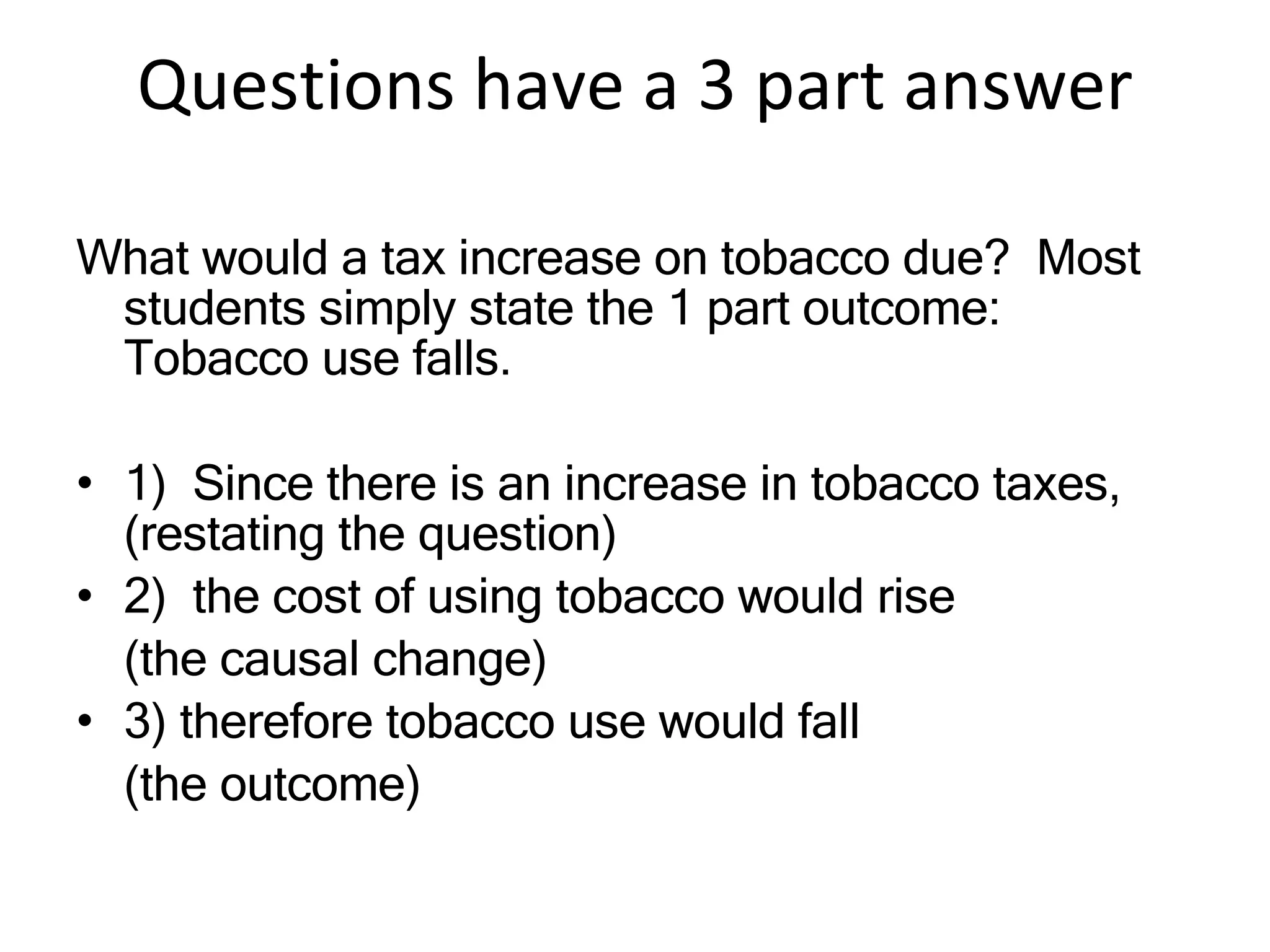
Questions have a 3 part answer What would a tax increase on tobacco due?  Most students simply state the 1 part outcome:  Tobacco use falls. 1)  Since there is an increase in tobacco taxes,  (restating the question) 2)  the cost of using tobacco would rise  (the causal change) 3) therefore tobacco use would fall  (the outcome)
Another example:  What would happen to US tourism to Europe if the dollar depreciated (weakened) against the Euro? The lazy one word answer they give is it would fall. The 3 part answer: 1) since the dollar has weakened against the euro, 2) it is now more expensive for American tourists to buy things in Europe 3) so US tourism to Europe will decrease.
Critical Thinking Socratic Questioning
Critical Thinking workshop hosted by the Foundation for Critical Thinking  February 27- March 1, 2009 Attended by: Christina Engen, Micki Newland,and Denise Pogroszewski
Resources Dr. Linda Elder and Dr. Richard Paul.  The Thinker’s Guide to Analytic Thinking. How to take Thinking Apart and What to Look for When You Do . 2007 Dr. Linda Elder and Dr. Richard Paul.  The Thinker’s Guide to The Art of Socratic Questioning . 2006 Richard Paul, A.J.A. Binker, Dougals Martin, and Ken Adamson.  Critical Thinking Handbook: High School A Guide for Redesigning Instruction .1995
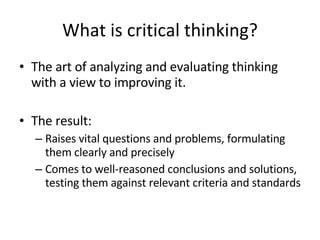
What is critical thinking? The art of analyzing and evaluating thinking with a view to improving it. The result: Raises vital questions and problems, formulating them clearly and precisely Comes to well-reasoned conclusions and solutions, testing them against relevant criteria and standards
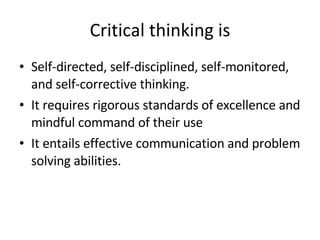
Critical thinking is Self-directed, self-disciplined, self-monitored, and self-corrective thinking. It requires rigorous standards of excellence and mindful command of their use It entails effective communication and problem solving abilities.
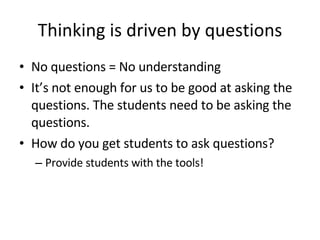
Thinking is driven by questions No questions = No understanding It’s not enough for us to be good at asking the questions. The students need to be asking the questions. How do you get students to ask questions? Provide students with the tools!
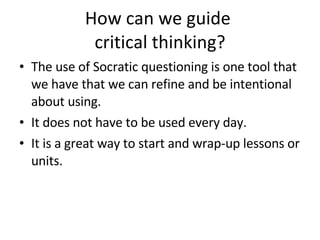
How can we guide  critical thinking? The use of Socratic questioning is one tool that we have that we can refine and be intentional about using. It does not have to be used every day.  It is a great way to start and wrap-up lessons or units.
Socratic Questioning To formulate questions that probe thinking in a disciplined and productive way
Socratic Questioning Raises basic issues Probes beneath the surface of things Pursues problematic areas of thought
Helps students discover the structure of their own thought Helps students develop sensitivity to clarity, accuracy, relevance, and depth Helps students arrive at judgments through their own reasoning Helps students analyze thinking- its purposes, assumptions, questions, points of view, information, inferences, concepts and implications
What kinds of questions? Clarity Could you elaborate further? Could you give me an example? Could you illustrate what you mean? Could you put that another way? What do you mean by…? Why do you say that? *Jane, would you summarize in your own words what Richard has said? Richard is that what you meant?
Accuracy How could we check on that? How could we find out if that is true? How could we verify or test that?
Precision Could you be more specific? Could you give me more details? Could you be more exact?
Logic Does all this make sense together? Does your first paragraph fit together with your last? Does what you say follow from the evidence?
Questions lead to discussion Socratic discussion, guided by the teacher, in which students’ thought is elicited and probed, allows students to develop and evaluate their thinking by making it explicit. This gives students an opportunity to develop and test their ideas. Through this process students can synthesize their beliefs into a more coherent and better-developed perspective.
Socratic questioning requires teachers to take seriously what their student say and think. What they mean Its significance to them Its relation to other beliefs How it can be tested To what extent and in what way is it true or makes sense
Socratic questioning has distinctive goals and ways to achieve them It is structured and disciplined The discussion is structured to take student thought from the unclear to the clear, from the implicit to the explicit
To learn how to participate in Socratic questioning, one has to learn how to listen carefully to what others say.
Guidelines for Socratic Questioning Think along with the class There are always a variety of ways you can respond Do not hesitate to pause and reflect quietly Keep control of the discussion
Guidelines continued Periodically summarize where the discussion is: what questions have been answered; what questions are yet unresolved Think of yourself as a kind of intellectual orchestra leader Keep control of the question on the floor
Ultimately we want our students to walk away from here not needing us.  We want our students to be self-directed, self-disciplined, self-monitored, and self-corrective thinkers.
Practice Read Transcript Four: Helping students think seriously about complex social issues. As you read, think and ask yourself… Does this example clarify what Socratic questioning is? Do I see the goal or purpose? Is the teacher the “intellectual orchestra leader”?
In groups of three A- you are the  questioner  – use the list of questions B- you are the person  answer ing the questions C- you are the  observer - the good listener
Pick a topic- it’s even better if person A doesn’t know that much about the topic Person A- ask a question about your topic B answers  Continue this process for a couple of minutes Person C- carefully listens and will report back to A and B about what s/he saw in their conversation related to their use of Socratic questioning.
Did You… Listen carefully to what others say? Think about a variety of ways you can respond Hesitate to pause and reflect quietly Keep control of the discussion Periodically summarize where the discussion is: what questions have been answered; what questions are yet unresolved Think of yourself as a kind of intellectual orchestra leader Keep control of the question on the floor

Critical Thinking May Faculty Meeting

  • 1.
    Questions have a3 part answer What would a tax increase on tobacco due? Most students simply state the 1 part outcome: Tobacco use falls. 1) Since there is an increase in tobacco taxes, (restating the question) 2) the cost of using tobacco would rise (the causal change) 3) therefore tobacco use would fall (the outcome)
  • 2.
    Another example: What would happen to US tourism to Europe if the dollar depreciated (weakened) against the Euro? The lazy one word answer they give is it would fall. The 3 part answer: 1) since the dollar has weakened against the euro, 2) it is now more expensive for American tourists to buy things in Europe 3) so US tourism to Europe will decrease.
  • 3.
  • 4.
    Critical Thinking workshophosted by the Foundation for Critical Thinking February 27- March 1, 2009 Attended by: Christina Engen, Micki Newland,and Denise Pogroszewski
  • 5.
    Resources Dr. LindaElder and Dr. Richard Paul. The Thinker’s Guide to Analytic Thinking. How to take Thinking Apart and What to Look for When You Do . 2007 Dr. Linda Elder and Dr. Richard Paul. The Thinker’s Guide to The Art of Socratic Questioning . 2006 Richard Paul, A.J.A. Binker, Dougals Martin, and Ken Adamson. Critical Thinking Handbook: High School A Guide for Redesigning Instruction .1995
  • 6.
    What is criticalthinking? The art of analyzing and evaluating thinking with a view to improving it. The result: Raises vital questions and problems, formulating them clearly and precisely Comes to well-reasoned conclusions and solutions, testing them against relevant criteria and standards
  • 7.
    Critical thinking isSelf-directed, self-disciplined, self-monitored, and self-corrective thinking. It requires rigorous standards of excellence and mindful command of their use It entails effective communication and problem solving abilities.
  • 8.
    Thinking is drivenby questions No questions = No understanding It’s not enough for us to be good at asking the questions. The students need to be asking the questions. How do you get students to ask questions? Provide students with the tools!
  • 9.
    How can weguide critical thinking? The use of Socratic questioning is one tool that we have that we can refine and be intentional about using. It does not have to be used every day. It is a great way to start and wrap-up lessons or units.
  • 10.
    Socratic Questioning Toformulate questions that probe thinking in a disciplined and productive way
  • 11.
    Socratic Questioning Raisesbasic issues Probes beneath the surface of things Pursues problematic areas of thought
  • 12.
    Helps students discoverthe structure of their own thought Helps students develop sensitivity to clarity, accuracy, relevance, and depth Helps students arrive at judgments through their own reasoning Helps students analyze thinking- its purposes, assumptions, questions, points of view, information, inferences, concepts and implications
  • 13.
    What kinds ofquestions? Clarity Could you elaborate further? Could you give me an example? Could you illustrate what you mean? Could you put that another way? What do you mean by…? Why do you say that? *Jane, would you summarize in your own words what Richard has said? Richard is that what you meant?
  • 14.
    Accuracy How couldwe check on that? How could we find out if that is true? How could we verify or test that?
  • 15.
    Precision Could yoube more specific? Could you give me more details? Could you be more exact?
  • 16.
    Logic Does allthis make sense together? Does your first paragraph fit together with your last? Does what you say follow from the evidence?
  • 17.
    Questions lead todiscussion Socratic discussion, guided by the teacher, in which students’ thought is elicited and probed, allows students to develop and evaluate their thinking by making it explicit. This gives students an opportunity to develop and test their ideas. Through this process students can synthesize their beliefs into a more coherent and better-developed perspective.
  • 18.
    Socratic questioning requiresteachers to take seriously what their student say and think. What they mean Its significance to them Its relation to other beliefs How it can be tested To what extent and in what way is it true or makes sense
  • 19.
    Socratic questioning hasdistinctive goals and ways to achieve them It is structured and disciplined The discussion is structured to take student thought from the unclear to the clear, from the implicit to the explicit
  • 20.
    To learn howto participate in Socratic questioning, one has to learn how to listen carefully to what others say.
  • 21.
    Guidelines for SocraticQuestioning Think along with the class There are always a variety of ways you can respond Do not hesitate to pause and reflect quietly Keep control of the discussion
  • 22.
    Guidelines continued Periodicallysummarize where the discussion is: what questions have been answered; what questions are yet unresolved Think of yourself as a kind of intellectual orchestra leader Keep control of the question on the floor
  • 23.
    Ultimately we wantour students to walk away from here not needing us. We want our students to be self-directed, self-disciplined, self-monitored, and self-corrective thinkers.
  • 24.
    Practice Read TranscriptFour: Helping students think seriously about complex social issues. As you read, think and ask yourself… Does this example clarify what Socratic questioning is? Do I see the goal or purpose? Is the teacher the “intellectual orchestra leader”?
  • 25.
    In groups ofthree A- you are the questioner – use the list of questions B- you are the person answer ing the questions C- you are the observer - the good listener
  • 26.
    Pick a topic-it’s even better if person A doesn’t know that much about the topic Person A- ask a question about your topic B answers Continue this process for a couple of minutes Person C- carefully listens and will report back to A and B about what s/he saw in their conversation related to their use of Socratic questioning.
  • 27.
    Did You… Listencarefully to what others say? Think about a variety of ways you can respond Hesitate to pause and reflect quietly Keep control of the discussion Periodically summarize where the discussion is: what questions have been answered; what questions are yet unresolved Think of yourself as a kind of intellectual orchestra leader Keep control of the question on the floor