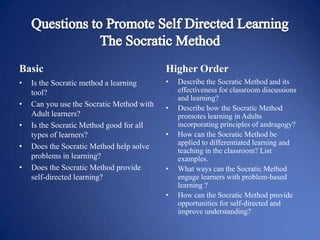
Basic

Higher Order

•

•

•
•
•

•

Is the Socratic method a learning
tool?
Can you use the Socratic Method with
Adult learners?
Is the Socratic Method good for all
types of learners?
Does the Socratic Method help solve
problems in learning?
Does the Socratic Method provide
self-directed learning?

•
•

•
•

Describe the Socratic Method and its
effectiveness for classroom discussions
and learning?
Describe how the Socratic Method
promotes learning in Adults
incorporating principles of andragogy?
How can the Socratic Method be
applied to differentiated learning and
teaching in the classroom? List
examples.
What ways can the Socratic Method
engage learners with problem-based
learning ?
How can the Socratic Method provide
opportunities for self-directed and
improve understanding?
•
•
•
•
•
•
•
•
•

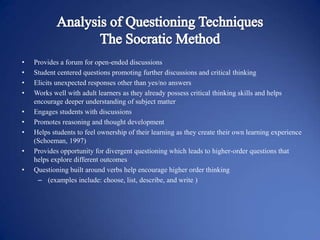
Provides a forum for open-ended discussions
Student centered questions promoting further discussions and critical thinking
Elicits unexpected responses other than yes/no answers
Works well with adult learners as they already possess critical thinking skills and helps
encourage deeper understanding of subject matter
Engages students with discussions
Promotes reasoning and thought development
Helps students to feel ownership of their learning as they create their own learning experience
(Schoeman, 1997)
Provides opportunity for divergent questioning which leads to higher-order questions that
helps explore different outcomes
Questioning built around verbs help encourage higher order thinking
– (examples include: choose, list, describe, and write )
•
•
•
•
•
•

•

Providing a comfortable learning experience for students who feel uncomfortable speaking in
front of others
Teachers may find difficulty introducing subject matter with accompanying creative
questioning
Helping students understand that making mistakes is part of learning
Keeping students engaged with active learning in classrooms with large numbers
Students may feel uneasy about answering with simple questions rather than complex
responses (Garrett, 1998)
Some students may not like that there is no “right” answer or genuinely do not know how to
respond
•
•
•
•
•
•
•
•
•
•

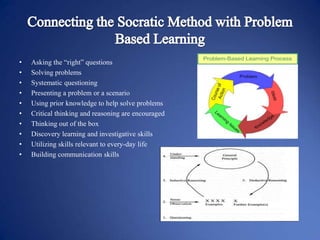
Asking the “right” questions
Solving problems
Systematic questioning
Presenting a problem or a scenario
Using prior knowledge to help solve problems
Critical thinking and reasoning are encouraged
Thinking out of the box
Discovery learning and investigative skills
Utilizing skills relevant to every-day life
Building communication skills
In summary, sound questioning techniques allow both instructor and student to form foundations
that promote responsibility in guided learning. This can be manifested through dialogue amongst
the students and questions instigated by the instructor, which in turn is developed via open-ended
questions, resulting in clear and critical thinking.
The instructor is also portrayed as the guide rather than the “sage on the stage” fostering
participation within a comfortable learning environment. Adult learners come to the forum with
prior knowledge and experience thus sound questioning technics permit learning to occur through
those foundations and adding on to further that knowledge. Sound questioning techniques also
foster engagement in problem-based learning at the same time as playing an integral role with
one’s own learning process
•
•
•
•
•

Drives independent learning to conduct research in direct reference to subject matter
Allows the student to develop ideas
Provides opportunities to access resources from University of Phoenix library, web resources
and investigation of web 2.0 tools
Makes provisions for creativity of individual work and learning
Leads the learner to activate prior learning and knowledge addressed in week three of
AET/531
Garrett, E. (1998). The Socratic Method. Green Bag, Inc, (), . Retrieved from
http://www.law.uchicago.edu/socrates/soc_article.html
Schoeman, S. (1997). Using the socratic method in secondary teaching. National Association of
Secondary School Principals.NASSP Bulletin, 81(587), 19-21. Retrieved from http://
search.proquest.com/docview/216027070?accountid=458

Self directed learning

  • 2.
    Basic Higher Order • • • • • • Is theSocratic method a learning tool? Can you use the Socratic Method with Adult learners? Is the Socratic Method good for all types of learners? Does the Socratic Method help solve problems in learning? Does the Socratic Method provide self-directed learning? • • • • Describe the Socratic Method and its effectiveness for classroom discussions and learning? Describe how the Socratic Method promotes learning in Adults incorporating principles of andragogy? How can the Socratic Method be applied to differentiated learning and teaching in the classroom? List examples. What ways can the Socratic Method engage learners with problem-based learning ? How can the Socratic Method provide opportunities for self-directed and improve understanding?
  • 3.
    • • • • • • • • • Provides a forumfor open-ended discussions Student centered questions promoting further discussions and critical thinking Elicits unexpected responses other than yes/no answers Works well with adult learners as they already possess critical thinking skills and helps encourage deeper understanding of subject matter Engages students with discussions Promotes reasoning and thought development Helps students to feel ownership of their learning as they create their own learning experience (Schoeman, 1997) Provides opportunity for divergent questioning which leads to higher-order questions that helps explore different outcomes Questioning built around verbs help encourage higher order thinking – (examples include: choose, list, describe, and write )
  • 4.
    • • • • • • • Providing a comfortablelearning experience for students who feel uncomfortable speaking in front of others Teachers may find difficulty introducing subject matter with accompanying creative questioning Helping students understand that making mistakes is part of learning Keeping students engaged with active learning in classrooms with large numbers Students may feel uneasy about answering with simple questions rather than complex responses (Garrett, 1998) Some students may not like that there is no “right” answer or genuinely do not know how to respond
  • 5.
    • • • • • • • • • • Asking the “right”questions Solving problems Systematic questioning Presenting a problem or a scenario Using prior knowledge to help solve problems Critical thinking and reasoning are encouraged Thinking out of the box Discovery learning and investigative skills Utilizing skills relevant to every-day life Building communication skills
  • 6.
    In summary, soundquestioning techniques allow both instructor and student to form foundations that promote responsibility in guided learning. This can be manifested through dialogue amongst the students and questions instigated by the instructor, which in turn is developed via open-ended questions, resulting in clear and critical thinking. The instructor is also portrayed as the guide rather than the “sage on the stage” fostering participation within a comfortable learning environment. Adult learners come to the forum with prior knowledge and experience thus sound questioning technics permit learning to occur through those foundations and adding on to further that knowledge. Sound questioning techniques also foster engagement in problem-based learning at the same time as playing an integral role with one’s own learning process
  • 7.
    • • • • • Drives independent learningto conduct research in direct reference to subject matter Allows the student to develop ideas Provides opportunities to access resources from University of Phoenix library, web resources and investigation of web 2.0 tools Makes provisions for creativity of individual work and learning Leads the learner to activate prior learning and knowledge addressed in week three of AET/531
  • 8.
    Garrett, E. (1998).The Socratic Method. Green Bag, Inc, (), . Retrieved from http://www.law.uchicago.edu/socrates/soc_article.html Schoeman, S. (1997). Using the socratic method in secondary teaching. National Association of Secondary School Principals.NASSP Bulletin, 81(587), 19-21. Retrieved from http:// search.proquest.com/docview/216027070?accountid=458