Offshoring 
Relocation opportunity study, execution and oversight 
Stephane Eyraud 
Clivana Khalilckhalil@chappuishalder.com 
seyraud@chappuishalder.com
AGENDA 
1 
2 
3 
4 
Business Drivers of an Offshoring Program 
High level approach 
Key Challenges and Success Factors 
Appendix: Focus on the methodology
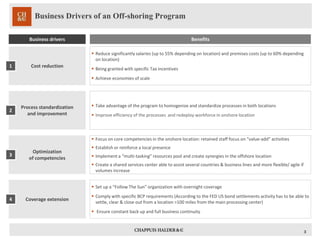
Benefits 
Business drivers 
Reduce significantly salaries (up to 55% depending on location) and premises costs (up to 60% depending on location) 
Being granted with specific Tax incentives 
Achieve economies of scale 
Cost reduction 
1 
Business Drivers of an Off-shoring Program 
Take advantage of the program to homogenize and standardize processes in both locations 
Improve efficiency of the processes and redeploy workforce in onshore location 
Process standardization 
and improvement 
2 
Focus on core competencies in the onshore location: retained staff focus on “value-add”activities 
Establish or reinforce a local presence 
Implement a “multi-tasking”resources pool and create synergies in the offshore location 
Create a shared services center able to assist several countries & business lines and more flexible/ agile if volumes increase 
Optimization 
of competencies 
3 
Set up a “Follow The Sun”organization with overnight coverage 
Comply with specific BCP requirements (According to the FED US bond settlements activity has to be able to settle, clear & close out from a location >100 miles from the main processing center) 
Ensure constant back up and full business continuity 
Coverage extension 
4 
3
Partial off/near 
shoring potential 
Partial off/near 
shoring potential 
Off/near shoring potential 
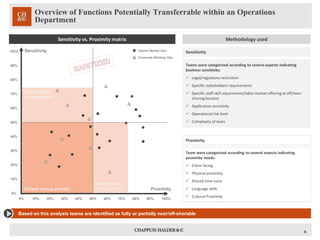
Overview of Functions Potentially Transferrable within an Operations Department 
Sensitivity vs. Proximity matrix 
Methodology used 
Based on this analysis teams are identified as fully or partially near/off-shorable 
10% 
0% 
30% 
20% 
50% 
40% 
70% 
60% 
90% 
80% 
100% 
10% 
0% 
30% 
20% 
50% 
40% 
70% 
60% 
90% 
80% 
100% 
Sensitivity 
Proximity 
Sensitivity 
Proximity 
Team were categorized according to several aspects indicating proximity needs: 
Client facing 
Physical proximity 
Shared time-zone 
Language skills 
Cultural Proximity 
4 
Teams were categorized according to several aspects indicating business sensitivity: 
Legal/regulatory restriction 
Specific stakeholders requirements 
Specific staff skill requirement/labor market offering at off/near- shoring location 
Application sensitivity 
Operational risk level 
Complexity of tasks 
Capital Market Ops 
Corporate Banking Ops
AGENDA 
1 
2 
3 
4 
Business Drivers of an Offshoring Program 
High level approach 
Key Challenges and Success Factors 
Appendix: Focus on the methodology
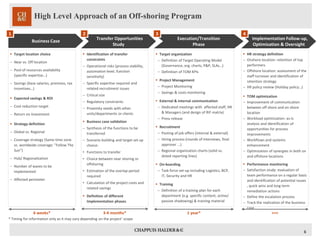
High Level Approach of an Off-shoring Program 
6 
Business Case 
Target location choice 
Near vs. Off location 
Pool of resources availability (specific expertise…) 
Savings (base salaries, premises, tax incentives…) 
Expected savings & ROI 
Cost reduction target 
Return on Investment 
Strategy definition 
Global vs. Regional 
Coverage strategy (Same time zone vs. worldwide coverage: ”Follow The Sun”) 
Hub/ Regionalization 
Number of waves to be implemented 
Affected perimeter 
1 
6 weeks* 
Transfer Opportunities 
Study 
Identification of transfer constraints 
Operational risks (process stability, automation level, function sensitivity) 
Specific expertise required and related recruitment issues 
Critical size 
Regulatory constraints 
Proximity needs with other units/departments or clients 
Business case validation 
Synthesis of the functions to be transferred 
Scenario building and target set up choice: 
•Functions to transfer 
•Choice between near shoring or offshoring 
•Estimation of the overlap period required 
•Calculation of the project costs and related savings 
Definition of different Implementation phases 
2 
3-4 months* 
Implementation Follow-up, Optimization & Oversight 
HR strategy definition 
Onshore location: retention of top performers 
Offshore location: assessment of the staff turnover and identification of retention strategy 
HR policy review (Holiday policy…) 
TOM optimization 
Improvement of communication between off shore and on shore location 
Workload optimization: as-is analysis and identification of opportunities for process improvements 
Workflows and systems enhancement 
Optimization of synergies in both on and offshore locations 
Performance monitoring 
Satisfaction study: evaluation of team performance on a regular basis and identification of potential issues , quick wins and long term remediation actions 
Define the escalation process 
Track the realization of the business case 
4 
>>> 
Execution/Transition 
Phase 
Target organization 
Definition of Target Operating Model (Governance, org. charts, P&P, SLAs…) 
Definition of TOM KPIs 
Project Management 
Project Monitoring 
Savings & costs monitoring 
External & internal communication 
Dedicated meetings with affected staff, HR & Managers (and design of RIF matrix) 
Press release 
Recruitment 
Posting of job offers (internal & external) 
Hiring process (rounds of interviews, final approver ...) 
Regional organization charts (solid vs. doted reporting lines) 
On-boarding 
Task force set-up including Logistics, BCP, IT, Security and HR 
Training 
Definition of a training plan for each department (e.g. specific content, active/ passive shadowing) & training material 
3 
1 year* 
* Timing for information only as it may vary depending on the project’scope
AGENDA 
1 
2 
3 
4 
Business Drivers of an Offshoring Program 
High level approach 
Key Challenges and Success Factors 
Appendix: Focus on the methodology
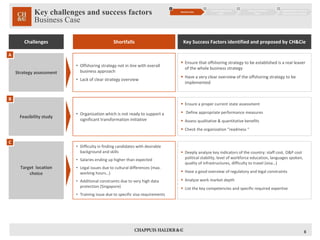
Key challenges and success factors 
Business Case 
8 
Challenges Shortfalls Key Success Factors identified and proposed by CH&Cie 
 Deeply analyze key indicators of the country: staff cost, O&P cost 
political stability, level of workforce education, languages spoken, 
quality of infrastructures, difficulty to travel (visa…) 
 Have a good overview of regulatory and legal constraints 
 Analyze work market depth 
 List the key competencies and specific required expertise 
Target location 
choice 
• Difficulty in finding candidates with desirable 
background and skills 
• Salaries ending up higher than expected 
• Legal issues due to cultural differences (max. 
working hours…) 
• Additional constraints due to very high data 
protection (Singapore) 
• Training issue due to specific visa requirements 
Business Case 
1 
Transfer Opportunities 
Study 
2 
Execution/Transition 
Phase 
3 
Implementation Follow-up, 
Optimization & Oversight 
4 
 Ensure that offshoring strategy to be established is a real leaver 
of the whole business strategy 
 Have a very clear overview of the offshoring strategy to be 
implemented 
Strategy assessment 
• Offshoring strategy not in line with overall 
business approach 
• Lack of clear strategy overview 
 Ensure a proper current state assessment 
 Define appropriate performance measures 
 Assess qualitative & quantitative benefits 
 Check the organization “readiness “ 
Feasibility study 
• Organization which is not ready to support a 
significant transformation initiative 
A 
B 
C
Key challenges and success factors 
Transfer Opportunities Study 
9 
Business Case 
1 
Transfer Opportunities 
Study 
2 
Execution/Transition 
Phase 
3 
Implementation Follow-up, 
Optimization & Oversight 
4 
Key Success Factors identified Challenges Shortfalls and proposed by CH&Cie 
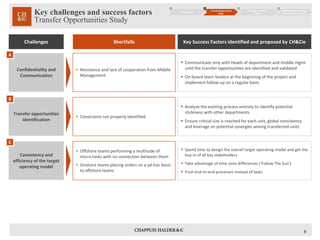
 Spend time to design the overall target operating model and get the 
buy-in of all key stakeholders 
 Take advantage of time zone differences (‘Follow The Sun’) 
 Push end-to-end processes instead of tasks 
Consistency and 
efficiency of the target 
operating model 
• Offshore teams performing a multitude of 
micro-tasks with no connection between them 
• Onshore teams placing orders on a ad-hoc basis 
to offshore teams 
 Communicate only with Heads of department and middle mgmt 
until the transfer opportunities are identified and validated 
 On-board team leaders at the beginning of the project and 
implement follow-up on a regular basis 
Confidentiality and 
Communication 
• Resistance and lack of cooperation from Middle 
Management 
 Analyze the existing process entirely to identify potential 
stickiness with other departments 
 Ensure critical size is reached for each unit, global consistency 
and leverage on potential synergies among transferred units 
Transfer opportunities 
identification 
• Constraints not properly identified 
A 
B 
C
Key challenges and success factors 
Execution/Transition Phase 
10 
Business Case 
1 
Transfer Opportunities 
Study 
2 
Execution/Transition 
Phase 
3 
Implementation Follow-up, 
Optimization & Oversight 
4 
Key Success Factors identified Challenges Shortfalls and proposed by CH&Cie 
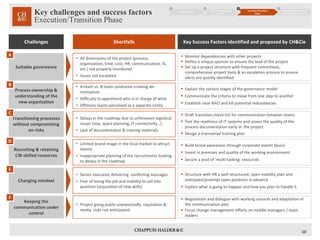
 Explain the various stages of the governance model 
 Communicate the criteria to move from one step to another 
 Establish clear RACI and kill potential redundancies 
Process ownership & 
understanding of the 
new organization 
• A-team vs. B-team syndrome creating de-motivation 
• Difficulty to apprehend who is in charge of what 
• Offshore teams perceived as a separate entity 
B 
 Draft transition check-list for communication between teams 
 Test the readiness of IT systems and assess the quality of the 
process documentation early in the project 
 Design a transversal training plan 
Transitioning processes 
without compromising 
on risks 
• Delays in the roadmap due to unforeseen logistical 
issues (visa, space planning, IT connectivity…) 
• Lack of documentation & training materials 
C 
 Build brand awareness through corporate events (buzz) 
 Invest in premises and quality of the working environment 
 Secure a pool of ‘multi-tasking’ resources 
Recruiting & retaining 
CIB-skilled resources 
• Limited brand image in the local market to attract 
talents 
• Inappropriate planning of the recruitments leading 
to delays in the roadmap 
D 
 Structure with HR a well-structured, open mobility plan and 
anticipate/preempt open positions in advance 
 Explain what is going to happen and how you plan to handle it 
Changing mindset 
• Senior executive delivering conflicting messages 
• Fear of losing the job and inability to call into 
question (acquisition of new skills) 
E 
 Negotiation and dialogue with working councils and adaptation of 
the communication plan 
 Focus change management efforts on middle managers / team 
leaders 
Keeping the 
communication under 
control 
• Project going public unexpectedly, reputation & 
media risks not anticipated 
F 
 Monitor dependencies with other projects 
 Define a unique sponsor to ensure the lead of the project 
 Set up a project structure with frequent committees, 
comprehensive project tools & an escalation process to ensure 
alerts are quickly identified 
Suitable governance 
• All dimensions of the project (process, 
organization, time, cost, HR, communication, IS, 
etc.) not properly monitored 
• Issues not escalated 
A
Key challenges and success factors 
Implementation Follow-up, Optimization 
& Oversight 
11 
Business Case 
1 
Transfer Opportunities 
Study 
2 
Execution/Transition 
Phase 
3 
Implementation Follow-up, 
Optimization & Oversight 
4 
Key Success Factors identified Challenges Shortfalls and proposed by CH&Cie 
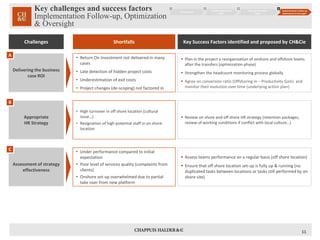
 Plan in the project a reorganization of onshore and offshore teams 
after the transfers (optimization phase) 
 Strengthen the headcount monitoring process globally 
 Agree on conversion ratio (Offshoring In – Productivity Gain) and 
monitor their evolution over time (underlying action plan) 
Delivering the business 
case ROI 
• Return On Investment not delivered in many 
cases 
• Late detection of hidden project costs 
• Underestimation of exit costs 
• Project changes (de-scoping) not factored in 
A 
 Assess teams performance on a regular basis (off shore location) 
 Ensure that off shore location set-up is fully up & running (no 
duplicated tasks between locations or tasks still performed by on 
shore site) 
Assessment of strategy 
effectiveness 
• Under performance compared to initial 
expectation 
• Poor level of services quality (complaints from 
clients) 
• Onshore set-up overwhelmed due to partial 
take over from new platform 
C 
 Review on shore and off shore HR strategy (retention packages, 
review of working conditions if conflict with local culture…) 
Appropriate 
HR Strategy 
• High turnover in off shore location (cultural 
issue…) 
• Resignation of high potential staff in on shore 
location 
B
AGENDA 
1 
2 
3 
4 
Business Drivers of an Offshoring Program 
High level approach 
Key Challenges and Success Factors 
Appendix: Focus on the methodology

CH&Cie_Offshoring opportunities_Teaser

  • 1.
    Offshoring Relocation opportunitystudy, execution and oversight Stephane Eyraud Clivana Khalilckhalil@chappuishalder.com seyraud@chappuishalder.com
  • 2.
    AGENDA 1 2 3 4 Business Drivers of an Offshoring Program High level approach Key Challenges and Success Factors Appendix: Focus on the methodology
  • 3.
    Benefits Business drivers Reduce significantly salaries (up to 55% depending on location) and premises costs (up to 60% depending on location) Being granted with specific Tax incentives Achieve economies of scale Cost reduction 1 Business Drivers of an Off-shoring Program Take advantage of the program to homogenize and standardize processes in both locations Improve efficiency of the processes and redeploy workforce in onshore location Process standardization and improvement 2 Focus on core competencies in the onshore location: retained staff focus on “value-add”activities Establish or reinforce a local presence Implement a “multi-tasking”resources pool and create synergies in the offshore location Create a shared services center able to assist several countries & business lines and more flexible/ agile if volumes increase Optimization of competencies 3 Set up a “Follow The Sun”organization with overnight coverage Comply with specific BCP requirements (According to the FED US bond settlements activity has to be able to settle, clear & close out from a location >100 miles from the main processing center) Ensure constant back up and full business continuity Coverage extension 4 3
  • 4.
    Partial off/near shoringpotential Partial off/near shoring potential Off/near shoring potential Overview of Functions Potentially Transferrable within an Operations Department Sensitivity vs. Proximity matrix Methodology used Based on this analysis teams are identified as fully or partially near/off-shorable 10% 0% 30% 20% 50% 40% 70% 60% 90% 80% 100% 10% 0% 30% 20% 50% 40% 70% 60% 90% 80% 100% Sensitivity Proximity Sensitivity Proximity Team were categorized according to several aspects indicating proximity needs: Client facing Physical proximity Shared time-zone Language skills Cultural Proximity 4 Teams were categorized according to several aspects indicating business sensitivity: Legal/regulatory restriction Specific stakeholders requirements Specific staff skill requirement/labor market offering at off/near- shoring location Application sensitivity Operational risk level Complexity of tasks Capital Market Ops Corporate Banking Ops
  • 5.
    AGENDA 1 2 3 4 Business Drivers of an Offshoring Program High level approach Key Challenges and Success Factors Appendix: Focus on the methodology
  • 6.
    High Level Approachof an Off-shoring Program 6 Business Case Target location choice Near vs. Off location Pool of resources availability (specific expertise…) Savings (base salaries, premises, tax incentives…) Expected savings & ROI Cost reduction target Return on Investment Strategy definition Global vs. Regional Coverage strategy (Same time zone vs. worldwide coverage: ”Follow The Sun”) Hub/ Regionalization Number of waves to be implemented Affected perimeter 1 6 weeks* Transfer Opportunities Study Identification of transfer constraints Operational risks (process stability, automation level, function sensitivity) Specific expertise required and related recruitment issues Critical size Regulatory constraints Proximity needs with other units/departments or clients Business case validation Synthesis of the functions to be transferred Scenario building and target set up choice: •Functions to transfer •Choice between near shoring or offshoring •Estimation of the overlap period required •Calculation of the project costs and related savings Definition of different Implementation phases 2 3-4 months* Implementation Follow-up, Optimization & Oversight HR strategy definition Onshore location: retention of top performers Offshore location: assessment of the staff turnover and identification of retention strategy HR policy review (Holiday policy…) TOM optimization Improvement of communication between off shore and on shore location Workload optimization: as-is analysis and identification of opportunities for process improvements Workflows and systems enhancement Optimization of synergies in both on and offshore locations Performance monitoring Satisfaction study: evaluation of team performance on a regular basis and identification of potential issues , quick wins and long term remediation actions Define the escalation process Track the realization of the business case 4 >>> Execution/Transition Phase Target organization Definition of Target Operating Model (Governance, org. charts, P&P, SLAs…) Definition of TOM KPIs Project Management Project Monitoring Savings & costs monitoring External & internal communication Dedicated meetings with affected staff, HR & Managers (and design of RIF matrix) Press release Recruitment Posting of job offers (internal & external) Hiring process (rounds of interviews, final approver ...) Regional organization charts (solid vs. doted reporting lines) On-boarding Task force set-up including Logistics, BCP, IT, Security and HR Training Definition of a training plan for each department (e.g. specific content, active/ passive shadowing) & training material 3 1 year* * Timing for information only as it may vary depending on the project’scope
  • 7.
    AGENDA 1 2 3 4 Business Drivers of an Offshoring Program High level approach Key Challenges and Success Factors Appendix: Focus on the methodology
  • 8.
    Key challenges andsuccess factors Business Case 8 Challenges Shortfalls Key Success Factors identified and proposed by CH&Cie  Deeply analyze key indicators of the country: staff cost, O&P cost political stability, level of workforce education, languages spoken, quality of infrastructures, difficulty to travel (visa…)  Have a good overview of regulatory and legal constraints  Analyze work market depth  List the key competencies and specific required expertise Target location choice • Difficulty in finding candidates with desirable background and skills • Salaries ending up higher than expected • Legal issues due to cultural differences (max. working hours…) • Additional constraints due to very high data protection (Singapore) • Training issue due to specific visa requirements Business Case 1 Transfer Opportunities Study 2 Execution/Transition Phase 3 Implementation Follow-up, Optimization & Oversight 4  Ensure that offshoring strategy to be established is a real leaver of the whole business strategy  Have a very clear overview of the offshoring strategy to be implemented Strategy assessment • Offshoring strategy not in line with overall business approach • Lack of clear strategy overview  Ensure a proper current state assessment  Define appropriate performance measures  Assess qualitative & quantitative benefits  Check the organization “readiness “ Feasibility study • Organization which is not ready to support a significant transformation initiative A B C
  • 9.
    Key challenges andsuccess factors Transfer Opportunities Study 9 Business Case 1 Transfer Opportunities Study 2 Execution/Transition Phase 3 Implementation Follow-up, Optimization & Oversight 4 Key Success Factors identified Challenges Shortfalls and proposed by CH&Cie  Spend time to design the overall target operating model and get the buy-in of all key stakeholders  Take advantage of time zone differences (‘Follow The Sun’)  Push end-to-end processes instead of tasks Consistency and efficiency of the target operating model • Offshore teams performing a multitude of micro-tasks with no connection between them • Onshore teams placing orders on a ad-hoc basis to offshore teams  Communicate only with Heads of department and middle mgmt until the transfer opportunities are identified and validated  On-board team leaders at the beginning of the project and implement follow-up on a regular basis Confidentiality and Communication • Resistance and lack of cooperation from Middle Management  Analyze the existing process entirely to identify potential stickiness with other departments  Ensure critical size is reached for each unit, global consistency and leverage on potential synergies among transferred units Transfer opportunities identification • Constraints not properly identified A B C
  • 10.
    Key challenges andsuccess factors Execution/Transition Phase 10 Business Case 1 Transfer Opportunities Study 2 Execution/Transition Phase 3 Implementation Follow-up, Optimization & Oversight 4 Key Success Factors identified Challenges Shortfalls and proposed by CH&Cie  Explain the various stages of the governance model  Communicate the criteria to move from one step to another  Establish clear RACI and kill potential redundancies Process ownership & understanding of the new organization • A-team vs. B-team syndrome creating de-motivation • Difficulty to apprehend who is in charge of what • Offshore teams perceived as a separate entity B  Draft transition check-list for communication between teams  Test the readiness of IT systems and assess the quality of the process documentation early in the project  Design a transversal training plan Transitioning processes without compromising on risks • Delays in the roadmap due to unforeseen logistical issues (visa, space planning, IT connectivity…) • Lack of documentation & training materials C  Build brand awareness through corporate events (buzz)  Invest in premises and quality of the working environment  Secure a pool of ‘multi-tasking’ resources Recruiting & retaining CIB-skilled resources • Limited brand image in the local market to attract talents • Inappropriate planning of the recruitments leading to delays in the roadmap D  Structure with HR a well-structured, open mobility plan and anticipate/preempt open positions in advance  Explain what is going to happen and how you plan to handle it Changing mindset • Senior executive delivering conflicting messages • Fear of losing the job and inability to call into question (acquisition of new skills) E  Negotiation and dialogue with working councils and adaptation of the communication plan  Focus change management efforts on middle managers / team leaders Keeping the communication under control • Project going public unexpectedly, reputation & media risks not anticipated F  Monitor dependencies with other projects  Define a unique sponsor to ensure the lead of the project  Set up a project structure with frequent committees, comprehensive project tools & an escalation process to ensure alerts are quickly identified Suitable governance • All dimensions of the project (process, organization, time, cost, HR, communication, IS, etc.) not properly monitored • Issues not escalated A
  • 11.
    Key challenges andsuccess factors Implementation Follow-up, Optimization & Oversight 11 Business Case 1 Transfer Opportunities Study 2 Execution/Transition Phase 3 Implementation Follow-up, Optimization & Oversight 4 Key Success Factors identified Challenges Shortfalls and proposed by CH&Cie  Plan in the project a reorganization of onshore and offshore teams after the transfers (optimization phase)  Strengthen the headcount monitoring process globally  Agree on conversion ratio (Offshoring In – Productivity Gain) and monitor their evolution over time (underlying action plan) Delivering the business case ROI • Return On Investment not delivered in many cases • Late detection of hidden project costs • Underestimation of exit costs • Project changes (de-scoping) not factored in A  Assess teams performance on a regular basis (off shore location)  Ensure that off shore location set-up is fully up & running (no duplicated tasks between locations or tasks still performed by on shore site) Assessment of strategy effectiveness • Under performance compared to initial expectation • Poor level of services quality (complaints from clients) • Onshore set-up overwhelmed due to partial take over from new platform C  Review on shore and off shore HR strategy (retention packages, review of working conditions if conflict with local culture…) Appropriate HR Strategy • High turnover in off shore location (cultural issue…) • Resignation of high potential staff in on shore location B
  • 12.
    AGENDA 1 2 3 4 Business Drivers of an Offshoring Program High level approach Key Challenges and Success Factors Appendix: Focus on the methodology