Rethinking Client Onboarding 
January 2014 
Stephanie Baruk sbaruk@chappuishalder.com
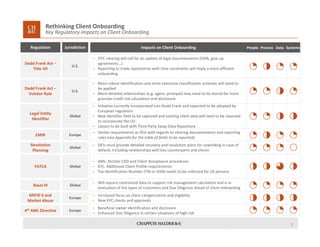
Regulation Jurisdiction Impacts on Client Onboarding People Process Data Systems 
2 
Rethinking Client Onboarding 
Key Regulatory impacts on Client Onboarding 
– OTC clearing will call for an update of legal documentation (ISDA, give‐up 
agreements…) 
– Reporting to trade repositories with time constraints will imply a more efficient 
onboarding 
Dodd Frank Act – 
Title VII U.S. 
– More robust identification and more extensive classification schemes will need to 
be applied 
– More detailed relationships (e.g. agent, principal) may need to be stored for more 
granular credit risk calculation and disclosure 
Dodd Frank Act – 
Volcker Rule U.S. 
Legal Entity 
Identifier Global 
– Initiative currently incorporated into Dodd Frank and expected to be adopted by 
European regulators 
– New identifier field to be captured and existing client data will need to be cleansed 
to incorporate the LEI 
– Liaison to be built with Third Party Swap Data Repository 
EMIR Europe – Similar requirements as DFA with regards to clearing documentation and reporting 
rules (see Appendix for the table of fields to be reported) 
Resolution 
Planning Global – SIFIs must provide detailed recovery and resolution plans for unwinding in case of 
FATCA Global 
default, including relationships with key counterparts and clients 
– AML: Stricter CDD and Client Acceptance procedures 
– KYC: Additional Client Profile requirements 
– Tax Identification Number (TIN or GIIN) needs to be collected for US persons 
Basel III Global – Will require centralized data to support risk management calculation and a re‐evaluation 
of the types of customers and Due Diligence ahead of client onboarding 
MIFID II and 
Market Abuse Europe – Increased focus on client categorization and eligibility 
– New KYC checks and approvals 
– Beneficial owner identification and disclosure 
4 – Enhanced Due Diligence in certain situations of high risk th AML Directive Europe
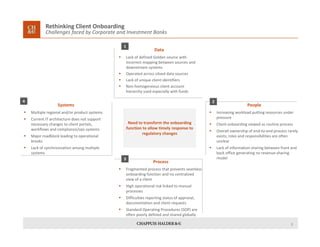
Data 
 Lack of defined Golden source with 
incorrect mapping between sources and 
downstream systems 
 Operated across siloed data sources 
 Lack of unique client identifiers 
 Non‐homogeneous client account 
hierarchy used especially with funds 
4 2 
Systems 
 Multiple regional and/or product systems 
 Current IT architecture does not support 
necessary changes to client portals, 
workflows and compliance/ops systems 
 Major roadblock leading to operational 
breaks 
 Lack of synchronization among multiple 
systems 
1 
3 
Need to transform the onboarding 
function to allow timely response to 
regulatory changes 
Process 
 Fragmented process that prevents seamless 
onboarding function and no centralized 
view of a client 
 High operational risk linked to manual 
processes 
 Difficulties reporting status of approval, 
documentation and client requests 
 Standard Operating Procedures (SOP) are 
often poorly defined and shared globally 
People 
 Increasing workload putting resources under 
pressure 
 Client onboarding viewed as routine process 
 Overall ownership of end‐to‐end process rarely 
exists; roles and responsibilities are often 
unclear 
 Lack of information sharing between front and 
back office generating no revenue‐sharing 
model 
Rethinking Client Onboarding 
Challenges faced by Corporate and Investment Banks 
3
4 
Rethinking Client Onboarding 
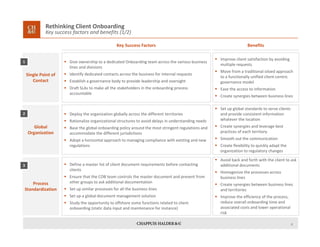
Key success factors and benefits (1/2) 
Key Success Factors Benefits 
Single Point of 
Contact 
 Give ownership to a dedicated Onboarding team across the various business 
lines and divisions 
 Identify dedicated contacts across the business for internal requests 
 Establish a governance body to provide leadership and oversight 
 Draft SLAs to make all the stakeholders in the onboarding process 
accountable 
 Improve client satisfaction by avoiding 
multiple requests 
 Move from a traditional siloed approach 
to a functionally unified client‐centric 
governance model 
 Ease the access to information 
 Create synergies between business lines 
1 
Global 
Organization 
 Deploy the organization globally across the different territories 
 Rationalize organizational structures to avoid delays in understanding needs 
 Base the global onboarding policy around the most stringent regulations and 
accommodate the different jurisdictions 
 Adopt a horizontal approach to managing compliance with existing and new 
regulations 
 Set up global standards to serve clients 
and provide consistent information 
whatever the location 
 Create synergies and leverage best 
practices of each territory 
 Smooth out the communication 
 Create flexibility to quickly adapt the 
organization to regulatory changes 
2 
Process 
Standardization 
 Define a master list of client document requirements before contacting 
clients 
 Ensure that the COB team controls the master document and prevent from 
other groups to ask additional documentation 
 Set up similar processes for all the business lines 
 Set up a global document management solution 
 Study the opportunity to offshore some functions related to client 
onboarding (static data input and maintenance for instance) 
 Avoid back and forth with the client to ask 
additional documents 
 Homogenize the processes across 
business lines 
 Create synergies between business lines 
and territories 
 Improve the efficiency of the process, 
reduce overall onboarding time and 
associated costs and lower operational 
risk 
3
5 
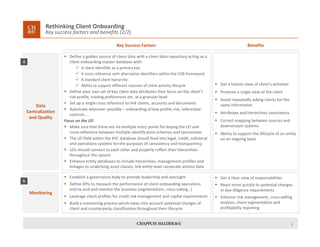
Key Success Factors Benefits 
Data 
Centralization 
and Quality 
 Define a golden source of client data with a client data repository acting as a 
client onboarding master database with: 
 A client identifier as a primary key 
 A cross reference with alternative identifiers within the COB framework 
 A standard client hierarchy 
 Ability to support different statuses of client activity lifecycle 
 Define your own set of key client data attributes then focus on the client’s 
risk profile, trading preferences etc. at a granular level 
 Set up a single cross reference to link clients, accounts and documents 
 Automate wherever possible – onboarding of low‐profile risk, referential 
controls… 
Focus on the LEI 
 Make sure that there are no multiple entry points for keying the LEI and 
cross‐reference between multiple identification schemes and taxonomies 
 The LEI field within the KYC database should feed into legal, credit, collateral 
and operations systems for the purposes of consistency and transparency 
 LEIs should connect to each other and properly reflect their hierarchies 
throughout the system 
 Enhance entity databases to include hierarchies, management profiles and 
linkages to underlying asset classes, link entity level corporate actions data 
 Get a holistic view of client’s activities 
 Promote a single view of the client 
 Avoid repeatedly asking clients for the 
same information 
 Attributes and hierarchies consistency 
 Correct mapping between sources and 
downstream systems 
 Ability to support the lifecycle of an entity 
on an ongoing basis 
4 
Rethinking Client Onboarding 
Key success factors and benefits (2/2) 
Monitoring 
 Establish a governance body to provide leadership and oversight 
 Define KPIs to measure the performance of client onboarding operations 
end‐to‐end and monitor the business (segmentation, cross‐selling…) 
 Leverage client profiles for credit risk management and capital requirements 
 Build a monitoring process which takes into account potential changes of 
client and counterparty classification throughout their lifecycle 
 Get a clear view of responsibilities 
 React more quickly to potential changes 
in due diligence requirements 
 Enhance risk management, cross‐selling 
analysis, client segmentation and 
profitability reporting 
5

CH&Cie_Rethinking client on boarding_Teaser

  • 1.
    Rethinking Client Onboarding January 2014 Stephanie Baruk sbaruk@chappuishalder.com
  • 2.
    Regulation Jurisdiction Impactson Client Onboarding People Process Data Systems 2 Rethinking Client Onboarding Key Regulatory impacts on Client Onboarding – OTC clearing will call for an update of legal documentation (ISDA, give‐up agreements…) – Reporting to trade repositories with time constraints will imply a more efficient onboarding Dodd Frank Act – Title VII U.S. – More robust identification and more extensive classification schemes will need to be applied – More detailed relationships (e.g. agent, principal) may need to be stored for more granular credit risk calculation and disclosure Dodd Frank Act – Volcker Rule U.S. Legal Entity Identifier Global – Initiative currently incorporated into Dodd Frank and expected to be adopted by European regulators – New identifier field to be captured and existing client data will need to be cleansed to incorporate the LEI – Liaison to be built with Third Party Swap Data Repository EMIR Europe – Similar requirements as DFA with regards to clearing documentation and reporting rules (see Appendix for the table of fields to be reported) Resolution Planning Global – SIFIs must provide detailed recovery and resolution plans for unwinding in case of FATCA Global default, including relationships with key counterparts and clients – AML: Stricter CDD and Client Acceptance procedures – KYC: Additional Client Profile requirements – Tax Identification Number (TIN or GIIN) needs to be collected for US persons Basel III Global – Will require centralized data to support risk management calculation and a re‐evaluation of the types of customers and Due Diligence ahead of client onboarding MIFID II and Market Abuse Europe – Increased focus on client categorization and eligibility – New KYC checks and approvals – Beneficial owner identification and disclosure 4 – Enhanced Due Diligence in certain situations of high risk th AML Directive Europe
  • 3.
    Data  Lackof defined Golden source with incorrect mapping between sources and downstream systems  Operated across siloed data sources  Lack of unique client identifiers  Non‐homogeneous client account hierarchy used especially with funds 4 2 Systems  Multiple regional and/or product systems  Current IT architecture does not support necessary changes to client portals, workflows and compliance/ops systems  Major roadblock leading to operational breaks  Lack of synchronization among multiple systems 1 3 Need to transform the onboarding function to allow timely response to regulatory changes Process  Fragmented process that prevents seamless onboarding function and no centralized view of a client  High operational risk linked to manual processes  Difficulties reporting status of approval, documentation and client requests  Standard Operating Procedures (SOP) are often poorly defined and shared globally People  Increasing workload putting resources under pressure  Client onboarding viewed as routine process  Overall ownership of end‐to‐end process rarely exists; roles and responsibilities are often unclear  Lack of information sharing between front and back office generating no revenue‐sharing model Rethinking Client Onboarding Challenges faced by Corporate and Investment Banks 3
  • 4.
    4 Rethinking ClientOnboarding Key success factors and benefits (1/2) Key Success Factors Benefits Single Point of Contact  Give ownership to a dedicated Onboarding team across the various business lines and divisions  Identify dedicated contacts across the business for internal requests  Establish a governance body to provide leadership and oversight  Draft SLAs to make all the stakeholders in the onboarding process accountable  Improve client satisfaction by avoiding multiple requests  Move from a traditional siloed approach to a functionally unified client‐centric governance model  Ease the access to information  Create synergies between business lines 1 Global Organization  Deploy the organization globally across the different territories  Rationalize organizational structures to avoid delays in understanding needs  Base the global onboarding policy around the most stringent regulations and accommodate the different jurisdictions  Adopt a horizontal approach to managing compliance with existing and new regulations  Set up global standards to serve clients and provide consistent information whatever the location  Create synergies and leverage best practices of each territory  Smooth out the communication  Create flexibility to quickly adapt the organization to regulatory changes 2 Process Standardization  Define a master list of client document requirements before contacting clients  Ensure that the COB team controls the master document and prevent from other groups to ask additional documentation  Set up similar processes for all the business lines  Set up a global document management solution  Study the opportunity to offshore some functions related to client onboarding (static data input and maintenance for instance)  Avoid back and forth with the client to ask additional documents  Homogenize the processes across business lines  Create synergies between business lines and territories  Improve the efficiency of the process, reduce overall onboarding time and associated costs and lower operational risk 3
  • 5.
    5 Key SuccessFactors Benefits Data Centralization and Quality  Define a golden source of client data with a client data repository acting as a client onboarding master database with:  A client identifier as a primary key  A cross reference with alternative identifiers within the COB framework  A standard client hierarchy  Ability to support different statuses of client activity lifecycle  Define your own set of key client data attributes then focus on the client’s risk profile, trading preferences etc. at a granular level  Set up a single cross reference to link clients, accounts and documents  Automate wherever possible – onboarding of low‐profile risk, referential controls… Focus on the LEI  Make sure that there are no multiple entry points for keying the LEI and cross‐reference between multiple identification schemes and taxonomies  The LEI field within the KYC database should feed into legal, credit, collateral and operations systems for the purposes of consistency and transparency  LEIs should connect to each other and properly reflect their hierarchies throughout the system  Enhance entity databases to include hierarchies, management profiles and linkages to underlying asset classes, link entity level corporate actions data  Get a holistic view of client’s activities  Promote a single view of the client  Avoid repeatedly asking clients for the same information  Attributes and hierarchies consistency  Correct mapping between sources and downstream systems  Ability to support the lifecycle of an entity on an ongoing basis 4 Rethinking Client Onboarding Key success factors and benefits (2/2) Monitoring  Establish a governance body to provide leadership and oversight  Define KPIs to measure the performance of client onboarding operations end‐to‐end and monitor the business (segmentation, cross‐selling…)  Leverage client profiles for credit risk management and capital requirements  Build a monitoring process which takes into account potential changes of client and counterparty classification throughout their lifecycle  Get a clear view of responsibilities  React more quickly to potential changes in due diligence requirements  Enhance risk management, cross‐selling analysis, client segmentation and profitability reporting 5