Handling Unanticipated Change
Presented at the
XXX Charleston Conference
by Nancy Richey, Elisabeth Knight,
and Roxanne Spencer,
Western Kentucky University Libraries
Change
If you want to make enemies,
try to change something….
Woodrow
Wilson
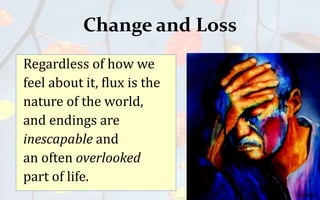
Change and Loss
Regardless of how we
feel about it, flux is the
nature of the world,
and endings are
inescapable and
an often overlooked
part of life.
First, Some Definitions
• Knowledge Management
• Change Management
• Institutional Memory
Why?
• Lack of resources
• “Turf Wars”?
• Narrow understanding of responsibilities
• Lack of documentation and training
• Old habits die hard
• Lack of leadership
• Personality issues
• Corporate culture
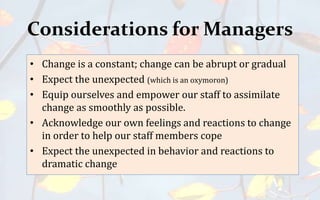
Considerations for Managers
• Change is a constant; change can be abrupt or gradual
• Expect the unexpected (which is an oxymoron)
• Equip ourselves and empower our staff to assimilate
change as smoothly as possible.
• Acknowledge our own feelings and reactions to change
in order to help our staff members cope
• Expect the unexpected in behavior and reactions to
dramatic change
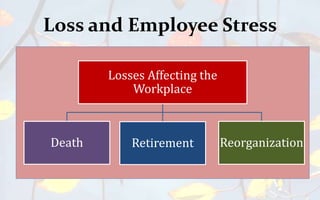
Loss and Employee Stress
Losses Affecting the
Workplace
Death Retirement Reorganization
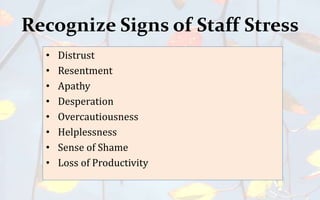
Recognize Signs of Staff Stress
• Distrust
• Resentment
• Apathy
• Desperation
• Overcautiousness
• Helplessness
• Sense of Shame
• Loss of Productivity
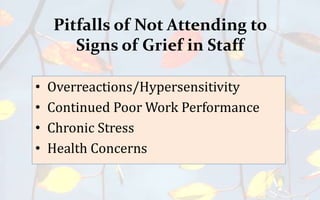
Pitfalls of Not Attending to
Signs of Grief in Staff
• Overreactions/Hypersensitivity
• Continued Poor Work Performance
• Chronic Stress
• Health Concerns
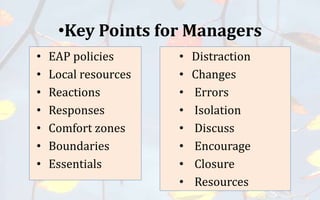
• EAP policies
• Local resources
• Reactions
• Responses
• Comfort zones
• Boundaries
• Essentials
•Key Points for Managers
• Distraction
• Changes
• Errors
• Isolation
• Discuss
• Encourage
• Closure
• Resources
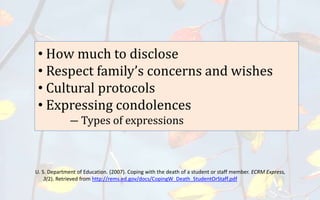
• How much to disclose
• Respect family’s concerns and wishes
• Cultural protocols
• Expressing condolences
― Types of expressions
U. S. Department of Education. (2007). Coping with the death of a student or staff member. ECRM Express,
3(2). Retrieved from http://rems.ed.gov/docs/CopingW_Death_StudentOrStaff.pdf
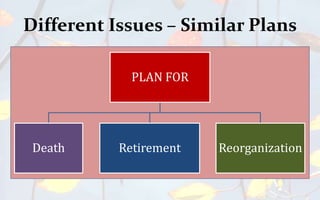
Different Issues – Similar Plans
PLAN FOR
Death Retirement Reorganization
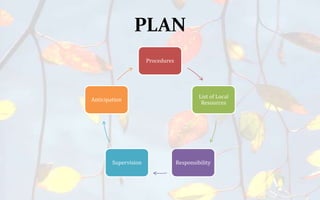
PLAN
Procedures
List of Local
Resources
ResponsibilitySupervision
Anticipation
Planning
• Policies and Procedures Manual
– Each Department
• Each Job
• Current
– Mission
• Goals
• Anticipate Changes
What is Your Objective?
• Replacement Planning
• Succession Planning
• Carrying on During a Time of Grief
Succession Planning
Succession planning … is defined as a systematic effort
by the library to ensure continuity in key positions,
retain and develop intellectual and knowledge capital
for the future, and encourage individual advancement.
It is designed to be ongoing, owned by leadership. It
encourages a focus on aligning staff and leadership
with the library’s strategic goals and objectives.
Paula Singer, Succession Planning in the Library
Planning and Assessment
• Assessment Plan
• Assessment Team
• Team Responsiveness
• Responsibility
Crisis Assessment Plan Or Assessment Plan
• A Crisis Assessment Plan is for efficient
intervention in times of crisis
• An Assessment Plan is for efficient
transition in times of change
• Plans are developed by Assessment Teams
Assessment Manual
• Manual with a List of Policies and
Procedures to Follow to Assess an On-
Going Situation and How to React
Procedures Manual
• Job Descriptions
• Policies for each department
• Procedures
– Overview Summary
– Flowchart or Bulleted List
– Detailed Guidelines
• Job Responsibilities
– Back-up (basis for cross-training)
Crisis Assessment Team or Assessment Team
• A Crisis Assessment Team is for efficient
intervention
• An Assessment Team is for efficient
transition
• Usually the Same Personnel for Both
Assessment Team Comprised of
• Top Administrator (Dean, Director, etc.)
• Administrative/Management Personnel
(Department Heads)
• Professional Staff
• Clerical and Facilities Staff
Crisis Assessment Team
• Don’t wait for a crisis to organize this team!
• Team is charged with immediate response
to crisis
• Will follow procedures in Assessment
Manual to Determine Best Course of Action
DEATH
• Crisis Assessment Plan and Team duties
• Keep on file Local Resources for Counseling, etc.
• Handle Media as needed
• Put Together Workplace Memorial Service
• Expect Work Disruption and Distraction
• Ensure Services Continue without
Disruption
• Cross-train staff to assume duties of others
• Planning for the Transference of
Institutional Memory
– Job Shadow
– Retiree to write up responsibilities and
procedures of position
– Interview and record retiree reflections
(walkaround, internal blog, provides
training material)
RETIREMENT
REORGANIZATION
• Positions Merge or Are Eliminated
• Departments Are Restructured or
Eliminated
Adjustments & Assessments
• Job Reordered to Conform to Mission &
Objectives
• Procedures Manual – revise and combine
• Redistribution of Labor
• Assess Outcome
• Give Staff Opportunity to Adjust and Express
Concerns
“Coping With the Short Goodbye”: Conclusion
• Every work environment faces anticipated and unexpected
losses
• Staff can be reassured that their concerns are taken into
consideration
• Managers can plan for anticipated losses and devise coping
mechanisms for unexpected losses
• Knowledge and change management and institutional
memory all play significant roles
Questions?

Charleston conf short_goodbye_11042010_final

  • 1.
  • 2.
    Presented at the XXXCharleston Conference by Nancy Richey, Elisabeth Knight, and Roxanne Spencer, Western Kentucky University Libraries
  • 3.
    Change If you wantto make enemies, try to change something…. Woodrow Wilson
  • 4.
    Change and Loss Regardlessof how we feel about it, flux is the nature of the world, and endings are inescapable and an often overlooked part of life.
  • 5.
    First, Some Definitions •Knowledge Management • Change Management • Institutional Memory
  • 6.
    Why? • Lack ofresources • “Turf Wars”? • Narrow understanding of responsibilities • Lack of documentation and training • Old habits die hard • Lack of leadership • Personality issues • Corporate culture
  • 7.
    Considerations for Managers •Change is a constant; change can be abrupt or gradual • Expect the unexpected (which is an oxymoron) • Equip ourselves and empower our staff to assimilate change as smoothly as possible. • Acknowledge our own feelings and reactions to change in order to help our staff members cope • Expect the unexpected in behavior and reactions to dramatic change
  • 8.
    Loss and EmployeeStress Losses Affecting the Workplace Death Retirement Reorganization
  • 9.
    Recognize Signs ofStaff Stress • Distrust • Resentment • Apathy • Desperation • Overcautiousness • Helplessness • Sense of Shame • Loss of Productivity
  • 10.
    Pitfalls of NotAttending to Signs of Grief in Staff • Overreactions/Hypersensitivity • Continued Poor Work Performance • Chronic Stress • Health Concerns
  • 11.
    • EAP policies •Local resources • Reactions • Responses • Comfort zones • Boundaries • Essentials •Key Points for Managers • Distraction • Changes • Errors • Isolation • Discuss • Encourage • Closure • Resources
  • 12.
    • How muchto disclose • Respect family’s concerns and wishes • Cultural protocols • Expressing condolences ― Types of expressions U. S. Department of Education. (2007). Coping with the death of a student or staff member. ECRM Express, 3(2). Retrieved from http://rems.ed.gov/docs/CopingW_Death_StudentOrStaff.pdf
  • 13.
    Different Issues –Similar Plans PLAN FOR Death Retirement Reorganization
  • 14.
  • 15.
    Planning • Policies andProcedures Manual – Each Department • Each Job • Current – Mission • Goals • Anticipate Changes
  • 16.
    What is YourObjective? • Replacement Planning • Succession Planning • Carrying on During a Time of Grief
  • 17.
    Succession Planning Succession planning… is defined as a systematic effort by the library to ensure continuity in key positions, retain and develop intellectual and knowledge capital for the future, and encourage individual advancement. It is designed to be ongoing, owned by leadership. It encourages a focus on aligning staff and leadership with the library’s strategic goals and objectives. Paula Singer, Succession Planning in the Library
  • 18.
    Planning and Assessment •Assessment Plan • Assessment Team • Team Responsiveness • Responsibility
  • 19.
    Crisis Assessment PlanOr Assessment Plan • A Crisis Assessment Plan is for efficient intervention in times of crisis • An Assessment Plan is for efficient transition in times of change • Plans are developed by Assessment Teams
  • 20.
    Assessment Manual • Manualwith a List of Policies and Procedures to Follow to Assess an On- Going Situation and How to React
  • 21.
    Procedures Manual • JobDescriptions • Policies for each department • Procedures – Overview Summary – Flowchart or Bulleted List – Detailed Guidelines • Job Responsibilities – Back-up (basis for cross-training)
  • 22.
    Crisis Assessment Teamor Assessment Team • A Crisis Assessment Team is for efficient intervention • An Assessment Team is for efficient transition • Usually the Same Personnel for Both
  • 23.
    Assessment Team Comprisedof • Top Administrator (Dean, Director, etc.) • Administrative/Management Personnel (Department Heads) • Professional Staff • Clerical and Facilities Staff
  • 24.
    Crisis Assessment Team •Don’t wait for a crisis to organize this team! • Team is charged with immediate response to crisis • Will follow procedures in Assessment Manual to Determine Best Course of Action
  • 25.
    DEATH • Crisis AssessmentPlan and Team duties • Keep on file Local Resources for Counseling, etc. • Handle Media as needed • Put Together Workplace Memorial Service • Expect Work Disruption and Distraction • Ensure Services Continue without Disruption • Cross-train staff to assume duties of others
  • 26.
    • Planning forthe Transference of Institutional Memory – Job Shadow – Retiree to write up responsibilities and procedures of position – Interview and record retiree reflections (walkaround, internal blog, provides training material) RETIREMENT
  • 27.
    REORGANIZATION • Positions Mergeor Are Eliminated • Departments Are Restructured or Eliminated
  • 28.
    Adjustments & Assessments •Job Reordered to Conform to Mission & Objectives • Procedures Manual – revise and combine • Redistribution of Labor • Assess Outcome • Give Staff Opportunity to Adjust and Express Concerns
  • 29.
    “Coping With theShort Goodbye”: Conclusion • Every work environment faces anticipated and unexpected losses • Staff can be reassured that their concerns are taken into consideration • Managers can plan for anticipated losses and devise coping mechanisms for unexpected losses • Knowledge and change management and institutional memory all play significant roles Questions?

Editor's Notes

  • #5 Today, we are looking briefly at a crossroads of management issues with concepts used primarily in business and other industries, but seeing how it can and must be applied to libraries and other institutions. The concepts found in knowledge management, change management, and the transference of institutional memory, aid in dealing with the traumatic loss of library staff, either because of economic or catastrophic losses. For clarification- here are two definitions of these terms that I believe pertain the most to libraries and our topic of coping with sudden changes that will, not may, occur. Definitions: Any structured activity that improves an organization’s capacity to acquire, share, and use knowledge in ways that improve its survival and success. “Change management is a set of processes, tools and techniques for managing the people side of change to move a person or group from a current state to a desired future state to achieve the specific objectives of an identified change. Effective change management enables individuals and groups to support and participate in the process such that each person and is aware of their place, and works toward the objectives that the change will bring.” This issue is growing in relavance because during the next ten-year period beginning in 2010, we will see 45 percent of today’s librarians reaching the age of 65. This surge of retirements represents the early-wave of baby boom librarians crossing this threshold. But such an aging population means not only retirements but loss through long term disability and death. We would like to look at these issues from both a managerial and employee viewpoint, noting best practices on how to address these issues from an administrative viewpoint, but also from the perspective of employees who may feel guilt or resentment when faced with these traumatic situations. A recent survey highlighted that often, libraries do not have formal knowledge management plans in place, which causes even more upheaval when there is a catastrophic change. We look at research in a variety of fields to provide resources and tips that will help libraries plan for knowledge transfer, record institutional memory, and help staff cope with the difficult emotions that accompany loss of colleagues.
  • #7 For us, this topic was prompted by the recent departure of a long time library faculty member. She had been on staff for over 37 years. She left hurriedly, without any discussion of her wide range of institution knowledge. She operated by knowing “it’s in the red box in Room G8 or the files under my desk.” Her knowledge is now lost to us. A recent survey that I did in studying this topic gave me some insight into this problem. When asked if there was a plan in place for the transfer of institutional knowledge or for the loss of staff members these were some of the responses: Lack of resources---No plan, no time, no funds and not enough staff “Turf Wars”? Mostly due to a proprietary sense of holding back and no interest in sharing that knowledge, for this tightly held knowledge means power. Narrow understanding of responsibilities---- Staff members are encouraged to do "only their job," and not share information or cross train with other employees. It is the job of managers to understand the attitudes, expectations, perceptions, and behaviors that follow a traumatic change or loss. My colleague, Roxanne Spencer, will discuss some considerations for managers in handling staff reactions to loss.
  • #8 When change is dramatic or traumatic, we need to equip ourselves and empower those who report to us, with the ability to manage and assimilate great change as effectively and as smoothly as possible. If our institutions experience drastic layoffs, severe illness or accident, or worse, unanticipated death of a coworker, managers must address their own feelings and reactions in order to better assist their staff in dealing with the shock, anger, grief, and other complex emotions that don’t always show themselves in the workplace.
  • #9 The most significant types of loss affecting the workplace, workflow, and personnel are: Death Anticipated (as in long-term illness) or Unexpected (due to tragedy); Retirement Planned (transfers or illness); or unexpected (downsizing, restructuring, etc.). Reorganization Where departments and positions change within the organization, or we are absorbed by another institution. In dealing with these changes, which cause such stress in the organization, managers need to….
  • #11 We have the habit of not involving ourselves at work in someone’s grieving process. In a work crisis, however, we risk, missing significant issues that can develop. These have an impact not only the employees most affected, but also the general work environment. We try to be conscientious in attending to signs of staff experiencing difficulty coping during such stressful times. Here are some….
  • #12 Note your institution’s Employee Assistance Programs and policies; they may be needed. Keep local resources to help with grief counseling Accept shock and grief affect everyone differently Anticipate varied, delayed, even inappropriate, reactions Realize that many people experience strong emotions very privately or very visibly Prepare your response to the varied responses of your staff Seek others who can be sympathetic, calm during times of high emotion Share your feelings with those you feel comfortable Recognize that for a time, normal work boundaries may be stretched or tightened Keeping a focus on essential work tasks or upcoming deadlines might help provide structure during crisis Expect distracted behavior Note prolonged changes in staff behavior and work habits Anticipate more errors and more frequent, intense water cooler chats Be mindful of staff who isolate themselves Address issues honestly in staff meetings, but don’t dwell too long Encourage appropriate discussions, remembrances, memorials Seek closure, but respect individuals’ grieving processes Have available, online, in print, but do not insist on employees using them One example:   The APA’s brochure, The Road to Resilience, offers hopeful information about resilience and the ability to cope with extraordinary change. Resilience is the process of adapting well in the face of adversity, trauma, tragedy, threats, or even significant sources of stress. Recognize that developing resilience is a personal journey.   Among other considerations are….
  • #13 How much to disclose: As managers, disclosing information about the loss of a fellow employee to grieving staff must be considered carefully. Family concerns: Concerns and wishes of the late employee’s family should be respected about how much information is revealed and to whom. Cultural protocols: Protocols for expressing condolences vary culturally and socially. Be mindful of these often-subtle differences. Expressing condolences: Consider expressions of sympathy carefully and avoid platitudes. --Sometimes the supposedly well-intentioned remark that can, in fact, be quite insensitive and judgmental. What to Say: Appropriate Statements and Potentially Unhelpful Approaches *Appropriate Statements: ƒ. I’m so sorry to hear about your brother’s death. Is there something that I can do that will be helpful? ƒ. I am so sad to hear about your friend’s death; I can only imagine what you may be going through. *Potentially Unhelpful Approaches and Corresponding Statements: ƒ. Emphasizing a positive perspective or trying to cheer people up— ƒ. At least he had a good life before he died. ƒ. I’m sure you will feel better soon. Encouraging them to be strong or to hide their feelings ƒ. You don’t want to upset the other staff or have them see you cry. Telling them you know how they are feeling or ought to be feeling: ƒ. I know exactly what you are going through. Competing for sympathy: ƒ. Both of my parents died when I was your age.   So, we respect others’ ways of grieving, and stand ready to provide resources and support to see them through the most difficult times. For a look at practical workplace solutions, our colleague Rosemary will fill in for our colleague Beth, who unfortunately is ill today.  
  • #18 Retirement and Reorganization, Downsizing, or Personnel Rearrangement can both lead to Succession Planning (usually not a death) as it is a long term strategy
  • #23 Plan is created by crisis assessment team and a committee
  • #24 As needed