The relation between cost system functionality and contingent factors: an empirical study of Greek hotels Dr Odysseas Pavlatos Athens University of Economics an Business Department of Accounting and Finance
Presentation Outline Research objective Literature review Research hypotheses Research methodology Survey results Conclusions, limitations and future research
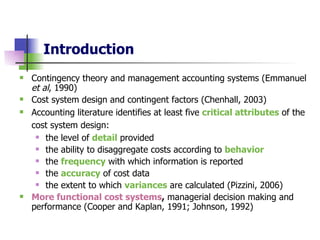
Introduction Contingency theory and management accounting systems ( Emmanuel  et al , 1990)   Cost system design and contingent factors (Chenhall, 2003) Accounting literature identifies at least five  critical attributes  of the cost system design:   the level of  detail  provided the ability to disaggregate costs according to  behavior the  frequency  with which information is reported the  accuracy  of cost data the extent to which  variances  are calculated (Pizzini, 2006) More functional cost systems ,  managerial decision making and performance (Cooper and Kaplan, 1991; Johnson, 1992)
Research objective That paper is a response to recent calls by Chenhall (2007; 2003) and Gerdin (2005) for additional research  “….to increase our understanding of contingent factors explaining cost system design and management control systems…..” This study investigates  associations  between  cost system functionality  and  contingent factors
The Hospitality Industry   Research in cost system design has traditionally focused on cost systems of  large manufacturing  companies (Sharma, 2002)  Accounting researchers interested in  service  production have conducted their research in non profit, public sector organizations (Olson  et al ., 1998; Brignall  et al.,  1991;) Evidence about cost accounting and its use in tourism enterprises and especially in  hotels  is rather  limited  (Pellinen, 2003)  There is an  active   interest  in cost and management accounting practices and  cost systems  of hotels (Harris and Mongiello, 2006; Potter and  Schmidgall, 1999 ) The  Greek tourism sector  is  is one of Greece's three biggest industries,   a continuous growth market and represents 18% of the country’s GDP
Literature review   (1) Considerations of interest to designers and researchers of  cost systems  have been: the extent to which the systems provide  information  (Mia and Chenhall, 1994) the degree of  use   (e.g. Guilding, 1999; Anderson and Young, 1999) the  usefulness  of the information (Chenhall and Morris, 1986; Shields, 1995)   the beneficial  nature  of the cost systems (Chenhall and Langfield-Smith, 1998) the importance in making  operational decisions  (Bouwens and Abernethy, 2000) whether they are  helpful  to the organization (Guilding, 1999) the  satisfaction  with the systems (Bruns and Waterhouse, 1975)
Literature review   (2) Gerdin (2005) and Tillema (2005)  identified several  contingency factors  influencing the  sophistication  of management accounting systems   Abdel-Kader and Luther (2008) and Al-Omiri and Drury (2007) investigated the impact of a range of potentially  contingent variables  on management accounting  sophistication  and cost system  sophistication Pizzini (2006) examined  the association between  cost-system functionality , managers’ beliefs about the relevance and usefulness of cost data, and actual financial performance in  hospitals Mia and Pattier (2001) investigated the  use  of management accounting systems by general managers and department managers in luxury hotels
Literature review   (3) Conclusions Most of the studies linked  contextual variables  with the  adoption , the  use  and the  usefulness  of cost systems (Chenhall 2003) Empirical evidence on the contingent factors of cost-system design is focused upon a  single aspect of cost-system design  (activity-based costing); and here, results are modest  (e.g.  Al-Omiri  and  Drury, 2007, Pizzini, 2006 ) Chenhall (2003; 2007) reports that there is a need for more research into  service organizations , including hospitality and tourism sector, about cost system design and contextual variables, as these entities become increasingly important within most economies   It is hardly surprising that our knowledge of MCS design in specific  service industries  and contexts is  limited  (Auser and Langfield-Smith 2005)
Research hypotheses   (1) H 1 : There is a positive association between the extent of  use of cost data  and the cost system functionality H 2 : There is a positive association between the  low cost strategy  and the cost system functionality H 3 : There is a positive association between the  level of competition  and the cost system functionality H 4 : There is a positive association between  the company’s  size  and the cost system functionality
Research hypotheses   (2) H 5 :   There is a positive association between the  number of services  and products and the cost system functionality H 6 : There is a positive association between the membership of  multinational chain  and the cost system functionality H 7 : There is a positive association between the extent of the use of  innovative management accounting  techniques and the cost system functionality
Research Methodology Sample characteristics and data collection   The sample surveyed included the  leading  Greek hotel enterprises (ICAP’s Directory 2002) The research was realized in  two phases A  pilot test  took place (interviews)  The participation form was sent to 196 hotel companies The  response rate  was 51% (100 hotels) The questionnaires were answered at 96% by executives in the top hierarchy of the  financial departments
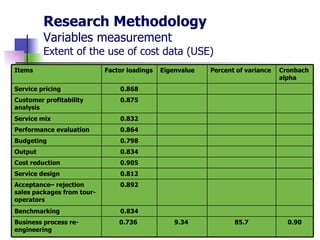
Research Methodology Variables measurement Extent of the use of cost data (USE) 0.90 Cronbach alpha  85.7 9 . 34  0 .736   Business process re-engineering   0 . 834 Benchmarking 0 . 892 Acceptance– rejection sales packages from tour- operators 0 . 812 Service design 0 . 905 Cost reduction 0 . 834 Output 0 . 798 Budgeting 0 . 864 Performance evaluation 0 . 832 Service mix 0 . 875 Customer profitability analysis 0 . 868 Service pricing Percent of variance  Ε igenvalue Factor loadings Items
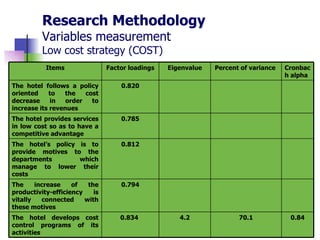
Research Methodology Variables measurement Low cost strategy (COST) 0.84 Cronbach alpha  70.1 4.2 0 . 834   The hotel develops cost control programs of its activities   0 . 794 The increase of the productivity-efficiency is vitally connected with these motives 0 . 812 The hotel’s policy is to provide motives to the departments which manage to lower their costs 0 . 785 The hotel provides services in low cost so as to have a competitive advantage 0 . 820 The hotel follows a policy oriented to the cost decrease in order to increase its revenues Percent of variance  Ε igenvalue Factor loadings Items
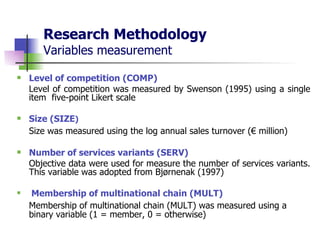
Research Methodology Variables measurement Level of competition (COMP) Level of competition was measured by Swenson (1995) using a single item  five-point Likert scale  Size (SIZE )   Size was measured using the log annual sales turnover (€ million) Number of services variants (SERV)   Objective data were used for measure the number of services variants. This variable was adopted from Bjørnenak (1997) Membership of multinational chain (MULT)   Membership of multinational chain (MULT) was measured using a binary variable (1 = member, 0 = otherwise)
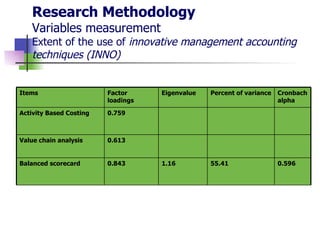
Research Methodology Variables measurement Extent of the use of  innovative management accounting techniques (INNO) 0.596  55.41 1.16 0.843 Balanced scorecard   0.613 Value chain analysis 0.759 Activity Based Costing Cronbach alpha  Percent of variance  Ε igenvalue Factor loadings Items
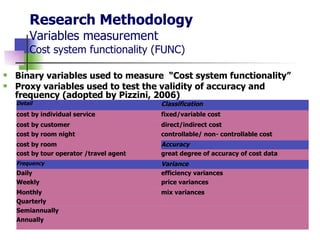
Research Methodology Variables measurement Cost system functionality (FUNC) Binary variables used to measure  “Cost system functionality” Proxy variables used to test the validity of accuracy and frequency (adopted by Pizzini, 2006) Semiannually Quarterly mix variances Monthly price variances Weekly efficiency variances Daily Variance   Frequency   great degree of accuracy of cost data   cost by tour operator /travel agent  Annually Accuracy   cost by room   controllable/ non- controllable cost cost by room night  direct/indirect cost cost by customer   fixed/variable cost   cost by individual service Classification   Detail
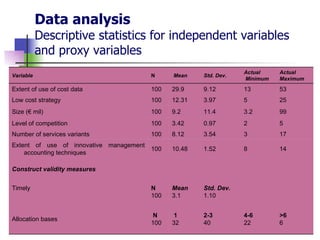
Data analysis Descriptive statistics for independent variables and proxy variables >6 6 4-6 22 2-3 40 1 32 N 100 Allocation bases Std. Dev. 1.10 Mean 3.1 N   100 Timely Construct validity measures 14 8 1.52 10.48 100 Extent of use of innovative management accounting techniques 17 3 3.54 8.12 100 Number of services variants  5 2 0.97 3.42 100 Level of competition 99 3.2 11.4 9.2 100 Size (€ mil) 25 5 3.97 12.31 100 Low cost strategy 53 13 9.12 29.9 100 Extent of use of cost data Actual  Maximum Actual Minimum Std. Dev. Mean N Variable
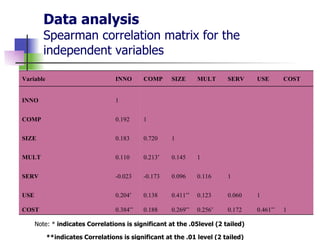
Data analysis Spearman correlation matrix for the independent variables Note: *  indicates Correlations is significant at the .05level (2 tailed) **indicates Correlations is significant at the .01 level (2 tailed) 1 0.461 ** 0.172 0.256 * 0.269 ** 0.188 0.384 ** CO ST 1 0.060 0.123 0.411 ** 0.138 0.204 * USE 1 0.116 0.096 -0.173 -0.023 SERV 1 0.145 0.213 * 0.110 MULT 1 0.720 0.183 SIZE 1 0.192 COMP           1 INNO CO ST USE SERV MULT SIZE COMP INNO Variable
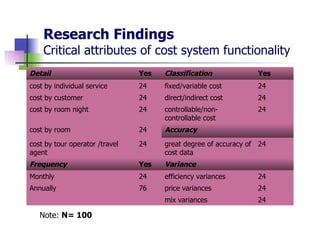
Research Findings Critical attributes of cost system functionality Note:  N= 100 24 efficiency variances  24 Monthly   24 price variances  76 Annually   24 mix variances  Variance Yes Frequency   24 great degree of accuracy of cost data  24 cost by tour operator /travel agent Accuracy 24 cost by room   24 controllable/non- controllable cost  24 cost by room night 24 direct/indirect cost 24 cost by customer 24 fixed/variable cost  24 cost by individual service Yes Classification Yes Detail
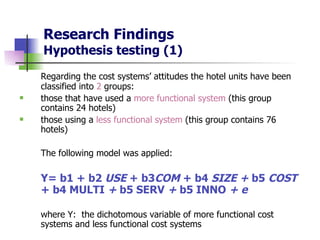
Research Findings Hypothesis testing (1) Regarding the cost systems’ attitudes the hotel units have been classified into  2  groups: those that have used a  more functional system  (this group contains 24 hotels)  those using a  less functional system  (this group contains 76 hotels) The following model was applied: Y= b1 + b2  USE  + b3 COM  + b4  SIZE +  b5  COST  + b4  MULTI  +  b5   SERV   +  b5   INNO  + e where Y:  the dichotomous variable of more functional cost systems and less functional cost systems
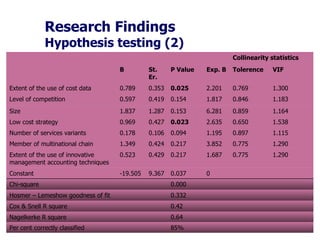
Research Findings Hypothesis testing (2) 0.64 Nagelkerke R square  0.42 Cox & Snell R square  0.332 Hosmer – Lemeshow goodness of fit 0.000 Chi-square 0 0.037 9.367 -19.505 Constant   1.290 0.775 1.687 0.217 0.429 0.523 Extent of the use of innovative management accounting techniques 1.290 0.775 3.852 0.217 0.424 1.349 Member of multinational chain 1.115 0.897 1.195 0.094 0.106 0.178 Number of services variants 1.538 0.650 2.635 0.023 0.427 0.969 Low cost strategy   1.164 0.859 6.281 0.153 1.287 1.837 Size  1.183 0.846 1.817 0.154 0.419 0.597   Level of competition 1.300   0.769   2.201 0.025   0.353   0.789   Extent of the use of cost data VIF Tolerence Exp. B P Value St .  Er . B 85% Per cent correctly classified Collinearity statistics
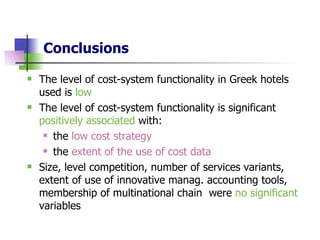
Conclusions   The level of cost-system functionality in Greek hotels used is  low   The level of cost-system functionality is significant  positively associated  with: the  low cost strategy   the  extent of the use of cost data   Size, level competition, number of services variants, extent of use of innovative manag. accounting tools, membership of multinational chain  were  no significant  variables
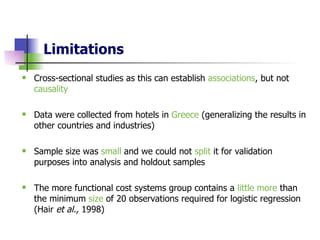
Limitations Cross-sectional studies as this can establish  associations , but not  causality Data were collected from hotels in  Greece  (generalizing the results in other countries and industries)   Sample size was  small  and we could not  split  it for validation purposes into analysis and holdout samples   The more functional cost systems group contains a  little more  than the minimum  size  of 20 observations required for logistic regression (Hair  et al.,  1998)
Contribution The results provide the  first empirical evidence  of the relation between cost system functionality and contingent factors in the  hospitality industry Comprehensive  survey data provide a relatively objective,  multidimensional  characterization of the functions a cost system can perform, rather than simply identifying whether an organization has adopted a  single costing technique   The operational  homogeneity  of hotels enables  powerful  tests of the research hypotheses  Adds to the literature on contingency theory by measuring ‘‘ fit ’’ between control system and organizational context using both ‘‘ selection ’’ and ‘‘ systems ’’ approaches (Selto et.al., 1995)
Future research Incorporate other important  variables  from  contingency theory  that are likely to influence the level of functionality of cost system: top management support quality of information technology   satisfaction of the existing cost system   etc. Examine  associations  between cost system functionality and actual  performance
 

Eaa 2009

  • 1.
    The relation betweencost system functionality and contingent factors: an empirical study of Greek hotels Dr Odysseas Pavlatos Athens University of Economics an Business Department of Accounting and Finance
  • 2.
    Presentation Outline Researchobjective Literature review Research hypotheses Research methodology Survey results Conclusions, limitations and future research
  • 3.
    Introduction Contingency theoryand management accounting systems ( Emmanuel et al , 1990) Cost system design and contingent factors (Chenhall, 2003) Accounting literature identifies at least five critical attributes of the cost system design: the level of detail provided the ability to disaggregate costs according to behavior the frequency with which information is reported the accuracy of cost data the extent to which variances are calculated (Pizzini, 2006) More functional cost systems , managerial decision making and performance (Cooper and Kaplan, 1991; Johnson, 1992)
  • 4.
    Research objective Thatpaper is a response to recent calls by Chenhall (2007; 2003) and Gerdin (2005) for additional research “….to increase our understanding of contingent factors explaining cost system design and management control systems…..” This study investigates associations between cost system functionality and contingent factors
  • 5.
    The Hospitality Industry Research in cost system design has traditionally focused on cost systems of large manufacturing companies (Sharma, 2002) Accounting researchers interested in service production have conducted their research in non profit, public sector organizations (Olson et al ., 1998; Brignall et al., 1991;) Evidence about cost accounting and its use in tourism enterprises and especially in hotels is rather limited (Pellinen, 2003) There is an active interest in cost and management accounting practices and cost systems of hotels (Harris and Mongiello, 2006; Potter and Schmidgall, 1999 ) The Greek tourism sector is is one of Greece's three biggest industries, a continuous growth market and represents 18% of the country’s GDP
  • 6.
    Literature review (1) Considerations of interest to designers and researchers of cost systems have been: the extent to which the systems provide information (Mia and Chenhall, 1994) the degree of use (e.g. Guilding, 1999; Anderson and Young, 1999) the usefulness of the information (Chenhall and Morris, 1986; Shields, 1995) the beneficial nature of the cost systems (Chenhall and Langfield-Smith, 1998) the importance in making operational decisions (Bouwens and Abernethy, 2000) whether they are helpful to the organization (Guilding, 1999) the satisfaction with the systems (Bruns and Waterhouse, 1975)
  • 7.
    Literature review (2) Gerdin (2005) and Tillema (2005) identified several contingency factors influencing the sophistication of management accounting systems Abdel-Kader and Luther (2008) and Al-Omiri and Drury (2007) investigated the impact of a range of potentially contingent variables on management accounting sophistication and cost system sophistication Pizzini (2006) examined the association between cost-system functionality , managers’ beliefs about the relevance and usefulness of cost data, and actual financial performance in hospitals Mia and Pattier (2001) investigated the use of management accounting systems by general managers and department managers in luxury hotels
  • 8.
    Literature review (3) Conclusions Most of the studies linked contextual variables with the adoption , the use and the usefulness of cost systems (Chenhall 2003) Empirical evidence on the contingent factors of cost-system design is focused upon a single aspect of cost-system design (activity-based costing); and here, results are modest (e.g. Al-Omiri and Drury, 2007, Pizzini, 2006 ) Chenhall (2003; 2007) reports that there is a need for more research into service organizations , including hospitality and tourism sector, about cost system design and contextual variables, as these entities become increasingly important within most economies It is hardly surprising that our knowledge of MCS design in specific service industries and contexts is limited (Auser and Langfield-Smith 2005)
  • 9.
    Research hypotheses (1) H 1 : There is a positive association between the extent of use of cost data and the cost system functionality H 2 : There is a positive association between the low cost strategy and the cost system functionality H 3 : There is a positive association between the level of competition and the cost system functionality H 4 : There is a positive association between the company’s size and the cost system functionality
  • 10.
    Research hypotheses (2) H 5 : There is a positive association between the number of services and products and the cost system functionality H 6 : There is a positive association between the membership of multinational chain and the cost system functionality H 7 : There is a positive association between the extent of the use of innovative management accounting techniques and the cost system functionality
  • 11.
    Research Methodology Samplecharacteristics and data collection The sample surveyed included the leading Greek hotel enterprises (ICAP’s Directory 2002) The research was realized in two phases A pilot test took place (interviews) The participation form was sent to 196 hotel companies The response rate was 51% (100 hotels) The questionnaires were answered at 96% by executives in the top hierarchy of the financial departments
  • 12.
    Research Methodology Variablesmeasurement Extent of the use of cost data (USE) 0.90 Cronbach alpha 85.7 9 . 34 0 .736 Business process re-engineering 0 . 834 Benchmarking 0 . 892 Acceptance– rejection sales packages from tour- operators 0 . 812 Service design 0 . 905 Cost reduction 0 . 834 Output 0 . 798 Budgeting 0 . 864 Performance evaluation 0 . 832 Service mix 0 . 875 Customer profitability analysis 0 . 868 Service pricing Percent of variance Ε igenvalue Factor loadings Items
  • 13.
    Research Methodology Variablesmeasurement Low cost strategy (COST) 0.84 Cronbach alpha 70.1 4.2 0 . 834 The hotel develops cost control programs of its activities 0 . 794 The increase of the productivity-efficiency is vitally connected with these motives 0 . 812 The hotel’s policy is to provide motives to the departments which manage to lower their costs 0 . 785 The hotel provides services in low cost so as to have a competitive advantage 0 . 820 The hotel follows a policy oriented to the cost decrease in order to increase its revenues Percent of variance Ε igenvalue Factor loadings Items
  • 14.
    Research Methodology Variablesmeasurement Level of competition (COMP) Level of competition was measured by Swenson (1995) using a single item five-point Likert scale Size (SIZE ) Size was measured using the log annual sales turnover (€ million) Number of services variants (SERV) Objective data were used for measure the number of services variants. This variable was adopted from Bjørnenak (1997) Membership of multinational chain (MULT) Membership of multinational chain (MULT) was measured using a binary variable (1 = member, 0 = otherwise)
  • 15.
    Research Methodology Variablesmeasurement Extent of the use of innovative management accounting techniques (INNO) 0.596 55.41 1.16 0.843 Balanced scorecard 0.613 Value chain analysis 0.759 Activity Based Costing Cronbach alpha Percent of variance Ε igenvalue Factor loadings Items
  • 16.
    Research Methodology Variablesmeasurement Cost system functionality (FUNC) Binary variables used to measure “Cost system functionality” Proxy variables used to test the validity of accuracy and frequency (adopted by Pizzini, 2006) Semiannually Quarterly mix variances Monthly price variances Weekly efficiency variances Daily Variance Frequency great degree of accuracy of cost data cost by tour operator /travel agent Annually Accuracy cost by room controllable/ non- controllable cost cost by room night direct/indirect cost cost by customer fixed/variable cost cost by individual service Classification Detail
  • 17.
    Data analysis Descriptivestatistics for independent variables and proxy variables >6 6 4-6 22 2-3 40 1 32 N 100 Allocation bases Std. Dev. 1.10 Mean 3.1 N 100 Timely Construct validity measures 14 8 1.52 10.48 100 Extent of use of innovative management accounting techniques 17 3 3.54 8.12 100 Number of services variants 5 2 0.97 3.42 100 Level of competition 99 3.2 11.4 9.2 100 Size (€ mil) 25 5 3.97 12.31 100 Low cost strategy 53 13 9.12 29.9 100 Extent of use of cost data Actual Maximum Actual Minimum Std. Dev. Mean N Variable
  • 18.
    Data analysis Spearmancorrelation matrix for the independent variables Note: * indicates Correlations is significant at the .05level (2 tailed) **indicates Correlations is significant at the .01 level (2 tailed) 1 0.461 ** 0.172 0.256 * 0.269 ** 0.188 0.384 ** CO ST 1 0.060 0.123 0.411 ** 0.138 0.204 * USE 1 0.116 0.096 -0.173 -0.023 SERV 1 0.145 0.213 * 0.110 MULT 1 0.720 0.183 SIZE 1 0.192 COMP           1 INNO CO ST USE SERV MULT SIZE COMP INNO Variable
  • 19.
    Research Findings Criticalattributes of cost system functionality Note: N= 100 24 efficiency variances 24 Monthly 24 price variances 76 Annually 24 mix variances Variance Yes Frequency 24 great degree of accuracy of cost data 24 cost by tour operator /travel agent Accuracy 24 cost by room 24 controllable/non- controllable cost 24 cost by room night 24 direct/indirect cost 24 cost by customer 24 fixed/variable cost 24 cost by individual service Yes Classification Yes Detail
  • 20.
    Research Findings Hypothesistesting (1) Regarding the cost systems’ attitudes the hotel units have been classified into 2 groups: those that have used a more functional system (this group contains 24 hotels) those using a less functional system (this group contains 76 hotels) The following model was applied: Y= b1 + b2 USE + b3 COM + b4 SIZE + b5 COST + b4 MULTI + b5 SERV + b5 INNO + e where Y: the dichotomous variable of more functional cost systems and less functional cost systems
  • 21.
    Research Findings Hypothesistesting (2) 0.64 Nagelkerke R square 0.42 Cox & Snell R square 0.332 Hosmer – Lemeshow goodness of fit 0.000 Chi-square 0 0.037 9.367 -19.505 Constant 1.290 0.775 1.687 0.217 0.429 0.523 Extent of the use of innovative management accounting techniques 1.290 0.775 3.852 0.217 0.424 1.349 Member of multinational chain 1.115 0.897 1.195 0.094 0.106 0.178 Number of services variants 1.538 0.650 2.635 0.023 0.427 0.969 Low cost strategy 1.164 0.859 6.281 0.153 1.287 1.837 Size 1.183 0.846 1.817 0.154 0.419 0.597 Level of competition 1.300 0.769 2.201 0.025 0.353 0.789 Extent of the use of cost data VIF Tolerence Exp. B P Value St . Er . B 85% Per cent correctly classified Collinearity statistics
  • 22.
    Conclusions The level of cost-system functionality in Greek hotels used is low The level of cost-system functionality is significant positively associated with: the low cost strategy the extent of the use of cost data Size, level competition, number of services variants, extent of use of innovative manag. accounting tools, membership of multinational chain were no significant variables
  • 23.
    Limitations Cross-sectional studiesas this can establish associations , but not causality Data were collected from hotels in Greece (generalizing the results in other countries and industries) Sample size was small and we could not split it for validation purposes into analysis and holdout samples The more functional cost systems group contains a little more than the minimum size of 20 observations required for logistic regression (Hair et al., 1998)
  • 24.
    Contribution The resultsprovide the first empirical evidence of the relation between cost system functionality and contingent factors in the hospitality industry Comprehensive survey data provide a relatively objective, multidimensional characterization of the functions a cost system can perform, rather than simply identifying whether an organization has adopted a single costing technique The operational homogeneity of hotels enables powerful tests of the research hypotheses Adds to the literature on contingency theory by measuring ‘‘ fit ’’ between control system and organizational context using both ‘‘ selection ’’ and ‘‘ systems ’’ approaches (Selto et.al., 1995)
  • 25.
    Future research Incorporateother important variables from contingency theory that are likely to influence the level of functionality of cost system: top management support quality of information technology satisfaction of the existing cost system etc. Examine associations between cost system functionality and actual performance
  • 26.