Definition:
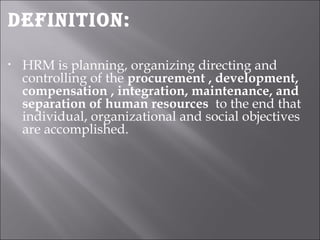
• HRM is planning, organizing directing and
controlling of the procurement , development,
compensation , integration, maintenance, and
separation of human resources to the end that
individual, organizational and social objectives
are accomplished.
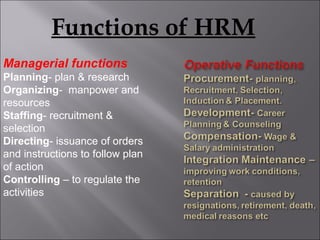
Managerial functions
Planning- plan & research
Organizing- manpower and
resources
Staffing- recruitment &
selection
Directing- issuance of orders
and instructions to follow plan
of action
Controlling – to regulate the
activities
Functions of HRM
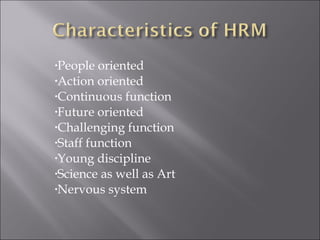
•People oriented
•Action oriented
•Continuous function
•Future oriented
•Challenging function
•Staff function
•Young discipline
•Science as well as Art
•Nervous system
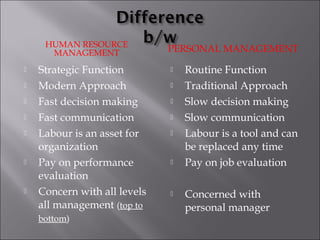
HUMAN RESOURCE
MANAGEMENT PERSONAL MANAGEMENT
 Strategic Function
 Modern Approach
 Fast decision making
 Fast communication
 Labour is an asset for
organization
 Pay on performance
evaluation
 Concern with all levels
all management (top to
bottom)
 Routine Function
 Traditional Approach
 Slow decision making
 Slow communication
 Labour is a tool and can
be replaced any time
 Pay on job evaluation
 Concerned with
personal manager
Human resource managment

Human resource managment

  • 2.
    Definition: • HRM isplanning, organizing directing and controlling of the procurement , development, compensation , integration, maintenance, and separation of human resources to the end that individual, organizational and social objectives are accomplished.
  • 3.
    Managerial functions Planning- plan& research Organizing- manpower and resources Staffing- recruitment & selection Directing- issuance of orders and instructions to follow plan of action Controlling – to regulate the activities Functions of HRM
  • 4.
    •People oriented •Action oriented •Continuousfunction •Future oriented •Challenging function •Staff function •Young discipline •Science as well as Art •Nervous system
  • 5.
    HUMAN RESOURCE MANAGEMENT PERSONALMANAGEMENT  Strategic Function  Modern Approach  Fast decision making  Fast communication  Labour is an asset for organization  Pay on performance evaluation  Concern with all levels all management (top to bottom)  Routine Function  Traditional Approach  Slow decision making  Slow communication  Labour is a tool and can be replaced any time  Pay on job evaluation  Concerned with personal manager