@LAMKfi
CAPACITY BUILDING WITH
COMPETENCE MANAGEMENT
VALUED EMPLOYEES DELIVER
BETTER RETURNS
Päivi Huotari
paivi.huotari@lamk.fi
Capacity
building in
this
presentation
• Capacity building refers to actions to strengthen an
organizations ability to better achieve its mission and
stated objectives to enhance health and social welfare
• Organizational sustainability, efficiency, effectiveness and
impact on community health and wellbeing
• The development of knowledge, skills, commitment,
structures, systems and leadership to enable effective
promotion of health and social welfare (modified WHO)
• Capabilities –the combined, collective skills, abilities,
and expertise of an organization
• Capacity building intervention - investments in
staffing, training, compensation, communication, and
other human resource areas – investing in people –
investing in leadership – improving, enhancing and
sustaining individual and organizational capacity to
address health and social welfare issues
ORGANIZATIONAL
ENVIRONMENT
The Cynefin Framework
SIMPLE
Sense
Categorize
Respond
COMPLEX
Probe
Sense
Respond
CHAOTIC
Act
Sense
Respond
COMPLICATED
Sense
Analyze
Respond
(Snowden & Boone 2007)
U
N
O
R
D
E
R
E
D
O
R
D
E
R
DISORDER
HR goes agile: redesigning talent
practices (Cappeli & Tavis 2018; Burrell)
• Performance management and appraisals: from annual to more,
more often, multidirectional feedback, upward feedack
• Compensation: spot bonuses, agile values
• Recruiting potential
• Learning and development: to bring new skills into organizations
more quickly (online learning, peer learning, knowledge sharing
practices, best practices, good practices)
• Co-Creating the Employee Experience (how we see HR; user-
driven, organizational design) – Employee engagement
• Social media – HR needs to work outside the organization
• Do not delegate competence management to the HR Department
COMPETENCIESBRAINSBRAWN POTENTIAL
TALKING ABOUT THE REVOLUTION… NO I MEANT
POTENTIAL
Competency movement 1980-Taylorism 1911- Human relations;
Management by
Objectives (MBO)1950-
(Fernández-Aráoz et al. 2017.
Harvard Business Review 95(6),
86-93, graph; found on p. 91)
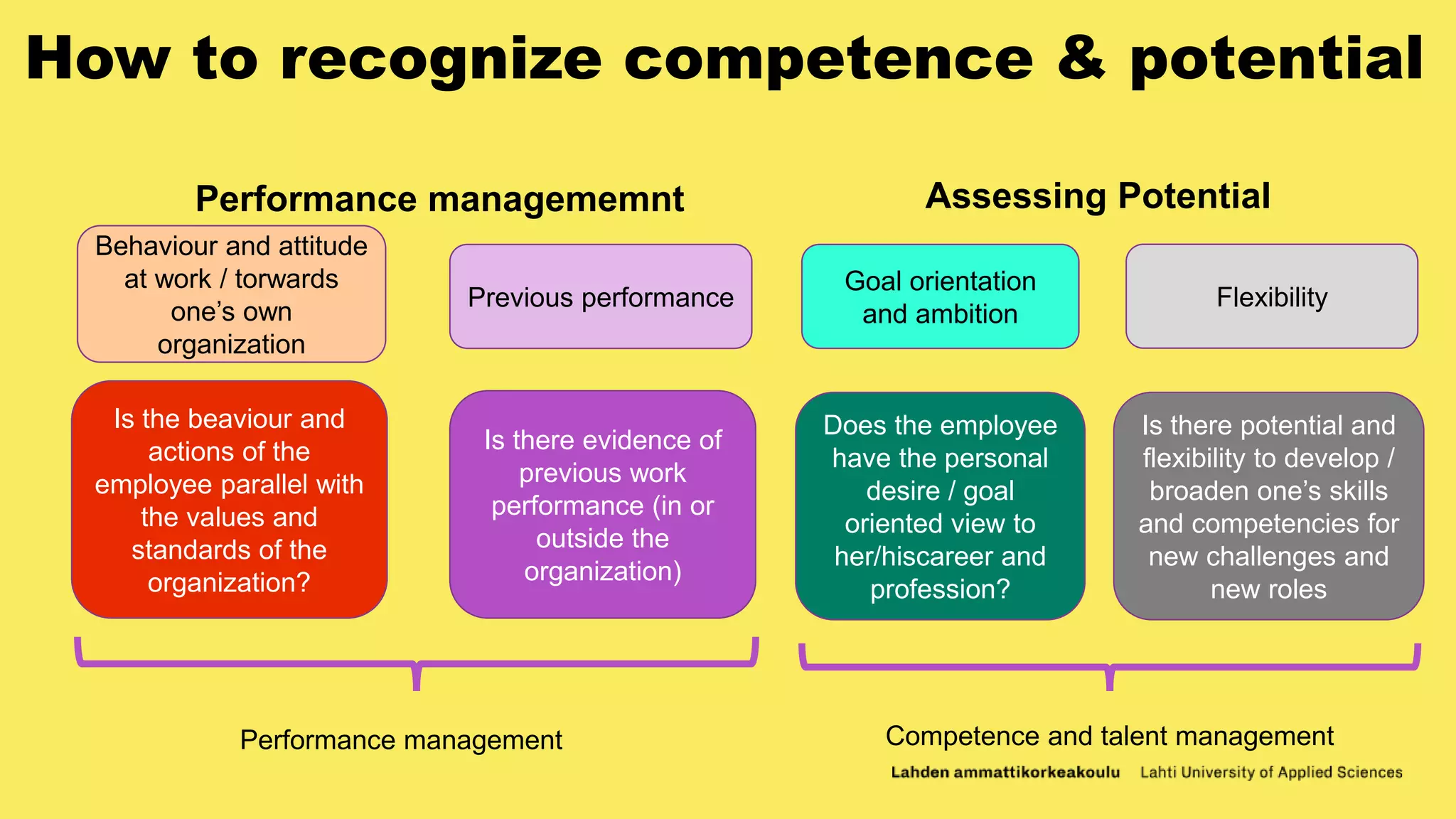
How to recognize competence & potential
Behaviour and attitude
at work / torwards
one’s own
organization
Previous performance
Goal orientation
and ambition
Flexibility
Is the beaviour and
actions of the
employee parallel with
the values and
standards of the
organization?
Is there evidence of
previous work
performance (in or
outside the
organization)
Does the employee
have the personal
desire / goal
oriented view to
her/hiscareer and
profession?
Is there potential and
flexibility to develop /
broaden one’s skills
and competencies for
new challenges and
new roles
Performance management Competence and talent management
Assessing PotentialPerformance managememnt
?
PERSONNEL PORTFOLIO (Lähteenmäki 1995)
High
Potential
Minor
High
The employee’s impact and role within organizational competence
and capabilities
Minor
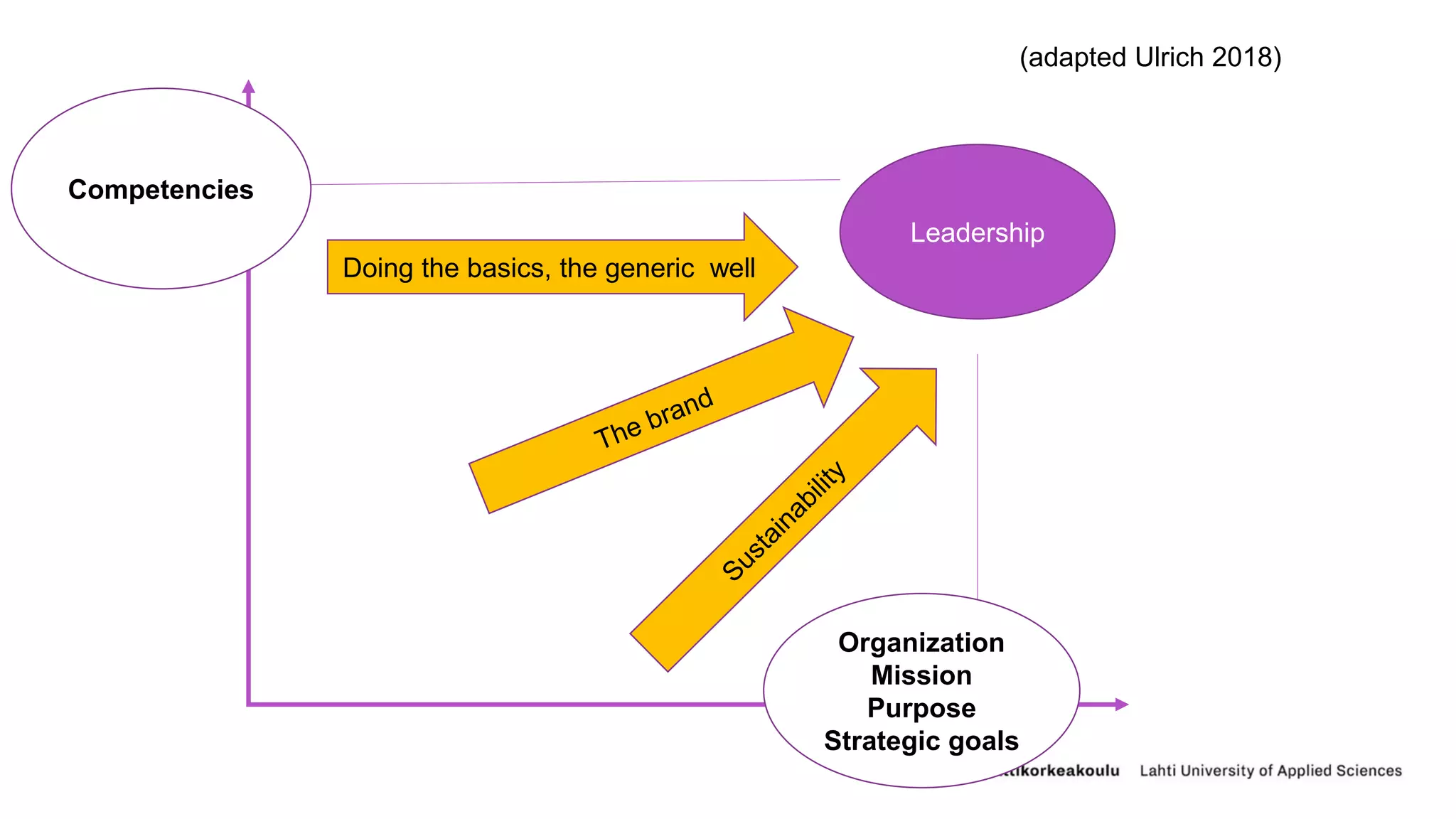
Leadership
Doing the basics, the generic well
(adapted Ulrich 2018)
Competencies
Organization
Mission
Purpose
Strategic goals
Three Types of Empathy
(Goleman 2013)
• Cognitive: the ability to understand
another person’s perspective
• Emotional: the ability to feel what
another person feels
• Empathic concern: the ability to sense
what another person needs from you
12
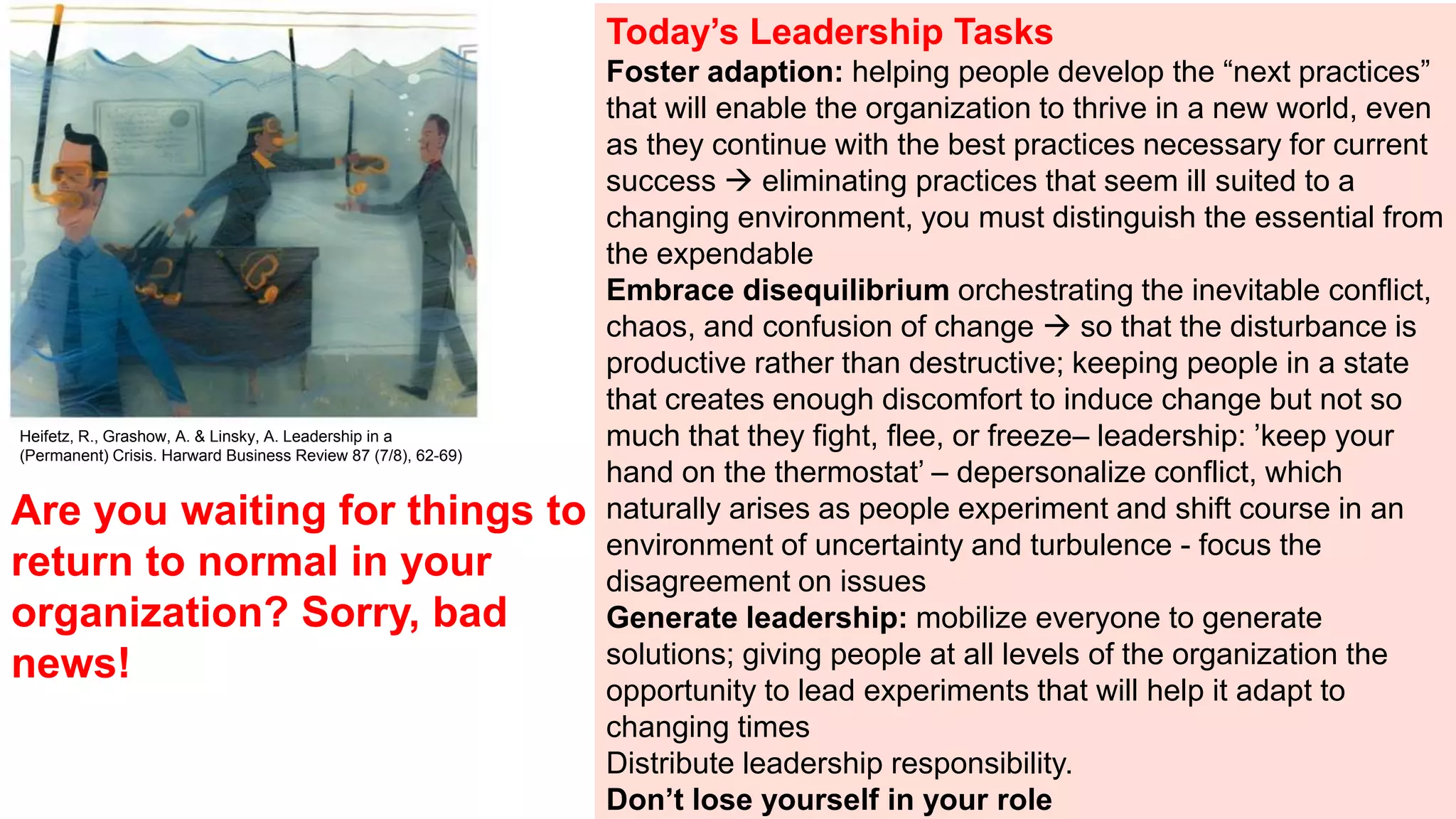
Are you waiting for things to
return to normal in your
organization? Sorry, bad
news!
Today’s Leadership Tasks
Foster adaption: helping people develop the “next practices”
that will enable the organization to thrive in a new world, even
as they continue with the best practices necessary for current
success  eliminating practices that seem ill suited to a
changing environment, you must distinguish the essential from
the expendable
Embrace disequilibrium orchestrating the inevitable conflict,
chaos, and confusion of change  so that the disturbance is
productive rather than destructive; keeping people in a state
that creates enough discomfort to induce change but not so
much that they fight, flee, or freeze– leadership: ’keep your
hand on the thermostat’ – depersonalize conflict, which
naturally arises as people experiment and shift course in an
environment of uncertainty and turbulence - focus the
disagreement on issues
Generate leadership: mobilize everyone to generate
solutions; giving people at all levels of the organization the
opportunity to lead experiments that will help it adapt to
changing times
Distribute leadership responsibility.
Don’t lose yourself in your role
Heifetz, R., Grashow, A. & Linsky, A. Leadership in a
(Permanent) Crisis. Harward Business Review 87 (7/8), 62-69)
Competence Management is about people
• Knowledge is in the minds of people- only people have
compared with other resources an ability to create value
without loosing it - allowing people to be the best that they
can be
• Doing what is needed to get the most out of human resources
• Helping people find ways to share and utilize their collective
knowledge - human and intellectual capital are the greatest
resources - human competency, intuition, ideas, and
motivations
Vision and
strategic aims
HR policies
Leadership
competencies
and capacity
Strategy driven
professional
competencies
and capacity
Adaptive
capacity as an
organizational
skillset
Capacity building interventions
SYSTEM
THINKING AND
DECISION MAKING
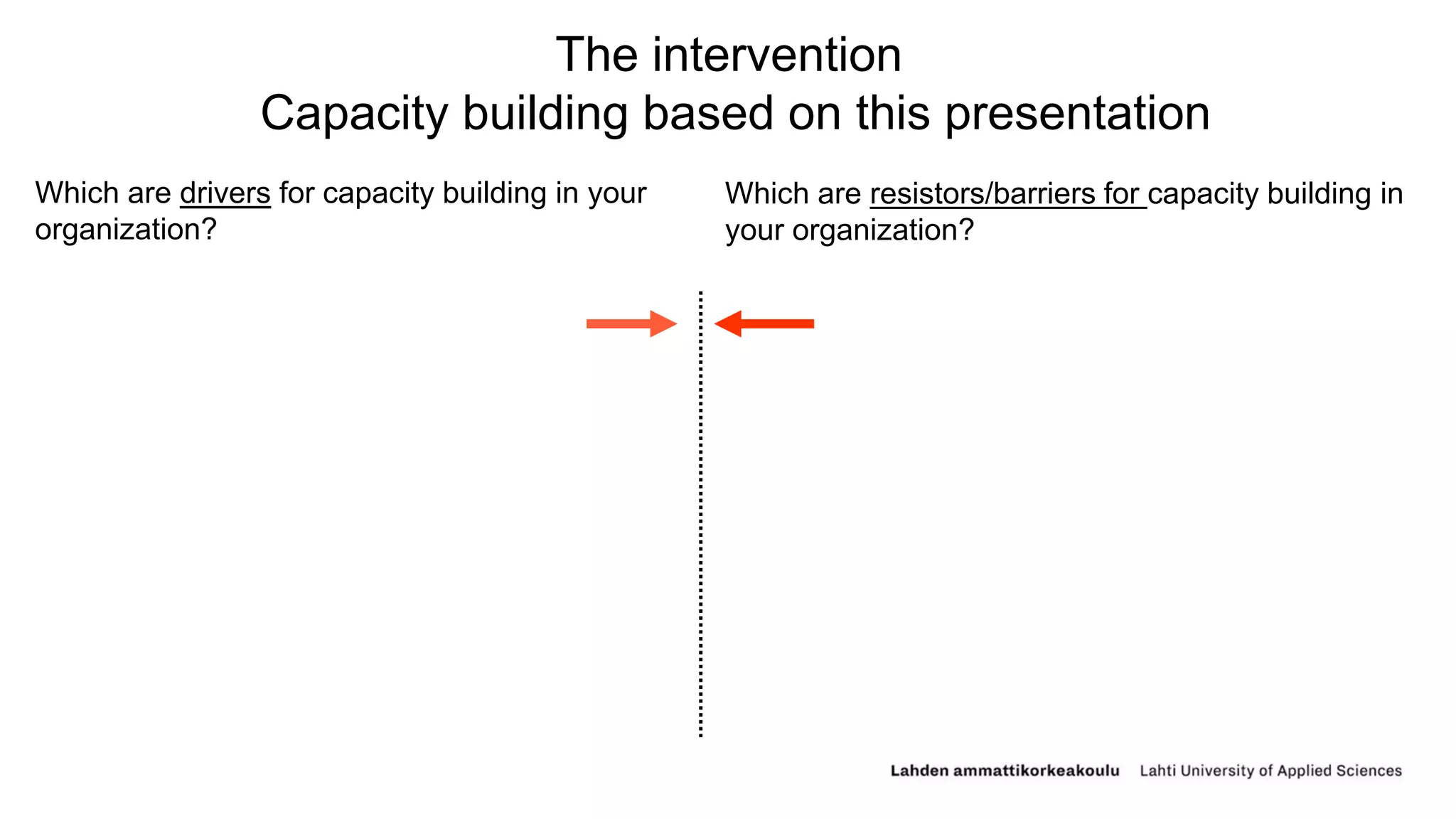
The intervention
Capacity building based on this presentation
Which are resistors/barriers for capacity building in
your organization?
Which are drivers for capacity building in your
organization?
Your solution: Aims and implementation
Aims
Implementation

Capacity building with competence management

  • 1.
    @LAMKfi CAPACITY BUILDING WITH COMPETENCEMANAGEMENT VALUED EMPLOYEES DELIVER BETTER RETURNS Päivi Huotari paivi.huotari@lamk.fi
  • 2.
    Capacity building in this presentation • Capacitybuilding refers to actions to strengthen an organizations ability to better achieve its mission and stated objectives to enhance health and social welfare • Organizational sustainability, efficiency, effectiveness and impact on community health and wellbeing • The development of knowledge, skills, commitment, structures, systems and leadership to enable effective promotion of health and social welfare (modified WHO) • Capabilities –the combined, collective skills, abilities, and expertise of an organization • Capacity building intervention - investments in staffing, training, compensation, communication, and other human resource areas – investing in people – investing in leadership – improving, enhancing and sustaining individual and organizational capacity to address health and social welfare issues
  • 3.
  • 4.
    HR goes agile:redesigning talent practices (Cappeli & Tavis 2018; Burrell) • Performance management and appraisals: from annual to more, more often, multidirectional feedback, upward feedack • Compensation: spot bonuses, agile values • Recruiting potential • Learning and development: to bring new skills into organizations more quickly (online learning, peer learning, knowledge sharing practices, best practices, good practices) • Co-Creating the Employee Experience (how we see HR; user- driven, organizational design) – Employee engagement • Social media – HR needs to work outside the organization • Do not delegate competence management to the HR Department
  • 5.
    COMPETENCIESBRAINSBRAWN POTENTIAL TALKING ABOUTTHE REVOLUTION… NO I MEANT POTENTIAL Competency movement 1980-Taylorism 1911- Human relations; Management by Objectives (MBO)1950-
  • 6.
    (Fernández-Aráoz et al.2017. Harvard Business Review 95(6), 86-93, graph; found on p. 91)
  • 7.
    How to recognizecompetence & potential Behaviour and attitude at work / torwards one’s own organization Previous performance Goal orientation and ambition Flexibility Is the beaviour and actions of the employee parallel with the values and standards of the organization? Is there evidence of previous work performance (in or outside the organization) Does the employee have the personal desire / goal oriented view to her/hiscareer and profession? Is there potential and flexibility to develop / broaden one’s skills and competencies for new challenges and new roles Performance management Competence and talent management Assessing PotentialPerformance managememnt
  • 8.
    ? PERSONNEL PORTFOLIO (Lähteenmäki1995) High Potential Minor High The employee’s impact and role within organizational competence and capabilities Minor
  • 9.
    Leadership Doing the basics,the generic well (adapted Ulrich 2018) Competencies Organization Mission Purpose Strategic goals
  • 10.
    Three Types ofEmpathy (Goleman 2013) • Cognitive: the ability to understand another person’s perspective • Emotional: the ability to feel what another person feels • Empathic concern: the ability to sense what another person needs from you 12
  • 11.
    Are you waitingfor things to return to normal in your organization? Sorry, bad news! Today’s Leadership Tasks Foster adaption: helping people develop the “next practices” that will enable the organization to thrive in a new world, even as they continue with the best practices necessary for current success  eliminating practices that seem ill suited to a changing environment, you must distinguish the essential from the expendable Embrace disequilibrium orchestrating the inevitable conflict, chaos, and confusion of change  so that the disturbance is productive rather than destructive; keeping people in a state that creates enough discomfort to induce change but not so much that they fight, flee, or freeze– leadership: ’keep your hand on the thermostat’ – depersonalize conflict, which naturally arises as people experiment and shift course in an environment of uncertainty and turbulence - focus the disagreement on issues Generate leadership: mobilize everyone to generate solutions; giving people at all levels of the organization the opportunity to lead experiments that will help it adapt to changing times Distribute leadership responsibility. Don’t lose yourself in your role Heifetz, R., Grashow, A. & Linsky, A. Leadership in a (Permanent) Crisis. Harward Business Review 87 (7/8), 62-69)
  • 12.
    Competence Management isabout people • Knowledge is in the minds of people- only people have compared with other resources an ability to create value without loosing it - allowing people to be the best that they can be • Doing what is needed to get the most out of human resources • Helping people find ways to share and utilize their collective knowledge - human and intellectual capital are the greatest resources - human competency, intuition, ideas, and motivations
  • 13.
    Vision and strategic aims HRpolicies Leadership competencies and capacity Strategy driven professional competencies and capacity Adaptive capacity as an organizational skillset Capacity building interventions SYSTEM THINKING AND DECISION MAKING
  • 14.
    The intervention Capacity buildingbased on this presentation Which are resistors/barriers for capacity building in your organization? Which are drivers for capacity building in your organization?
  • 15.
    Your solution: Aimsand implementation Aims Implementation