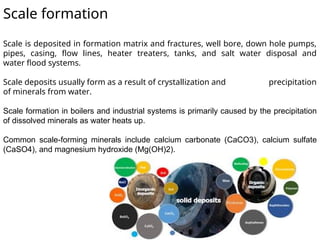
Scale formation
Scale isdeposited in formation matrix and fractures, well bore, down hole pumps,
pipes, casing, flow lines, heater treaters, tanks, and salt water disposal and
water flood systems.
Scale deposits usually form as a result of crystallization and precipitation
of minerals from water.
Scale formation in boilers and industrial systems is primarily caused by the precipitation
of dissolved minerals as water heats up.
Common scale-forming minerals include calcium carbonate (CaCO3), calcium sulfate
(CaSO4), and magnesium hydroxide (Mg(OH)2).
3.
Causes of scaling
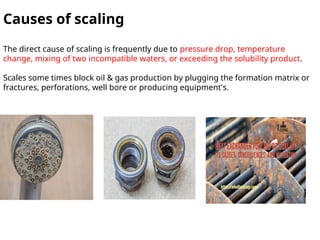
Thedirect cause of scaling is frequently due to pressure drop, temperature
change, mixing of two incompatible waters, or exceeding the solubility product.
Scales some times block oil & gas production by plugging the formation matrix or
fractures, perforations, well bore or producing equipment's.
4.
.
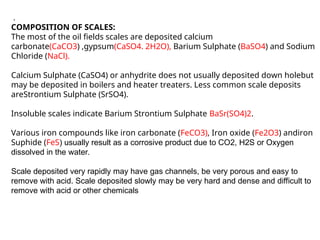
COMPOSITION OF SCALES:
Themost of the oil fields scales are deposited calcium
carbonate(CaCO3) ,gypsum(CaSO4. 2H2O), Barium Sulphate (BaSO4) and Sodium
Chloride (NaCl).
Calcium Sulphate (CaSO4) or anhydrite does not usually deposited down holebut
may be deposited in boilers and heater treaters. Less common scale deposits
areStrontium Sulphate (SrSO4).
Insoluble scales indicate Barium Strontium Sulphate BaSr(SO4)2.
Various iron compounds like iron carbonate (FeCO3), Iron oxide (Fe2O3) andiron
Suphide (FeS) usually result as a corrosive product due to CO2, H2S or Oxygen
dissolved in the water.
Scale deposited very rapidly may have gas channels, be very porous and easy to
remove with acid. Scale deposited slowly may be very hard and dense and difficult to
remove with acid or other chemicals
5.
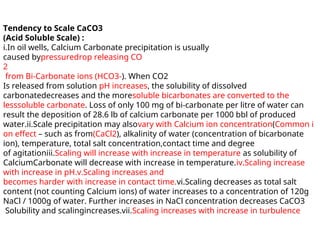
Tendency to ScaleCaCO3
(Acid Soluble Scale) :
i.In oil wells, Calcium Carbonate precipitation is usually
caused bypressuredrop releasing CO
2
from Bi-Carbonate ions (HCO3-). When CO2
Is released from solution pH increases, the solubility of dissolved
carbonatedecreases and the moresoluble bicarbonates are converted to the
lesssoluble carbonate. Loss of only 100 mg of bi-carbonate per litre of water can
result the deposition of 28.6 lb of calcium carbonate per 1000 bbl of produced
water.ii.Scale precipitation may alsovary with Calcium ion concentration(Common i
on effect – such as from(CaCl2), alkalinity of water (concentration of bicarbonate
ion), temperature, total salt concentration,contact time and degree
of agitationiii.Scaling will increase with increase in temperature as solubility of
CalciumCarbonate will decrease with increase in temperature.iv.Scaling increase
with increase in pH.v.Scaling increases and
becomes harder with increase in contact time.vi.Scaling decreases as total salt
content (not counting Calcium ions) of water increases to a concentration of 120g
NaCl / 1000g of water. Further increases in NaCl concentration decreases CaCO3
Solubility and scalingincreases.vii.Scaling increases with increase in turbulence
6.
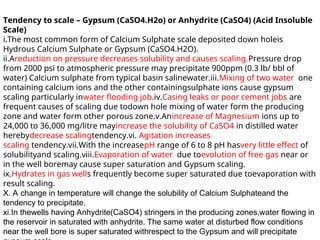
Tendency to scale– Gypsum (CaSO4.H2o) or Anhydrite (CaSO4) (Acid Insoluble
Scale)
i.The most common form of Calcium Sulphate scale deposited down holeis
Hydrous Calcium Sulphate or Gypsum (CaSO4.H2O).
ii.Areduction on pressure decreases solubility and causes scaling.Pressure drop
from 2000 psi to atmospheric pressure may precipitate 900ppm (0.3 lb/ bbl of
water) Calcium sulphate from typical basin salinewater.iii.Mixing of two water one
containing calcium ions and the other containingsulphate ions cause gypsum
scaling particularly inwater flooding job.iv.Casing leaks or poor cement jobs are
frequent causes of scaling due todown hole mixing of water form the producing
zone and water form other porous zone.v.Anincrease of Magnesium ions up to
24,000 to 36,000 mg/litre mayincrease the solubility of CaSO4 in distilled water
herebydecrease scalingtendency.vi. Agitation increases
scaling tendency.vii.With the increasepH range of 6 to 8 pH hasvery little effect of
solubilityand scaling.viii.Evaporation of water due toevolution of free gas near or
in the well boremay cause super saturation and Gypsum scaling.
ix.Hydrates in gas wells frequently become super saturated due toevaporation with
result scaling.
X. A change in temperature will change the solubility of Calcium Sulphateand the
tendency to precipitate.
xi.In thewells having Anhydrite(CaSO4) stringers in the producing zones,water flowing in
the reservoir in saturated with anhydrite. The same water at disturbed flow conditions
near the well bore is super saturated withrespect to the Gypsum and will precipitate
7.
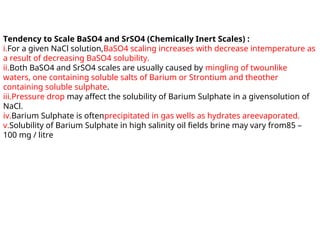
Tendency to ScaleBaSO4 and SrSO4 (Chemically Inert Scales) :
i.For a given NaCl solution,BaSO4 scaling increases with decrease intemperature as
a result of decreasing BaSO4 solubility.
ii.Both BaSO4 and SrSO4 scales are usually caused by mingling of twounlike
waters, one containing soluble salts of Barium or Strontium and theother
containing soluble sulphate.
iii.Pressure drop may affect the solubility of Barium Sulphate in a givensolution of
NaCl.
iv.Barium Sulphate is oftenprecipitated in gas wells as hydrates areevaporated.
v.Solubility of Barium Sulphate in high salinity oil fields brine may vary from85 –
100 mg / litre
8.
Tendency to ScaleNaCl (Water Soluble Scales) :
i.Precipitation of NaCl is normallycaused by super-saturation due toevaporation or
decrease in temperature. 4000 mg / litre of NaCl may beprecipitated from
saturated salt water if temperature drops from 140 – 86deg F.
ii.Salt precipitation may be severe near bottom ingas producing wells or high GOR
oil wellsproducing very small volume of water.
iii. Precipitation may result from bothdrop in temperature and pressurethrough
perforations and in to the tubing. Drygas will evaporate the water leaving the salt as
a precipitated scale
9.
PREDICTION OF SCALES
i.Analysis of water properties immediately after sampling is the best approachto
predict the scale formation tendency.
ii. Analysis of water flood water provides a reliable basis for estimating scaling
ininjection lines and down hole in injection wells.
iii. Analysis of produced brine predicts the scaling in the surface facilities. It
mayprovide the basis to estimate the scaling in the down hole
equipments inproducing wells because of possible prior deposition of scales due to
releaseof CO2 form Bi-carbonate ions in water as pressure declines.
iv. If bottom hole pressure is near original, bottom hole sample brought
under subsurface condition may provide reliable information on both down hole
andsurface scaling tendencies under original reservoir condition.
v. To determine Calcium carbonate super saturation, take a well head sample
of water and run test on water at the time of sampling. If the calcium
carbonatesuper saturation is more than 10% of bi-carbonate alkalinity content,
then thewater will usually have a scaling tendency
10.
IDENTIFICATION OF SCALES
i.X-raydiffraction is the most used method for the scale identification. Thisinvolves
directing a beam of X-ray on to a powdered sample of scalecrystal.
ii.Each chemical compound in the scale diffracts x-rays in a
characteristicsmanner which permits its identification. It is thefastest method
andrequiresleast amount of sample.
iii.Chemical analysis may also be used for scale identification. Samples of scales are
decomposed and then dissolved in chemical solution. Scalecompounds are
then analysed by standard techniques of titration or precipitation.
iv.Scale compounds will usually not be identified unless the analysis ismade for
each specific chemical compound, By comparison, all chemicalcompound can
readily be identified form an x-ray analysis.
v.After adding HCl to the scale sample, effervescence usually indicatesCaCO3,
specially if the sample does not contain iron sulphate or ironcarbonate
11.
SCALE REMOVAL
Scale isclassified by method of removal. Chemically inert scales are notsoluble
in chemicals. Chemically reactive scales may be classified as water soluble, acid
soluble and soluble in chemicals other than water or acids
MECHANICAL METHOD:
For perforated casing,re-perforating is a most effective method of
bypassingperforations sealed with scale. Mechanical methods such as string shot,
sonictools, drilling, or reaming have been used to remove both soluble &
insolublescales from tubing, casing or open holes. Scales may be removed from
surfacelines with pigging or reaming out.
12.
CHEMICAL REMOVAL:WATER SOLUBLESCALES:
i. The most common water soluble scale is NaCl scale which can be readilydissolved
with relatively fresh water , Acid should not be used to removeNaCl scales.
ii. If gypsum scale is newly formed and porous, it may be dissolved bycirculating
water containing about 55,000 mg/litre NaCl past the scale. At100 deg F,
55,000 mg/ litre NaCl will dissolve three times as much asgypsum as fresh water .
13.
ACID SOLUBLE SCALES:
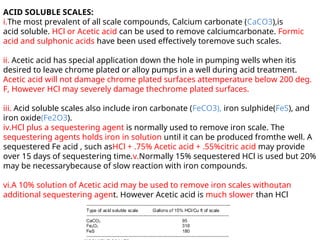
i.Themost prevalent of all scale compounds, Calcium carbonate (CaCO3),is
acid soluble. HCl or Acetic acid can be used to remove calciumcarbonate. Formic
acid and sulphonic acids have been used effectively toremove such scales.
ii. Acetic acid has special application down the hole in pumping wells when itis
desired to leave chrome plated or alloy pumps in a well during acid treatment.
Acetic acid will not damage chrome plated surfaces attemperature below 200 deg.
F, However HCl may severely damage thechrome plated surfaces.
iii. Acid soluble scales also include iron carbonate (FeCO3), iron sulphide(FeS), and
iron oxide(Fe2O3).
iv.HCl plus a sequestering agent is normally used to remove iron scale. The
sequestering agents holds iron in solution until it can be produced fromthe well. A
sequestered Fe acid , such asHCl + .75% Acetic acid + .55%citric acid may provide
over 15 days of sequestering time.v.Normally 15% sequestered HCl is used but 20%
may be necessarybecause of slow reaction with iron compounds.
vi.A 10% solution of Acetic acid may be used to remove iron scales withoutan
additional sequestering agent. However Acetic acid is much slower than HCl
14.
ACID INSOLUBLE SCALES:
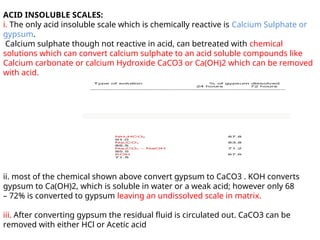
i.The only acid insoluble scale which is chemically reactive is Calcium Sulphate or
gypsum.
Calcium sulphate though not reactive in acid, can betreated with chemical
solutions which can convert calcium sulphate to an acid soluble compounds like
Calcium carbonate or calcium Hydroxide CaCO3 or Ca(OH)2 which can be removed
with acid.
ii. most of the chemical shown above convert gypsum to CaCO3 . KOH converts
gypsum to Ca(OH)2, which is soluble in water or a weak acid; however only 68
– 72% is converted to gypsum leaving an undissolved scale in matrix.
iii. After converting gypsum the residual fluid is circulated out. CaCO3 can be
removed with either HCl or Acetic acid
15.
SCALE REMOVAL IFWAXES, IRON CARBONATE AND GYPSUM AREPRESENT:
i.Degrease with a solvent such as Kerosene or Carbon Di-sulphide plus asurfactant.
ii.Remove iron scales with a sequestered acid.
iii. Convert gypsum scales to CaCO3 or Ca(OH)2.
iv. Remove converted CaCO3 scale with HCl or Acetic acid. Dissolve Ca(OH)2
with water or weak acid.
v.Compounds such as EDTA (Ethylene di-amine Tetra-acetic acid) and DTPA (Di-
ethylene Tri-amine Penta-acetic acid) can dissolve gypsumwithout the necessity of
conversion to CaCO3 or Ca(OH)2. But EDTA or DTPA are not used because of high
cost.
16.
CHEMICALLY INERT SCALES:
Themost common chemically inert scales are Barium Sulphate (BaSO4)
andStrontium Sulphate SrSO4
Barium Sulphate scales on the formation face or in theperforation may be
removed by mechanical methods such asstring shots, drilling outor under reaming
or by-passing by re-perforating. The best approach is to prevent the
scale deposition









![Boiler_water_presentation.ppt [POWER PLANT]](https://cdn.slidesharecdn.com/ss_thumbnails/boilerwaterpresentation-240602120436-24f069f3-thumbnail.jpg?width=640&height=640&fit=bounds)


