Chandana.M M.com , B.Ed.
Assistant professor. VVFGC
Tumkur
Financial
service
FIMS
Financial services are the economic services
provided by the finance industry, which encompasses
a broad range of businesses that manage money,
including credit unions, banks, credit-card
companies, insurance companies, accountancy
companies, consumer-finance companies, stock
brokerages, investment funds, individual ...
Meaning
Definition
According to the finance and development
department of the International Monetary
Fund (IMF), financial services are the
processes by which consumers or
businesses acquire financial goods.
Financial
Services
•Importance
1.Capital Allocation:.
2.Risk Management
3.Liquidity Provision:.
4.Investment and Savings Opportunities:
5.Financial Inclusion:
6.Efficiency and Innovation:
7.Economic Growth:
8.Global Connectivity:
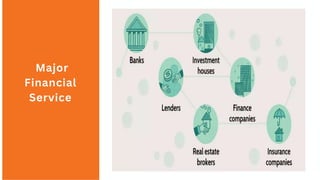
Major
Financial
Service
O v e r v i e w
Types of Financial Services
Banking.
Professional Advisory.
Wealth Management.
Mutual Funds.
Insurance.
Stock Market.
Treasury/Debt Instruments.
Tax/Audit Consulting.
Capital Restructuring
Portfolio Management
Banking
Meaning
Banking is the business of protecting money for
others. Banks lend this money, generating interest that
creates profits for the bank and its customers. A bank
is a financial institution licensed to accept deposits and
make loans. But they may also perform other financial
services.
Banking services mainly include accepting deposits,
lending money, facilitating transactions, and offering
various financial products like savings accounts, loans,
and credit cards.
Banking
The banking industry is the backbone of India’s financial
services industry.The country has several ,public sector (27),
private sector (21), foreign (49), regional rural (56) and
urban/rural cooperative (95,000+) banks.The financial
services offered in this segment include:
Individual Banking (checking accounts, savings accounts,
debit/credit cards, etc.)
Business Banking (merchant services, checking accounts and
savings accounts for businesses, treasury services, etc.)
Loans (business loans, personal loans, home loans, automobile
loans, working-capital loans, etc.)
The banking sector is regulated by the Reserve Bank of India
(RBI), which monitors and maintains the segment’s liquidity,
capitalization, and financial health.
Professional Advisory
India has a strong presence of professional
financial advisory service providers, which offer
individuals and businesses a wide portfolio of
services, including investment due diligence, M&A
advisory, valuation, real-estate consulting, risk
consulting, taxation consulting.These offerings are
made by a range of providers, including individual
domestic consultants to large multi-national
organizations.
Wealth Management
Financial services offered within this
segment include managing and investing
customers’ wealth across various financial
instruments- including debt, equity, mutual
funds, insurance products, derivatives,
structured products, commodities, and real
estate, based on the clients’ financial goals,
risk profile and time horizons.
 A mutual fund is a company that pools money
from many investors and invests the money
in securities such as stocks, bonds, and
short-term debt. The combined holdings of
the mutual fund are known as its portfolio.
Investors buy shares in mutual funds.
Mutual fund
 These products are very popular in India as they
generally have lower risks, tax benefits, stable
returns and properties of diversification. The mutual
funds segment has witnessed double-digit growth
in assets under management over the last five
years, owing to its popularity as a low-risk wealth
multiplier
Insurance is a legal agreement between two parties – the insurer
and the insured, also known as insurance coverage or insurance
policy.The insurer provides financial coverage for the losses of
the insured that s/he may bear under certain circumstances.
General Insurance (automotive, home, medical, fire, travel, etc.)
Life Insurance (term-life, money-back, unit-linked, pension
plans, etc.)
Insurance
Insurance solutions enable individuals and organizations to
safeguard against unforeseen circumstances and accidents.
Payouts for these products vary across the nature of the
product, time horizons, customer risk assessment, premiums,
and several other key qualitative and quantitative aspects.
Stock Market
The stock market provides a venue where companies
raise capital by selling shares of stock, or equity, to
investors.
The stock market segment includes investment solutions for
customers in Indian stock markets (National Stock Exchange and
Bombay Stock Exchange), across various equity-linked products.The
returns for customers are based on capital appreciation – growth in
the value of the equity solution and/or dividends – and payouts made
by companies to its investors.
Treasury/
Debt Instruments
Treasury bills and debt instruments are short term instrument
that mature within a year.They can be redeemed only at maturity.
They are sold at a discount if sold before maturity.
Services offered in this segment include investments into
government and private organization bonds (debt).The issuer of
the bonds (borrower) offers fixed payments (interest) and
principal repayment to the investor at the end of the investment
period.The types of instruments in this segment include listed
bonds, non-convertible debentures, capital-gain bonds, savings
bonds, tax-free bonds, etc.
Tax/Audit
Consulting
This segment includes a large portfolio of financial
services within the tax and auditing domain.This services
domain can be segmented based on individual and
business clients.They include:
Tax – Individual (determining tax liability, filing tax-returns,
tax-savings advisory, etc.)
Tax – Business (determining tax liability, transfer pricing
analysis and structuring, GST registrations, tax compliance
advisory, etc.)
In the auditing segment, service providers offer solutions
including statutory audits, internal audits, service tax
audits, tax audits, process/transaction audits, risk audits,
stock audits, etc.
Capital
Restructuring
These services are offered primarily to organizations and
involve the restructuring of capital structure (debt and
equity) to bolster profitability or respond to crises such as
bankruptcy, volatile markets, liquidity crunch or hostile
takeovers. The types of financial solutions in this segment
typically include structured transactions, lender
negotiations, accelerated M&A and capital raising
Portfolio Management
This segment includes a highly specialized and
customized range of solutions that enables clients to
reach their financial goals through portfolio managers
who analyze and optimize investments for clients
across a wide range of assets (debt, equity, insurance,
real estate, etc.).
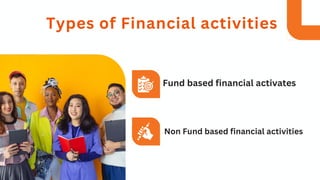
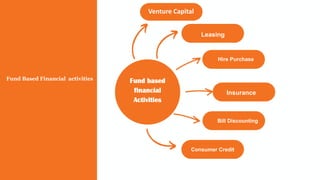
Fund based financial activates
Non Fund based financial activities
Types of Financial activities
Fund based
financial
Activities
Fund Based Financial activities
Leasing
Hire Purchase
Insurance
Bill Discounting
Consumer Credit
Venture Capital
1.Venture capital is a specialized fund-based
service providing financing to startups and small
enterprises showing potential for high growth.
2.Example: Venture capital firms providing funding
to promising tech startups to help them scale their
operations.
1.Venture Capital:
 Leasing is a contractual arrangement where
assets are provided to clients for use over a
specified period in return for periodic lease
payments.
 Example: Companies leasing vehicles or
equipment from financial institutions, making
periodic payments as per the lease
agreement.
2. Leasing
 In a hire purchase agreement, customers can
purchase assets by making an initial down
payment followed by subsequent periodic
payments.
 Example: Acquiring machinery or vehicles on hire
purchase, paying a part of the cost upfront and
the rest in installments.
3. Hire Purchase
 Insurance services provide coverage against
specified risks, offering financial protection to
individuals and entities.
 Example: Insurance companies offering life
insurance, health insurance, or property
insurance.
4. Insurance
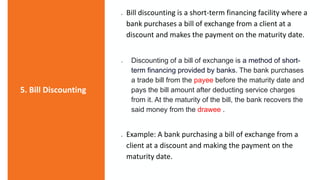
 Bill discounting is a short-term financing facility where a
bank purchases a bill of exchange from a client at a
discount and makes the payment on the maturity date.
 Discounting of a bill of exchange is a method of short-
term financing provided by banks. The bank purchases
a trade bill from the payee before the maturity date and
pays the bill amount after deducting service charges
from it. At the maturity of the bill, the bank recovers the
said money from the drawee .
 Example: A bank purchasing a bill of exchange from a
client at a discount and making the payment on the
maturity date.
5. Bill Discounting
 Consumer credit involves providing funds to
individuals for purchasing consumer goods like
vehicles, appliances, or other products.
 Example: Banks providing loans to individuals for
purchasing vehicles or other consumer goods.
6. Consumer Credit
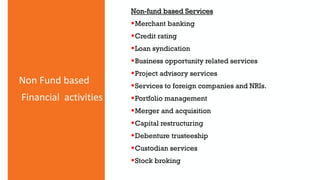
Non Fund based
Financial activities
Non-fund based Services
Merchant banking
Credit rating
Loan syndication
Business opportunity related services
Project advisory services
Services to foreign companies and NRIs.
Portfolio management
Merger and acquisition
Capital restructuring
Debenture trusteeship
Custodian services
Stock broking
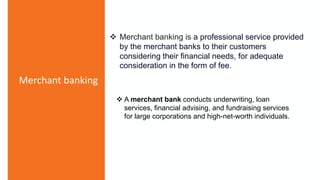
Merchant banking
 Merchant banking is a professional service provided
by the merchant banks to their customers
considering their financial needs, for adequate
consideration in the form of fee.
 A merchant bank conducts underwriting, loan
services, financial advising, and fundraising services
for large corporations and high-net-worth individuals.
Credit rating
A credit rating is an independent assessment of a
company's or government entity's creditworthiness in
general terms or with respect to a particular debt or
financial obligation.
Credit rating is an analysis of the credit risks
associated with a financial instrument or a
financial entity.
Loan syndication
Syndicated loan is a form of loan business in
which two or more lenders jointly provide loans
for one or more borrowers on the same loan
terms and with different duties and sign the same
loan agreement.
Usually, one bank is appointed as the agency
bank to manage the loan business on behalf of
the syndicate members.
•Tax and TDS on Property Sales
•Lower Tax Certificate on Sale of Properties
•Tax (TDS) on Interest and Rental Income
•Income Tax Filing
•Income Tax Scrutiny Notices
•Tax planning for returning Indians
Services to foreign
companies and NRIs.
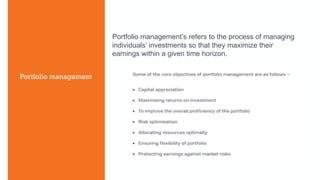
Portfolio management
Portfolio management’s refers to the process of managing
individuals’ investments so that they maximize their
earnings within a given time horizon.
Debenture trusteeship
To hold the Security/Charge on behalf of debenture
holders and hold the security documents in safe
custody.
A debenture trustee means a trustee of a trust deed for
securing any issue of debentures of a body corporate.
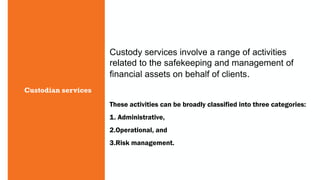
Custodian services
Custody services involve a range of activities
related to the safekeeping and management of
financial assets on behalf of clients.
These activities can be broadly classified into three categories:
1. Administrative,
2.Operational, and
3.Risk management.
Stock broking
Stockbrokers are individuals who buy and sell
stocks and other securities for retail and
institutional clients, through a stock
exchange or over the counter, in return for a
fee or a commission.
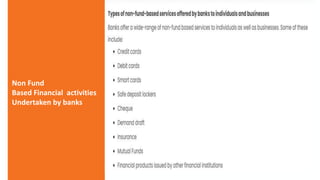
Non Fund
Based Financial activities
Undertaken by banks
Functions of
financial services
Mobilization of funds
Effective utilization of funds
Transforming risks
Enhancement of economic development
Provision of liquidity
Creation of employment opportunities
Role of Financial service in
Economic development
HELP BUSINESS TO GROW
PROMOTES ENTERPRENEURSHIP
PROMOTES FREE AND EASY TRADE
ENSURES AVAILABILITY OF MONEY IN THE ECONOMY
ENSURES EASY AVAILABILITY OF LOANS AND CAPITAL
PROMOTES INFRASTRUCTURE DEVELOPMENT
Leasing
01 02 03
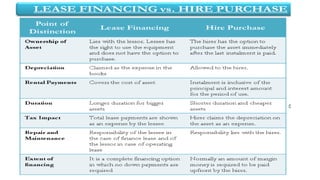
Leasing is a process by which a firm can obtain the use of a
certain fixed assets for which it must pay a series of
contractual, periodic, tax deductible payments. The lessee
is the receiver of the services or the assets under the lease
contract and the lessor is the owner of the assets.
A financial arrangement in which a person, company, etc. pays
to use land, a vehicle, etc. for a particular period of time
The relationship between the tenant and the landlord is
called a tenancy, and can be for a fixed or an indefinite
period of time (called the term of the lease). The
consideration for the lease is called rent
01 02 03
Definition
Lease can be defined as the following ways:
 A contract by which one party (lessor) gives to
another (lessee) the use and possession of
equipment for a specified time and for fixed
payments.
The document in which this contract is written.
A great way companies can conserve capital.
An easy way vendors can increase sales.
01 02 03
Main features of a Financial Lease
The lessee (borrower or customer) selects an asset
(equipment, software, vehicle)
The lessor (finance company) purchases that asset
The lessee uses that asset during the lease
The lessee pays a series of installments or rentals for using
that asset
The lessor recovers a large part or almost complete cost of the
asset in addition to earning interest from the rentals paid by
the lessee
The lessee has the option of acquiring ownership of the asset
(bargain option purchase price or paying the last rental)
01 02 03
Importance of Lease Financing
Helps to possess and use a new piece of machinery or equipment
Enables businesses to preserve precious cash reserves
Enable businesses with limited capital to manage their cash flow more
effectively
Allows businesses to upgrade assets more frequently
Offers the flexibility of the repayment period being matched to the useful life of
the equipment.
It is easy to access because it is secured – largely or entirely
It gives businesses certainty because asset finance agreements cannot be
cancelled by the lenders and repayments are generally fixed.
01 02 03
Advantages of lease Finance
LESS INITIAL CASH INVESTMENT REQUIRED
LOWER MONTHLY PAYMENTS
TAX BENEFITS
FAST TURNAROUND TIME
CONSERVE YOUR CAPITAL
AVOID TECHNOLOGICAL OBSOLESCENCE
ASSIST CORPORATE GROWTH
LET THE EQUIPMENT PAY FOR ITSELF
FIXED RATE FINANCING
01 02 03
Contents of a lease agreement
 Description of the lessor, the lessee, and the equipment.
 Amount, time and place of lease rentals payments.
 Time and place of equipment delivery.
 Lessee’s responsibility for taking delivery and possession of the leased equipment.
 Lessee’s responsibility for maintenance, repairs, registration, etc. and the lessor’s right in
case of default by the lessee.
 Lessee’s right to enjoy the benefits of the warranties provided by the equipment
manufacturer/supplier.
 Insurance to be taken by the lessee on behalf of the lessor.
 Variation in lease rentals if there is a change in certain external factors like bank interest
rates, depreciation rates, and fiscal incentives.
 Options of lease renewal for the lessee.
 Return of equipment on expiry of the lease period.
 Arbitration procedure in the event of dispute.
01 02 03
 As there is no separate statue for equipment leasing in India, the provisions relating to
bailment in the Indian Contract Act govern equipment leasing agreements as well section
148 of the Indian Contract Act defines bailment as:
 “The delivery of goods by one person to another, for some purpose, upon a contract that
they shall, when the purpose is accomplished, be returned or otherwise disposed off
according to the directions of the person delivering them.The person delivering the
goods is called the ‘bailor’ and the person to whom they are delivered is called the
‘bailee’.
 Essentially these provisions have the following implications for the lessor and the lessee.
 The lessor has the duty to deliver the asset to the lessee, to legally authorize the lessee to
use the asset, and to leave the asset in peaceful possession of the lessee during the
currency of the agreement.
 The lessor has the obligation to pay the lease rentals as specified in the lease agreement,
to protect the lessor’s title, to take reasonable care of the asset, and to return the leased
asset on the expiry of the lease period.
Legal Aspects of Leasing
01 02 03
Depreciation(TaxAspectofleasing)
The tax-payer claiming depreciation should own the asset.
The lessor must establish himself to be the beneficial owner as well
The lessor’s beneficial ownership of the leased asset is proved
essentially by the right of reversion of the asset at the end of the lease
period
When a movable property becomes a permanent fixtures to land not
belonging to the lessor, the lessor ceases to be the legal owner of such
fixture.
Condition for depreciation is that the tax payer should be using the
asset
It is on the strength of the lessor’s use that depreciation is claimed and
not on the strength of the lessee’s use.
01 02 03
Types of Leases
The Gross Lease
The gross lease tends to favor the tenant.The most notable
characteristic of this kind of agreement is that the tenant pays
one large sum.The landlord is responsible for paying insurance,
utilities and maintenance. Occasionally, the tenant will be
required to pay electricity, water, or gas him or herself. Because
more is required of the landlord, the amount the tenant pays is
usually higher to compensate.
01 02 03
Types of Leases
The Modified Gross Lease
The modified gross lease was developed to be a middle
ground between favoring the landlord and favoring the
tenant.
This kind of agreement still has tenants pay their amount
in one large sum, but which fees they must also cover
varies.The tenant and the landlord must discuss who will
pay for maintenance, utilities, common area maintenance,
and property taxes.
01 02 03
Types of Leases
The Net Lease
The net lease, however, tends to favor the
landlord. In this agreement, the base rent
tenants pays is lower, but they must also pay
maintenance fees of all kinds.Which fees the
tenant must pay depends on the net lease.
01 02 03
Hire Purchase
Hire purchase is an arrangement made while
buying expensive goods. The consumer makes
a down payment during the purchase, and the
outstanding balance will be paid in installments
with an Interest charge.
01 02 03
Capital and operating lease
 Capital lease is a lease agreement in which the lessor agrees
to transfer the ownership rights to the lessee after the
completion of the lease period. Capital or finance leases are
long term and non cancellable in nature.
 Operating lease is a contract wherein the owner, called the
Lessor, permits the user, called the Lesse, to use of an asset
for a particular period which is shorter than the economic life of
the asset without any transfer of ownership rights.
Thank you

Unit 3 (1).pptx financial services , custodian service

  • 1.
    Chandana.M M.com ,B.Ed. Assistant professor. VVFGC Tumkur Financial service FIMS
  • 2.
    Financial services arethe economic services provided by the finance industry, which encompasses a broad range of businesses that manage money, including credit unions, banks, credit-card companies, insurance companies, accountancy companies, consumer-finance companies, stock brokerages, investment funds, individual ... Meaning
  • 3.
    Definition According to thefinance and development department of the International Monetary Fund (IMF), financial services are the processes by which consumers or businesses acquire financial goods.
  • 4.
    Financial Services •Importance 1.Capital Allocation:. 2.Risk Management 3.LiquidityProvision:. 4.Investment and Savings Opportunities: 5.Financial Inclusion: 6.Efficiency and Innovation: 7.Economic Growth: 8.Global Connectivity:
  • 5.
  • 6.
    O v er v i e w Types of Financial Services Banking. Professional Advisory. Wealth Management. Mutual Funds. Insurance. Stock Market. Treasury/Debt Instruments. Tax/Audit Consulting. Capital Restructuring Portfolio Management
  • 7.
    Banking Meaning Banking is thebusiness of protecting money for others. Banks lend this money, generating interest that creates profits for the bank and its customers. A bank is a financial institution licensed to accept deposits and make loans. But they may also perform other financial services. Banking services mainly include accepting deposits, lending money, facilitating transactions, and offering various financial products like savings accounts, loans, and credit cards.
  • 8.
    Banking The banking industryis the backbone of India’s financial services industry.The country has several ,public sector (27), private sector (21), foreign (49), regional rural (56) and urban/rural cooperative (95,000+) banks.The financial services offered in this segment include: Individual Banking (checking accounts, savings accounts, debit/credit cards, etc.) Business Banking (merchant services, checking accounts and savings accounts for businesses, treasury services, etc.) Loans (business loans, personal loans, home loans, automobile loans, working-capital loans, etc.) The banking sector is regulated by the Reserve Bank of India (RBI), which monitors and maintains the segment’s liquidity, capitalization, and financial health.
  • 9.
    Professional Advisory India hasa strong presence of professional financial advisory service providers, which offer individuals and businesses a wide portfolio of services, including investment due diligence, M&A advisory, valuation, real-estate consulting, risk consulting, taxation consulting.These offerings are made by a range of providers, including individual domestic consultants to large multi-national organizations.
  • 10.
    Wealth Management Financial servicesoffered within this segment include managing and investing customers’ wealth across various financial instruments- including debt, equity, mutual funds, insurance products, derivatives, structured products, commodities, and real estate, based on the clients’ financial goals, risk profile and time horizons.
  • 11.
     A mutualfund is a company that pools money from many investors and invests the money in securities such as stocks, bonds, and short-term debt. The combined holdings of the mutual fund are known as its portfolio. Investors buy shares in mutual funds. Mutual fund  These products are very popular in India as they generally have lower risks, tax benefits, stable returns and properties of diversification. The mutual funds segment has witnessed double-digit growth in assets under management over the last five years, owing to its popularity as a low-risk wealth multiplier

  • 12.
    Insurance is alegal agreement between two parties – the insurer and the insured, also known as insurance coverage or insurance policy.The insurer provides financial coverage for the losses of the insured that s/he may bear under certain circumstances. General Insurance (automotive, home, medical, fire, travel, etc.) Life Insurance (term-life, money-back, unit-linked, pension plans, etc.) Insurance Insurance solutions enable individuals and organizations to safeguard against unforeseen circumstances and accidents. Payouts for these products vary across the nature of the product, time horizons, customer risk assessment, premiums, and several other key qualitative and quantitative aspects.
  • 13.
    Stock Market The stockmarket provides a venue where companies raise capital by selling shares of stock, or equity, to investors. The stock market segment includes investment solutions for customers in Indian stock markets (National Stock Exchange and Bombay Stock Exchange), across various equity-linked products.The returns for customers are based on capital appreciation – growth in the value of the equity solution and/or dividends – and payouts made by companies to its investors.
  • 14.
    Treasury/ Debt Instruments Treasury billsand debt instruments are short term instrument that mature within a year.They can be redeemed only at maturity. They are sold at a discount if sold before maturity. Services offered in this segment include investments into government and private organization bonds (debt).The issuer of the bonds (borrower) offers fixed payments (interest) and principal repayment to the investor at the end of the investment period.The types of instruments in this segment include listed bonds, non-convertible debentures, capital-gain bonds, savings bonds, tax-free bonds, etc.
  • 15.
    Tax/Audit Consulting This segment includesa large portfolio of financial services within the tax and auditing domain.This services domain can be segmented based on individual and business clients.They include: Tax – Individual (determining tax liability, filing tax-returns, tax-savings advisory, etc.) Tax – Business (determining tax liability, transfer pricing analysis and structuring, GST registrations, tax compliance advisory, etc.) In the auditing segment, service providers offer solutions including statutory audits, internal audits, service tax audits, tax audits, process/transaction audits, risk audits, stock audits, etc.
  • 16.
    Capital Restructuring These services areoffered primarily to organizations and involve the restructuring of capital structure (debt and equity) to bolster profitability or respond to crises such as bankruptcy, volatile markets, liquidity crunch or hostile takeovers. The types of financial solutions in this segment typically include structured transactions, lender negotiations, accelerated M&A and capital raising
  • 17.
    Portfolio Management This segmentincludes a highly specialized and customized range of solutions that enables clients to reach their financial goals through portfolio managers who analyze and optimize investments for clients across a wide range of assets (debt, equity, insurance, real estate, etc.).
  • 18.
    Fund based financialactivates Non Fund based financial activities Types of Financial activities
  • 19.
    Fund based financial Activities Fund BasedFinancial activities Leasing Hire Purchase Insurance Bill Discounting Consumer Credit Venture Capital
  • 20.
    1.Venture capital isa specialized fund-based service providing financing to startups and small enterprises showing potential for high growth. 2.Example: Venture capital firms providing funding to promising tech startups to help them scale their operations. 1.Venture Capital:
  • 21.
     Leasing isa contractual arrangement where assets are provided to clients for use over a specified period in return for periodic lease payments.  Example: Companies leasing vehicles or equipment from financial institutions, making periodic payments as per the lease agreement. 2. Leasing
  • 22.
     In ahire purchase agreement, customers can purchase assets by making an initial down payment followed by subsequent periodic payments.  Example: Acquiring machinery or vehicles on hire purchase, paying a part of the cost upfront and the rest in installments. 3. Hire Purchase
  • 23.
     Insurance servicesprovide coverage against specified risks, offering financial protection to individuals and entities.  Example: Insurance companies offering life insurance, health insurance, or property insurance. 4. Insurance
  • 24.
     Bill discountingis a short-term financing facility where a bank purchases a bill of exchange from a client at a discount and makes the payment on the maturity date.  Discounting of a bill of exchange is a method of short- term financing provided by banks. The bank purchases a trade bill from the payee before the maturity date and pays the bill amount after deducting service charges from it. At the maturity of the bill, the bank recovers the said money from the drawee .  Example: A bank purchasing a bill of exchange from a client at a discount and making the payment on the maturity date. 5. Bill Discounting
  • 25.
     Consumer creditinvolves providing funds to individuals for purchasing consumer goods like vehicles, appliances, or other products.  Example: Banks providing loans to individuals for purchasing vehicles or other consumer goods. 6. Consumer Credit
  • 26.
    Non Fund based Financialactivities Non-fund based Services Merchant banking Credit rating Loan syndication Business opportunity related services Project advisory services Services to foreign companies and NRIs. Portfolio management Merger and acquisition Capital restructuring Debenture trusteeship Custodian services Stock broking
  • 27.
    Merchant banking  Merchantbanking is a professional service provided by the merchant banks to their customers considering their financial needs, for adequate consideration in the form of fee.  A merchant bank conducts underwriting, loan services, financial advising, and fundraising services for large corporations and high-net-worth individuals.
  • 28.
    Credit rating A creditrating is an independent assessment of a company's or government entity's creditworthiness in general terms or with respect to a particular debt or financial obligation. Credit rating is an analysis of the credit risks associated with a financial instrument or a financial entity.
  • 29.
    Loan syndication Syndicated loanis a form of loan business in which two or more lenders jointly provide loans for one or more borrowers on the same loan terms and with different duties and sign the same loan agreement. Usually, one bank is appointed as the agency bank to manage the loan business on behalf of the syndicate members.
  • 30.
    •Tax and TDSon Property Sales •Lower Tax Certificate on Sale of Properties •Tax (TDS) on Interest and Rental Income •Income Tax Filing •Income Tax Scrutiny Notices •Tax planning for returning Indians Services to foreign companies and NRIs.
  • 31.
    Portfolio management Portfolio management’srefers to the process of managing individuals’ investments so that they maximize their earnings within a given time horizon.
  • 32.
    Debenture trusteeship To holdthe Security/Charge on behalf of debenture holders and hold the security documents in safe custody. A debenture trustee means a trustee of a trust deed for securing any issue of debentures of a body corporate.
  • 33.
    Custodian services Custody servicesinvolve a range of activities related to the safekeeping and management of financial assets on behalf of clients. These activities can be broadly classified into three categories: 1. Administrative, 2.Operational, and 3.Risk management.
  • 34.
    Stock broking Stockbrokers areindividuals who buy and sell stocks and other securities for retail and institutional clients, through a stock exchange or over the counter, in return for a fee or a commission.
  • 35.
    Non Fund Based Financialactivities Undertaken by banks
  • 36.
    Functions of financial services Mobilizationof funds Effective utilization of funds Transforming risks Enhancement of economic development Provision of liquidity Creation of employment opportunities
  • 37.
    Role of Financialservice in Economic development HELP BUSINESS TO GROW PROMOTES ENTERPRENEURSHIP PROMOTES FREE AND EASY TRADE ENSURES AVAILABILITY OF MONEY IN THE ECONOMY ENSURES EASY AVAILABILITY OF LOANS AND CAPITAL PROMOTES INFRASTRUCTURE DEVELOPMENT
  • 38.
    Leasing 01 02 03 Leasingis a process by which a firm can obtain the use of a certain fixed assets for which it must pay a series of contractual, periodic, tax deductible payments. The lessee is the receiver of the services or the assets under the lease contract and the lessor is the owner of the assets. A financial arrangement in which a person, company, etc. pays to use land, a vehicle, etc. for a particular period of time The relationship between the tenant and the landlord is called a tenancy, and can be for a fixed or an indefinite period of time (called the term of the lease). The consideration for the lease is called rent
  • 39.
    01 02 03 Definition Leasecan be defined as the following ways:  A contract by which one party (lessor) gives to another (lessee) the use and possession of equipment for a specified time and for fixed payments. The document in which this contract is written. A great way companies can conserve capital. An easy way vendors can increase sales.
  • 40.
    01 02 03 Mainfeatures of a Financial Lease The lessee (borrower or customer) selects an asset (equipment, software, vehicle) The lessor (finance company) purchases that asset The lessee uses that asset during the lease The lessee pays a series of installments or rentals for using that asset The lessor recovers a large part or almost complete cost of the asset in addition to earning interest from the rentals paid by the lessee The lessee has the option of acquiring ownership of the asset (bargain option purchase price or paying the last rental)
  • 41.
    01 02 03 Importanceof Lease Financing Helps to possess and use a new piece of machinery or equipment Enables businesses to preserve precious cash reserves Enable businesses with limited capital to manage their cash flow more effectively Allows businesses to upgrade assets more frequently Offers the flexibility of the repayment period being matched to the useful life of the equipment. It is easy to access because it is secured – largely or entirely It gives businesses certainty because asset finance agreements cannot be cancelled by the lenders and repayments are generally fixed.
  • 42.
    01 02 03 Advantagesof lease Finance LESS INITIAL CASH INVESTMENT REQUIRED LOWER MONTHLY PAYMENTS TAX BENEFITS FAST TURNAROUND TIME CONSERVE YOUR CAPITAL AVOID TECHNOLOGICAL OBSOLESCENCE ASSIST CORPORATE GROWTH LET THE EQUIPMENT PAY FOR ITSELF FIXED RATE FINANCING
  • 43.
    01 02 03 Contentsof a lease agreement  Description of the lessor, the lessee, and the equipment.  Amount, time and place of lease rentals payments.  Time and place of equipment delivery.  Lessee’s responsibility for taking delivery and possession of the leased equipment.  Lessee’s responsibility for maintenance, repairs, registration, etc. and the lessor’s right in case of default by the lessee.  Lessee’s right to enjoy the benefits of the warranties provided by the equipment manufacturer/supplier.  Insurance to be taken by the lessee on behalf of the lessor.  Variation in lease rentals if there is a change in certain external factors like bank interest rates, depreciation rates, and fiscal incentives.  Options of lease renewal for the lessee.  Return of equipment on expiry of the lease period.  Arbitration procedure in the event of dispute.
  • 44.
    01 02 03 As there is no separate statue for equipment leasing in India, the provisions relating to bailment in the Indian Contract Act govern equipment leasing agreements as well section 148 of the Indian Contract Act defines bailment as:  “The delivery of goods by one person to another, for some purpose, upon a contract that they shall, when the purpose is accomplished, be returned or otherwise disposed off according to the directions of the person delivering them.The person delivering the goods is called the ‘bailor’ and the person to whom they are delivered is called the ‘bailee’.  Essentially these provisions have the following implications for the lessor and the lessee.  The lessor has the duty to deliver the asset to the lessee, to legally authorize the lessee to use the asset, and to leave the asset in peaceful possession of the lessee during the currency of the agreement.  The lessor has the obligation to pay the lease rentals as specified in the lease agreement, to protect the lessor’s title, to take reasonable care of the asset, and to return the leased asset on the expiry of the lease period. Legal Aspects of Leasing
  • 45.
    01 02 03 Depreciation(TaxAspectofleasing) Thetax-payer claiming depreciation should own the asset. The lessor must establish himself to be the beneficial owner as well The lessor’s beneficial ownership of the leased asset is proved essentially by the right of reversion of the asset at the end of the lease period When a movable property becomes a permanent fixtures to land not belonging to the lessor, the lessor ceases to be the legal owner of such fixture. Condition for depreciation is that the tax payer should be using the asset It is on the strength of the lessor’s use that depreciation is claimed and not on the strength of the lessee’s use.
  • 46.
    01 02 03 Typesof Leases The Gross Lease The gross lease tends to favor the tenant.The most notable characteristic of this kind of agreement is that the tenant pays one large sum.The landlord is responsible for paying insurance, utilities and maintenance. Occasionally, the tenant will be required to pay electricity, water, or gas him or herself. Because more is required of the landlord, the amount the tenant pays is usually higher to compensate.
  • 47.
    01 02 03 Typesof Leases The Modified Gross Lease The modified gross lease was developed to be a middle ground between favoring the landlord and favoring the tenant. This kind of agreement still has tenants pay their amount in one large sum, but which fees they must also cover varies.The tenant and the landlord must discuss who will pay for maintenance, utilities, common area maintenance, and property taxes.
  • 48.
    01 02 03 Typesof Leases The Net Lease The net lease, however, tends to favor the landlord. In this agreement, the base rent tenants pays is lower, but they must also pay maintenance fees of all kinds.Which fees the tenant must pay depends on the net lease.
  • 49.
    01 02 03 HirePurchase Hire purchase is an arrangement made while buying expensive goods. The consumer makes a down payment during the purchase, and the outstanding balance will be paid in installments with an Interest charge.
  • 50.
    01 02 03 Capitaland operating lease  Capital lease is a lease agreement in which the lessor agrees to transfer the ownership rights to the lessee after the completion of the lease period. Capital or finance leases are long term and non cancellable in nature.  Operating lease is a contract wherein the owner, called the Lessor, permits the user, called the Lesse, to use of an asset for a particular period which is shorter than the economic life of the asset without any transfer of ownership rights.
  • 52.