 VARUN BANSAL
20171004
 SHAILESH CHOUDHARY
20171113
 NISHITA MUNDRA
20171128
 RAJABABU GUPTA
20171021
 GAURAV MISTRY
20171035
 PRIYANKA SHARMA
20171048
 YASHKUMAR SIMARIA
20171148
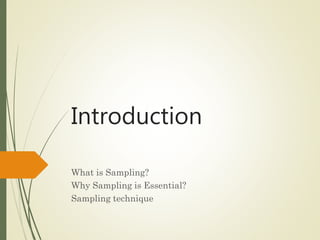
Introduction
What is Sampling?
Why Sampling is Essential?
Sampling technique
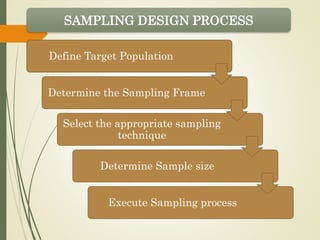
Define Target Population
Determine the Sampling Frame
Select the appropriate sampling
technique
Determine Sample size
Execute Sampling process
SAMPLING DESIGN PROCESS
1. Define Target Population
 Target Population refers to the entire group of individuals or
objects to which researchers are interested in generalizing the
conclusions.
 Improper definition of the target population will lead to misleading
results which might prove dangerous for a researcher.
 Therefore, target population must be defined very carefully.
2. Sampling frame must be
determined
 Sampling frame is the source material or device from
which a sample is drawn.
 It is a list of all those within a population who can be
sampled and may include individuals, households or
institutions.
 Sampling is carried out from the sampling frame and not
from the target population.
3.Appropriate sampling technique
must be selected.
 Selecting a sampling technique is a crucial decision for a
researcher.
 A researcher has to decide whether to use random
sampling or non- random sampling techniques.
4. Sample size must be defined
 Sample size refers to the number of elements to be
included in the study.
 Nature of research and analysis is an important
consideration while deciding the sample size.
 For qualitative research – small sample is sufficient.
 For conclusive research – larger sample is required.
5. Sampling process must be executed
 The execution of sampling technique require detailed
specification of target population, sampling frame,
sampling techniques and the sample size.
 Each step in the sampling process must be effectively
executed.
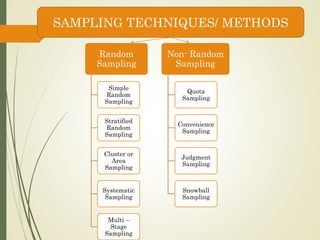
Random
Sampling
Simple
Random
Sampling
Stratified
Random
Sampling
Cluster or
Area
Sampling
Systematic
Sampling
Multi –
Stage
Sampling
Non- Random
Sampling
Quota
Sampling
Convenience
Sampling
Judgment
Sampling
Snowball
Sampling
SAMPLING TECHNIQUES/ METHODS
Random sampling
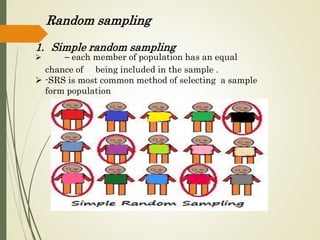
1. Simple random sampling
 – each member of population has an equal
chance of being included in the sample .
 -SRS is most common method of selecting a sample
form population
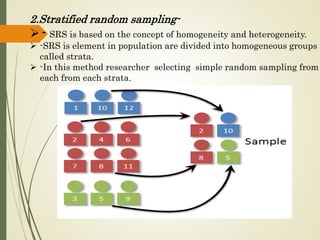
2.Stratified random sampling-
 - SRS is based on the concept of homogeneity and heterogeneity.
 -SRS is element in population are divided into homogeneous groups
called strata.
 -In this method researcher selecting simple random sampling from
each from each strata.
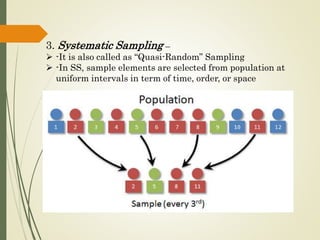
3. Systematic Sampling –
 -It is also called as “Quasi-Random” Sampling
 -In SS, sample elements are selected from population at
uniform intervals in term of time, order, or space
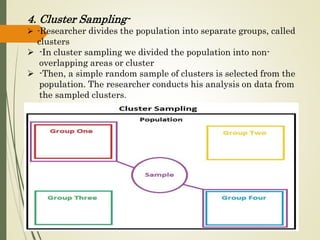
4. Cluster Sampling-
 -Researcher divides the population into separate groups, called
clusters
 -In cluster sampling we divided the population into non-
overlapping areas or cluster
 -Then, a simple random sample of clusters is selected from the
population. The researcher conducts his analysis on data from
the sampled clusters.
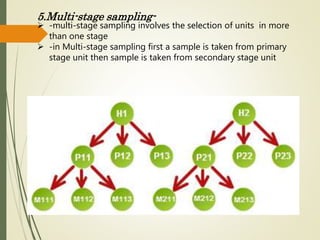
5.Multi-stage sampling-
 -multi-stage sampling involves the selection of units in more
than one stage
 -in Multi-stage sampling first a sample is taken from primary
stage unit then sample is taken from secondary stage unit
Sampling As Related To Qualitative
Studies
 Qualitative sampling
 Purposive sampling(Theoretical sampling)
 Grounded theory
 Theoretical saturation
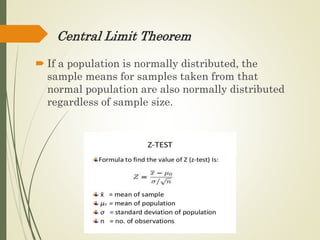
Central Limit Theorem
 If a population is normally distributed, the
sample means for samples taken from that
normal population are also normally distributed
regardless of sample size.
THANK YOU!

Brm group 3(sampling)

  • 1.
     VARUN BANSAL 20171004 SHAILESH CHOUDHARY 20171113  NISHITA MUNDRA 20171128  RAJABABU GUPTA 20171021  GAURAV MISTRY 20171035  PRIYANKA SHARMA 20171048  YASHKUMAR SIMARIA 20171148
  • 2.
    Introduction What is Sampling? WhySampling is Essential? Sampling technique
  • 3.
    Define Target Population Determinethe Sampling Frame Select the appropriate sampling technique Determine Sample size Execute Sampling process SAMPLING DESIGN PROCESS
  • 4.
    1. Define TargetPopulation  Target Population refers to the entire group of individuals or objects to which researchers are interested in generalizing the conclusions.  Improper definition of the target population will lead to misleading results which might prove dangerous for a researcher.  Therefore, target population must be defined very carefully.
  • 5.
    2. Sampling framemust be determined  Sampling frame is the source material or device from which a sample is drawn.  It is a list of all those within a population who can be sampled and may include individuals, households or institutions.  Sampling is carried out from the sampling frame and not from the target population.
  • 6.
    3.Appropriate sampling technique mustbe selected.  Selecting a sampling technique is a crucial decision for a researcher.  A researcher has to decide whether to use random sampling or non- random sampling techniques.
  • 7.
    4. Sample sizemust be defined  Sample size refers to the number of elements to be included in the study.  Nature of research and analysis is an important consideration while deciding the sample size.  For qualitative research – small sample is sufficient.  For conclusive research – larger sample is required.
  • 8.
    5. Sampling processmust be executed  The execution of sampling technique require detailed specification of target population, sampling frame, sampling techniques and the sample size.  Each step in the sampling process must be effectively executed.
  • 9.
    Random Sampling Simple Random Sampling Stratified Random Sampling Cluster or Area Sampling Systematic Sampling Multi – Stage Sampling Non-Random Sampling Quota Sampling Convenience Sampling Judgment Sampling Snowball Sampling SAMPLING TECHNIQUES/ METHODS
  • 10.
    Random sampling 1. Simplerandom sampling  – each member of population has an equal chance of being included in the sample .  -SRS is most common method of selecting a sample form population
  • 11.
    2.Stratified random sampling- - SRS is based on the concept of homogeneity and heterogeneity.  -SRS is element in population are divided into homogeneous groups called strata.  -In this method researcher selecting simple random sampling from each from each strata.
  • 12.
    3. Systematic Sampling–  -It is also called as “Quasi-Random” Sampling  -In SS, sample elements are selected from population at uniform intervals in term of time, order, or space
  • 13.
    4. Cluster Sampling- -Researcher divides the population into separate groups, called clusters  -In cluster sampling we divided the population into non- overlapping areas or cluster  -Then, a simple random sample of clusters is selected from the population. The researcher conducts his analysis on data from the sampled clusters.
  • 14.
    5.Multi-stage sampling-  -multi-stagesampling involves the selection of units in more than one stage  -in Multi-stage sampling first a sample is taken from primary stage unit then sample is taken from secondary stage unit
  • 15.
    Sampling As RelatedTo Qualitative Studies  Qualitative sampling  Purposive sampling(Theoretical sampling)  Grounded theory  Theoretical saturation
  • 16.
    Central Limit Theorem If a population is normally distributed, the sample means for samples taken from that normal population are also normally distributed regardless of sample size.
  • 17.