MULTIMEDIA
Character Sets and AlphabetsCharacter Sets and Alphabets
• The ASCII Character Set
• The Extended Character Set
• Unicode
Character Sets and Alphabets
Knowing that there is a wide selection
of characters available to you on your
computer and understanding how you
can create and use special and
custom-made characters will broaden
your creative range when you design
and build multimedia projects.
The ASCII Character Set
The American Standard Code for
Information Interchange (ASCII) is
the 7-bit character coding system
most commonly used by computer
systems in the United States and
abroad.
The ASCII Character Set
ASCII assigns a number or value to 128
characters, including both lower and
uppercase letters, punctuation marks,
Arabic numbers, and math symbols.
ASCII code numbers always represent a
letter or symbol of the English alphabet, so
that a computer or printer can work with
the number that represents the letter,
The ASCII Character Set
The number 65, for example, always
represents an uppercase letter A.
The Extended Character Set
The extended character set is most
commonly filled with ANSI (American
National Standards Institute) standard
characters, including often-used symbols,
such as ¢ or ∞, and international alphabet
characters, such as a or n. This fuller set of
255 characters is also known as the ISO-
Latin-1 character set;
it is used when programming the text of
HTML web pages.
Unicode
Since 1989, a joint effort on the part of linguists,
engineers, and information professionals from
many well-known computer companies has been
focused on a 16-bit architecture for multilingual
text and character encoding. Called Unicode,
the original standard accommodated up to
about 65,000 characters to include the
characters from all known languages and
alphabets in the world.
Unicode
Unicode
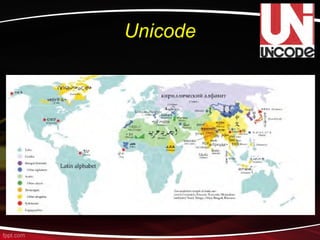
Where several languages share a set of
symbols that have a historically related
derivation, the shared symbols of each
language are unified into collections of
symbols (called scripts).
A single script can work for tens or even
hundreds of languages
Unicode
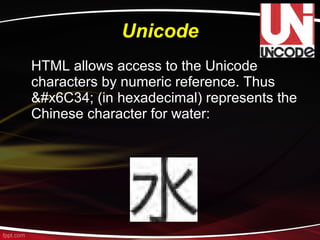
HTML allows access to the Unicode
characters by numeric reference. Thus
水 (in hexadecimal) represents the
Chinese character for water:
Character sets and alphabets

Character sets and alphabets

  • 1.
    MULTIMEDIA Character Sets andAlphabetsCharacter Sets and Alphabets
  • 2.
    Character Sets andAlphabetsCharacter Sets and Alphabets • The ASCII Character Set • The Extended Character Set • Unicode
  • 3.
    Character Sets andAlphabets Knowing that there is a wide selection of characters available to you on your computer and understanding how you can create and use special and custom-made characters will broaden your creative range when you design and build multimedia projects.
  • 4.
    The ASCII CharacterSet The American Standard Code for Information Interchange (ASCII) is the 7-bit character coding system most commonly used by computer systems in the United States and abroad.
  • 5.
    The ASCII CharacterSet ASCII assigns a number or value to 128 characters, including both lower and uppercase letters, punctuation marks, Arabic numbers, and math symbols. ASCII code numbers always represent a letter or symbol of the English alphabet, so that a computer or printer can work with the number that represents the letter,
  • 6.
    The ASCII CharacterSet The number 65, for example, always represents an uppercase letter A.
  • 7.
    The Extended CharacterSet The extended character set is most commonly filled with ANSI (American National Standards Institute) standard characters, including often-used symbols, such as ¢ or ∞, and international alphabet characters, such as a or n. This fuller set of 255 characters is also known as the ISO- Latin-1 character set; it is used when programming the text of HTML web pages.
  • 8.
    Unicode Since 1989, ajoint effort on the part of linguists, engineers, and information professionals from many well-known computer companies has been focused on a 16-bit architecture for multilingual text and character encoding. Called Unicode, the original standard accommodated up to about 65,000 characters to include the characters from all known languages and alphabets in the world.
  • 9.
  • 10.
    Unicode Where several languagesshare a set of symbols that have a historically related derivation, the shared symbols of each language are unified into collections of symbols (called scripts). A single script can work for tens or even hundreds of languages
  • 11.
    Unicode HTML allows accessto the Unicode characters by numeric reference. Thus 水 (in hexadecimal) represents the Chinese character for water: