Presented by-
medha agarwal
PLANNING

      How To Best Meet Your
             Mission


We must plan for the future,
because people who stay in the
present will remain in the past.


                      Abraham Lincoln
The plan fights for the freedom of speech , government
transparency and to promote personal growth !

To achieve this , anonymous uses a team effort to utilize
our weapons of viral education , valid facts & resources ,
  & encouraging unity and tolerance .

Together , we will accomplish a far more sustainable
society build around growing & informed knowledge
network & living under a new , limited , transparent
government system .


                   What is the plan ?
A business plan is any plan that works for a
business to look ahead, allocate resources, focus
on key points, and prepare for problems and
opportunities. Unfortunately, many people think
of business plans only for starting a new
business or applying for business loans. But they
are also vital for running a business, whether or
not the business needs new loans or new
investments. Businesses need plans to optimise
growth and development according to priorities.


   What is a Business Plan?
What is Corporate Planning?

 Corporate planning often ends with a
hastily prepared business plan, prepared
to satisfy debt or equity funding sources.
While a plan prepared in such a way may
meet it's immediate objectives, it is near
worthless as a sound operations planning
tool.
WHAT   IS STRATEGIC PLANNING?

Strategic Planning is a management tool
that helps an organization focus its energy,
to ensure that members of the organization
are working toward the same goals, to
assess and adjust the organization's
direction in response to a changing
environment.
In short, strategic planning is a disciplined
effort to produce fundamental decisions and
actions that shape and guide what an
organization is, what it does, and why it
does it, with a focus on the future.
   Be familiar with the components of
    strategic plan .

   Construct a priority setting tool .

   Create an action plan .


Objective of strategic planning :
Strategic Goals and Plans


   Strategic Goals pertain to the entire
    organization (not specific divisions and
    departments).

   Strategic Plans define the action
    steps the company will use to attain
    strategic goals.
Goal Characteristics
   Be specific and measurable
    ◦ Quantitive Terms

   Cover key result areas
    ◦ Contribute most to company performance

   Be challenging but realistic

   Be for a defined time period.

   Be linked to rewards.
A tactical plan is concerned with what
the lower level units within each division
must do, how they must do it, and who is
in charge at each level. Tactics are the
means needed to activate a strategy and
make it work.


      Tactical Plan
Tactical Goals and Plans

   Tactical Goals apply to middle
    management and describe what major
    subunits must do to to enable the
    organization to meet its strategic goals.

   Tactical Plans:
    ◦ Help execute major Strategic Plans.
    ◦ Cover a shorter period of time.
Along with your Action and Monitoring
 Plans the Operational Plan is the third part
 of your completed Strategic Plan. It
 defines how you will operate in practice to
 implement your action and monitoring
 plans – what your capacity needs are,
 how you will engage resources, how you
 will deal with risks, and how you will
 ensure sustainability of the project’s
 achievements.


Operational Plan
   Operational Goals: the specific results
    expected of small units, workgroups, and
    individuals.

   Operational Plans: developed at the lower
    levels of an organization to specify actions
    required to achieve operational goals and
    to support tactical plans.


Operational Goals and Plans
   Single-use plans are developed to achieve
    objectives that are not likely to be repeated
    in the future. Single-use plans include
    programs, budgets and projects.
    ◦

   Standing plans are used to provide guidance
    for tasks performed repeatedly within the
    organization. The primary standing plans are
    organizational policies, rules, and procedures


Types of Plans
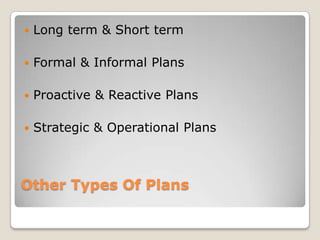
   Long term & Short term

   Formal & Informal Plans

   Proactive & Reactive Plans

   Strategic & Operational Plans


Other Types Of Plans
PLANNING

PLANNING

  • 1.
  • 2.
    PLANNING How To Best Meet Your Mission We must plan for the future, because people who stay in the present will remain in the past. Abraham Lincoln
  • 3.
    The plan fightsfor the freedom of speech , government transparency and to promote personal growth ! To achieve this , anonymous uses a team effort to utilize our weapons of viral education , valid facts & resources , & encouraging unity and tolerance . Together , we will accomplish a far more sustainable society build around growing & informed knowledge network & living under a new , limited , transparent government system . What is the plan ?
  • 5.
    A business planis any plan that works for a business to look ahead, allocate resources, focus on key points, and prepare for problems and opportunities. Unfortunately, many people think of business plans only for starting a new business or applying for business loans. But they are also vital for running a business, whether or not the business needs new loans or new investments. Businesses need plans to optimise growth and development according to priorities. What is a Business Plan?
  • 6.
    What is CorporatePlanning? Corporate planning often ends with a hastily prepared business plan, prepared to satisfy debt or equity funding sources. While a plan prepared in such a way may meet it's immediate objectives, it is near worthless as a sound operations planning tool.
  • 7.
    WHAT IS STRATEGIC PLANNING? Strategic Planning is a management tool that helps an organization focus its energy, to ensure that members of the organization are working toward the same goals, to assess and adjust the organization's direction in response to a changing environment. In short, strategic planning is a disciplined effort to produce fundamental decisions and actions that shape and guide what an organization is, what it does, and why it does it, with a focus on the future.
  • 8.
    Be familiar with the components of strategic plan .  Construct a priority setting tool .  Create an action plan . Objective of strategic planning :
  • 9.
    Strategic Goals andPlans  Strategic Goals pertain to the entire organization (not specific divisions and departments).  Strategic Plans define the action steps the company will use to attain strategic goals.
  • 10.
    Goal Characteristics  Be specific and measurable ◦ Quantitive Terms  Cover key result areas ◦ Contribute most to company performance  Be challenging but realistic  Be for a defined time period.  Be linked to rewards.
  • 11.
    A tactical planis concerned with what the lower level units within each division must do, how they must do it, and who is in charge at each level. Tactics are the means needed to activate a strategy and make it work. Tactical Plan
  • 12.
    Tactical Goals andPlans  Tactical Goals apply to middle management and describe what major subunits must do to to enable the organization to meet its strategic goals.  Tactical Plans: ◦ Help execute major Strategic Plans. ◦ Cover a shorter period of time.
  • 13.
    Along with yourAction and Monitoring Plans the Operational Plan is the third part of your completed Strategic Plan. It defines how you will operate in practice to implement your action and monitoring plans – what your capacity needs are, how you will engage resources, how you will deal with risks, and how you will ensure sustainability of the project’s achievements. Operational Plan
  • 14.
    Operational Goals: the specific results expected of small units, workgroups, and individuals.  Operational Plans: developed at the lower levels of an organization to specify actions required to achieve operational goals and to support tactical plans. Operational Goals and Plans
  • 15.
    Single-use plans are developed to achieve objectives that are not likely to be repeated in the future. Single-use plans include programs, budgets and projects. ◦  Standing plans are used to provide guidance for tasks performed repeatedly within the organization. The primary standing plans are organizational policies, rules, and procedures Types of Plans
  • 16.
    Long term & Short term  Formal & Informal Plans  Proactive & Reactive Plans  Strategic & Operational Plans Other Types Of Plans