CHAPTER-VI
FACILITY LOCATION
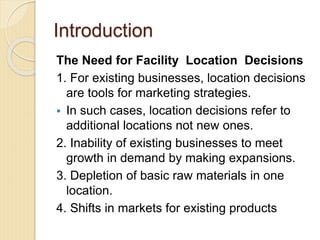
Introduction
The Need for Facility Location Decisions
1. For existing businesses, location decisions
are tools for marketing strategies.
 In such cases, location decisions refer to
additional locations not new ones.
2. Inability of existing businesses to meet
growth in demand by making expansions.
3. Depletion of basic raw materials in one
location.
4. Shifts in markets for existing products
The Nature of Location
Decisions
• The nature of location decisions can
be seen in terms of:
a. Importance of Location Decisions
b. Objectives of Locations and
c. Location options
a. Importance of Location
Decisions
 Location decisions are important in
that:
i. They involve long-term commitment
of resources
ii. They determine investment and
operating costs
iii. They determine revenue or sales
volume
iv. Availability of qualified labor
v. Availability of suppliers
b. Objectives of Location
Decisions
 Sales generation
 Cost Minimization
 Profit maximization
 Accessing raw materials
 Proxmity to customers and delivering
services to all customers
In any situation, there can never be a
single best location.
c. Location Options
 Four Location options are generally
considered in making location
decisions.
1. Expantion
 Realistic only if there exists adequate
space.
 Preferable only if the existing
location has special features that
other locations do not have.
2. Adding a new location
 This is important for:
a. Counter attacks against rivals
b. Expanding markets in new locations
c. Defensive strategy against new
entrants
3. Moving into a New Location
The causes for moving into a new location
can be either:
a. A shift in markets or
b. exhaustion of raw materials or
Procedure for Making Location
Decisions
1. Decide on the criteria to use for
evaluating location alternatives, such
as increased revenues or community
service.
2. Identify important factors, such as
location of markets or raw materials.
3. Develop location alternatives:
a. Identify the general region for a
location
b. Identify a small number of
community alternatives
c. Identify site alternatives among the
community alternatives.
4. Evaluate the alternatives and make
a selection.
Factors that Affect Location
Decisions
 Many factors affect location decisions,
each of them may not have equal
importance and thus managers
consider the most important ones.
 In a manufacturing industry, for
instance, the most important factors
include availability of raw materials,
energy, water supply transportation
cost etc.
Cont…
 In the service industry, the important
factors can be proximity to customers
and traffic flows and competitors’
location.
 The factors are generally be classified
into the following ones.
1. Regional Factors
a. Location of Raw Materials: Firms
locate near or at the source of raw
materials for three primary reasons:
I. necessity
II. Perishability and
III. transportation costs
b. Location of markets
2. Labor Factors
 Labor factors include:
a. Labor cost and availability of labor
b. Wage rates
c. Attitude of labor towards work and
labor productivity
d. Availability and seriousness of labor
unions
e. Labor skills
3. Community Related
Factors
 From a company standpoint, a
number of factors determine the
desirability of a community as a place
for its workers and managers to live.
 They include facilities for education,
shopping, recreation, transportation,
religious worship, and entertainment;
the quality of police, fire, and medical
services; local attitudes toward the
company; and the size of the
community.
4. Site Related Factors
 Evaluation of potential sites may
require consulting with engineers or
architect especially in the case of
heavy manufacturing or the erection of
large buildings.
 Soil conditions, load factors, and
drainage rates can be critical and
often necessitate certain kinds of
expertise in evaluation.

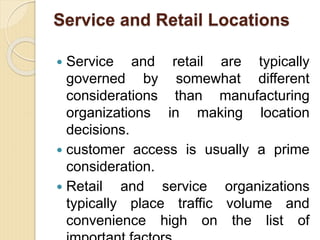
Service and Retail Locations
 Service and retail are typically
governed by somewhat different
considerations than manufacturing
organizations in making location
decisions.
 customer access is usually a prime
consideration.
 Retail and service organizations
typically place traffic volume and
convenience high on the list of
Cont….
 If a business is unique, and has its
own drawing power, nearness to
customers may not be a factor.
 . Restaurants and specialty stores
often locate in and around malls,
benefiting from the high traffic.
 Medical services are often located
near hospitals for convenience of
patients.
 Available public transportation is often
Quantitative Evaluation of
Location Alternatives
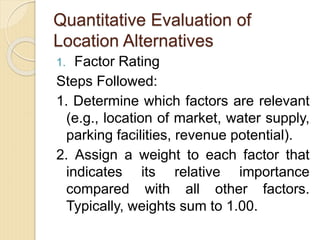
1. Factor Rating
Steps Followed:
1. Determine which factors are relevant
(e.g., location of market, water supply,
parking facilities, revenue potential).
2. Assign a weight to each factor that
indicates its relative importance
compared with all other factors.
Typically, weights sum to 1.00.
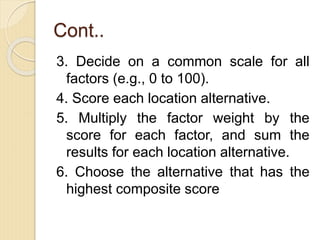
Cont..
3. Decide on a common scale for all
factors (e.g., 0 to 100).
4. Score each location alternative.
5. Multiply the factor weight by the
score for each factor, and sum the
results for each location alternative.
6. Choose the alternative that has the
highest composite score
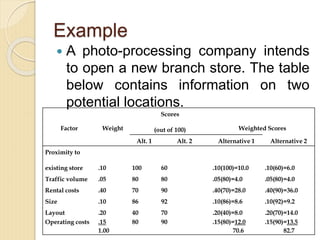
Example
 A photo-processing company intends
to open a new branch store. The table
below contains information on two
potential locations.
Factor Weight
Scores
(out of 100) Weighted Scores
Alt. 1 Alt. 2 Alternative 1 Alternative 2
Proximity to
existing store .10 100 60 .10(100)=10.0 .10(60)=6.0
Traffic volume .05 80 80 .05(80)=4.0 .05(80)=4.0
Rental costs .40 70 90 .40(70)=28.0 .40(90)=36.0
Size .10 86 92 .10(86)=8.6 .10(92)=9.2
Layout .20 40 70 .20(40)=8.0 .20(70)=14.0
Operating costs .15 80 90 .15(80)=12.0 .15(90)=13.5
1.00 70.6 82.7
2. The Center of Gravity
Method
 The center of gravity method is a technique for
locating single facilities that considers the existing
facilities, the distances between them, and the
volumes of goods to be shipped.
 The center of gravity method is a method to
determine the location of a distribution center that
will minimize distribution costs.
 It treats distribution cost as a linear function of the
distance and the quantity shipped.
 quantity to be shipped to each destination is
assumed to be fixed (i.e., will not change over
time).
Cont…
 The technique is often used to locate
intermediate or distribution warehouses.
 The center of gravity method begins by
placing the existing locations on a
coordinate grid system.
 The purpose is to establish relative
distances between locations.
 The center of gravity is found by calculating
the X and Y coordinates that result in the
minimal transportation cost.
Example 3
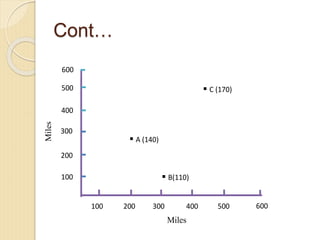
 A company is going to construct a new
warehouse served by suppliers A, B,
and C. The locations of the three
suppliers and the annual number of
truck carriers that will serve the
warehouse are shown in the following
figure.
Cont…
 C (170)
 A (140)
 B(110)
100 200 300 400 500 600
100
200
300
400
500
600
Miles
Miles
Cont…
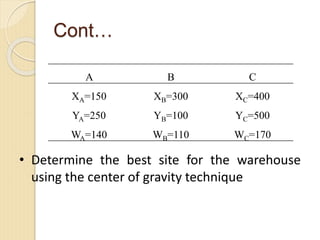
A B C
XA=150 XB=300 XC=400
YA=250 YB=100 YC=500
WA=140 WB=110 WC=170
• Determine the best site for the warehouse
using the center of gravity technique
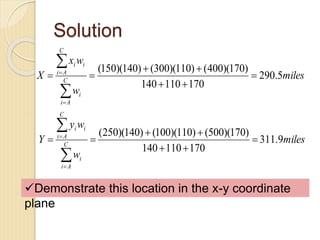
Solution
miles
w
w
x
X C
A
i
i
C
A
i
i
i
5
.
290
170
110
140
)
170
)(
400
(
)
110
)(
300
(
)
140
)(
150
(











miles
w
w
y
Y C
A
i
i
C
A
i
i
i
9
.
311
170
110
140
)
170
)(
500
(
)
110
)(
100
(
)
140
)(
250
(











Demonstrate this location in the x-y coordinate
plane

OM CHAPTER SIX.PPT

  • 1.
  • 2.
    Introduction The Need forFacility Location Decisions 1. For existing businesses, location decisions are tools for marketing strategies.  In such cases, location decisions refer to additional locations not new ones. 2. Inability of existing businesses to meet growth in demand by making expansions. 3. Depletion of basic raw materials in one location. 4. Shifts in markets for existing products
  • 3.
    The Nature ofLocation Decisions • The nature of location decisions can be seen in terms of: a. Importance of Location Decisions b. Objectives of Locations and c. Location options
  • 4.
    a. Importance ofLocation Decisions  Location decisions are important in that: i. They involve long-term commitment of resources ii. They determine investment and operating costs iii. They determine revenue or sales volume iv. Availability of qualified labor v. Availability of suppliers
  • 5.
    b. Objectives ofLocation Decisions  Sales generation  Cost Minimization  Profit maximization  Accessing raw materials  Proxmity to customers and delivering services to all customers In any situation, there can never be a single best location.
  • 6.
    c. Location Options Four Location options are generally considered in making location decisions. 1. Expantion  Realistic only if there exists adequate space.  Preferable only if the existing location has special features that other locations do not have.
  • 7.
    2. Adding anew location  This is important for: a. Counter attacks against rivals b. Expanding markets in new locations c. Defensive strategy against new entrants 3. Moving into a New Location The causes for moving into a new location can be either: a. A shift in markets or b. exhaustion of raw materials or
  • 8.
    Procedure for MakingLocation Decisions 1. Decide on the criteria to use for evaluating location alternatives, such as increased revenues or community service. 2. Identify important factors, such as location of markets or raw materials. 3. Develop location alternatives:
  • 9.
    a. Identify thegeneral region for a location b. Identify a small number of community alternatives c. Identify site alternatives among the community alternatives. 4. Evaluate the alternatives and make a selection.
  • 10.
    Factors that AffectLocation Decisions  Many factors affect location decisions, each of them may not have equal importance and thus managers consider the most important ones.  In a manufacturing industry, for instance, the most important factors include availability of raw materials, energy, water supply transportation cost etc.
  • 11.
    Cont…  In theservice industry, the important factors can be proximity to customers and traffic flows and competitors’ location.  The factors are generally be classified into the following ones.
  • 12.
    1. Regional Factors a.Location of Raw Materials: Firms locate near or at the source of raw materials for three primary reasons: I. necessity II. Perishability and III. transportation costs b. Location of markets
  • 13.
    2. Labor Factors Labor factors include: a. Labor cost and availability of labor b. Wage rates c. Attitude of labor towards work and labor productivity d. Availability and seriousness of labor unions e. Labor skills
  • 14.
    3. Community Related Factors From a company standpoint, a number of factors determine the desirability of a community as a place for its workers and managers to live.  They include facilities for education, shopping, recreation, transportation, religious worship, and entertainment; the quality of police, fire, and medical services; local attitudes toward the company; and the size of the community.
  • 15.
    4. Site RelatedFactors  Evaluation of potential sites may require consulting with engineers or architect especially in the case of heavy manufacturing or the erection of large buildings.  Soil conditions, load factors, and drainage rates can be critical and often necessitate certain kinds of expertise in evaluation. 
  • 16.
    Service and RetailLocations  Service and retail are typically governed by somewhat different considerations than manufacturing organizations in making location decisions.  customer access is usually a prime consideration.  Retail and service organizations typically place traffic volume and convenience high on the list of
  • 17.
    Cont….  If abusiness is unique, and has its own drawing power, nearness to customers may not be a factor.  . Restaurants and specialty stores often locate in and around malls, benefiting from the high traffic.  Medical services are often located near hospitals for convenience of patients.  Available public transportation is often
  • 18.
    Quantitative Evaluation of LocationAlternatives 1. Factor Rating Steps Followed: 1. Determine which factors are relevant (e.g., location of market, water supply, parking facilities, revenue potential). 2. Assign a weight to each factor that indicates its relative importance compared with all other factors. Typically, weights sum to 1.00.
  • 19.
    Cont.. 3. Decide ona common scale for all factors (e.g., 0 to 100). 4. Score each location alternative. 5. Multiply the factor weight by the score for each factor, and sum the results for each location alternative. 6. Choose the alternative that has the highest composite score
  • 20.
    Example  A photo-processingcompany intends to open a new branch store. The table below contains information on two potential locations. Factor Weight Scores (out of 100) Weighted Scores Alt. 1 Alt. 2 Alternative 1 Alternative 2 Proximity to existing store .10 100 60 .10(100)=10.0 .10(60)=6.0 Traffic volume .05 80 80 .05(80)=4.0 .05(80)=4.0 Rental costs .40 70 90 .40(70)=28.0 .40(90)=36.0 Size .10 86 92 .10(86)=8.6 .10(92)=9.2 Layout .20 40 70 .20(40)=8.0 .20(70)=14.0 Operating costs .15 80 90 .15(80)=12.0 .15(90)=13.5 1.00 70.6 82.7
  • 21.
    2. The Centerof Gravity Method  The center of gravity method is a technique for locating single facilities that considers the existing facilities, the distances between them, and the volumes of goods to be shipped.  The center of gravity method is a method to determine the location of a distribution center that will minimize distribution costs.  It treats distribution cost as a linear function of the distance and the quantity shipped.  quantity to be shipped to each destination is assumed to be fixed (i.e., will not change over time).
  • 22.
    Cont…  The techniqueis often used to locate intermediate or distribution warehouses.  The center of gravity method begins by placing the existing locations on a coordinate grid system.  The purpose is to establish relative distances between locations.  The center of gravity is found by calculating the X and Y coordinates that result in the minimal transportation cost.
  • 23.
    Example 3  Acompany is going to construct a new warehouse served by suppliers A, B, and C. The locations of the three suppliers and the annual number of truck carriers that will serve the warehouse are shown in the following figure.
  • 24.
    Cont…  C (170) A (140)  B(110) 100 200 300 400 500 600 100 200 300 400 500 600 Miles Miles
  • 25.
    Cont… A B C XA=150XB=300 XC=400 YA=250 YB=100 YC=500 WA=140 WB=110 WC=170 • Determine the best site for the warehouse using the center of gravity technique
  • 26.