Warm Up California Standards Lesson Presentation Preview
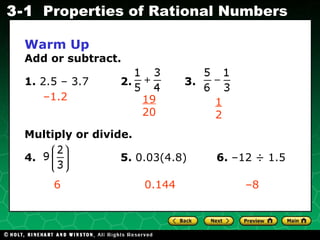
Warm Up Add or subtract. 1.  2.5 – 3.7 2.   3.  Multiply or divide. 4.  5.  0.03(4.8) 6.  –12 ÷ 1.5 – 1.2 19 20 1 2 6 0.144 – 8
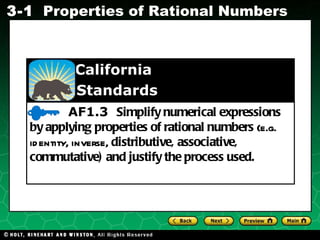
AF1.3  Simplify numerical expressions by applying properties of rational numbers  (e.g. identity, inverse,  distributive, associative, commutative) and justify the process used.    California    Standards
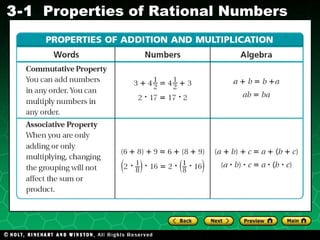
Vocabulary Commutative Property Associative Property Distributive Property
 
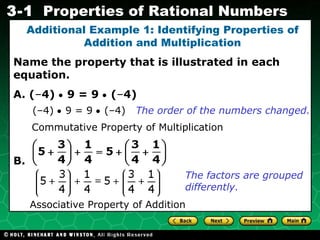
Additional Example 1: Identifying Properties of Addition and Multiplication Name the property that is illustrated in each equation. A. ( – 4)    9 = 9    ( – 4) B.  (–4)    9 = 9    (–4) The order of the numbers changed. Commutative Property of Multiplication Associative Property of Addition The factors are grouped differently.
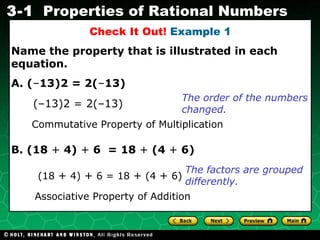
Check It Out!  Example 1 Name the property that is illustrated in each equation. A. ( – 13)2 = 2( – 13) B. (18  +  4)  +  6  = 18  +  (4  +  6) (–13)2 = 2(–13) The order of the numbers changed. Commutative Property of Multiplication Associative Property of Addition The factors are grouped differently. (18  +  4)  +  6 = 18  +  (4  +  6)
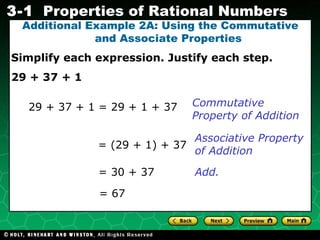
Additional Example 2A: Using the Commutative and Associate Properties Simplify each expression. Justify each step. 29 + 37 + 1 29 + 37 + 1 = 29 + 1 + 37 Commutative Property of Addition = (29 + 1) + 37 = 30 + 37 Associative Property of Addition = 67 Add.
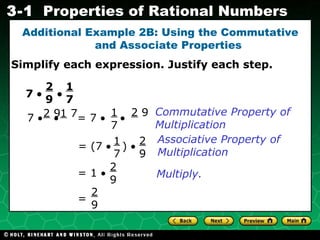
Additional Example 2B: Using the Commutative and Associate Properties Simplify each expression. Justify each step. 7      Commutative Property of Multiplication Associative Property of Multiplication Multiply. 2  9 1  7 7        = 7        2  9 1  7 2  9 1  7 = (7     )     2  9 1  7 = 2  9 = 1   2  9
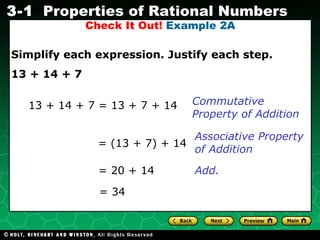
Check It Out!  Example 2A Simplify each expression. Justify each step. 13 + 14 + 7 13 + 14 + 7 = 13 + 7 + 14 Commutative Property of Addition = (13 + 7) + 14 = 20 + 14 Associative Property of Addition = 34 Add.
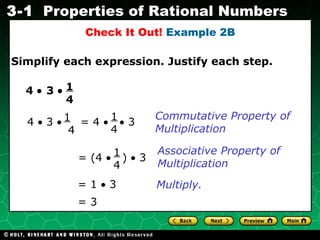
Check It Out!  Example 2B Simplify each expression. Justify each step. 4    3   Commutative Property of Multiplication Associative Property of Multiplication Multiply. 1  4 4    3     = 4       3  1   t 4 1  4 = (4     )    3  1  4 = 3 = 1    3
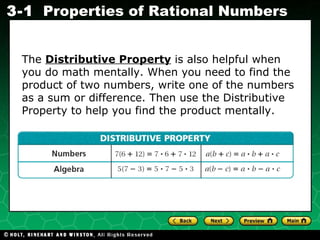
The  Distributive Property  is also helpful when you do math mentally. When you need to find the product of two numbers, write one of the numbers as a sum or difference. Then use the Distributive Property to help you find the product mentally.
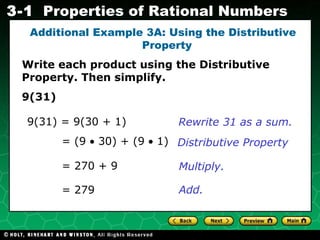
Additional Example 3A: Using the Distributive Property Write each product using the Distributive Property. Then simplify. 9(31) = (9    30) + (9    1) Rewrite 31 as a sum. = 270 + 9 = 279 Distributive Property Multiply. Add. 9(31) = 9(30 + 1)
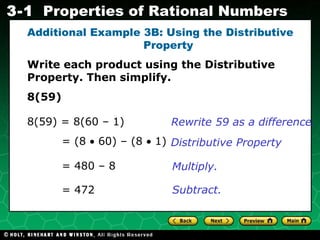
Additional Example 3B: Using the Distributive Property Write each product using the Distributive Property. Then simplify. 8(59) = (8    60) – (8    1) Rewrite 59 as a difference. = 480 – 8 = 472 Distributive Property Multiply. Subtract. 8(59) = 8(60 – 1)
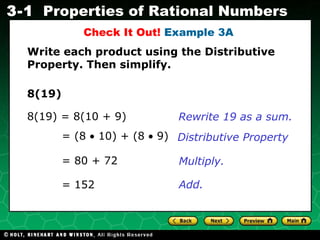
Check It Out!  Example 3A  Write each product using the Distributive Property. Then simplify. 8(19) = (8    10) + (8    9) Rewrite 19 as a sum. = 80 + 72 = 152 Distributive Property Multiply. Add. 8(19) = 8(10 + 9)
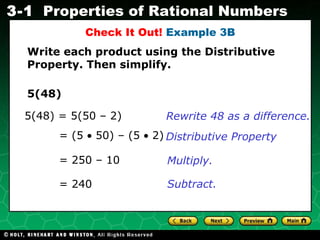
Check It Out!  Example 3B Write each product using the Distributive Property. Then simplify. 5(48) = (5    50) – (5    2) Rewrite 48 as a difference. = 250 – 10 = 240 Distributive Property Multiply. Subtract. 5(48) = 5(50 – 2)
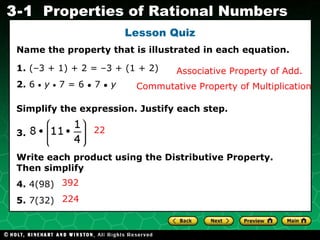
Lesson Quiz Name the property that is illustrated in each equation. 1.  (–3 + 1) + 2 = –3 + (1 + 2) 2.  6     y     7 = 6  ●  7  ●   y Simplify the expression. Justify each step. 3.   Write each product using the Distributive Property. Then simplify 4.  4(98) 5.  7(32)  Associative Property of Add. Commutative Property of Multiplication 22 392 224

Chapter3.1

  • 1.
    Warm Up CaliforniaStandards Lesson Presentation Preview
  • 2.
    Warm Up Addor subtract. 1. 2.5 – 3.7 2. 3. Multiply or divide. 4. 5. 0.03(4.8) 6. –12 ÷ 1.5 – 1.2 19 20 1 2 6 0.144 – 8
  • 3.
    AF1.3 Simplifynumerical expressions by applying properties of rational numbers (e.g. identity, inverse, distributive, associative, commutative) and justify the process used. California Standards
  • 4.
    Vocabulary Commutative PropertyAssociative Property Distributive Property
  • 5.
  • 6.
    Additional Example 1:Identifying Properties of Addition and Multiplication Name the property that is illustrated in each equation. A. ( – 4)  9 = 9  ( – 4) B. (–4)  9 = 9  (–4) The order of the numbers changed. Commutative Property of Multiplication Associative Property of Addition The factors are grouped differently.
  • 7.
    Check It Out! Example 1 Name the property that is illustrated in each equation. A. ( – 13)2 = 2( – 13) B. (18 + 4) + 6 = 18 + (4 +  6) (–13)2 = 2(–13) The order of the numbers changed. Commutative Property of Multiplication Associative Property of Addition The factors are grouped differently. (18 + 4) + 6 = 18 + (4 + 6)
  • 8.
    Additional Example 2A:Using the Commutative and Associate Properties Simplify each expression. Justify each step. 29 + 37 + 1 29 + 37 + 1 = 29 + 1 + 37 Commutative Property of Addition = (29 + 1) + 37 = 30 + 37 Associative Property of Addition = 67 Add.
  • 9.
    Additional Example 2B:Using the Commutative and Associate Properties Simplify each expression. Justify each step. 7   Commutative Property of Multiplication Associative Property of Multiplication Multiply. 2 9 1 7 7   = 7   2 9 1 7 2 9 1 7 = (7  )  2 9 1 7 = 2 9 = 1  2 9
  • 10.
    Check It Out! Example 2A Simplify each expression. Justify each step. 13 + 14 + 7 13 + 14 + 7 = 13 + 7 + 14 Commutative Property of Addition = (13 + 7) + 14 = 20 + 14 Associative Property of Addition = 34 Add.
  • 11.
    Check It Out! Example 2B Simplify each expression. Justify each step. 4  3  Commutative Property of Multiplication Associative Property of Multiplication Multiply. 1 4 4  3  = 4   3 1 t 4 1 4 = (4  )  3 1 4 = 3 = 1  3
  • 12.
    The DistributiveProperty is also helpful when you do math mentally. When you need to find the product of two numbers, write one of the numbers as a sum or difference. Then use the Distributive Property to help you find the product mentally.
  • 13.
    Additional Example 3A:Using the Distributive Property Write each product using the Distributive Property. Then simplify. 9(31) = (9  30) + (9  1) Rewrite 31 as a sum. = 270 + 9 = 279 Distributive Property Multiply. Add. 9(31) = 9(30 + 1)
  • 14.
    Additional Example 3B:Using the Distributive Property Write each product using the Distributive Property. Then simplify. 8(59) = (8  60) – (8  1) Rewrite 59 as a difference. = 480 – 8 = 472 Distributive Property Multiply. Subtract. 8(59) = 8(60 – 1)
  • 15.
    Check It Out! Example 3A Write each product using the Distributive Property. Then simplify. 8(19) = (8  10) + (8  9) Rewrite 19 as a sum. = 80 + 72 = 152 Distributive Property Multiply. Add. 8(19) = 8(10 + 9)
  • 16.
    Check It Out! Example 3B Write each product using the Distributive Property. Then simplify. 5(48) = (5  50) – (5  2) Rewrite 48 as a difference. = 250 – 10 = 240 Distributive Property Multiply. Subtract. 5(48) = 5(50 – 2)
  • 17.
    Lesson Quiz Namethe property that is illustrated in each equation. 1. (–3 + 1) + 2 = –3 + (1 + 2) 2. 6  y  7 = 6 ● 7 ● y Simplify the expression. Justify each step. 3. Write each product using the Distributive Property. Then simplify 4. 4(98) 5. 7(32) Associative Property of Add. Commutative Property of Multiplication 22 392 224