Perspectives and Commentary 
                                    First Quarter, 2013  


                                                                                January 22, 2013 
US Economic and Market Overview  
The fourth quarter of 2012 brought an abundance of angst and speculation surrounding how, and
when, Congress might resolve its ongoing battle over fiscal policy. As investors worried about the
impact of the tax and spending provisions the Budget Control Act of 2011 would have on an already
fragile economy, Congress showed little inclination to reach a bi-partisan compromise. The result
was a layer of uncertainty in the financial markets that persisted into the proverbial “eleventh hour.”
Finally, over the last weekend before the New Year, Vice President Joe Biden and Senate Minority
Leader Mitch McConnell negotiated to avoid sequestration. Within seventy-two hours of their initial
discussions, Congress passed, and the President signed, the American Taxpayer Relief Act (ATRA)
of 2012. It appeared that four plus years of dispute over fiscal policy was resolved in less than three
days --- or was it?

The ATRA of 2012 prolongs by two months the budget sequestration deadline established in the Act
of 2011. Congress now has until the end of February 2013 (unless extended) to negotiate spending
cuts intended to lower the Federal deficit. Much now must be done in a short amount of time by a
group that has had little success reaching any sort of consensus over the past few years. Due to this
reality, uncertainty remains high which has not been lost on the financial markets. This thread of
uncertainty can be expected to weigh on investors, and caution will prevail until a detailed plan to
lower deficit spending has been articulated. The sequestration established in the Act of 2011, if
allowed to prevail, could threaten the economy in 2013. A compromise would have less impact on
the economy, though what form any compromise might take is pure speculation. This uncertainty
should dampen upside potential (especially in the equity markets) until a resolution is reached, and
failure to pass a needed increase in the debt ceiling could be most damaging.

Economic Conditions 
The debate over fiscal policy had a modestly negative impact on US economic output over the fourth
quarter of 2012. Q3 GDP grew at a stronger-than-expected 3.1%, yet appears to have slowed to
near 2% in Q4 as both businesses and consumers remained reluctant to spend in anticipation of
potential tax increases and further economic slowing. The ongoing recession in Europe and a
modest slowing in emerging markets detracted from US growth as well.

                                                  1 
 
Despite slower growth in Q4, the US added 453,000 jobs over the quarter, keeping the rate of
unemployment at 7.8%, a number consistent with the end of Q3. Dominant areas supporting job
growth include health care, food services, construction and manufacturing.

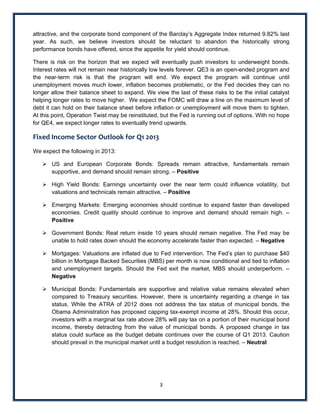
Though there is little doubt that fiscal drag at the federal government level will detract from economic
growth in 2013, our base case scenario assumes a compromise will be reached that will allow the
economy to expand over the year ahead. We expect any fiscal shock from the compromise will be
most apparent over the first six months of the year, subsiding in the second half as higher taxes and
lower government spending become the established norm.


              Source: HighMark Capital estimates and Thomson Datastream

Fixed Income Outlook 
On December 12, 2012, the Federal Open Market Committee (FOMC) announced they would
expand QE3 by over 200% (from $40 to $85 billion per month) following the end of Operation Twist
on December 31st. They also moved away from their commitment to keep rates low through 2015 by
pegging their timing for tightening monetary policy to the level of unemployment. We now expect
accommodative monetary policy will remain unchanged until the unemployment rate moves
substantially lower. Given that the FOMC forecasts unemployment to end 2014 at 7.05%, we expect
very low short-term interest rates throughout 2013. We believe this may not, however, be the case
for longer rates – despite the intentions behind QE3.

During 2012, ten-year US Treasury yields ranged between 2.38% and 1.39%, and finished the year
at 1.76%. Peak yield was achieved in March following two months of better-than-expected growth in
non-farm payroll (275k in January and 259k in February), suggesting an acceleration of economic
growth. As it turned out, the economy was not accelerating. In fact, it was slowing, as evidenced by
weak non-farm labor growth averaging only 67k over the second quarter of the year, and a drop in
GDP from 2.0% in Q1 to 1.3% in Q2. Less-than-favorable news pushed the 10-year yield to 1.39% in
July. Despite Operation Twist and the Fed’s desire to hold rates down, market forces continued to
dominate in the face of positive economic news. This suggests that Operation Twist, which has
essentially been extended as part of QE3, may not have the intended influence when the economy is
showing signs of improvement. Given our base scenario, which projects economic improvement over
the second half of 2013, we expect longer yields will move higher, with the 10-year near 2.5% at
year end, despite QE3.

We believe the modest rise in longer Treasury rates over 2013 should not detract from investor
desire to own yield. Economic fundamentals continue to support the ability for companies to service
debt and concern over credit deterioration remains low. Yield spreads, meanwhile, remain modestly

                                                   2 
 
attractive, and the corporate bond component of the Barclay’s Aggregate Index returned 9.82% last
year. As such, we believe investors should be reluctant to abandon the historically strong
performance bonds have offered, since the appetite for yield should continue.

There is risk on the horizon that we expect will eventually push investors to underweight bonds.
Interest rates will not remain near historically low levels forever. QE3 is an open-ended program and
the near-term risk is that the program will end. We expect the program will continue until
unemployment moves much lower, inflation becomes problematic, or the Fed decides they can no
longer allow their balance sheet to expand. We view the last of these risks to be the initial catalyst
helping longer rates to move higher. We expect the FOMC will draw a line on the maximum level of
debt it can hold on their balance sheet before inflation or unemployment will move them to tighten.
At this point, Operation Twist may be reinstituted, but the Fed is running out of options. With no hope
for QE4, we expect longer rates to eventually trend upwards.

Fixed Income Sector Outlook for Q1 2013  
We expect the following in 2013:

     US and European Corporate Bonds: Spreads remain attractive, fundamentals remain
      supportive, and demand should remain strong. – Positive

     High Yield Bonds: Earnings uncertainty over the near term could influence volatility, but
      valuations and technicals remain attractive. – Positive

     Emerging Markets: Emerging economies should continue to expand faster than developed
      economies. Credit quality should continue to improve and demand should remain high. –
      Positive

     Government Bonds: Real return inside 10 years should remain negative. The Fed may be
      unable to hold rates down should the economy accelerate faster than expected. – Negative

     Mortgages: Valuations are inflated due to Fed intervention. The Fed’s plan to purchase $40
      billion in Mortgage Backed Securities (MBS) per month is now conditional and tied to inflation
      and unemployment targets. Should the Fed exit the market, MBS should underperform. –
      Negative

     Municipal Bonds: Fundamentals are supportive and relative value remains elevated when
      compared to Treasury securities. However, there is uncertainty regarding a change in tax
      status. While the ATRA of 2012 does not address the tax status of municipal bonds, the
      Obama Administration has proposed capping tax-exempt income at 28%. Should this occur,
      investors with a marginal tax rate above 28% will pay tax on a portion of their municipal bond
      income, thereby detracting from the value of municipal bonds. A proposed change in tax
      status could surface as the budget debate continues over the course of Q1 2013. Caution
      should prevail in the municipal market until a budget resolution is reached. – Neutral


                                                  3 
 
Equity Outlook for Q1 2013 
In the midst of election results and the fiscal cliff debate, the stock market spent the fourth quarter
behaving as if stronger growth was imminent. Cyclical firms, small companies and value plays all
posted strong performance over the period, in contrast to the stable growth themes that had
provided the most consistent returns over the previous three quarters.

Looking forward to 2013, we feel the market is slightly overvalued on an absolute basis, yet
competitively valued versus other asset classes.

     Dividend yields are at 2.1%, one of the lowest levels in history.

     Revenues and margins look challenged. With sluggish economic growth, expectations for
      sales growth range in the 2-3% level. Margins are at all-time highs, and are likely to come
      under pressure.

     Market multiples, whether using a basic trailing or forward looking 12-month, or a smoothed
      10-year, are on the rich side compared to history.

Low yields, challenging earnings growth and a high multiple all add up to high overall stock market
valuations. In response to sluggish domestic growth, many firms have been investing considerable
resources into their offshore operations, where growth is higher and margins are better. Equity
markets could respond positively to any rise in bond rates stemming from economic resurgence or
the end of QE activity.

Summary  
Equities had a strong year overall in 2012 with the S&P 500 up an even 16%. While the first half of
the year was dominated by the same type of risk-on, risk-off volatility plaguing stock markets for the
last five years, the second half showed signs of stability reminiscent of less volatile markets, which
preceded the financial crisis.

We expect the following in 2013:

     Domestic: We see a market that is a bit expensive on an absolute basis, but priced fairly
       compared to returns in competitive investments. The ongoing budget negotiations could be a
       catalyst for market direction and quality going forward. A constructive agreement between
       Congress and the President could help end the risk-on, risk-off volatility. Against such a
       backdrop, firms could plan for the future, confidence among producers and consumers alike
       would increase, and positive investor sentiment would likely grow. Alternatively, if we risk
       sovereign default as we did in the summer of 2011, we could experience another market
       swoon with an attendant rise in volatility levels. This possibility leads us to continued
       uncertainty around what lies ahead. – Neutral

     With the broader stock markets, we see potential opportunity in Europe. Valuations in
       European markets are coming off of extreme lows, and if we see signs indicative of a
       bottoming out, particularly in many of the leading economic indicators, an overweight in
       Europe would be prudent. – Neutral to Positive

                                                  4 
 
 Similarly, we have hopes for Japan, based on our recent activity within the country. The
        Liberal Democratic Party’s return to power in the most recent election, based in part on a
        pledge to reflate the economy through monetary policy, has given investors reason for
        optimism. Yet, given the challenging demographics and deflationary competition, we remain
        cautious on Japan’s fortunes and recommend market weight on the region, – Neutral

      Emerging markets are resurgent in the last six months as their economies have re-
       accelerated in the face of challenges to their growth, – Positive

                                                David Wines – Chief Fixed Income Investment Officer
                                                       Derek Izuel – Chief Equity Investment Officer
                                                         http://www.highmarkfunds.com/commentary

Perspectives and Commentary is a publication of HighMark Capital Management, Inc. This
publication is for general information only and is not intended to provide specific advice to any
individual. Some information provided herein was obtained from third party sources deemed to be
reliable. HighMark Capital Management, Inc. and its affiliates make no representations or warranties
with respect to the timeliness, accuracy, or completeness of this publication and bear no liability for
any loss arising from its use. All forward looking information and forecasts contained in this
publication, unless otherwise noted, are the opinion of HighMark Capital Management, Inc. and
future market movements may differ significantly from our expectations. HighMark Capital
Management, Inc., a registered investment adviser and subsidiary of Union Bank, N.A., serves as
the investment adviser for HighMark Funds. HighMark Funds are distributed by HighMark Funds
Distributors, LLC, an affiliate of Foreside Distributors, LLC. Union Bank, N.A. provides certain
services for the HighMark Funds for which it is compensated. Shares in the HighMark Funds and
investments in HighMark Capital Management, Inc. strategies are not deposits, obligations of or
guaranteed by the adviser, its parent, or any affiliates. Index performance or any index related data
is given for illustrative purposes only and is not indicative of the performance of any portfolio. Note
that an investment cannot be made directly in an index. Any performance data shown herein
represents returns, and is no guarantee of future results. Investment return and principal value will
fluctuate, so that investors' shares, when sold, may be worth more or less than their original cost.
Current performance may be higher or lower than the performance quoted. Investments involve risk,
including possible LOSS of PRINCIPAL, offer NO BANK GUARANTEE, and are NOT INSURED by
the FDIC or any other agency. Mutual fund investing involves risk, including possible loss of
principal. Investors should consider the Funds' investment objectives, risks, charges and
expenses carefully before investing. This and other information can be found in the Funds'
prospectus, which may be obtained by calling 1.800.433.6884 or by visiting
www.highmarkfunds.com. Please read the prospectus carefully before investing. Entire
publication © HighMark Capital Management, Inc. 2013. All rights reserved.


                                                  5 
 

1Q 2013 NIFCU$ Perspectives and Commentary

  • 1.
    Perspectives and Commentary  First Quarter, 2013       January 22, 2013  US Economic and Market Overview   The fourth quarter of 2012 brought an abundance of angst and speculation surrounding how, and when, Congress might resolve its ongoing battle over fiscal policy. As investors worried about the impact of the tax and spending provisions the Budget Control Act of 2011 would have on an already fragile economy, Congress showed little inclination to reach a bi-partisan compromise. The result was a layer of uncertainty in the financial markets that persisted into the proverbial “eleventh hour.” Finally, over the last weekend before the New Year, Vice President Joe Biden and Senate Minority Leader Mitch McConnell negotiated to avoid sequestration. Within seventy-two hours of their initial discussions, Congress passed, and the President signed, the American Taxpayer Relief Act (ATRA) of 2012. It appeared that four plus years of dispute over fiscal policy was resolved in less than three days --- or was it? The ATRA of 2012 prolongs by two months the budget sequestration deadline established in the Act of 2011. Congress now has until the end of February 2013 (unless extended) to negotiate spending cuts intended to lower the Federal deficit. Much now must be done in a short amount of time by a group that has had little success reaching any sort of consensus over the past few years. Due to this reality, uncertainty remains high which has not been lost on the financial markets. This thread of uncertainty can be expected to weigh on investors, and caution will prevail until a detailed plan to lower deficit spending has been articulated. The sequestration established in the Act of 2011, if allowed to prevail, could threaten the economy in 2013. A compromise would have less impact on the economy, though what form any compromise might take is pure speculation. This uncertainty should dampen upside potential (especially in the equity markets) until a resolution is reached, and failure to pass a needed increase in the debt ceiling could be most damaging. Economic Conditions  The debate over fiscal policy had a modestly negative impact on US economic output over the fourth quarter of 2012. Q3 GDP grew at a stronger-than-expected 3.1%, yet appears to have slowed to near 2% in Q4 as both businesses and consumers remained reluctant to spend in anticipation of potential tax increases and further economic slowing. The ongoing recession in Europe and a modest slowing in emerging markets detracted from US growth as well. 1   
  • 2.
    Despite slower growthin Q4, the US added 453,000 jobs over the quarter, keeping the rate of unemployment at 7.8%, a number consistent with the end of Q3. Dominant areas supporting job growth include health care, food services, construction and manufacturing. Though there is little doubt that fiscal drag at the federal government level will detract from economic growth in 2013, our base case scenario assumes a compromise will be reached that will allow the economy to expand over the year ahead. We expect any fiscal shock from the compromise will be most apparent over the first six months of the year, subsiding in the second half as higher taxes and lower government spending become the established norm. Source: HighMark Capital estimates and Thomson Datastream Fixed Income Outlook  On December 12, 2012, the Federal Open Market Committee (FOMC) announced they would expand QE3 by over 200% (from $40 to $85 billion per month) following the end of Operation Twist on December 31st. They also moved away from their commitment to keep rates low through 2015 by pegging their timing for tightening monetary policy to the level of unemployment. We now expect accommodative monetary policy will remain unchanged until the unemployment rate moves substantially lower. Given that the FOMC forecasts unemployment to end 2014 at 7.05%, we expect very low short-term interest rates throughout 2013. We believe this may not, however, be the case for longer rates – despite the intentions behind QE3. During 2012, ten-year US Treasury yields ranged between 2.38% and 1.39%, and finished the year at 1.76%. Peak yield was achieved in March following two months of better-than-expected growth in non-farm payroll (275k in January and 259k in February), suggesting an acceleration of economic growth. As it turned out, the economy was not accelerating. In fact, it was slowing, as evidenced by weak non-farm labor growth averaging only 67k over the second quarter of the year, and a drop in GDP from 2.0% in Q1 to 1.3% in Q2. Less-than-favorable news pushed the 10-year yield to 1.39% in July. Despite Operation Twist and the Fed’s desire to hold rates down, market forces continued to dominate in the face of positive economic news. This suggests that Operation Twist, which has essentially been extended as part of QE3, may not have the intended influence when the economy is showing signs of improvement. Given our base scenario, which projects economic improvement over the second half of 2013, we expect longer yields will move higher, with the 10-year near 2.5% at year end, despite QE3. We believe the modest rise in longer Treasury rates over 2013 should not detract from investor desire to own yield. Economic fundamentals continue to support the ability for companies to service debt and concern over credit deterioration remains low. Yield spreads, meanwhile, remain modestly 2   
  • 3.
    attractive, and thecorporate bond component of the Barclay’s Aggregate Index returned 9.82% last year. As such, we believe investors should be reluctant to abandon the historically strong performance bonds have offered, since the appetite for yield should continue. There is risk on the horizon that we expect will eventually push investors to underweight bonds. Interest rates will not remain near historically low levels forever. QE3 is an open-ended program and the near-term risk is that the program will end. We expect the program will continue until unemployment moves much lower, inflation becomes problematic, or the Fed decides they can no longer allow their balance sheet to expand. We view the last of these risks to be the initial catalyst helping longer rates to move higher. We expect the FOMC will draw a line on the maximum level of debt it can hold on their balance sheet before inflation or unemployment will move them to tighten. At this point, Operation Twist may be reinstituted, but the Fed is running out of options. With no hope for QE4, we expect longer rates to eventually trend upwards. Fixed Income Sector Outlook for Q1 2013   We expect the following in 2013:  US and European Corporate Bonds: Spreads remain attractive, fundamentals remain supportive, and demand should remain strong. – Positive  High Yield Bonds: Earnings uncertainty over the near term could influence volatility, but valuations and technicals remain attractive. – Positive  Emerging Markets: Emerging economies should continue to expand faster than developed economies. Credit quality should continue to improve and demand should remain high. – Positive  Government Bonds: Real return inside 10 years should remain negative. The Fed may be unable to hold rates down should the economy accelerate faster than expected. – Negative  Mortgages: Valuations are inflated due to Fed intervention. The Fed’s plan to purchase $40 billion in Mortgage Backed Securities (MBS) per month is now conditional and tied to inflation and unemployment targets. Should the Fed exit the market, MBS should underperform. – Negative  Municipal Bonds: Fundamentals are supportive and relative value remains elevated when compared to Treasury securities. However, there is uncertainty regarding a change in tax status. While the ATRA of 2012 does not address the tax status of municipal bonds, the Obama Administration has proposed capping tax-exempt income at 28%. Should this occur, investors with a marginal tax rate above 28% will pay tax on a portion of their municipal bond income, thereby detracting from the value of municipal bonds. A proposed change in tax status could surface as the budget debate continues over the course of Q1 2013. Caution should prevail in the municipal market until a budget resolution is reached. – Neutral     3   
  • 4.
    Equity Outlook for Q1 2013  In the midstof election results and the fiscal cliff debate, the stock market spent the fourth quarter behaving as if stronger growth was imminent. Cyclical firms, small companies and value plays all posted strong performance over the period, in contrast to the stable growth themes that had provided the most consistent returns over the previous three quarters. Looking forward to 2013, we feel the market is slightly overvalued on an absolute basis, yet competitively valued versus other asset classes.  Dividend yields are at 2.1%, one of the lowest levels in history.  Revenues and margins look challenged. With sluggish economic growth, expectations for sales growth range in the 2-3% level. Margins are at all-time highs, and are likely to come under pressure.  Market multiples, whether using a basic trailing or forward looking 12-month, or a smoothed 10-year, are on the rich side compared to history. Low yields, challenging earnings growth and a high multiple all add up to high overall stock market valuations. In response to sluggish domestic growth, many firms have been investing considerable resources into their offshore operations, where growth is higher and margins are better. Equity markets could respond positively to any rise in bond rates stemming from economic resurgence or the end of QE activity. Summary   Equities had a strong year overall in 2012 with the S&P 500 up an even 16%. While the first half of the year was dominated by the same type of risk-on, risk-off volatility plaguing stock markets for the last five years, the second half showed signs of stability reminiscent of less volatile markets, which preceded the financial crisis. We expect the following in 2013:  Domestic: We see a market that is a bit expensive on an absolute basis, but priced fairly compared to returns in competitive investments. The ongoing budget negotiations could be a catalyst for market direction and quality going forward. A constructive agreement between Congress and the President could help end the risk-on, risk-off volatility. Against such a backdrop, firms could plan for the future, confidence among producers and consumers alike would increase, and positive investor sentiment would likely grow. Alternatively, if we risk sovereign default as we did in the summer of 2011, we could experience another market swoon with an attendant rise in volatility levels. This possibility leads us to continued uncertainty around what lies ahead. – Neutral  With the broader stock markets, we see potential opportunity in Europe. Valuations in European markets are coming off of extreme lows, and if we see signs indicative of a bottoming out, particularly in many of the leading economic indicators, an overweight in Europe would be prudent. – Neutral to Positive 4   
  • 5.
     Similarly, wehave hopes for Japan, based on our recent activity within the country. The Liberal Democratic Party’s return to power in the most recent election, based in part on a pledge to reflate the economy through monetary policy, has given investors reason for optimism. Yet, given the challenging demographics and deflationary competition, we remain cautious on Japan’s fortunes and recommend market weight on the region, – Neutral  Emerging markets are resurgent in the last six months as their economies have re- accelerated in the face of challenges to their growth, – Positive David Wines – Chief Fixed Income Investment Officer Derek Izuel – Chief Equity Investment Officer http://www.highmarkfunds.com/commentary Perspectives and Commentary is a publication of HighMark Capital Management, Inc. This publication is for general information only and is not intended to provide specific advice to any individual. Some information provided herein was obtained from third party sources deemed to be reliable. HighMark Capital Management, Inc. and its affiliates make no representations or warranties with respect to the timeliness, accuracy, or completeness of this publication and bear no liability for any loss arising from its use. All forward looking information and forecasts contained in this publication, unless otherwise noted, are the opinion of HighMark Capital Management, Inc. and future market movements may differ significantly from our expectations. HighMark Capital Management, Inc., a registered investment adviser and subsidiary of Union Bank, N.A., serves as the investment adviser for HighMark Funds. HighMark Funds are distributed by HighMark Funds Distributors, LLC, an affiliate of Foreside Distributors, LLC. Union Bank, N.A. provides certain services for the HighMark Funds for which it is compensated. Shares in the HighMark Funds and investments in HighMark Capital Management, Inc. strategies are not deposits, obligations of or guaranteed by the adviser, its parent, or any affiliates. Index performance or any index related data is given for illustrative purposes only and is not indicative of the performance of any portfolio. Note that an investment cannot be made directly in an index. Any performance data shown herein represents returns, and is no guarantee of future results. Investment return and principal value will fluctuate, so that investors' shares, when sold, may be worth more or less than their original cost. Current performance may be higher or lower than the performance quoted. Investments involve risk, including possible LOSS of PRINCIPAL, offer NO BANK GUARANTEE, and are NOT INSURED by the FDIC or any other agency. Mutual fund investing involves risk, including possible loss of principal. Investors should consider the Funds' investment objectives, risks, charges and expenses carefully before investing. This and other information can be found in the Funds' prospectus, which may be obtained by calling 1.800.433.6884 or by visiting www.highmarkfunds.com. Please read the prospectus carefully before investing. Entire publication © HighMark Capital Management, Inc. 2013. All rights reserved.            5