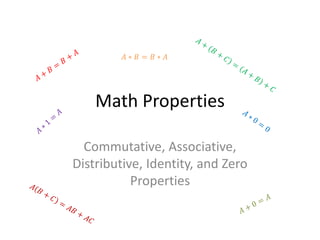
Math Properties
Commutative, Associative,
Distributive, Identity, and Zero
Properties
𝐴 ∗ 𝐵 = 𝐵 ∗ 𝐴
What are properties?
Math Properties are rules in math.
Properties are always true for every
number.
**Once you go beyond the set of Real numbers the properties may no longer hold.
Commute
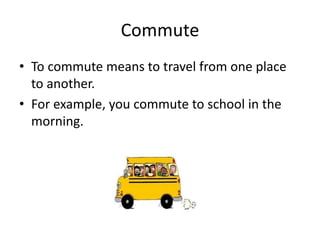
• To commute means to travel from one place
to another.
• For example, you commute to school in the
morning.
Commutative Property
• Just like you commute from home to school, a
number may commute from one spot to
another.
• A + B = B + A (The numbers change places.)
• This is called the commutative property of
addition.
• Ex) 2 + 3 = 3 + 2
• Both 2 + 3 and 3 + 2 equal 5.
The commutative property may be used with
addition as seen previously and also with
multiplication.
• A * B = B * A
• Ex) 3 * 5 = 5 * 3
• Both 3 * 5 and 5 * 3 equal 15.
• This is called the commutative property of
multiplication.
Associate
• An associate is a friend or someone
you work with.
• For example, the head cheerleader is
an associate of the school mascot.
Now imagine the football team played a late game
and the cheerleader and mascot forgot to study for
the math test.
Suddenly the cheerleader associates
with someone else.
Associative Property
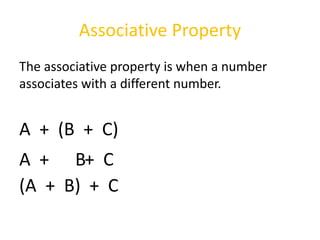
The associative property is when a number
associates with a different number.
A + (B + C)
(A + B) + C
A + + C
B
Associative Property
• (A + B) + C = A + (B + C) is called the
associative property of addition.
• Ex) (2 + 3) + 4 = 2 + (3 + 4)
• The order in which you add does not change
your answer.
• A * (B * C) = (A * B) * C is called the
associative property of multiplication.
Identity
• Your identity is who you are.
• Changing your clothes or getting a new haircut
does not change your identity.
• Your identity remains the same.
Identity Property of Addition
• A number also has an identity
• The identity of a number is the value of the
number
• The additive identity is the number that when
added to another number does not change
the identity of the original number
• 3 + __ = 3 (What goes in the blank?)
0
Zero
• The additive identity is zero.
• We can add zero to any number
and the answer is the original
number.
Identity Property of Multiplication
• We also have a multiplicative identity
• 3 * __ = 3 (What goes in this blank?)
• We can multiply any number by one and the
answer will be the original number.
1
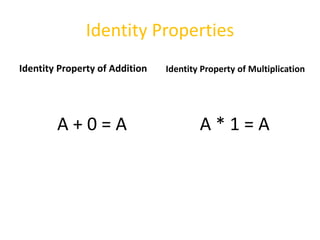
Identity Properties
Identity Property of Addition
A + 0 = A
Identity Property of Multiplication
A * 1 = A
Zero Property
• The zero property sounds just like what it is, a
property about zero.
• A * 0 = 0
• The zero property tells us that any number
multiplied by zero equals zero.
Summary
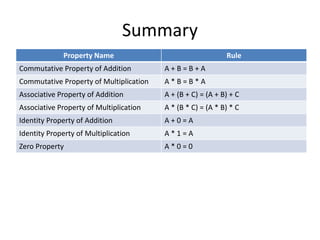
Property Name Rule
Commutative Property of Addition A + B = B + A
Commutative Property of Multiplication A * B = B * A
Associative Property of Addition A + (B + C) = (A + B) + C
Associative Property of Multiplication A * (B * C) = (A * B) * C
Identity Property of Addition A + 0 = A
Identity Property of Multiplication A * 1 = A
Zero Property A * 0 = 0
Distribute
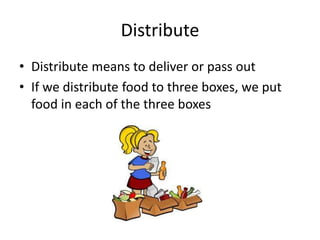
• Distribute means to deliver or pass out
• If we distribute food to three boxes, we put
food in each of the three boxes
Distributive Property
• A(B + C) = A*B + A*C
• The A is the food and the boxes are B and C.
• We pass out A to each of B and C.
• In this case that means that we multiply A by
both B and C separately and then add the
resulting products.
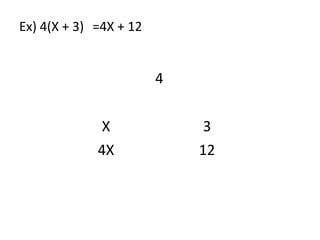
Ex) 4(X + 3)
4
X 3
4X 12
=4X + 12
Now you try these examples.
1) 5(X + 3) =
2) 7(X + 4) =
3) 2(Z -3) =
5X + 15
7X + 28
2Z - 6
Summary
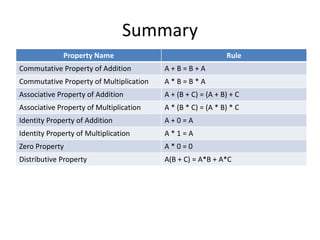
Property Name Rule
Commutative Property of Addition A + B = B + A
Commutative Property of Multiplication A * B = B * A
Associative Property of Addition A + (B + C) = (A + B) + C
Associative Property of Multiplication A * (B * C) = (A * B) * C
Identity Property of Addition A + 0 = A
Identity Property of Multiplication A * 1 = A
Zero Property A * 0 = 0
Distributive Property A(B + C) = A*B + A*C

Math Properties Commutative Associative and Distributive.pptx

  • 1.
    Math Properties Commutative, Associative, Distributive,Identity, and Zero Properties 𝐴 ∗ 𝐵 = 𝐵 ∗ 𝐴
  • 2.
    What are properties? MathProperties are rules in math. Properties are always true for every number. **Once you go beyond the set of Real numbers the properties may no longer hold.
  • 3.
    Commute • To commutemeans to travel from one place to another. • For example, you commute to school in the morning.
  • 4.
    Commutative Property • Justlike you commute from home to school, a number may commute from one spot to another. • A + B = B + A (The numbers change places.) • This is called the commutative property of addition. • Ex) 2 + 3 = 3 + 2 • Both 2 + 3 and 3 + 2 equal 5.
  • 5.
    The commutative propertymay be used with addition as seen previously and also with multiplication. • A * B = B * A • Ex) 3 * 5 = 5 * 3 • Both 3 * 5 and 5 * 3 equal 15. • This is called the commutative property of multiplication.
  • 6.
    Associate • An associateis a friend or someone you work with. • For example, the head cheerleader is an associate of the school mascot.
  • 7.
    Now imagine thefootball team played a late game and the cheerleader and mascot forgot to study for the math test. Suddenly the cheerleader associates with someone else.
  • 8.
    Associative Property The associativeproperty is when a number associates with a different number. A + (B + C) (A + B) + C A + + C B
  • 9.
    Associative Property • (A+ B) + C = A + (B + C) is called the associative property of addition. • Ex) (2 + 3) + 4 = 2 + (3 + 4) • The order in which you add does not change your answer. • A * (B * C) = (A * B) * C is called the associative property of multiplication.
  • 10.
    Identity • Your identityis who you are. • Changing your clothes or getting a new haircut does not change your identity. • Your identity remains the same.
  • 11.
    Identity Property ofAddition • A number also has an identity • The identity of a number is the value of the number • The additive identity is the number that when added to another number does not change the identity of the original number • 3 + __ = 3 (What goes in the blank?) 0
  • 12.
    Zero • The additiveidentity is zero. • We can add zero to any number and the answer is the original number.
  • 13.
    Identity Property ofMultiplication • We also have a multiplicative identity • 3 * __ = 3 (What goes in this blank?) • We can multiply any number by one and the answer will be the original number. 1
  • 14.
    Identity Properties Identity Propertyof Addition A + 0 = A Identity Property of Multiplication A * 1 = A
  • 15.
    Zero Property • Thezero property sounds just like what it is, a property about zero. • A * 0 = 0 • The zero property tells us that any number multiplied by zero equals zero.
  • 16.
    Summary Property Name Rule CommutativeProperty of Addition A + B = B + A Commutative Property of Multiplication A * B = B * A Associative Property of Addition A + (B + C) = (A + B) + C Associative Property of Multiplication A * (B * C) = (A * B) * C Identity Property of Addition A + 0 = A Identity Property of Multiplication A * 1 = A Zero Property A * 0 = 0
  • 17.
    Distribute • Distribute meansto deliver or pass out • If we distribute food to three boxes, we put food in each of the three boxes
  • 18.
    Distributive Property • A(B+ C) = A*B + A*C • The A is the food and the boxes are B and C. • We pass out A to each of B and C. • In this case that means that we multiply A by both B and C separately and then add the resulting products.
  • 19.
    Ex) 4(X +3) 4 X 3 4X 12 =4X + 12
  • 20.
    Now you trythese examples. 1) 5(X + 3) = 2) 7(X + 4) = 3) 2(Z -3) = 5X + 15 7X + 28 2Z - 6
  • 21.
    Summary Property Name Rule CommutativeProperty of Addition A + B = B + A Commutative Property of Multiplication A * B = B * A Associative Property of Addition A + (B + C) = (A + B) + C Associative Property of Multiplication A * (B * C) = (A * B) * C Identity Property of Addition A + 0 = A Identity Property of Multiplication A * 1 = A Zero Property A * 0 = 0 Distributive Property A(B + C) = A*B + A*C