Commutative and
Associative Properties
Commutative and Associative Properties
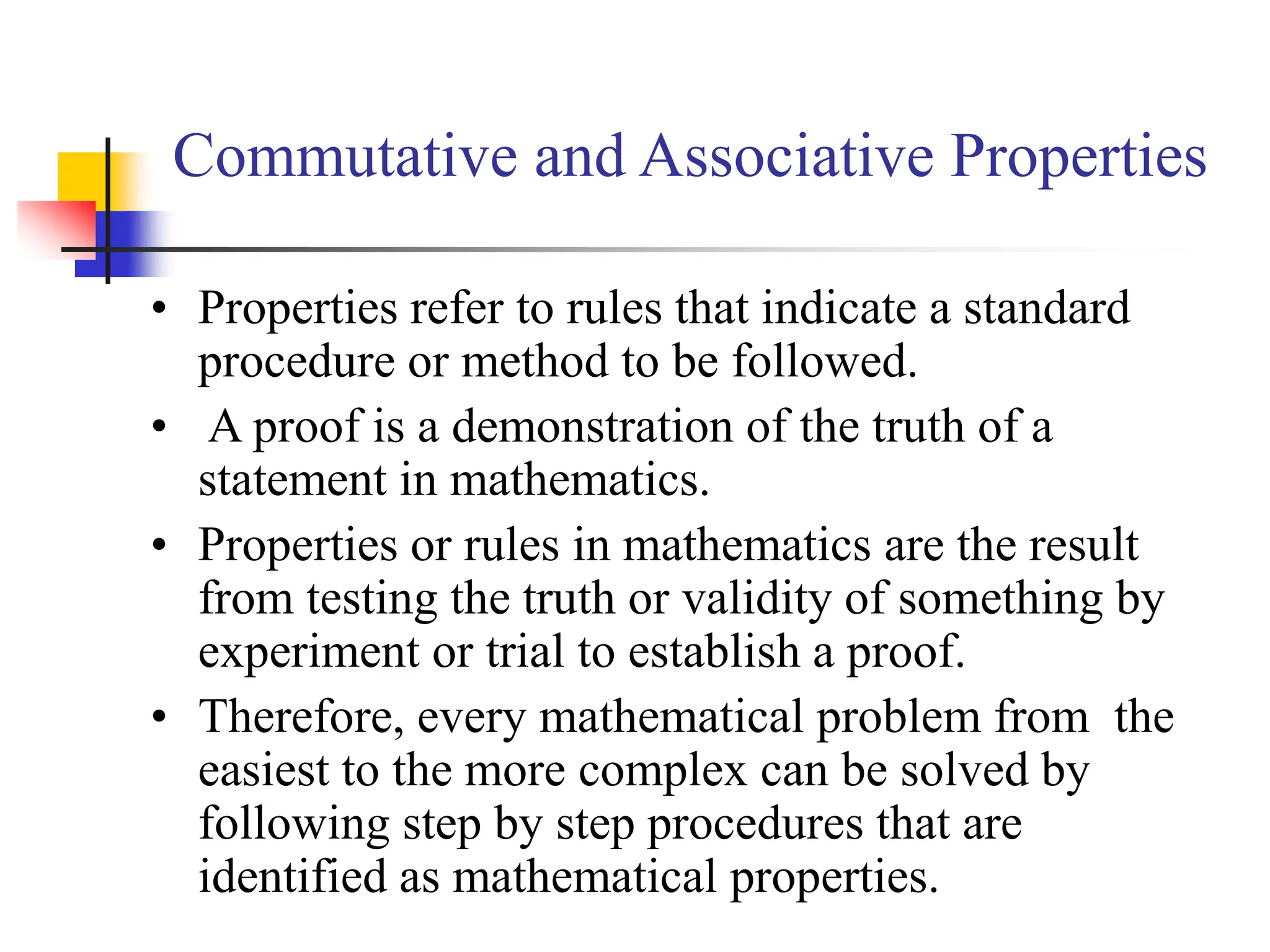
• Properties refer to rules that indicate a standard
procedure or method to be followed.
• A proof is a demonstration of the truth of a
statement in mathematics.
• Properties or rules in mathematics are the result
from testing the truth or validity of something by
experiment or trial to establish a proof.
• Therefore, every mathematical problem from the
easiest to the more complex can be solved by
following step by step procedures that are
identified as mathematical properties.
Commutative and Associative Properties
• Commutative Property means changing the order
in which you add or subtract numbers does not
change the sum or product.
• Associative Property means changing the
grouping of numbers when adding or multiplying
does not change their sum or product.
• Grouping symbols are typically parentheses (),but
can include brackets [] or Braces {}.
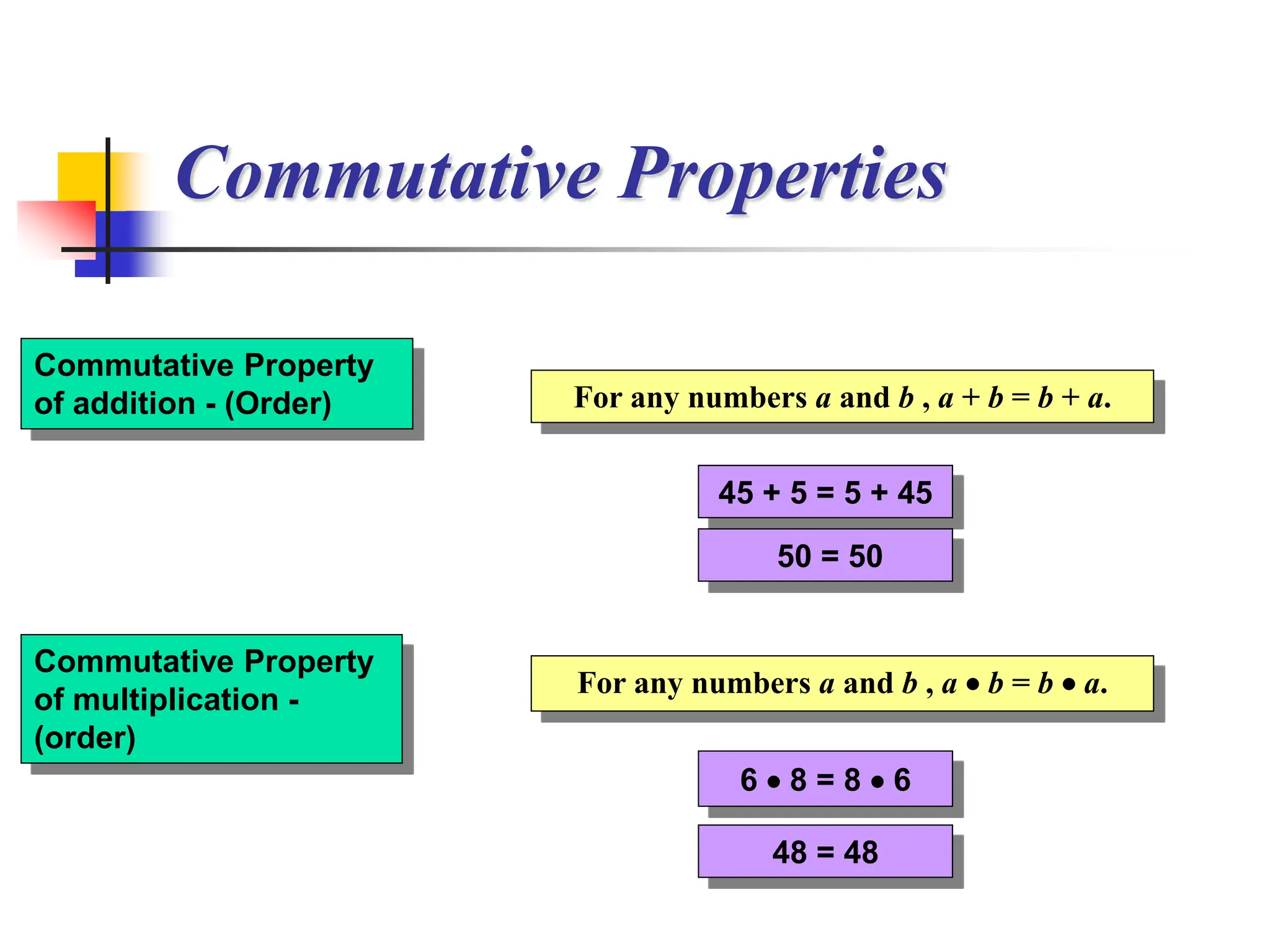
Commutative Property
of addition - (Order)
Commutative Property
of multiplication -
(order)
For any numbers a and b , a + b = b + a.
For any numbers a and b , a  b = b  a.
45 + 5 = 5 + 45
6  8 = 8  6
50 = 50
48 = 48
Commutative Properties
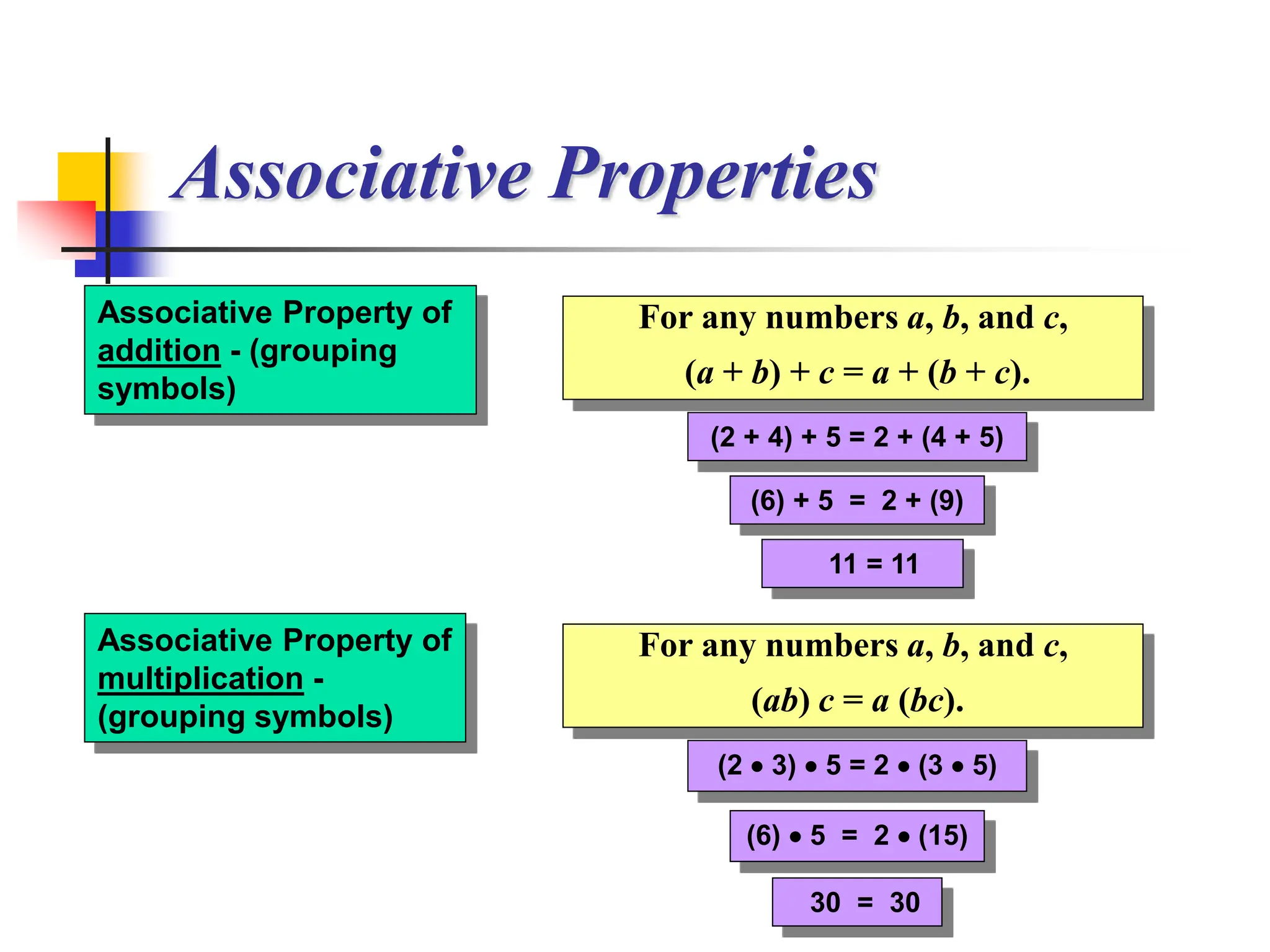
Associative Property of
addition - (grouping
symbols)
Associative Property of
multiplication -
(grouping symbols)
For any numbers a, b, and c,
(a + b) + c = a + (b + c).
For any numbers a, b, and c,
(ab) c = a (bc).
(2 + 4) + 5 = 2 + (4 + 5)
(2  3)  5 = 2  (3  5)
(6) + 5 = 2 + (9)
11 = 11
(6)  5 = 2  (15)
30 = 30
Associative Properties
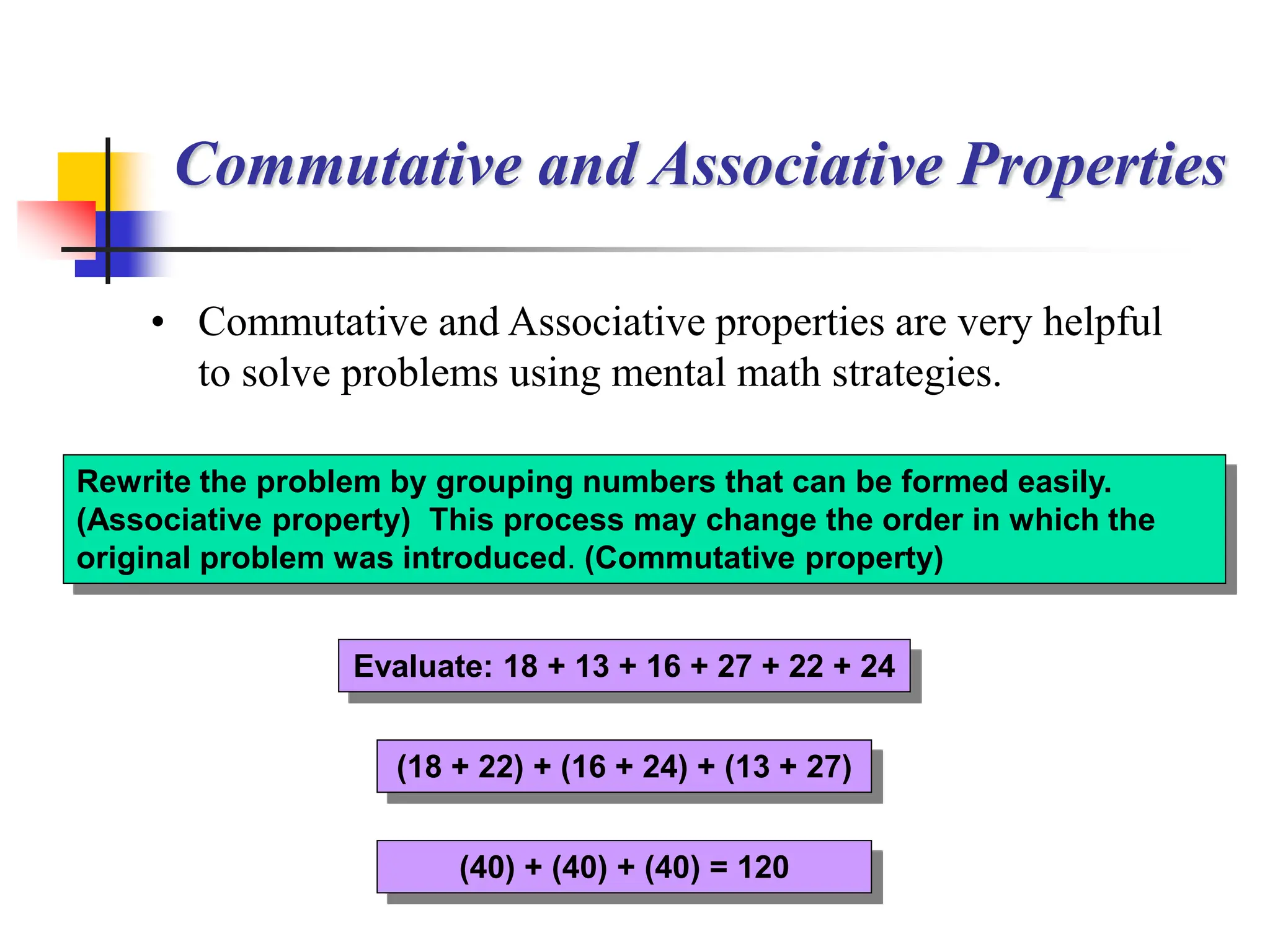
Evaluate: 18 + 13 + 16 + 27 + 22 + 24
Rewrite the problem by grouping numbers that can be formed easily.
(Associative property) This process may change the order in which the
original problem was introduced. (Commutative property)
(18 + 22) + (16 + 24) + (13 + 27)
(40) + (40) + (40) = 120
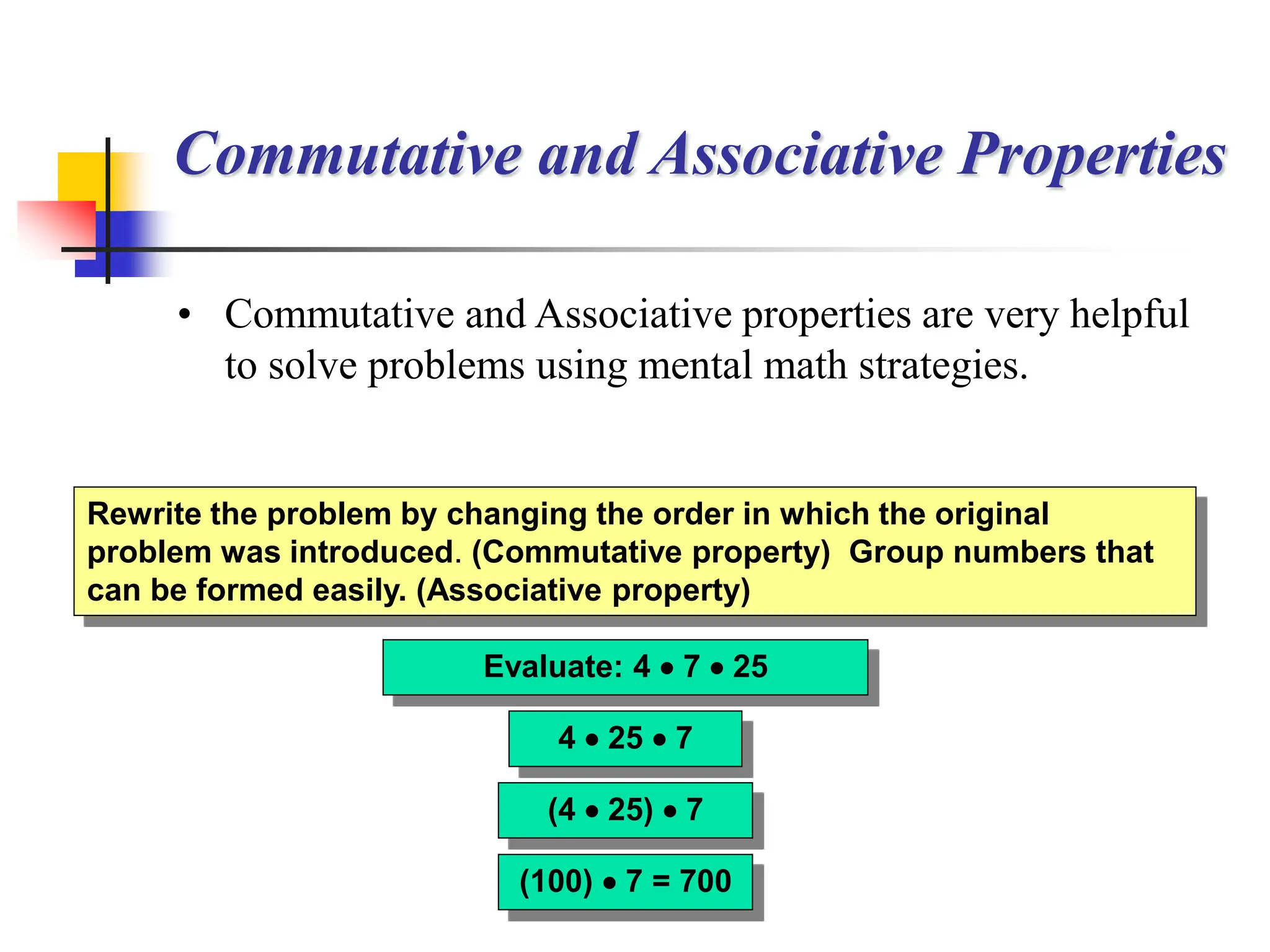
Commutative and Associative Properties
• Commutative and Associative properties are very helpful
to solve problems using mental math strategies.
Evaluate: 4  7  25
Rewrite the problem by changing the order in which the original
problem was introduced. (Commutative property) Group numbers that
can be formed easily. (Associative property)
4  25  7
(4  25)  7
(100)  7 = 700
Commutative and Associative Properties
• Commutative and Associative properties are very helpful
to solve problems using mental math strategies.

Associative and Commutative Property.ppt

  • 1.
  • 2.
    Commutative and AssociativeProperties • Properties refer to rules that indicate a standard procedure or method to be followed. • A proof is a demonstration of the truth of a statement in mathematics. • Properties or rules in mathematics are the result from testing the truth or validity of something by experiment or trial to establish a proof. • Therefore, every mathematical problem from the easiest to the more complex can be solved by following step by step procedures that are identified as mathematical properties.
  • 3.
    Commutative and AssociativeProperties • Commutative Property means changing the order in which you add or subtract numbers does not change the sum or product. • Associative Property means changing the grouping of numbers when adding or multiplying does not change their sum or product. • Grouping symbols are typically parentheses (),but can include brackets [] or Braces {}.
  • 4.
    Commutative Property of addition- (Order) Commutative Property of multiplication - (order) For any numbers a and b , a + b = b + a. For any numbers a and b , a  b = b  a. 45 + 5 = 5 + 45 6  8 = 8  6 50 = 50 48 = 48 Commutative Properties
  • 5.
    Associative Property of addition- (grouping symbols) Associative Property of multiplication - (grouping symbols) For any numbers a, b, and c, (a + b) + c = a + (b + c). For any numbers a, b, and c, (ab) c = a (bc). (2 + 4) + 5 = 2 + (4 + 5) (2  3)  5 = 2  (3  5) (6) + 5 = 2 + (9) 11 = 11 (6)  5 = 2  (15) 30 = 30 Associative Properties
  • 6.
    Evaluate: 18 +13 + 16 + 27 + 22 + 24 Rewrite the problem by grouping numbers that can be formed easily. (Associative property) This process may change the order in which the original problem was introduced. (Commutative property) (18 + 22) + (16 + 24) + (13 + 27) (40) + (40) + (40) = 120 Commutative and Associative Properties • Commutative and Associative properties are very helpful to solve problems using mental math strategies.
  • 7.
    Evaluate: 4 7  25 Rewrite the problem by changing the order in which the original problem was introduced. (Commutative property) Group numbers that can be formed easily. (Associative property) 4  25  7 (4  25)  7 (100)  7 = 700 Commutative and Associative Properties • Commutative and Associative properties are very helpful to solve problems using mental math strategies.