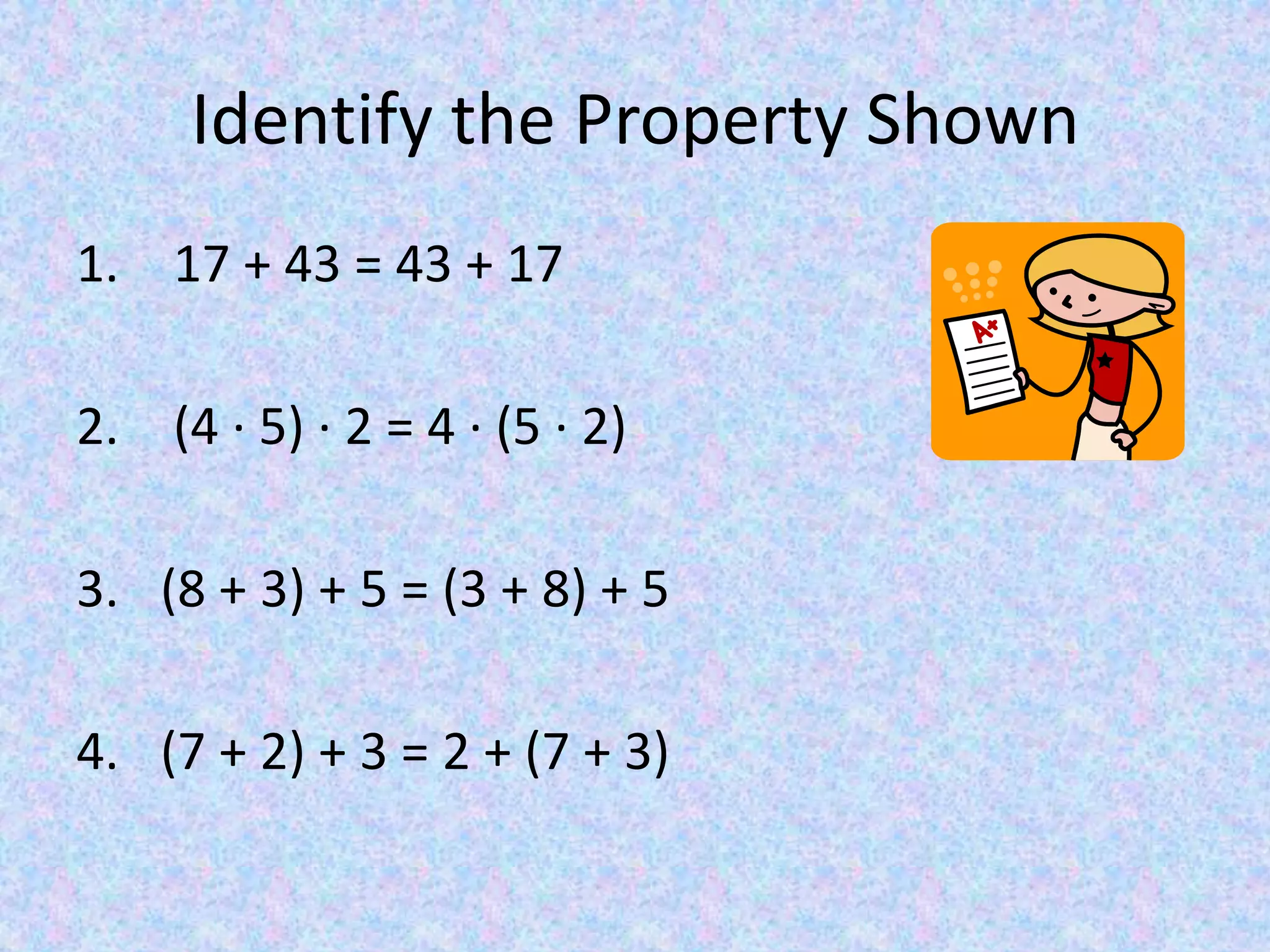
The document discusses the commutative and associative properties of real numbers. The commutative property states that the order of numbers does not matter in addition and multiplication, but it does matter in subtraction and division. The associative property states that the grouping of numbers does not matter in addition and multiplication, but it does matter in subtraction and division. Both properties only apply to addition and multiplication, not subtraction and division.
In this document
Powered by AI
Definition and implications of the Commutative Property for addition and multiplication, along with its ineffectiveness in subtraction and division.
Definition and implications of the Associative Property for addition and multiplication, emphasizing its failure in subtraction and division.
Examples illustrating the identification of the Commutative and Associative Properties in mathematical operations.
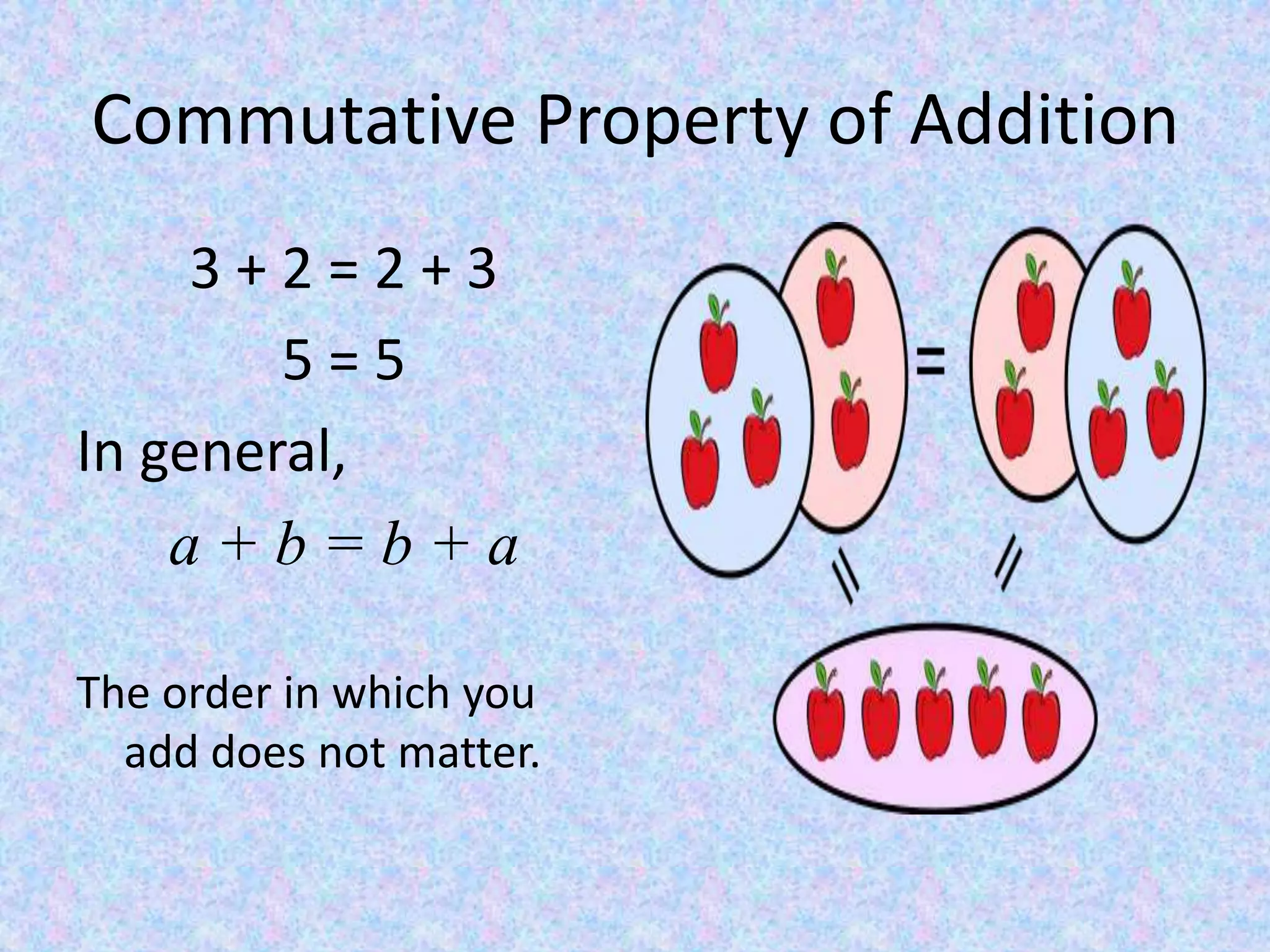
Commutative Property ofAddition3 + 2 = 2 + 35 = 5In general,a + b = b + aThe order in which you add does not matter.
3.
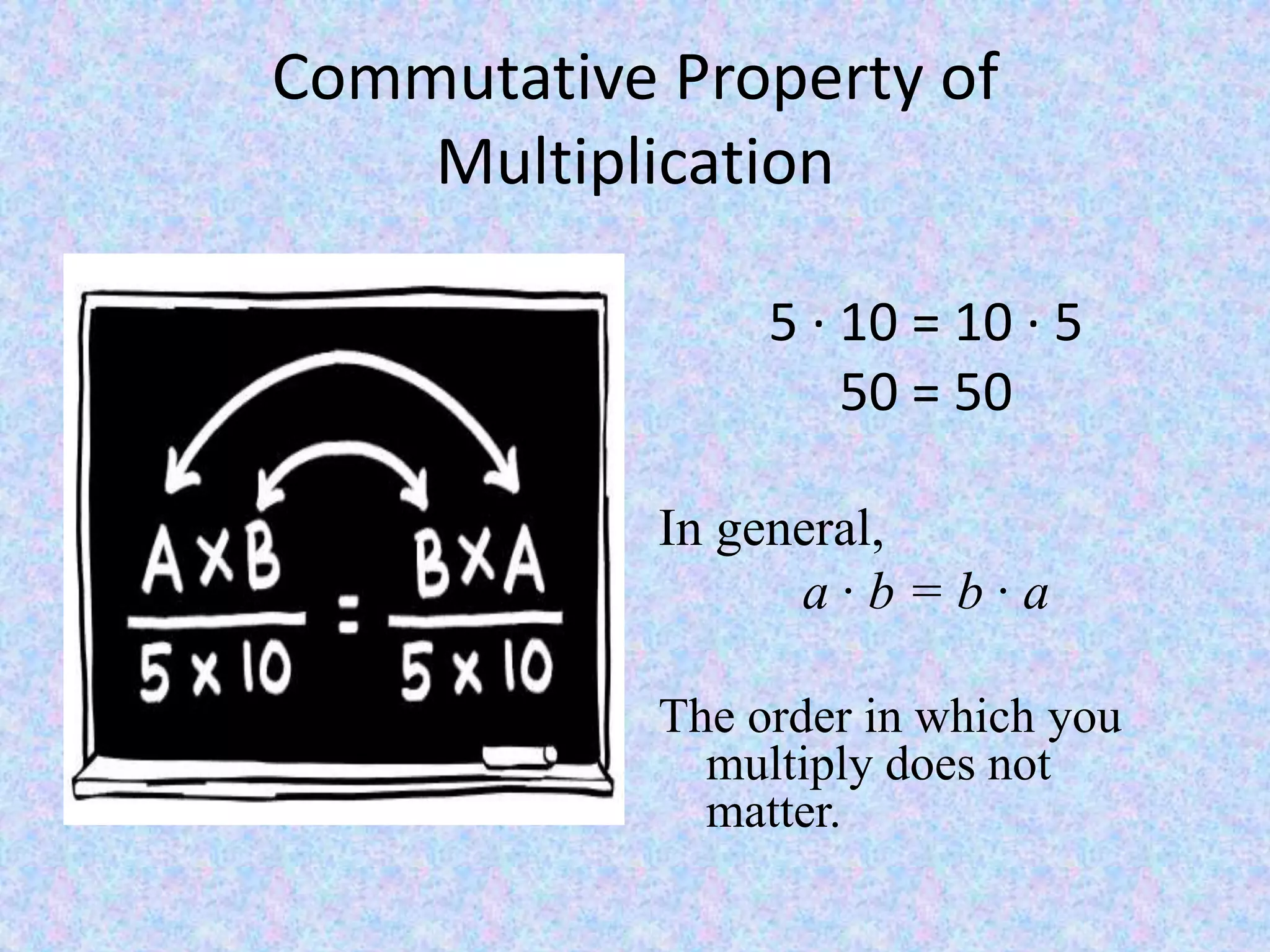
Commutative Property ofMultiplication5∙ 10 = 10 ∙ 550 = 50In general,a ∙ b = b ∙ aThe order in which you multiply does not matter.
4.
The Commutative Propertydoes not hold for subtraction and division.Look at the following examples: 1) Does 8 – 3 = 3 – 8 ? 5 ≠ -5 No! 2) Does 8 ÷ 4 = 4 ÷ 8 ? 2 ≠ ½ No!If you change the order in a subtraction or division problem, you get a different answer.
5.
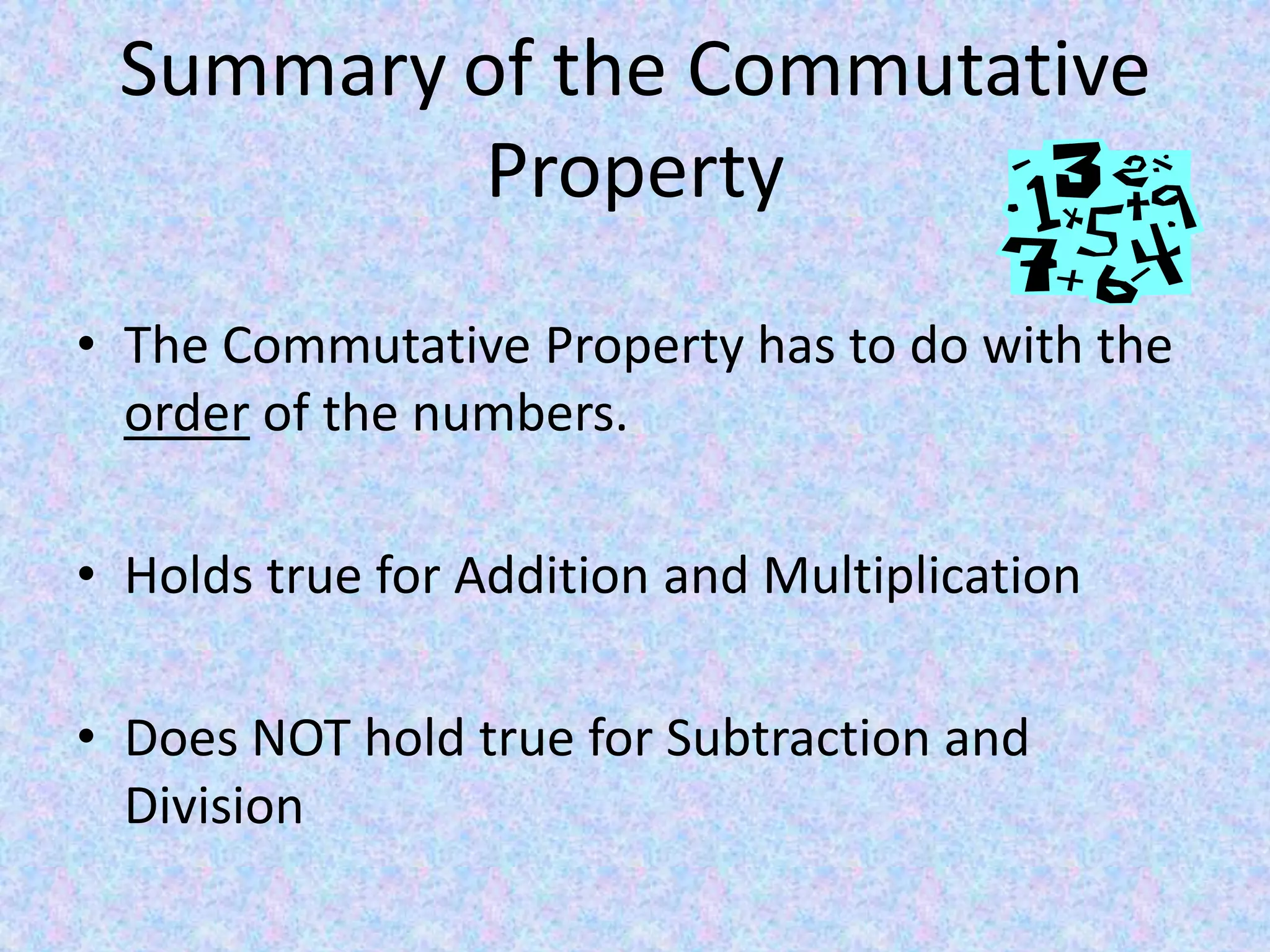
Summaryof the CommutativePropertyThe Commutative Property has to do with the order of the numbers.Holds true for Addition and MultiplicationDoes NOT hold true for Subtraction and Division
6.
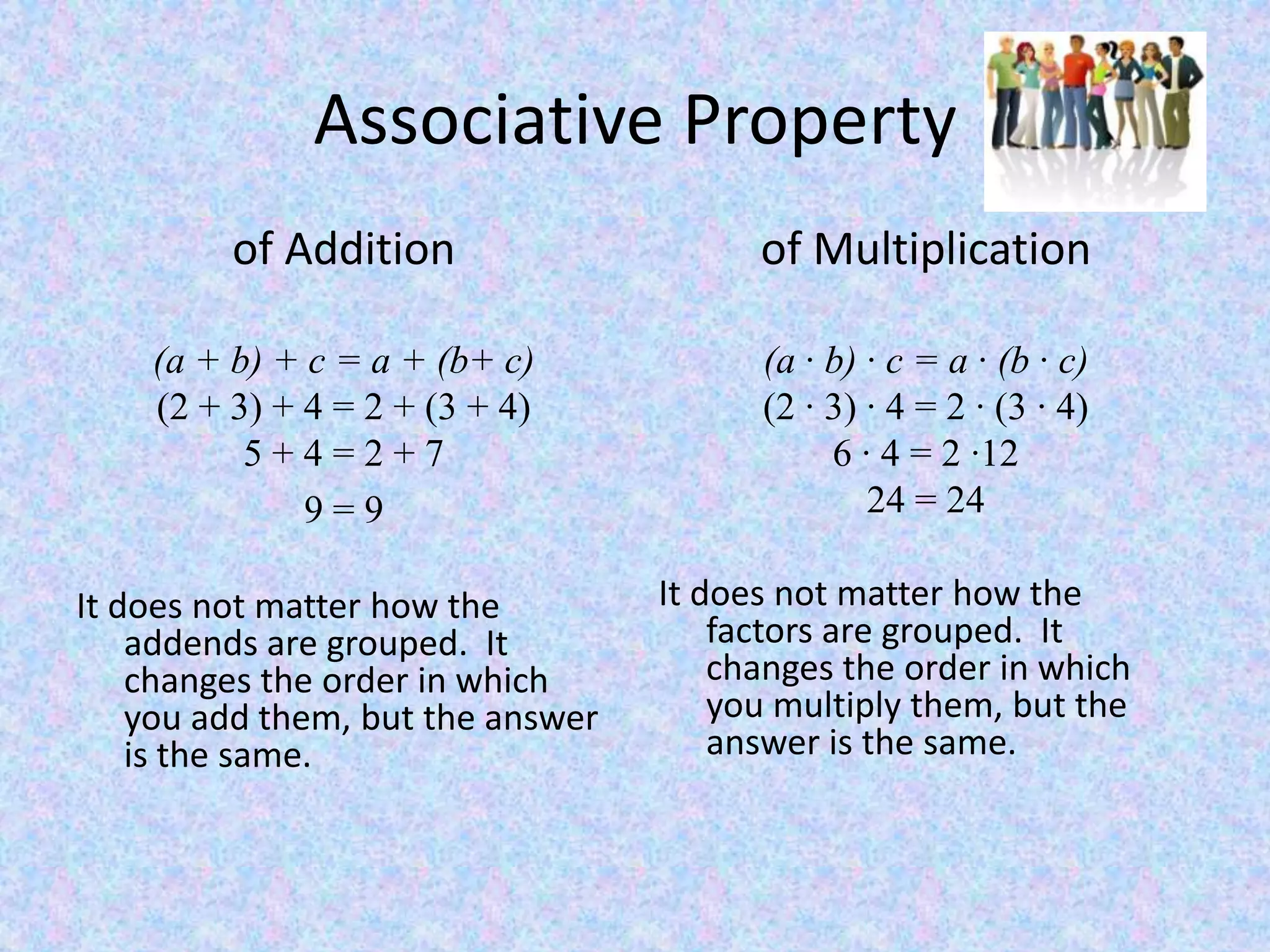
Associative Property ofAddition (a + b) + c = a + (b+ c)(2 + 3) + 4 = 2 + (3 + 4)5 + 4 = 2 + 79 = 9It does not matter how the addends are grouped. It changes the order in which you add them, but the answer is the same.of Multiplication(a ∙ b) ∙ c = a ∙ (b ∙ c)(2 ∙ 3) ∙ 4 = 2 ∙ (3 ∙ 4)6 ∙ 4 = 2 ∙1224 = 24It does not matter how the factors are grouped. It changes the order in which you multiply them, but the answer is the same.
7.
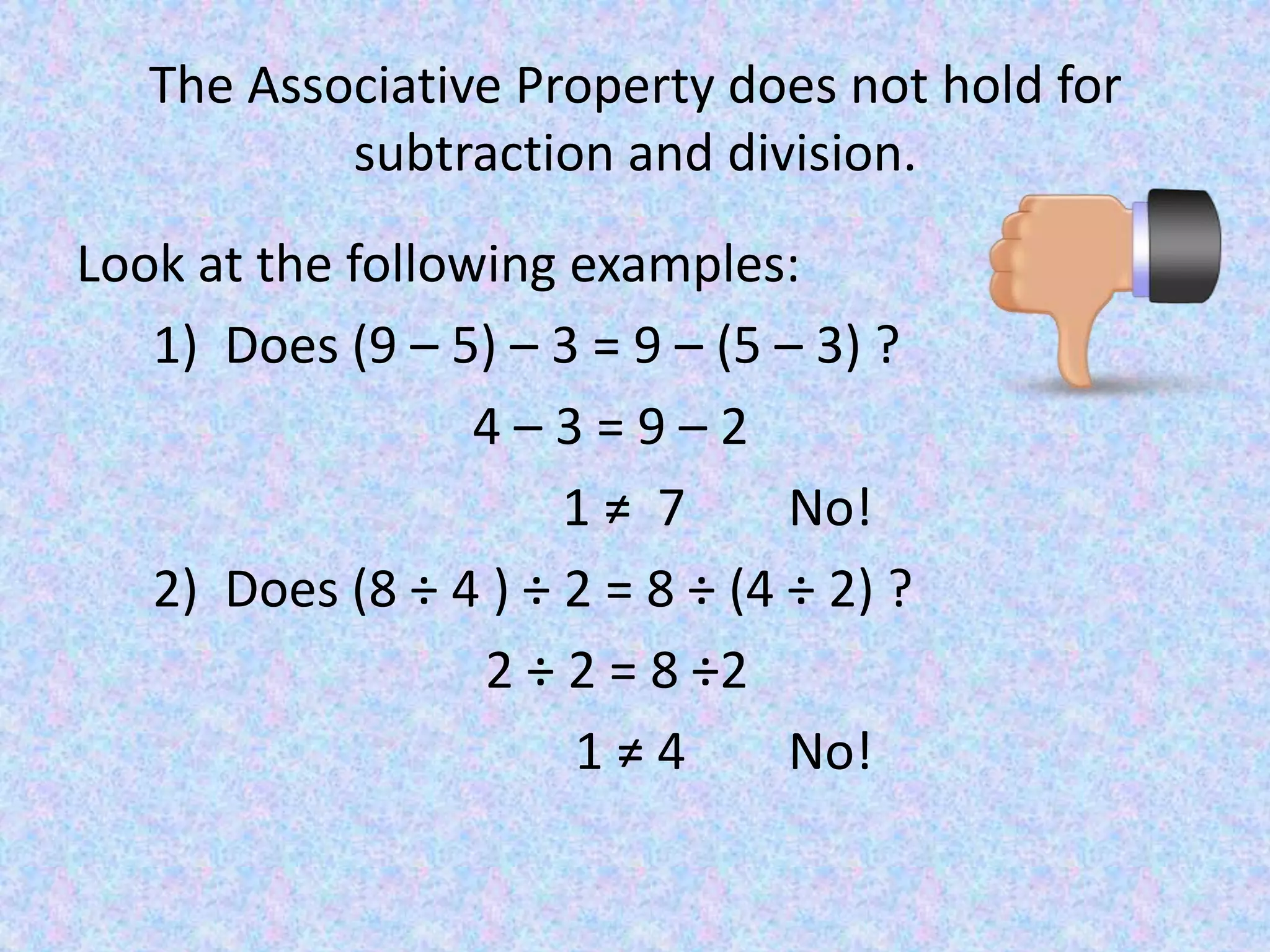
The Associative Propertydoes not hold for subtraction and division.Look at the following examples: 1) Does (9 – 5) – 3 = 9 – (5 – 3) ? 4 – 3 = 9 – 2 1 ≠ 7 No! 2) Does (8 ÷ 4 ) ÷ 2 = 8 ÷ (4 ÷ 2) ? 2 ÷ 2 = 8 ÷2 1 ≠ 4 No!
8.
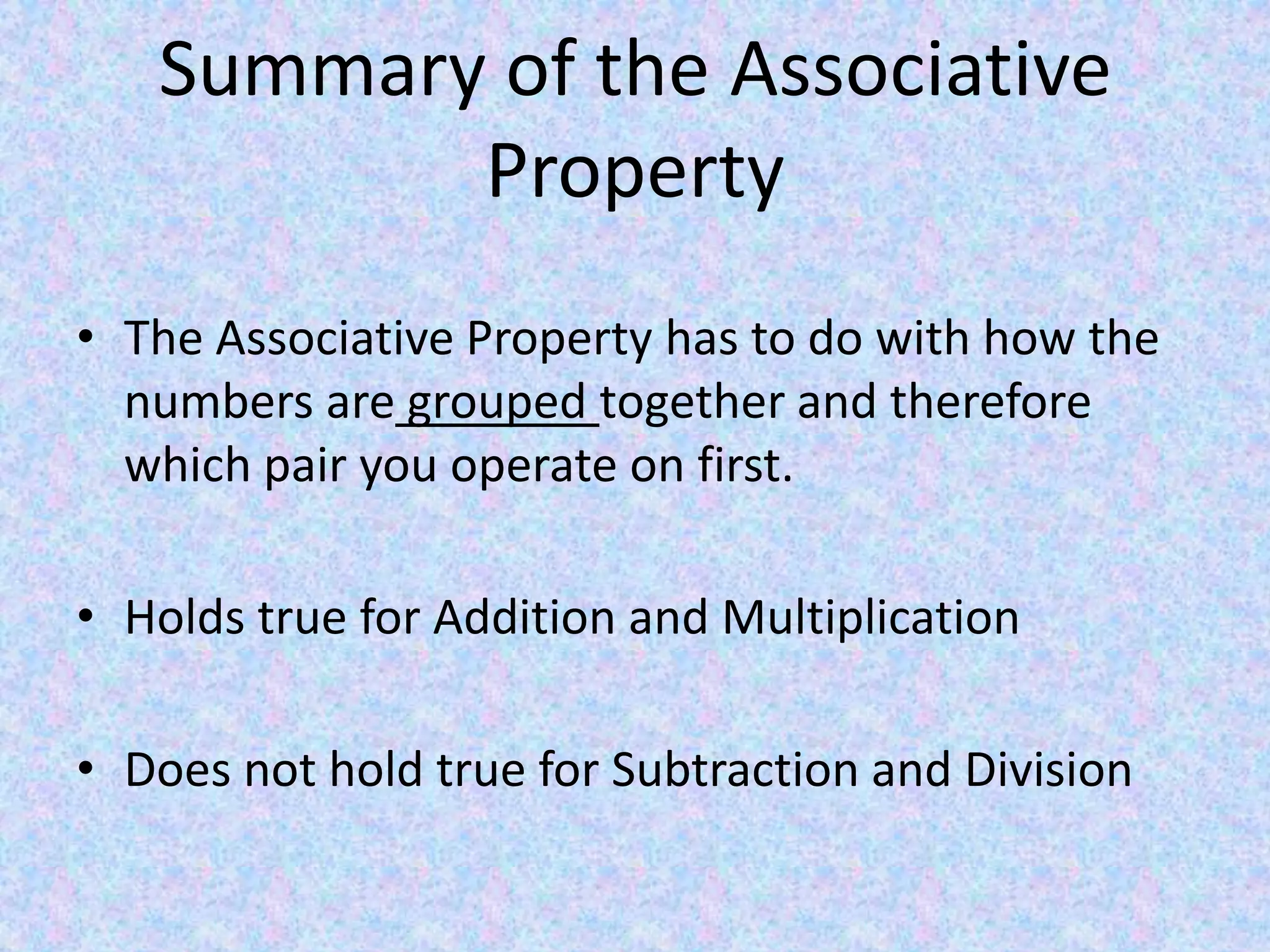
Summary of theAssociative PropertyThe Associative Property has to do with how the numbers are grouped together and therefore which pair you operate on first.Holds true for Addition and MultiplicationDoes not hold true for Subtraction and Division