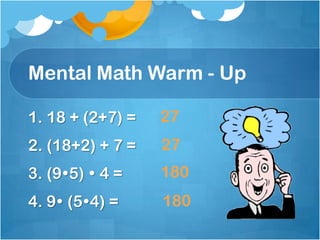
Mental Math Warm - Up

1. 18 + (2+7) =   27
2. (18+2) + 7 =   27
3. (95)  4 =    180
4. 9 (54) =     180
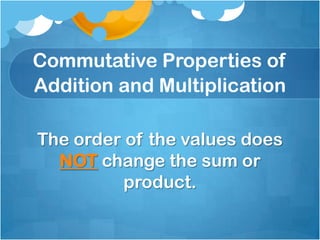
Commutative Properties of
Addition and Multiplication

The order of the values does
  NOT change the sum or
          product.
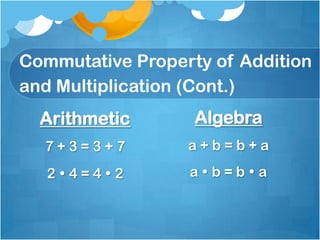
Commutative Property of Addition
and Multiplication (Cont.)
  Arithmetic       Algebra
  7+3=3+7         a+b=b+a
   24=42        ab=ba
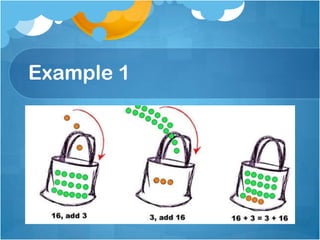
Example 1
Associative Property of
Addition and Multiplication

 The grouping of the values
does NOT change the sum or
         product.
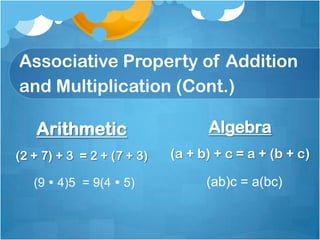
Associative Property of Addition
and Multiplication (Cont.)

   Arithmetic                     Algebra
(2 + 7) + 3 = 2 + (7 + 3)   (a + b) + c = a + (b + c)

   (9  4)5 = 9(4  5)            (ab)c = a(bc)
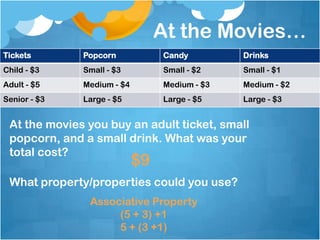
At the Movies…
Tickets       Popcorn            Candy         Drinks
Child - $3    Small - $3         Small - $2    Small - $1
Adult - $5    Medium - $4        Medium - $3   Medium - $2
Senior - $3   Large - $5         Large - $5    Large - $3


 At the movies you buy an adult ticket, small
 popcorn, and a small drink. What was your
 total cost?
                            $9
 What property/properties could you use?
               Associative Property
                    (5 + 3) +1
                    5 + (3 +1)
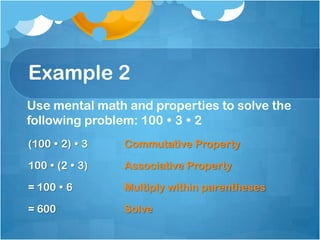
Example 2
Use mental math and properties to solve the
following problem: 100  3  2
(100  2)  3   Commutative Property

100  (2  3)   Associative Property

= 100  6       Multiply within parentheses

= 600           Solve
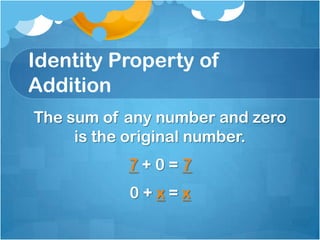
Identity Property of
Addition
The sum of any number and zero
     is the original number.
           7+0=7
           0+x=x
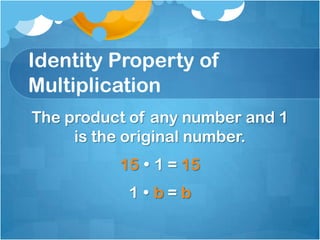
Identity Property of
Multiplication
The product of any number and 1
     is the original number.
          15  1 = 15
           1b=b
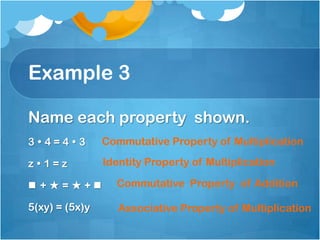
Example 3

Name each property shown.
34=43         Commutative Property of Multiplication

z1=z           Identity Property of Multiplication

 +★=★+          Commutative Property of Addition

5(xy) = (5x)y      Associative Property of Multiplication
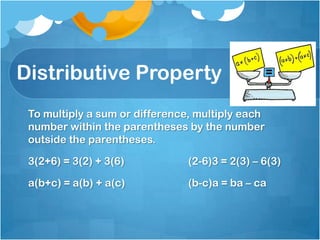
Distributive Property
 To multiply a sum or difference, multiply each
 number within the parentheses by the number
 outside the parentheses.

 3(2+6) = 3(2) + 3(6)           (2-6)3 = 2(3) – 6(3)

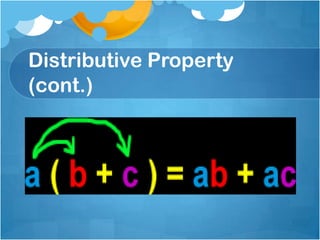
 a(b+c) = a(b) + a(c)           (b-c)a = ba – ca
Distributive Property
(cont.)
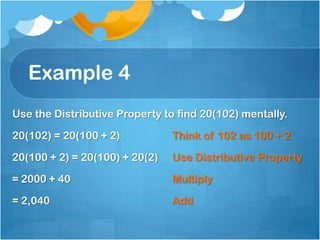
Example 4
Use the Distributive Property to find 20(102) mentally.

20(102) = 20(100 + 2)           Think of 102 as 100 + 2

20(100 + 2) = 20(100) + 20(2)   Use Distributive Property

= 2000 + 40                     Multiply

= 2,040                         Add
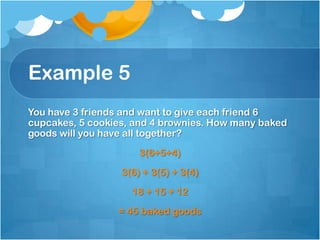
Example 5
You have 3 friends and want to give each friend 6
cupcakes, 5 cookies, and 4 brownies. How many baked
goods will you have all together?
                      3(6+5+4)
                  3(6) + 3(5) + 3(4)
                    18 + 15 + 12
                 = 45 baked goods
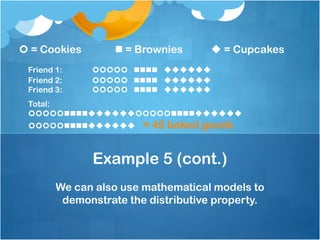
 = Cookies         = Brownies       = Cupcakes
 Friend 1:      
 Friend 2:      
 Friend 3:      
 Total:
 
         = 45 baked goods


              Example 5 (cont.)
        We can also use mathematical models to
         demonstrate the distributive property.
Practice Problems
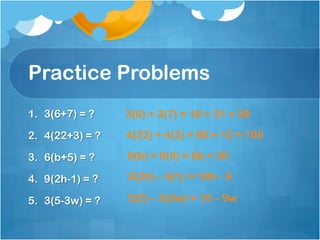
1. 3(6+7) = ?    3(6) + 3(7) = 18 + 21 = 39

2. 4(22+3) = ?   4(22) + 4(3) = 88 + 12 = 100

3. 6(b+5) = ?    6(b) + 6(5) = 6b + 30

4. 9(2h-1) = ?   9(2h) – 9(1) = 18h - 9

5. 3(5-3w) = ?   3(5) – 3(3w) = 15 – 9w
Practice Problems (Cont.)
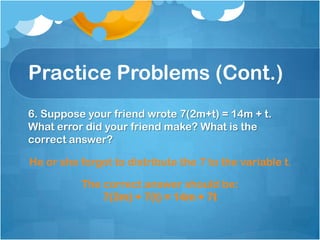
6. Suppose your friend wrote 7(2m+t) = 14m + t.
What error did your friend make? What is the
correct answer?

He or she forgot to distribute the 7 to the variable t.

           The correct answer should be:
               7(2m) + 7(t) = 14m + 7t
Picture Citations:

Light Bulb Guy Picture (Slide 2) -
http://www.cascadewellnessclinic.com/articles/2003art/0311art.shtml

Shopping Bag Picture (Slide 5) –
http://www.education.vic.gov.au/studentlearning/teachingresources/maths/mathscon
tinuum/structure/st275ma.htm

Distributive Arrow picture (Slide 14) - http://www.coolmath.com/reference/math-
dictionary-D.html

Distributive Property Balance (Slide 13) -
http://www.leslienettling.com/6thNewsletters/6thSep8-06.htm
Content Citations
Badur, Michalina Central Michigan University student

Davison, David M., Marsha S. Landau, Leah McCracken, and Linda Thompson.
       Prentice Hall Pre-algebra: Tools for a Changing World. Upper Saddle
       River, NJ: Prentice Hall, 2001. Print.

EDU 290H PowerPoint

  • 2.
    Mental Math Warm- Up 1. 18 + (2+7) = 27 2. (18+2) + 7 = 27 3. (95)  4 = 180 4. 9 (54) = 180
  • 3.
    Commutative Properties of Additionand Multiplication The order of the values does NOT change the sum or product.
  • 4.
    Commutative Property ofAddition and Multiplication (Cont.) Arithmetic Algebra 7+3=3+7 a+b=b+a 24=42 ab=ba
  • 5.
  • 6.
    Associative Property of Additionand Multiplication The grouping of the values does NOT change the sum or product.
  • 7.
    Associative Property ofAddition and Multiplication (Cont.) Arithmetic Algebra (2 + 7) + 3 = 2 + (7 + 3) (a + b) + c = a + (b + c) (9  4)5 = 9(4  5) (ab)c = a(bc)
  • 8.
    At the Movies… Tickets Popcorn Candy Drinks Child - $3 Small - $3 Small - $2 Small - $1 Adult - $5 Medium - $4 Medium - $3 Medium - $2 Senior - $3 Large - $5 Large - $5 Large - $3 At the movies you buy an adult ticket, small popcorn, and a small drink. What was your total cost? $9 What property/properties could you use? Associative Property (5 + 3) +1 5 + (3 +1)
  • 9.
    Example 2 Use mentalmath and properties to solve the following problem: 100  3  2 (100  2)  3 Commutative Property 100  (2  3) Associative Property = 100  6 Multiply within parentheses = 600 Solve
  • 10.
    Identity Property of Addition Thesum of any number and zero is the original number. 7+0=7 0+x=x
  • 11.
    Identity Property of Multiplication Theproduct of any number and 1 is the original number. 15  1 = 15 1b=b
  • 12.
    Example 3 Name eachproperty shown. 34=43 Commutative Property of Multiplication z1=z Identity Property of Multiplication  +★=★+ Commutative Property of Addition 5(xy) = (5x)y Associative Property of Multiplication
  • 13.
    Distributive Property Tomultiply a sum or difference, multiply each number within the parentheses by the number outside the parentheses. 3(2+6) = 3(2) + 3(6) (2-6)3 = 2(3) – 6(3) a(b+c) = a(b) + a(c) (b-c)a = ba – ca
  • 14.
  • 15.
    Example 4 Use theDistributive Property to find 20(102) mentally. 20(102) = 20(100 + 2) Think of 102 as 100 + 2 20(100 + 2) = 20(100) + 20(2) Use Distributive Property = 2000 + 40 Multiply = 2,040 Add
  • 16.
    Example 5 You have3 friends and want to give each friend 6 cupcakes, 5 cookies, and 4 brownies. How many baked goods will you have all together? 3(6+5+4) 3(6) + 3(5) + 3(4) 18 + 15 + 12 = 45 baked goods
  • 17.
     = Cookies  = Brownies  = Cupcakes Friend 1:    Friend 2:    Friend 3:    Total:   = 45 baked goods Example 5 (cont.) We can also use mathematical models to demonstrate the distributive property.
  • 18.
    Practice Problems 1. 3(6+7)= ? 3(6) + 3(7) = 18 + 21 = 39 2. 4(22+3) = ? 4(22) + 4(3) = 88 + 12 = 100 3. 6(b+5) = ? 6(b) + 6(5) = 6b + 30 4. 9(2h-1) = ? 9(2h) – 9(1) = 18h - 9 5. 3(5-3w) = ? 3(5) – 3(3w) = 15 – 9w
  • 19.
    Practice Problems (Cont.) 6.Suppose your friend wrote 7(2m+t) = 14m + t. What error did your friend make? What is the correct answer? He or she forgot to distribute the 7 to the variable t. The correct answer should be: 7(2m) + 7(t) = 14m + 7t
  • 20.
    Picture Citations: Light BulbGuy Picture (Slide 2) - http://www.cascadewellnessclinic.com/articles/2003art/0311art.shtml Shopping Bag Picture (Slide 5) – http://www.education.vic.gov.au/studentlearning/teachingresources/maths/mathscon tinuum/structure/st275ma.htm Distributive Arrow picture (Slide 14) - http://www.coolmath.com/reference/math- dictionary-D.html Distributive Property Balance (Slide 13) - http://www.leslienettling.com/6thNewsletters/6thSep8-06.htm
  • 21.
    Content Citations Badur, MichalinaCentral Michigan University student Davison, David M., Marsha S. Landau, Leah McCracken, and Linda Thompson. Prentice Hall Pre-algebra: Tools for a Changing World. Upper Saddle River, NJ: Prentice Hall, 2001. Print.