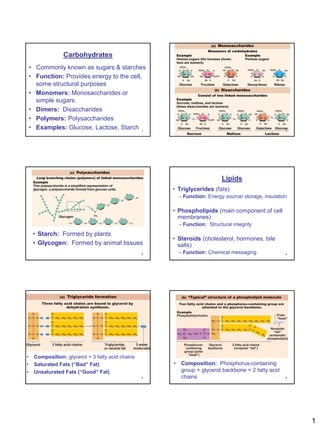
Carbohydrates
    • Commonly known as sugars & starches
    • Function: Provides energy to the cell,
      some structural purposes
    • Monomers: Monosaccharides or
      simple sugars
    • Dimers: Disaccharides
    • Polymers: Polysaccharides
    • Examples: Glucose, Lactose, Starch           1                                                  2


                                                                           Lipids
                                                       • Triglycerides (fats)
                                                         – Function: Energy source/ storage, insulation

                                                       • Phospholipids (main component of cell
                                                         membranes)
                                                         – Function: Structural integrity
     • Starch: Formed by plants
                                                       • Steroids (cholesterol, hormones, bile
     • Glycogen: Formed by animal tissues                salts)
                                                   3     – Function: Chemical messaging               4


•    Composition: glycerol + 3 fatty acid chains
•    Saturated Fats (“Bad” Fat)                        • Composition: Phosphorus-containing
•    Unsaturated Fats (“Good” Fat)                       group + glycerol backbone + 2 fatty acid
                                                   5     chains                                       6


                                                                                                          1
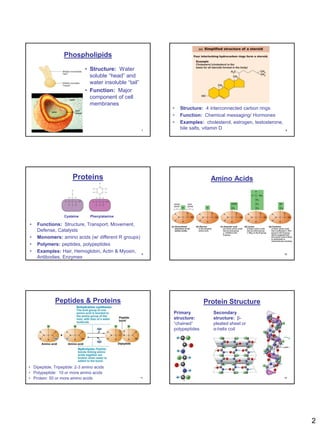
Phospholipids
                             • Structure: Water
                               soluble “head” and
                               water insoluble “tail”
                             • Function: Major
                               component of cell
                               membranes
                                                             •   Structure: 4 interconnected carbon rings
                                                             •   Function: Chemical messaging/ Hormones
                                                             •   Examples: cholesterol, estrogen, testosterone,
                                                        7
                                                                 bile salts, vitamin D                             8


                       Proteins                                               Amino Acids


                  Cysteine      Phenylalanine

•   Functions: Structure, Transport, Movement,
    Defense, Catalysts
•   Monomers: amino acids (w/ different R groups)
•   Polymers: peptides, polypeptides
•   Examples: Hair, Hemoglobin, Actin & Myosin,         9                                                         10
    Antibodies, Enzymes


              Peptides & Proteins                                           Protein Structure
                                                             Primary           Secondary
                                                             structure:        structure: β-
                                                             “chained”         pleated sheet or
                                                             polypeptides      α-helix coil


• Dipeptide, Tripeptide: 2-3 amino acids
• Polypeptide: 10 or more amino acids
• Protein: 50 or more amino acids                       11                                                        12


                                                                                                                       2
Protein Structure                                       Protein Denaturation

                                                          Loss of 3D conformation = Loss of function

                                                          Some causes:
                         Tertiary structure:
                                                            • Extreme pH
                         “3D”, unique folding pattern
                                                            • Extreme temperatures
                                                            • Radiation
                                    Quaternary
                                                            • Harsh chemicals
                                    structure:
                                    2 or more “3D”           Example: Frying an egg, High fevers
                                    structures
                                    combined 13                                                             14


                 Enzymes                                                    Enzymes
• Enzymes are globular, protein catalysts that
  increase the rate of a chemical (metabolic)
  reaction without being consumed by the
  reaction
• Enzymes regulate and coordinate metabolic
  reactions within the cell.                            • Some enzymes are holoenzymes (composed of two
• Basic reactions: building and breaking down             parts), an apoenzyme (protein itself) + a cofactor
  carbohydrates, lipids, proteins, and nucleic          • Some enzymes remain inactive until activated by a
  acids.                                                  cofactor or a coenzyme
• Typically end in –ase (hydrolase, oxydase,            • Cofactors: Metal ions (iron, zinc)
  peptidase)
                                                 15
                                                        • Coenzymes: Vitamins                                16


             Enzyme Activity                                           Enzyme Action


                                                 17
                                                        E+S  E-S  P+ E                                    18


                                                                                                                  3
Denatured Enzymes                                         Nucleic Acids


                                                 • Commonly known as DNA and RNA
                                                 • Monomers: Nucleotides (sugar + base + phosphate)
All enzymes are proteins.
                                                 • Bases: Adenine, Thymine, Guanine, Cytosine,
Not all proteins are enzymes.               19
                                                   Uracil                                       20


  Deoxyribonucleic Acid (DNA)                            Ribonucleic Acid (RNA)
                                                            A
                    • Sugar: Deoxyribose                              Sugar: Ribose
                    • Bases: A-T, G-C                       G
                    • Structure: Double                               Bases: A-U, G-C
                      stranded helix
                                                            U
                    • Function: Information                           Structure: Single stranded
                      storage, directs protein
                      synthesis…DNA                         C
                      contains all necessary                          Function: Carries out code for
                      information needed to                 U           the synthesis of proteins
                      sustain and reproduce
                      life!
                                                            A
                                            21                                                     22


 Adenosine Triphosphate (ATP)                       Adenosine Triphosphate (ATP)
                        •   Function:
                            Immediate energy
                            source that drives
                            cellular work
                        •   Structure:
                            Adenine, Ribose
                            sugar, 3
                            phosphate groups                                 H2O

                                                                ATP                ADP + P

                                            23                         H2O                         24


                                                                                                        4
Organic Compounds: Review
           Carbohydrates      Lipids        Proteins      Nucleic
                                                           Acids

Common Sugars &            Fats           Protein       DNA & RNA
 Name  Starches

 Main      Energy source   Energy         Structural    Genetic
Function                   storage        materials     material

Building   Monosaccharides Depends        Amino acids   Nucleotides
Blocks

Example Lactose, Starch    Fats           Hair          DNA & RNA
                           Phospholipid   Hemoglobin
                           s Steroids     Antibodies
                                                                   25


                                                                        5

Chapter2b

  • 1.
    Carbohydrates • Commonly known as sugars & starches • Function: Provides energy to the cell, some structural purposes • Monomers: Monosaccharides or simple sugars • Dimers: Disaccharides • Polymers: Polysaccharides • Examples: Glucose, Lactose, Starch 1 2 Lipids • Triglycerides (fats) – Function: Energy source/ storage, insulation • Phospholipids (main component of cell membranes) – Function: Structural integrity • Starch: Formed by plants • Steroids (cholesterol, hormones, bile • Glycogen: Formed by animal tissues salts) 3 – Function: Chemical messaging 4 • Composition: glycerol + 3 fatty acid chains • Saturated Fats (“Bad” Fat) • Composition: Phosphorus-containing • Unsaturated Fats (“Good” Fat) group + glycerol backbone + 2 fatty acid 5 chains 6 1
  • 2.
    Phospholipids • Structure: Water soluble “head” and water insoluble “tail” • Function: Major component of cell membranes • Structure: 4 interconnected carbon rings • Function: Chemical messaging/ Hormones • Examples: cholesterol, estrogen, testosterone, 7 bile salts, vitamin D 8 Proteins Amino Acids Cysteine Phenylalanine • Functions: Structure, Transport, Movement, Defense, Catalysts • Monomers: amino acids (w/ different R groups) • Polymers: peptides, polypeptides • Examples: Hair, Hemoglobin, Actin & Myosin, 9 10 Antibodies, Enzymes Peptides & Proteins Protein Structure Primary Secondary structure: structure: β- “chained” pleated sheet or polypeptides α-helix coil • Dipeptide, Tripeptide: 2-3 amino acids • Polypeptide: 10 or more amino acids • Protein: 50 or more amino acids 11 12 2
  • 3.
    Protein Structure Protein Denaturation Loss of 3D conformation = Loss of function Some causes: Tertiary structure: • Extreme pH “3D”, unique folding pattern • Extreme temperatures • Radiation Quaternary • Harsh chemicals structure: 2 or more “3D” Example: Frying an egg, High fevers structures combined 13 14 Enzymes Enzymes • Enzymes are globular, protein catalysts that increase the rate of a chemical (metabolic) reaction without being consumed by the reaction • Enzymes regulate and coordinate metabolic reactions within the cell. • Some enzymes are holoenzymes (composed of two • Basic reactions: building and breaking down parts), an apoenzyme (protein itself) + a cofactor carbohydrates, lipids, proteins, and nucleic • Some enzymes remain inactive until activated by a acids. cofactor or a coenzyme • Typically end in –ase (hydrolase, oxydase, • Cofactors: Metal ions (iron, zinc) peptidase) 15 • Coenzymes: Vitamins 16 Enzyme Activity Enzyme Action 17 E+S  E-S  P+ E 18 3
  • 4.
    Denatured Enzymes Nucleic Acids • Commonly known as DNA and RNA • Monomers: Nucleotides (sugar + base + phosphate) All enzymes are proteins. • Bases: Adenine, Thymine, Guanine, Cytosine, Not all proteins are enzymes. 19 Uracil 20 Deoxyribonucleic Acid (DNA) Ribonucleic Acid (RNA) A • Sugar: Deoxyribose Sugar: Ribose • Bases: A-T, G-C G • Structure: Double Bases: A-U, G-C stranded helix U • Function: Information Structure: Single stranded storage, directs protein synthesis…DNA C contains all necessary Function: Carries out code for information needed to U the synthesis of proteins sustain and reproduce life! A 21 22 Adenosine Triphosphate (ATP) Adenosine Triphosphate (ATP) • Function: Immediate energy source that drives cellular work • Structure: Adenine, Ribose sugar, 3 phosphate groups H2O ATP ADP + P 23 H2O 24 4
  • 5.
    Organic Compounds: Review Carbohydrates Lipids Proteins Nucleic Acids Common Sugars & Fats Protein DNA & RNA Name Starches Main Energy source Energy Structural Genetic Function storage materials material Building Monosaccharides Depends Amino acids Nucleotides Blocks Example Lactose, Starch Fats Hair DNA & RNA Phospholipid Hemoglobin s Steroids Antibodies 25 5