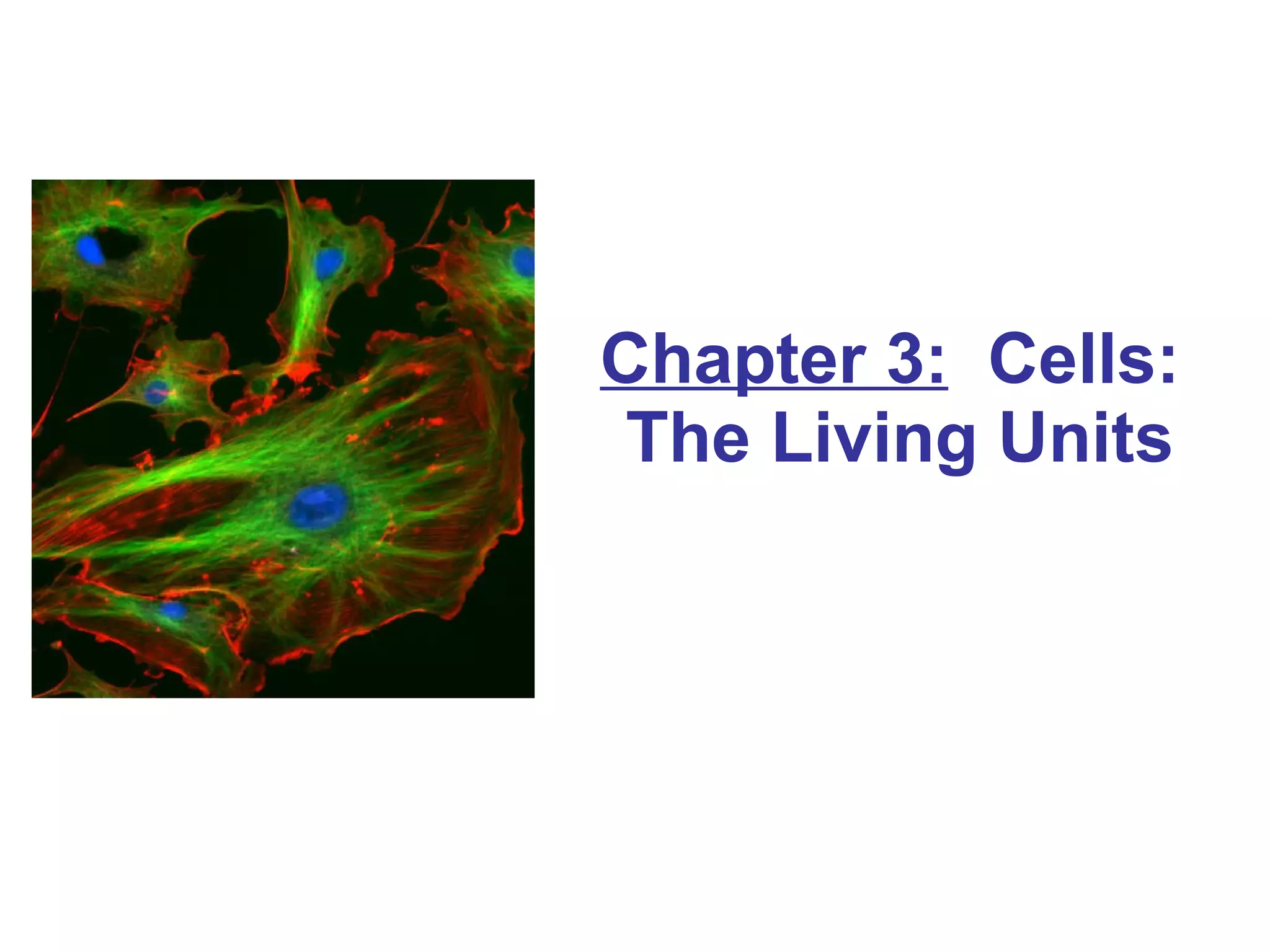
Chapter 3:   Cells:  The Living Units
The Cellular Basis of Life:  Cell Theory A cell is the basic structural & functional unit of living organisms The activity of an organism depends both the individual & collective activity of its cells Biochemical activities of cells are dictated by the relative number of their specific subcellular structures Continuity of life has a cellular basis
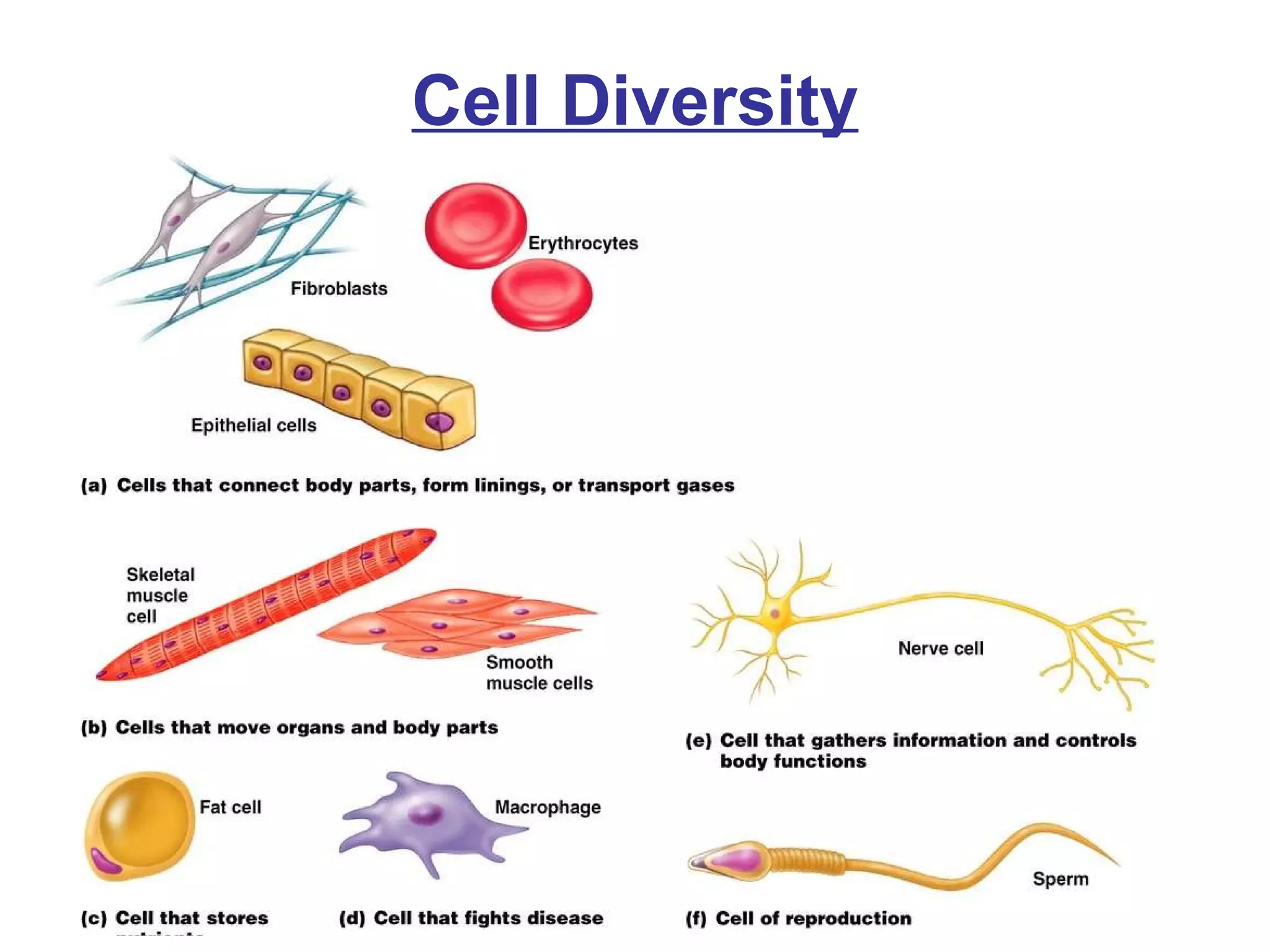
Cell Diversity
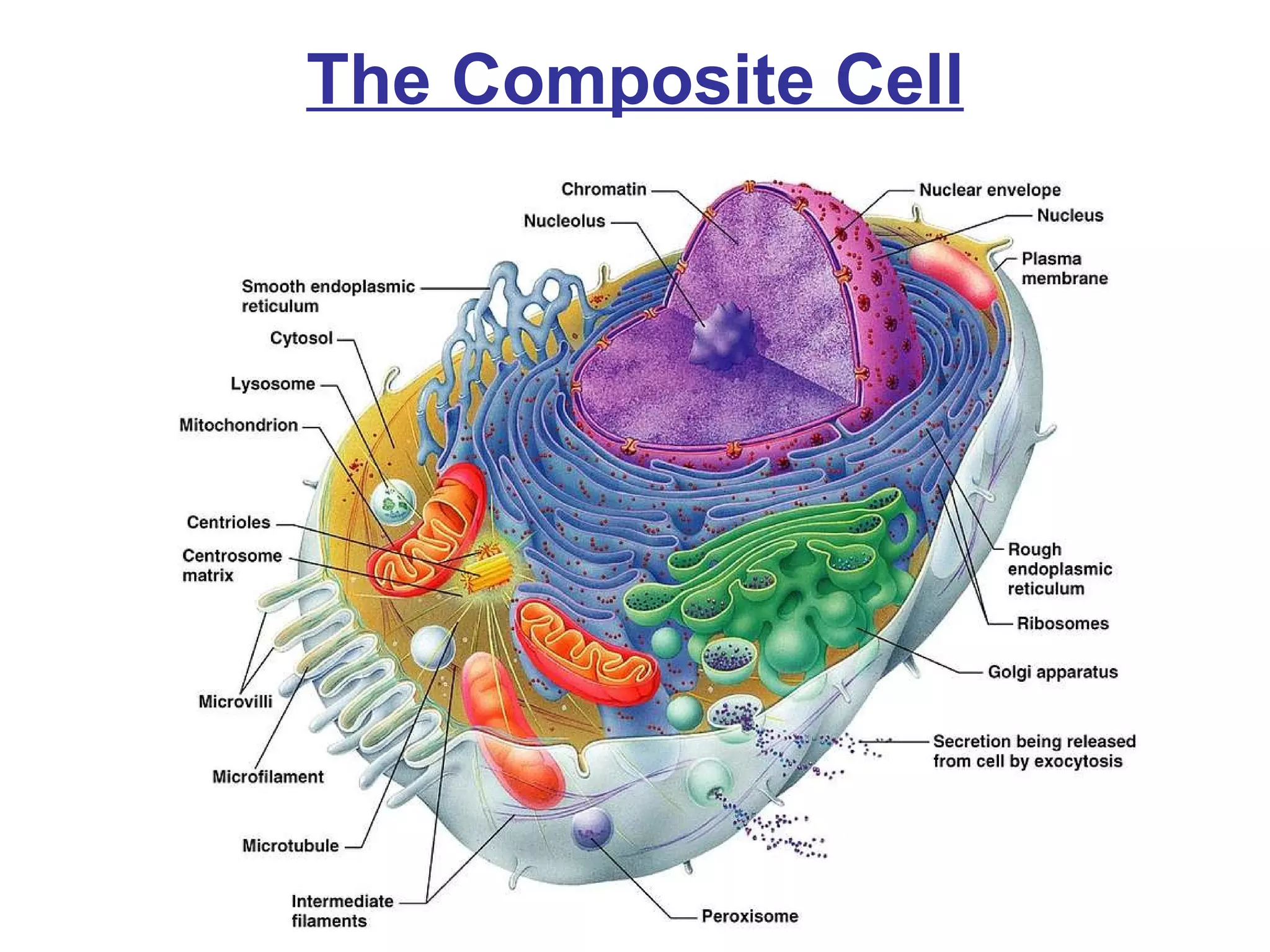
The Composite Cell
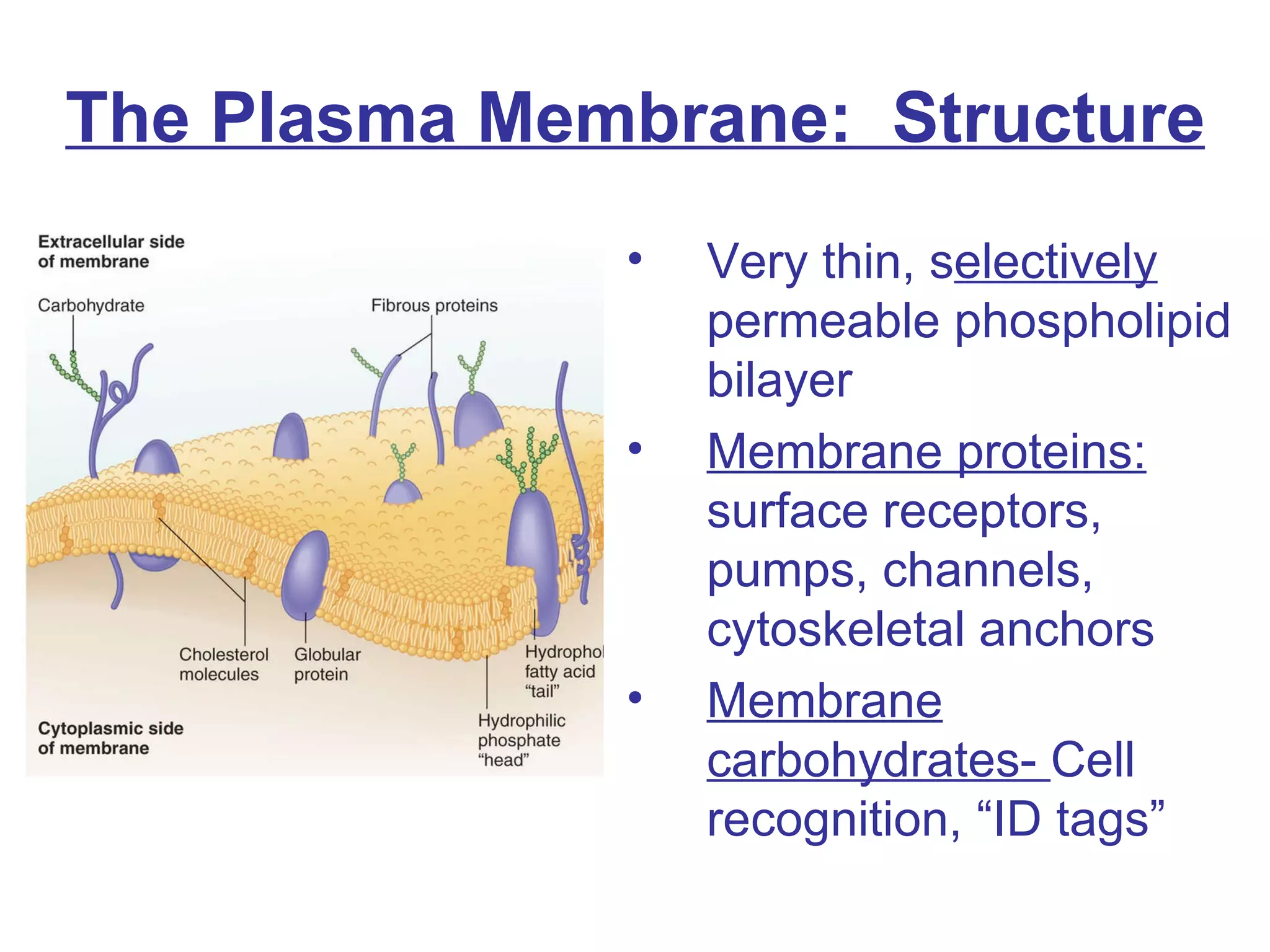
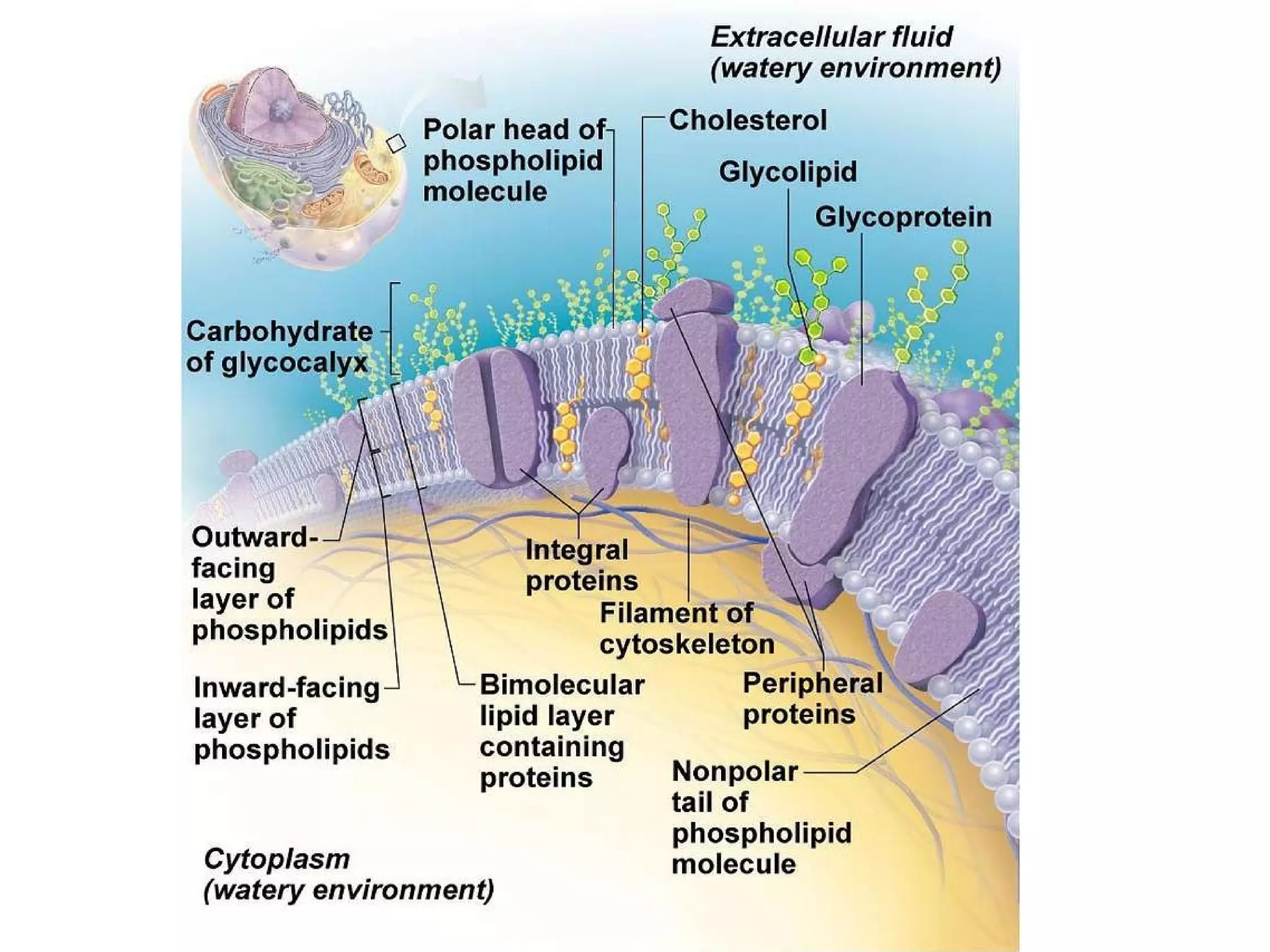
The Plasma Membrane:  Structure Very thin, s electively  permeable phospholipid bilayer Membrane proteins:  surface receptors, pumps, channels, cytoskeletal anchors Membrane carbohydrates-  Cell recognition, “ID tags”
 
The Plasma Membrane:  Functions Defines the cell’s boundary Selectively permeable membrane that transports substances in and out of the cell Generates and maintains the resting membrane potential Mediates cell-cell and cell-environment interactions
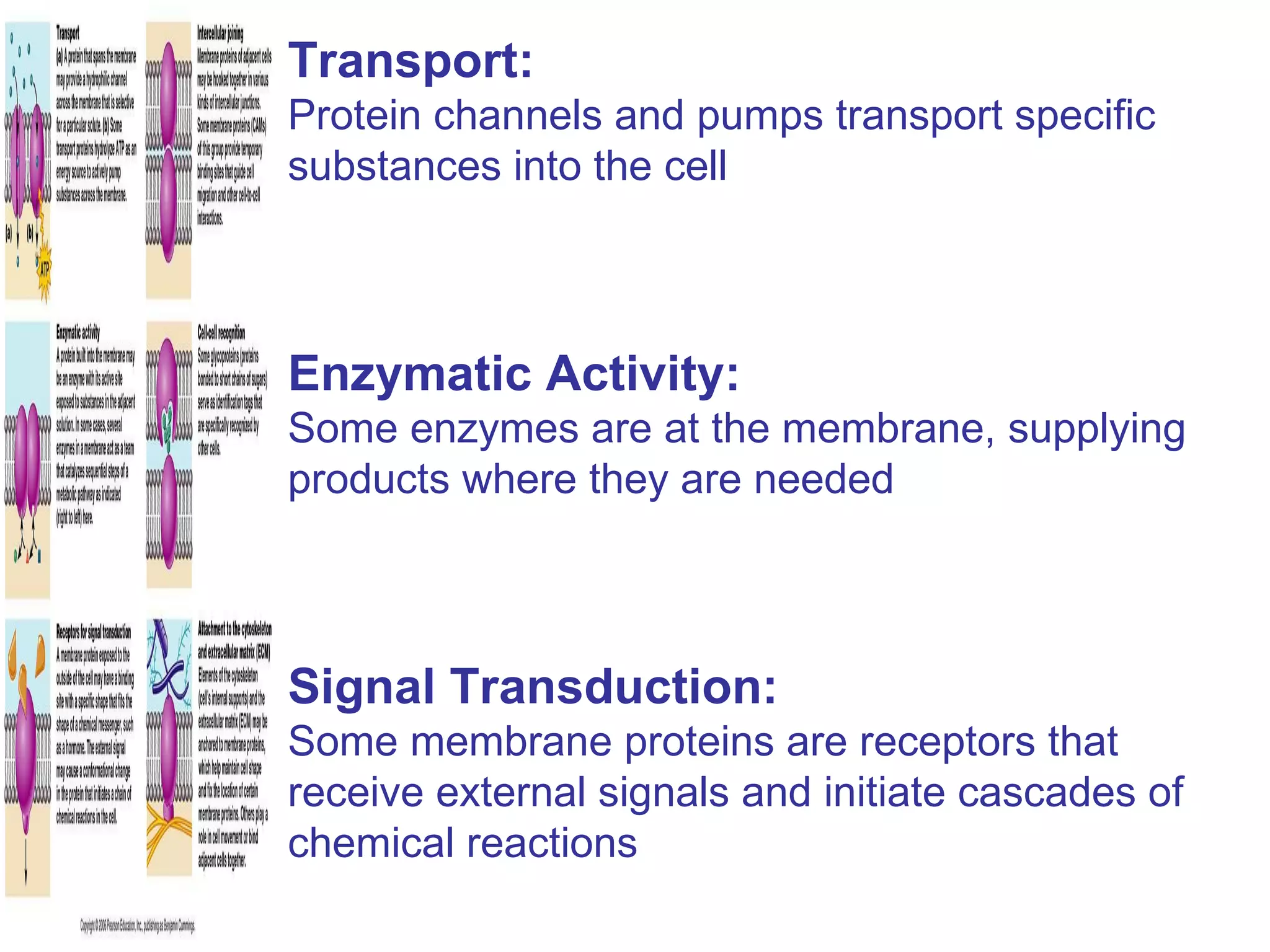
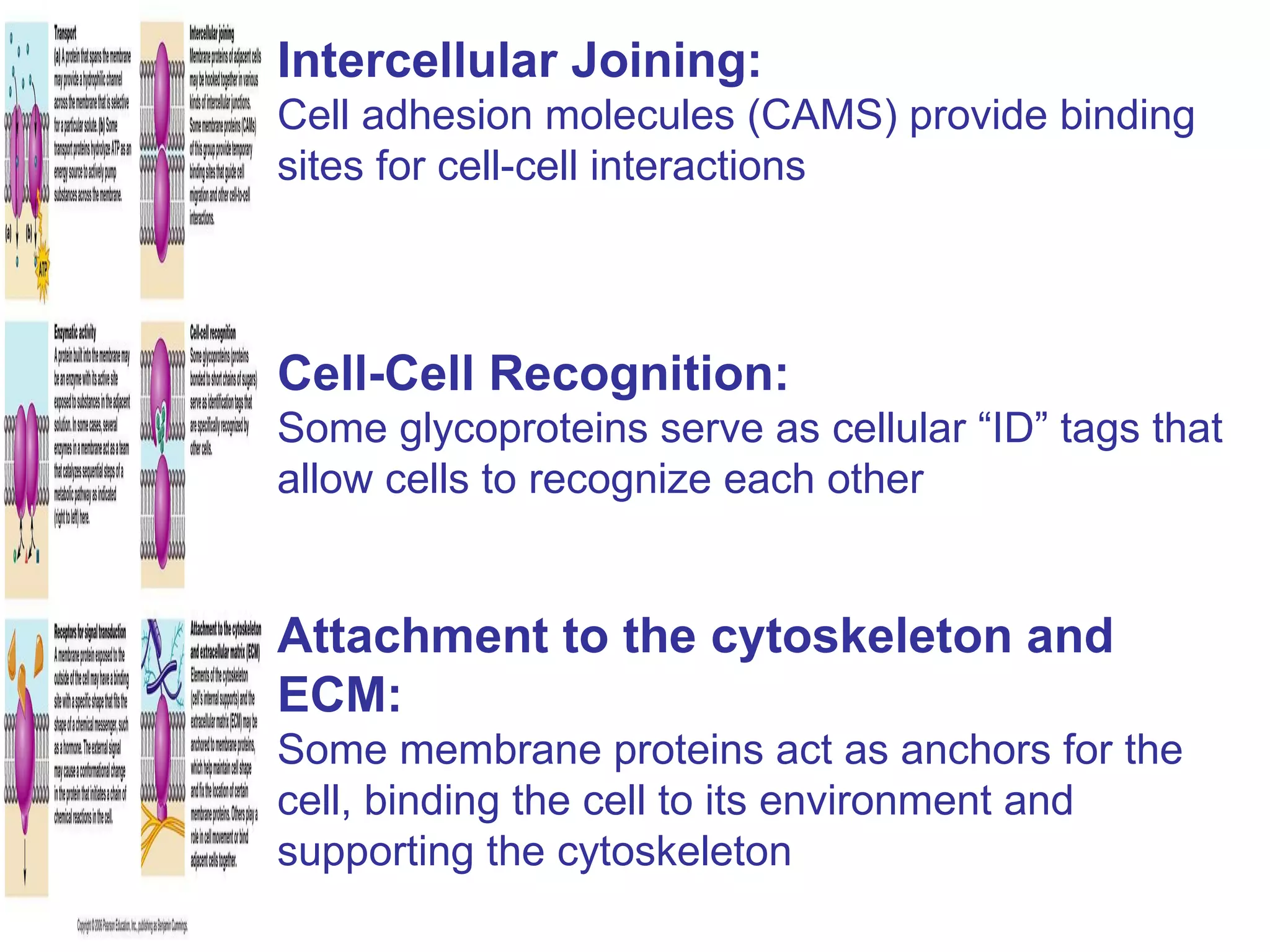
Transport: Protein channels and pumps transport specific substances into the cell  Enzymatic Activity: Some enzymes are at the membrane, supplying products where they are needed Signal Transduction: Some membrane proteins are receptors that receive external signals and initiate cascades of chemical reactions
Intercellular Joining: Cell adhesion molecules (CAMS) provide binding sites for cell-cell interactions Cell-Cell Recognition: Some glycoproteins serve as cellular “ID” tags that allow cells to recognize each other Attachment to the cytoskeleton and ECM: Some membrane proteins act as anchors for the cell, binding the cell to its environment and supporting the cytoskeleton
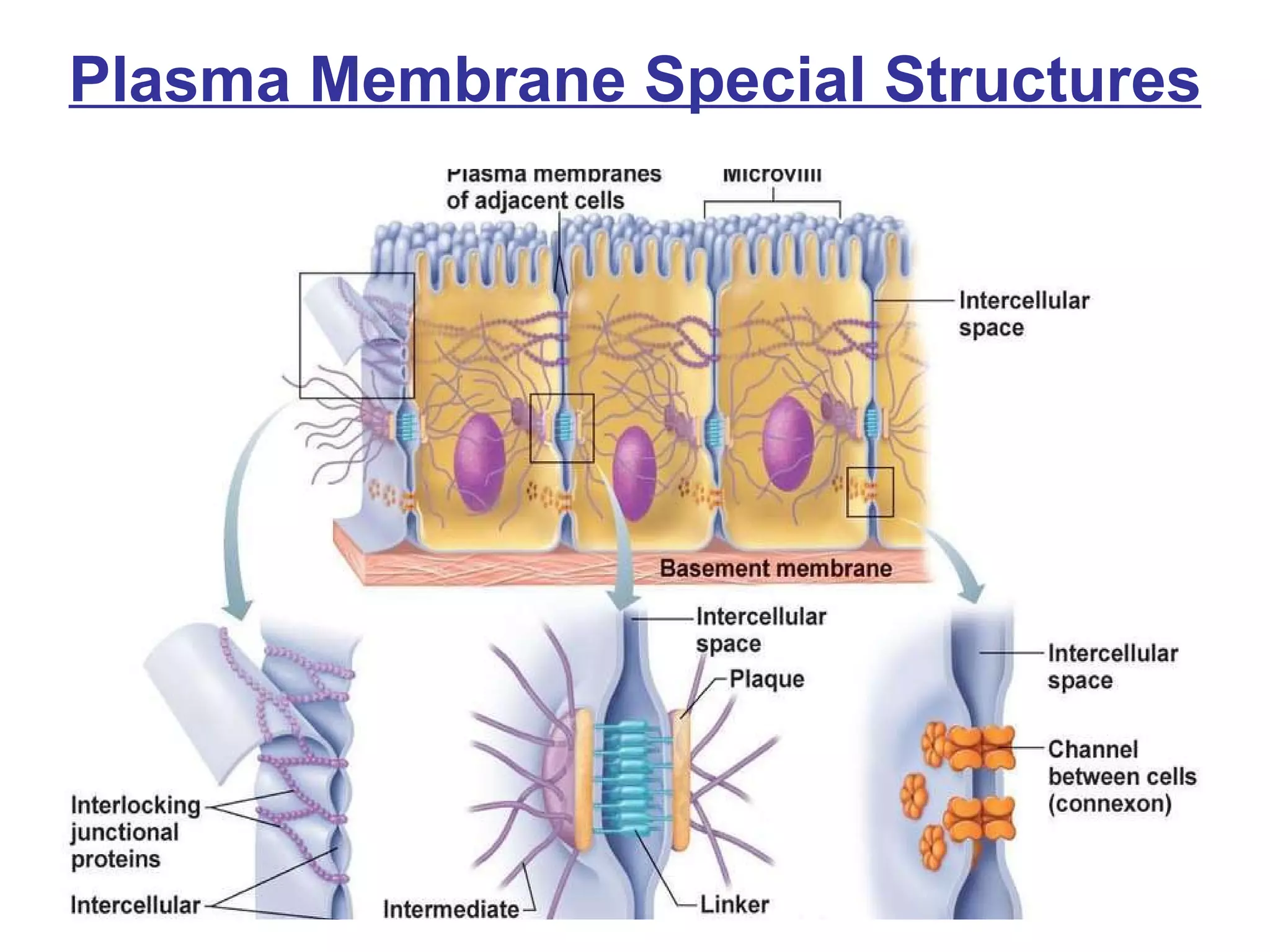
Plasma Membrane Special Structures
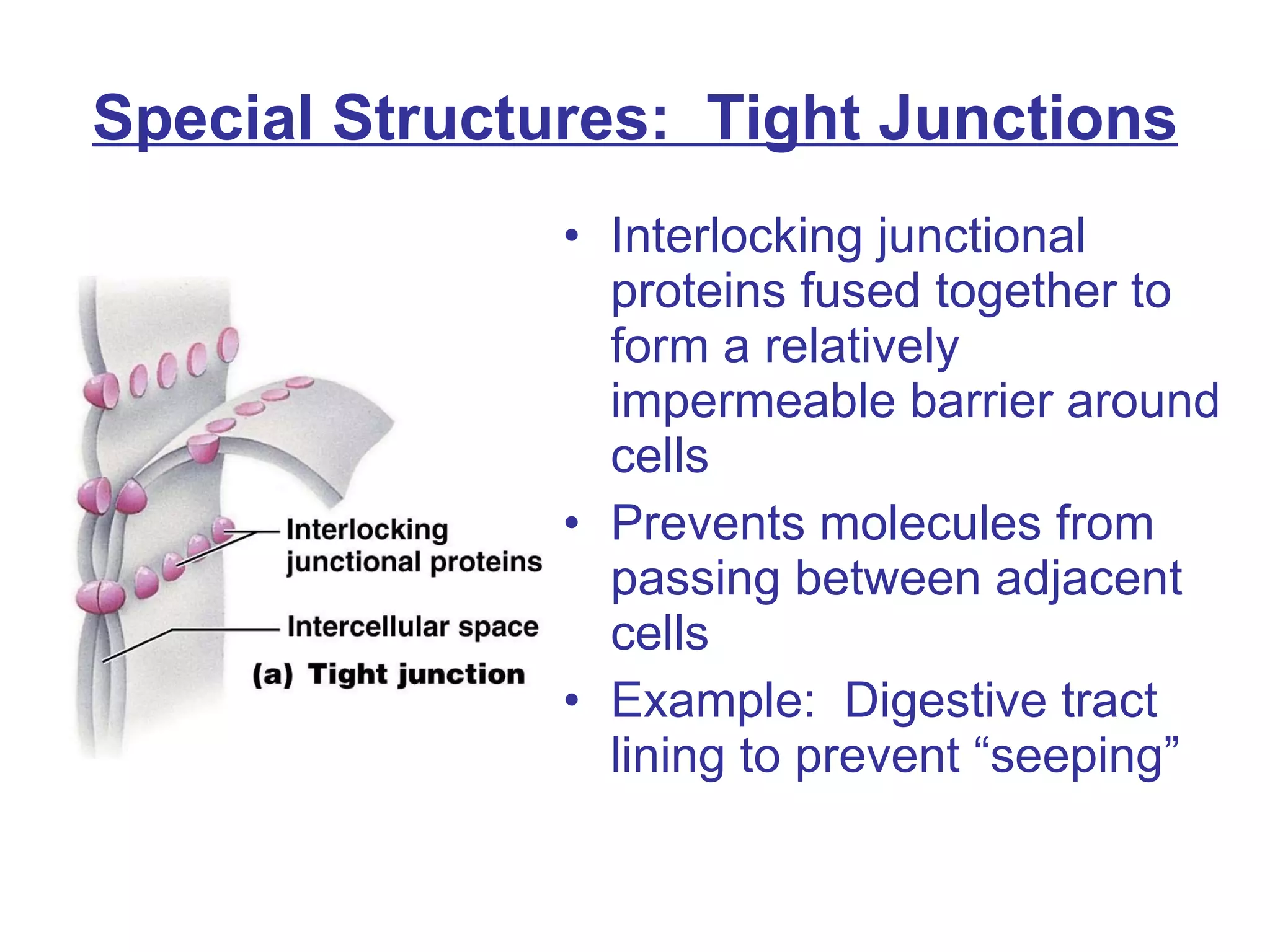
Special Structures:  Tight Junctions Interlocking junctional proteins fused together to form a relatively impermeable barrier around cells  Prevents molecules from passing between adjacent cells Example:  Digestive tract lining to prevent “seeping”
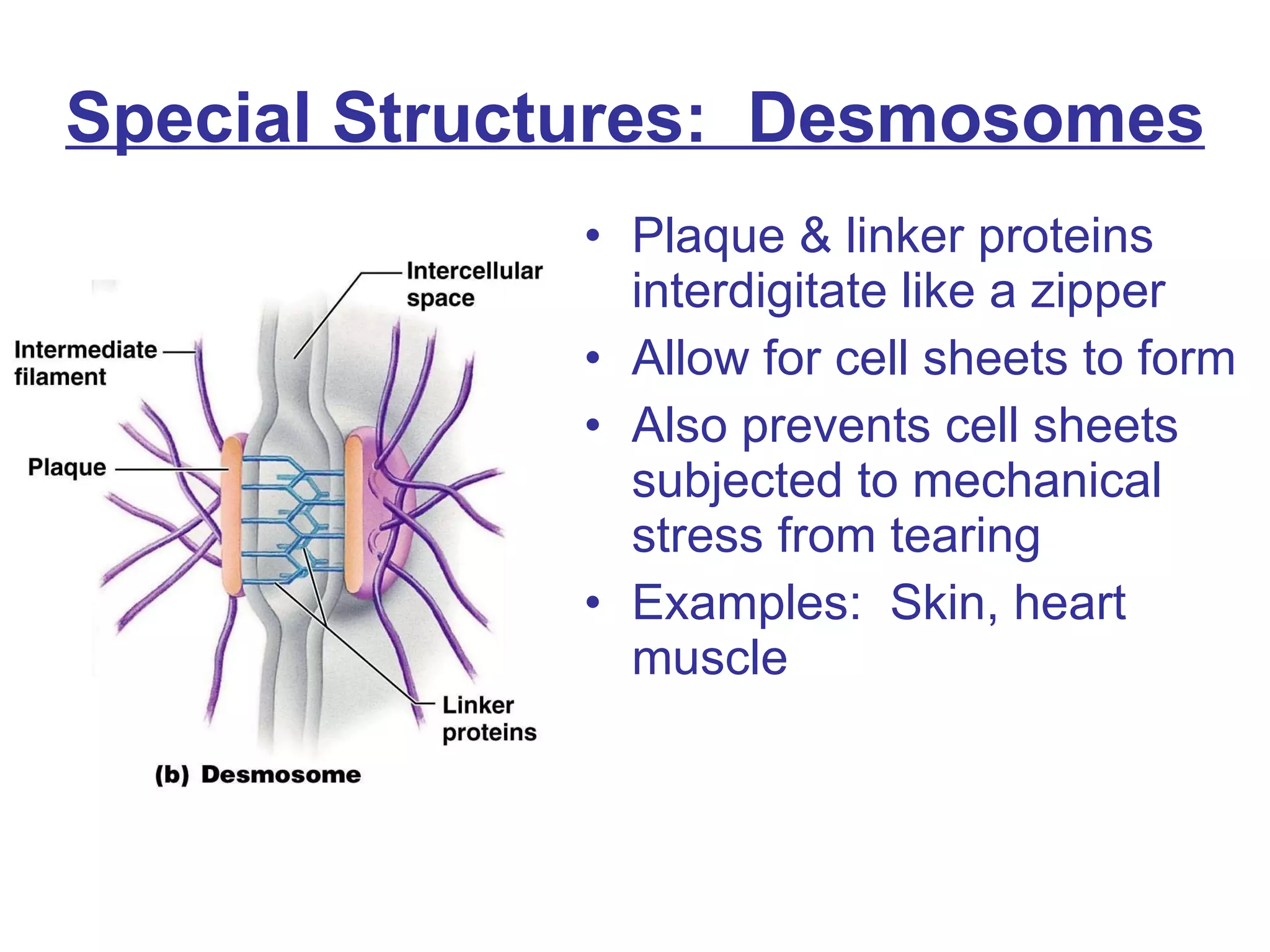
Special Structures:  Desmosomes Plaque & linker proteins interdigitate like a zipper Allow for cell sheets to form Also prevents cell sheets subjected to mechanical stress from tearing Examples:  Skin, heart muscle
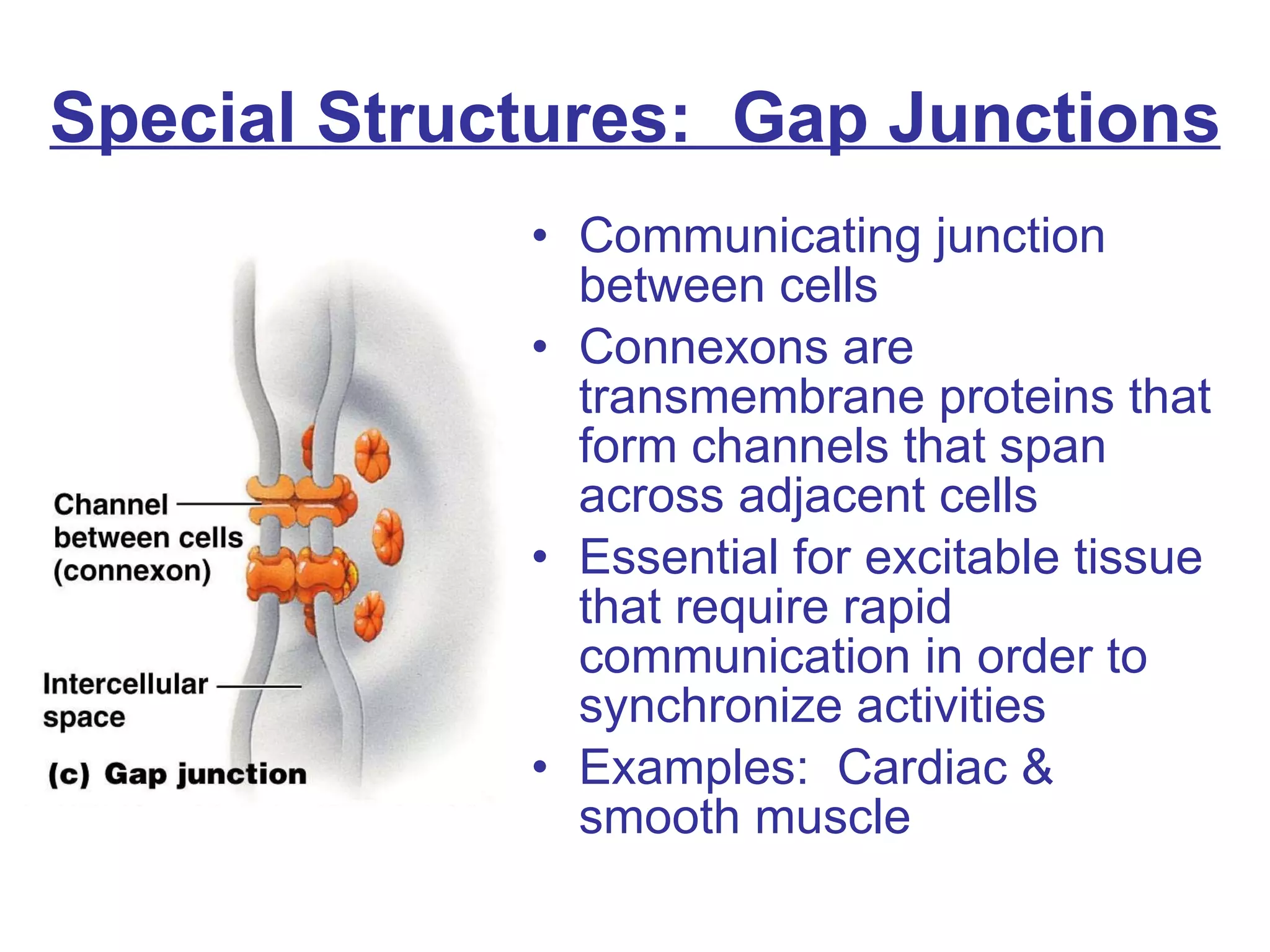
Special Structures:  Gap Junctions Communicating junction between cells Connexons are transmembrane proteins that form channels that span across adjacent cells Essential for excitable tissue that require rapid communication in order to synchronize activities Examples:  Cardiac & smooth muscle
Membrane Transport Cells are surrounded by extracellular fluid/ interstitial fluid containing nutrients, amino acids, sugars, fatty acids, vitamins, etc. Cells need to extract essential substances from interstitial fluid in order to survive Traffic across the plasma membrane is constant but is also selective on what substances are introduced into the cell Transport is either passive or active
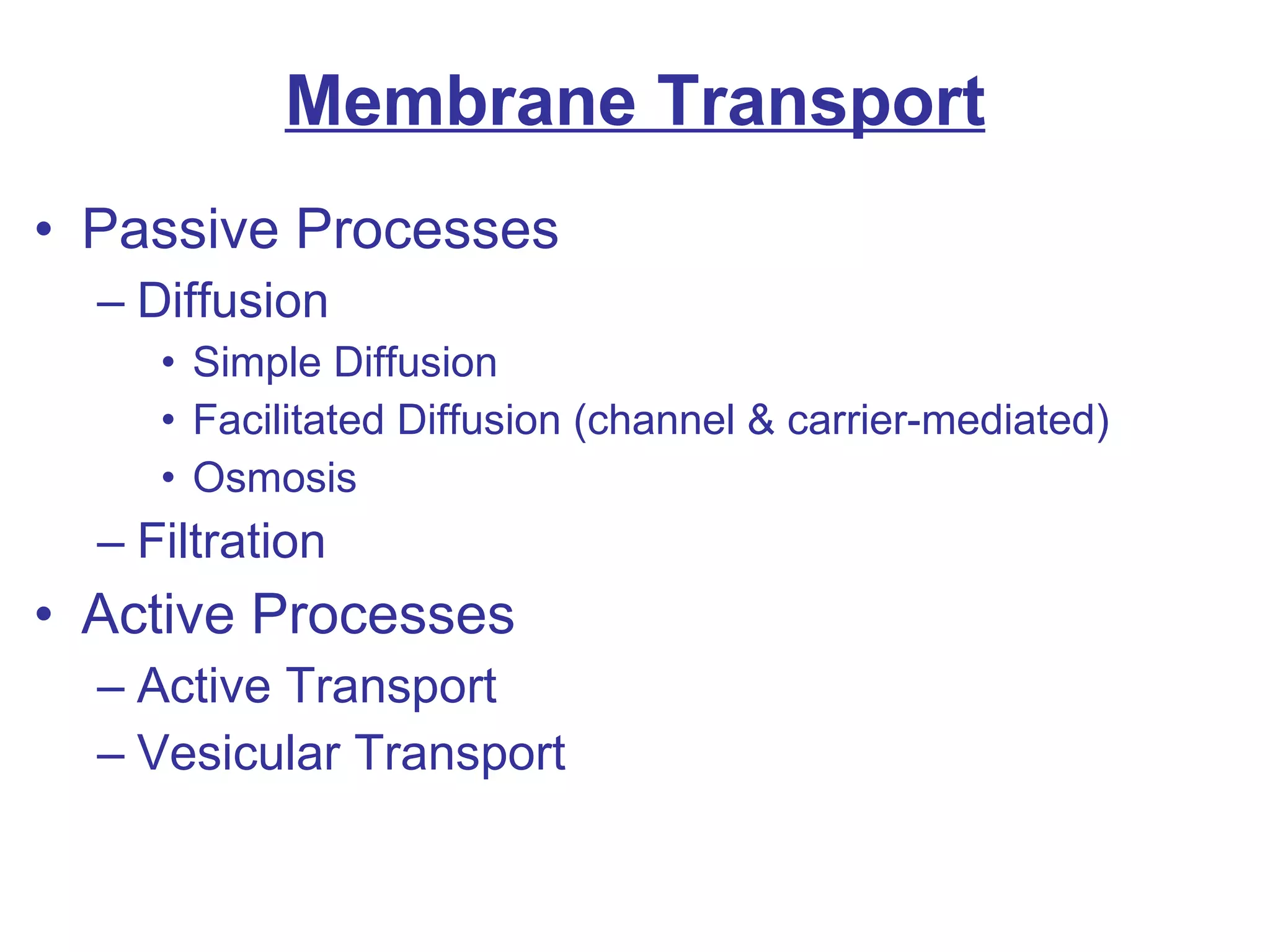
Membrane Transport Passive Processes Diffusion Simple Diffusion Facilitated Diffusion (channel & carrier-mediated) Osmosis Filtration Active Processes Active Transport Vesicular Transport
Diffusion The tendency of molecules or ions to scatter evenly throughout the environment Molecules and ions move down their concentration gradients until equilibrium is reached [High]    [Low]
Diffusion Molecules diffuse through the membrane if: Lipid-soluble Small Assisted by a carrier molecule Types of Diffusion: Simple Diffusion:  Unassisted diffusion Facilitated Diffusion:  Assisted diffusion Channel-mediated Carrier-mediated  3)  Osmosis:  Diffusion of solvents (water)
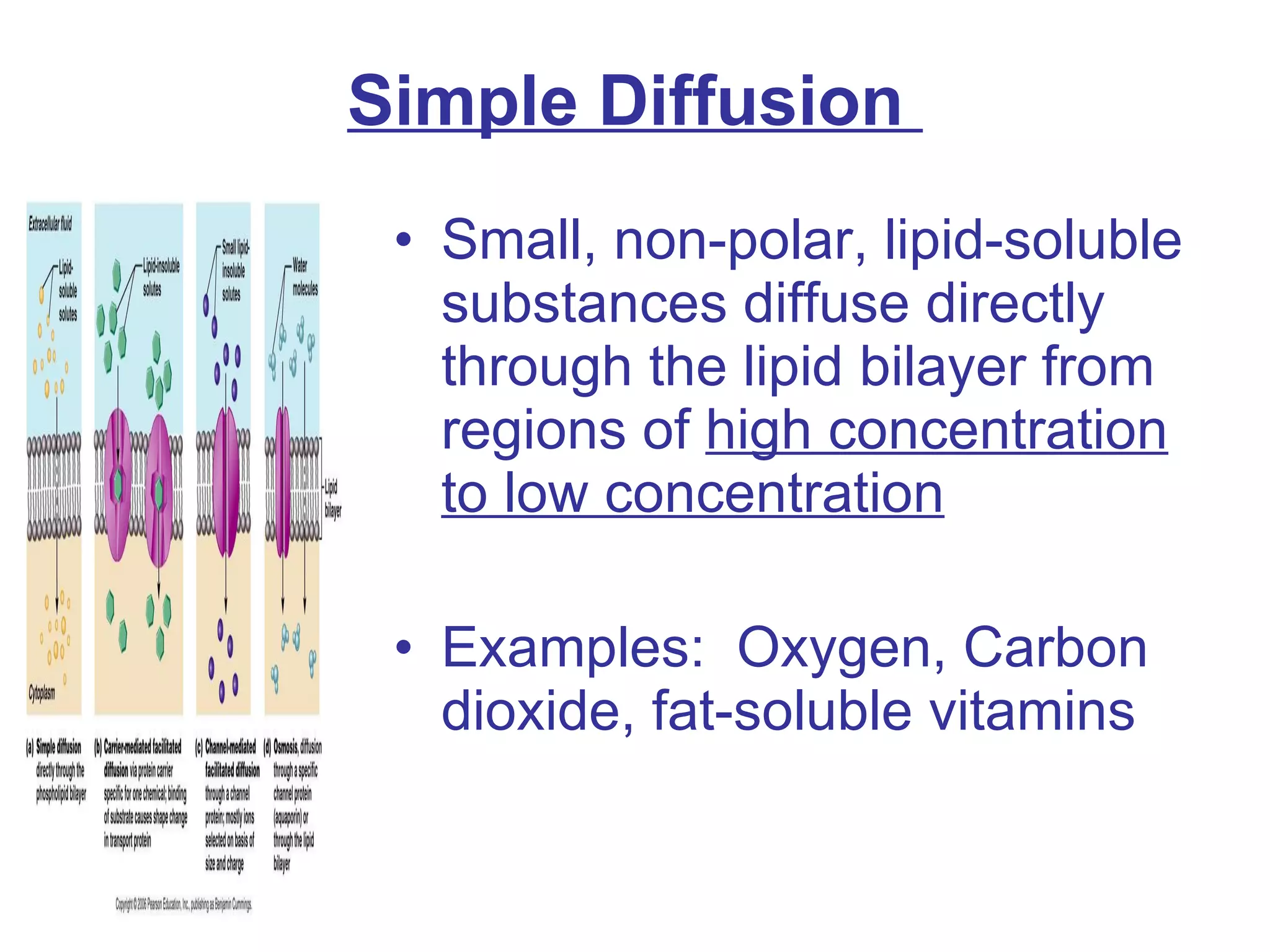
Simple Diffusion  Small, non-polar, lipid-soluble substances diffuse directly through the lipid bilayer from regions of  high concentration to low concentration Examples:  Oxygen, Carbon dioxide, fat-soluble vitamins
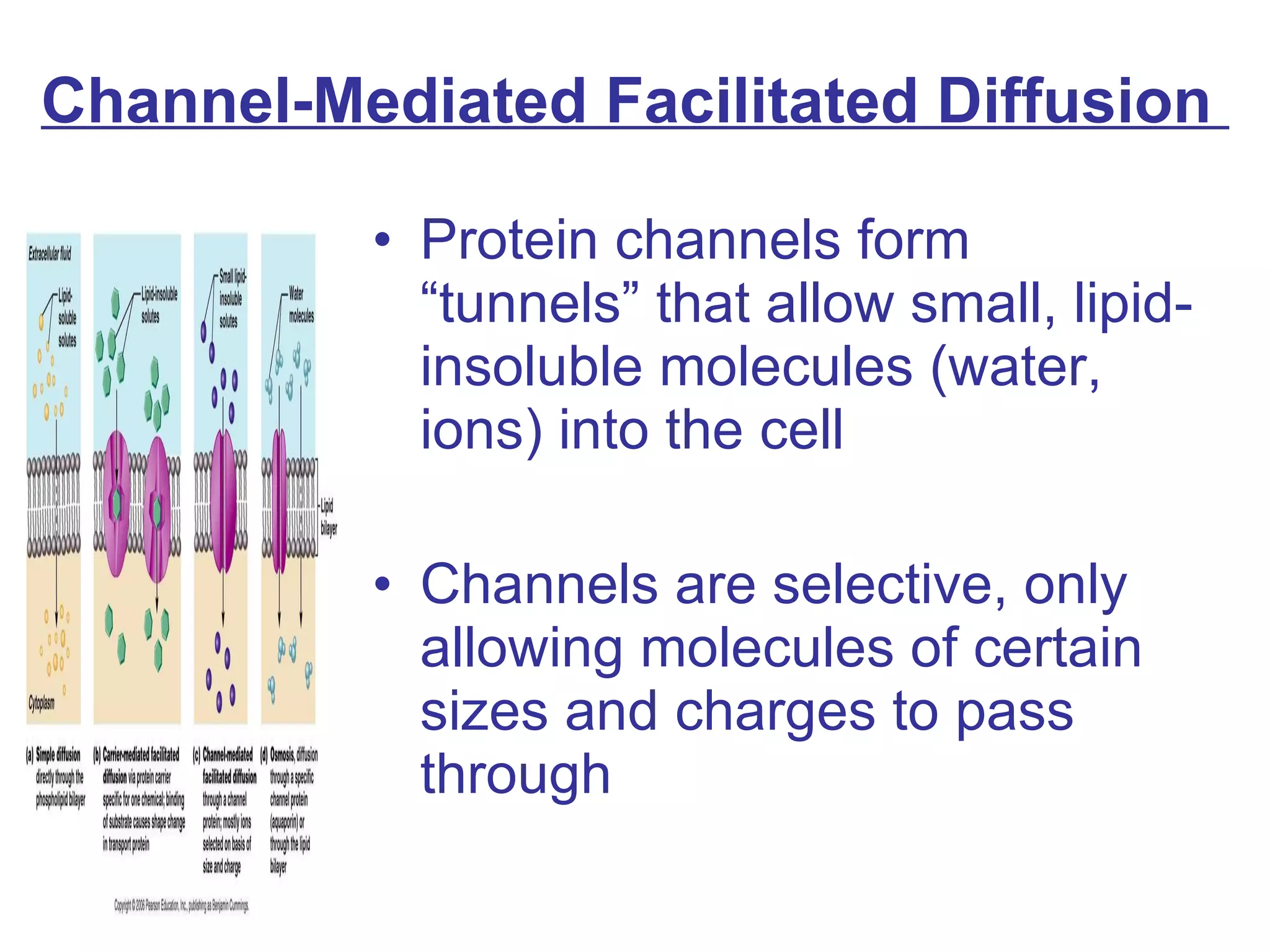
Channel-Mediated Facilitated Diffusion  Protein channels form “tunnels” that allow small, lipid-insoluble molecules (water, ions) into the cell  Channels are selective, only allowing molecules of certain sizes and charges to pass through
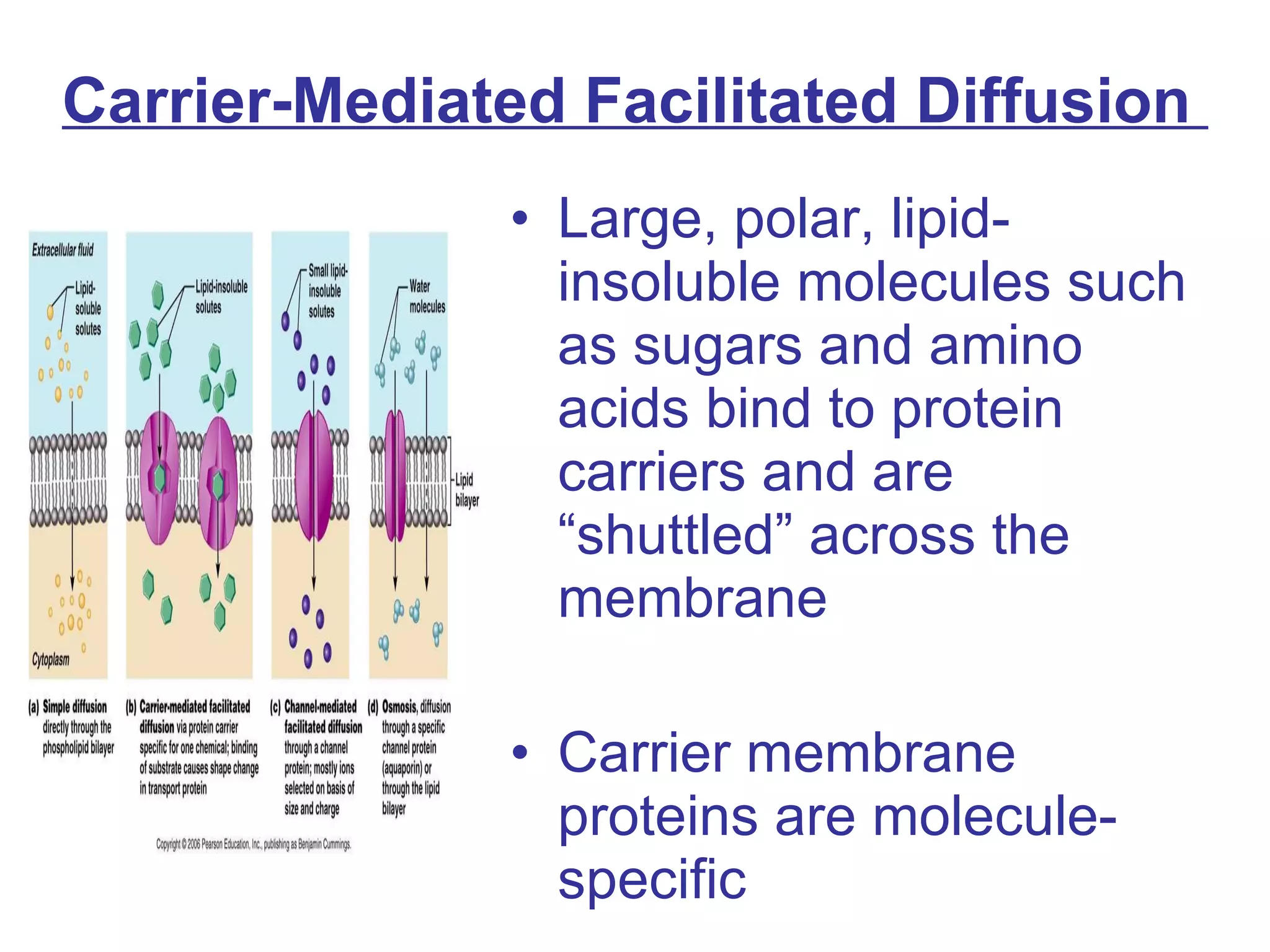
Carrier-Mediated Facilitated Diffusion  Large, polar, lipid-insoluble molecules such as sugars and amino acids bind to protein carriers and are “shuttled” across the membrane Carrier membrane proteins are molecule-specific
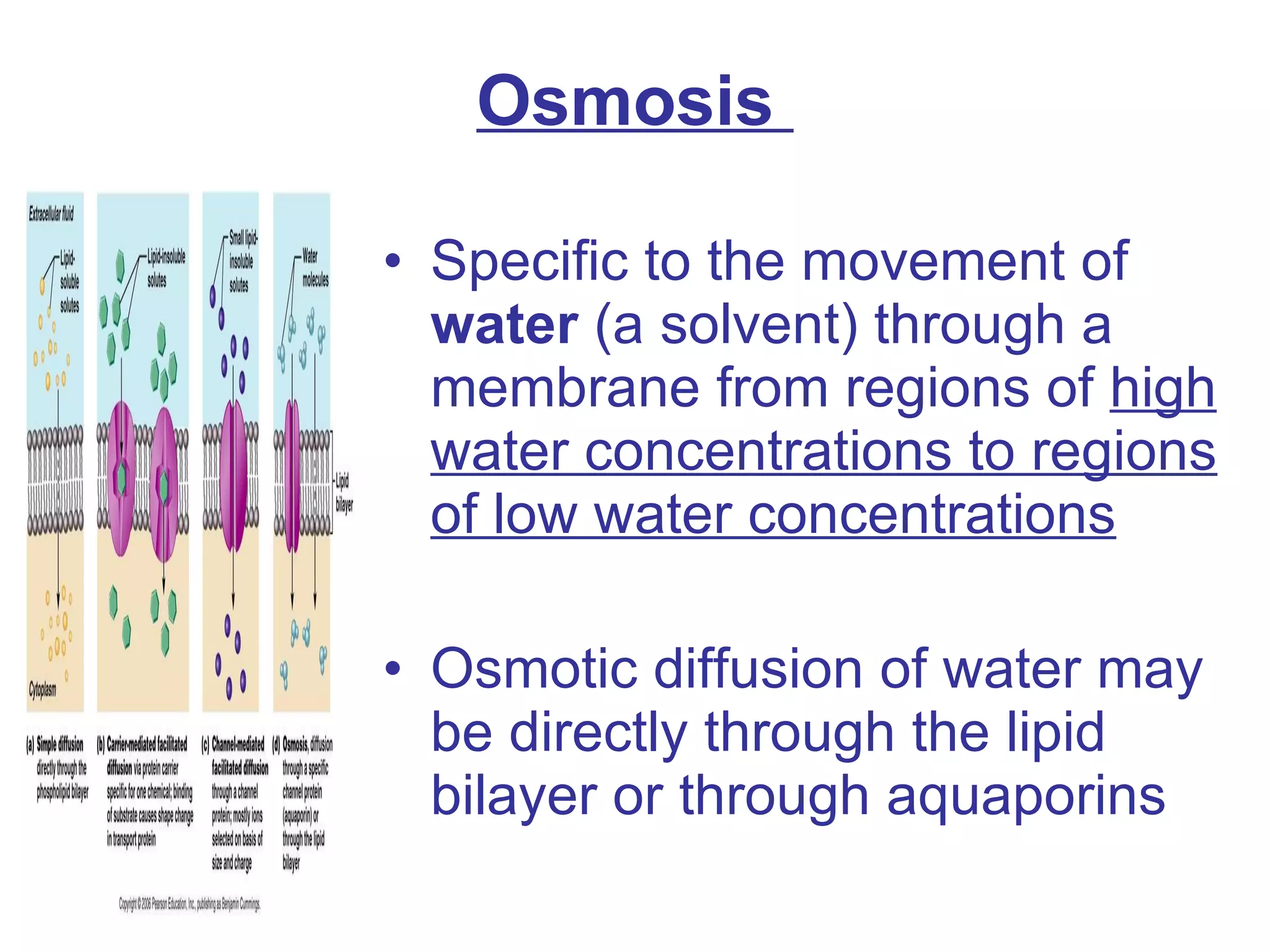
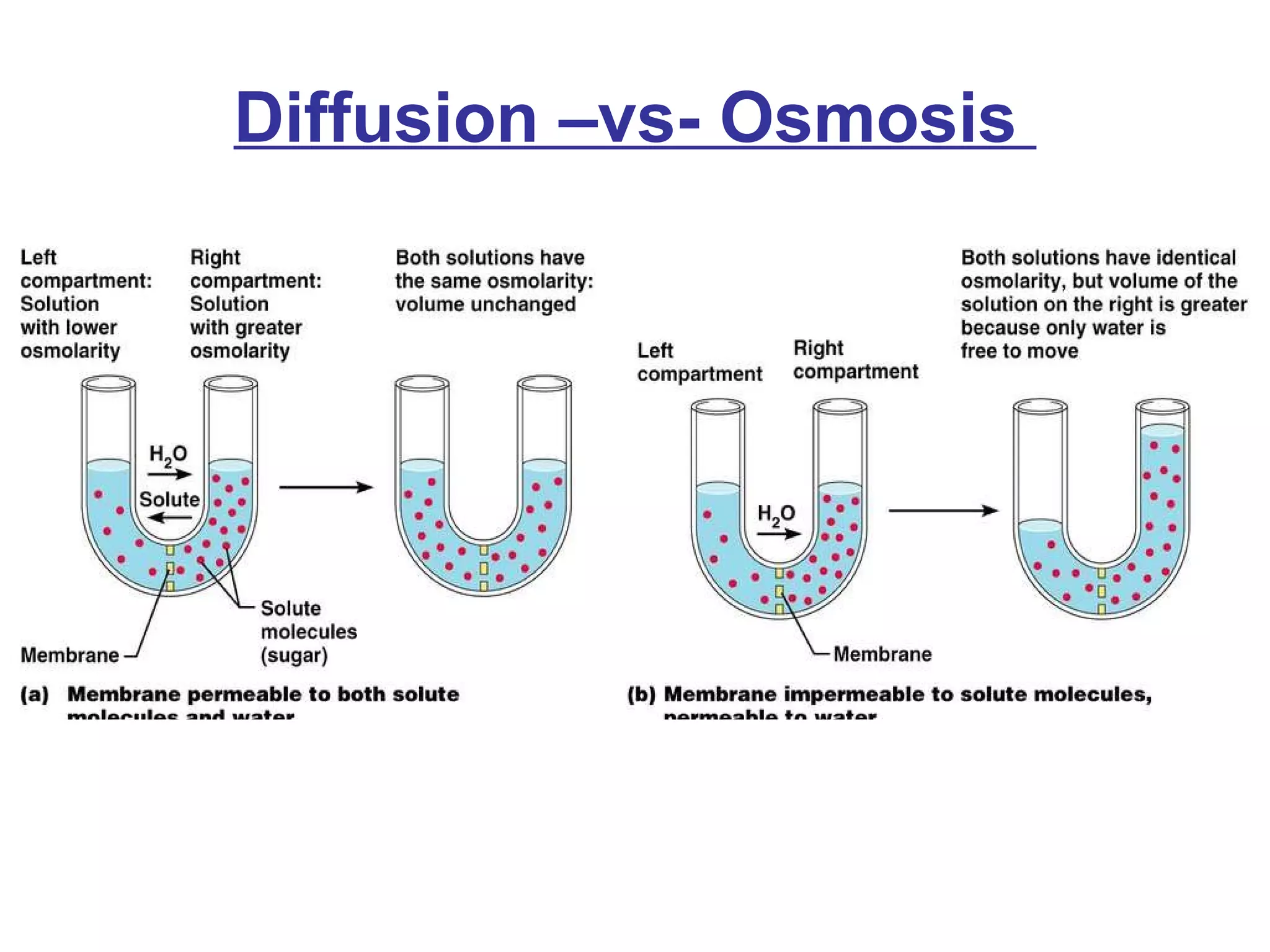
Osmosis  Specific to the movement of  water  (a solvent) through a membrane from regions of  high water concentrations to regions of low water concentrations Osmotic diffusion of water may be directly through the lipid bilayer or through aquaporins
Diffusion –vs- Osmosis
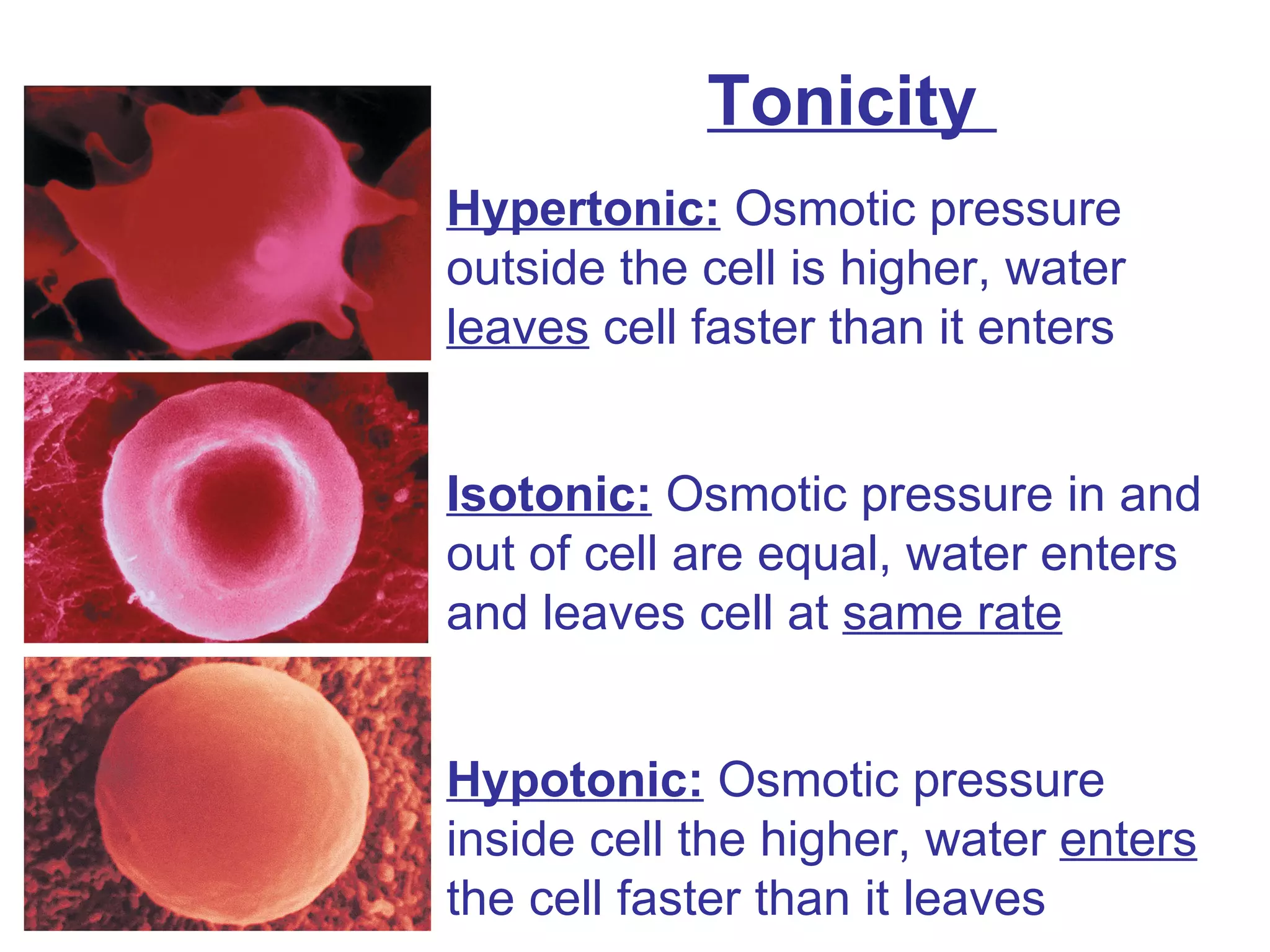
Tonicity  Hypertonic:  Osmotic pressure outside the cell is higher, water  leaves  cell faster than it enters Isotonic:  Osmotic pressure in and out of cell are equal, water enters and leaves cell at  same rate   Hypotonic:  Osmotic pressure inside cell the higher, water  enters  the cell faster than it leaves
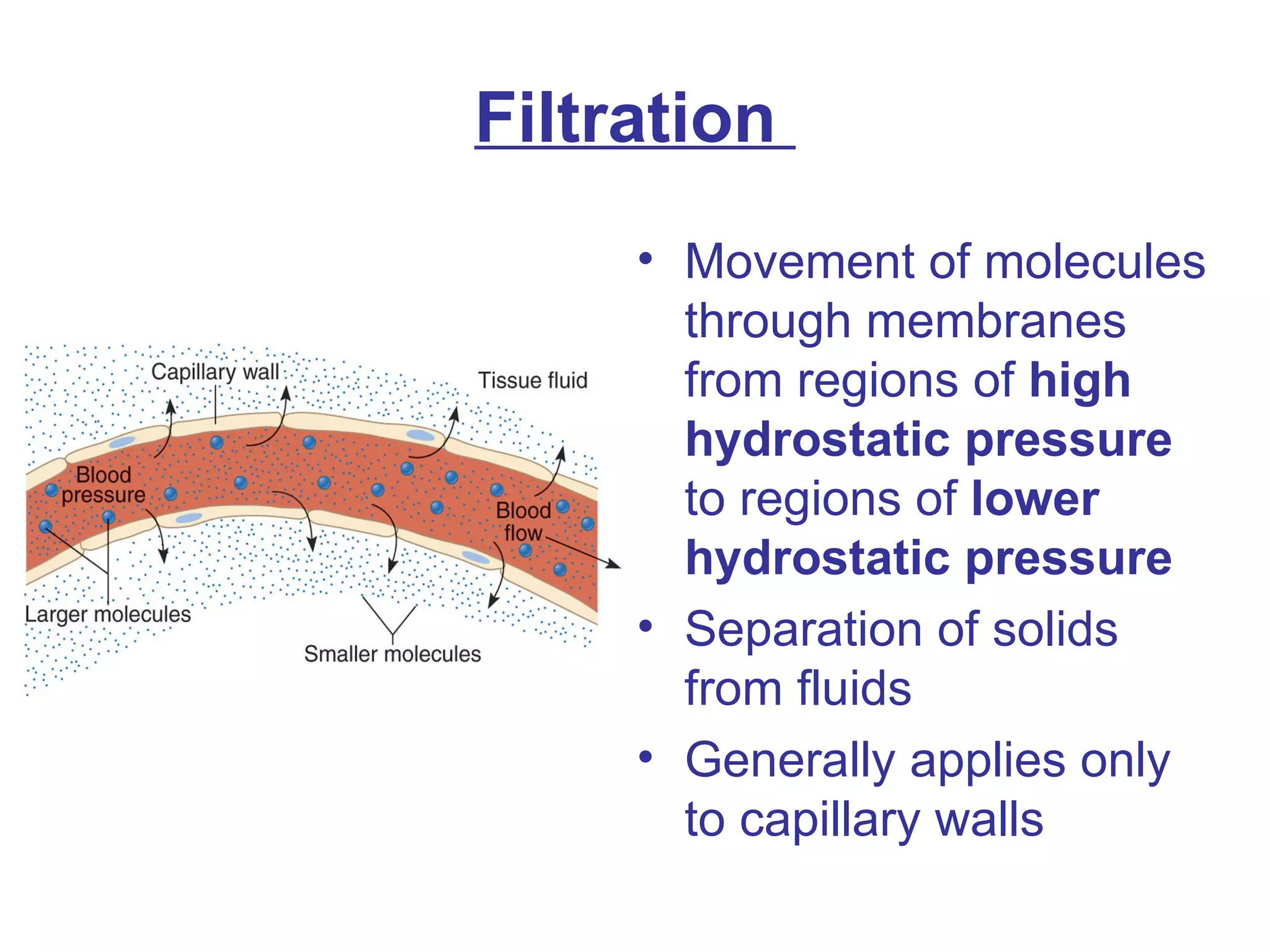
Filtration  Movement of molecules through membranes from regions of  high hydrostatic pressure  to regions of  lower hydrostatic pressure   Separation of solids from fluids Generally applies only to capillary walls

Chapter3a

  • 1.
    Chapter 3: Cells: The Living Units
  • 2.
    The Cellular Basisof Life: Cell Theory A cell is the basic structural & functional unit of living organisms The activity of an organism depends both the individual & collective activity of its cells Biochemical activities of cells are dictated by the relative number of their specific subcellular structures Continuity of life has a cellular basis
  • 3.
  • 4.
  • 5.
    The Plasma Membrane: Structure Very thin, s electively permeable phospholipid bilayer Membrane proteins: surface receptors, pumps, channels, cytoskeletal anchors Membrane carbohydrates- Cell recognition, “ID tags”
  • 6.
  • 7.
    The Plasma Membrane: Functions Defines the cell’s boundary Selectively permeable membrane that transports substances in and out of the cell Generates and maintains the resting membrane potential Mediates cell-cell and cell-environment interactions
  • 8.
    Transport: Protein channelsand pumps transport specific substances into the cell Enzymatic Activity: Some enzymes are at the membrane, supplying products where they are needed Signal Transduction: Some membrane proteins are receptors that receive external signals and initiate cascades of chemical reactions
  • 9.
    Intercellular Joining: Celladhesion molecules (CAMS) provide binding sites for cell-cell interactions Cell-Cell Recognition: Some glycoproteins serve as cellular “ID” tags that allow cells to recognize each other Attachment to the cytoskeleton and ECM: Some membrane proteins act as anchors for the cell, binding the cell to its environment and supporting the cytoskeleton
  • 10.
  • 11.
    Special Structures: Tight Junctions Interlocking junctional proteins fused together to form a relatively impermeable barrier around cells Prevents molecules from passing between adjacent cells Example: Digestive tract lining to prevent “seeping”
  • 12.
    Special Structures: Desmosomes Plaque & linker proteins interdigitate like a zipper Allow for cell sheets to form Also prevents cell sheets subjected to mechanical stress from tearing Examples: Skin, heart muscle
  • 13.
    Special Structures: Gap Junctions Communicating junction between cells Connexons are transmembrane proteins that form channels that span across adjacent cells Essential for excitable tissue that require rapid communication in order to synchronize activities Examples: Cardiac & smooth muscle
  • 14.
    Membrane Transport Cellsare surrounded by extracellular fluid/ interstitial fluid containing nutrients, amino acids, sugars, fatty acids, vitamins, etc. Cells need to extract essential substances from interstitial fluid in order to survive Traffic across the plasma membrane is constant but is also selective on what substances are introduced into the cell Transport is either passive or active
  • 15.
    Membrane Transport PassiveProcesses Diffusion Simple Diffusion Facilitated Diffusion (channel & carrier-mediated) Osmosis Filtration Active Processes Active Transport Vesicular Transport
  • 16.
    Diffusion The tendencyof molecules or ions to scatter evenly throughout the environment Molecules and ions move down their concentration gradients until equilibrium is reached [High]  [Low]
  • 17.
    Diffusion Molecules diffusethrough the membrane if: Lipid-soluble Small Assisted by a carrier molecule Types of Diffusion: Simple Diffusion: Unassisted diffusion Facilitated Diffusion: Assisted diffusion Channel-mediated Carrier-mediated 3) Osmosis: Diffusion of solvents (water)
  • 18.
    Simple Diffusion Small, non-polar, lipid-soluble substances diffuse directly through the lipid bilayer from regions of high concentration to low concentration Examples: Oxygen, Carbon dioxide, fat-soluble vitamins
  • 19.
    Channel-Mediated Facilitated Diffusion Protein channels form “tunnels” that allow small, lipid-insoluble molecules (water, ions) into the cell Channels are selective, only allowing molecules of certain sizes and charges to pass through
  • 20.
    Carrier-Mediated Facilitated Diffusion Large, polar, lipid-insoluble molecules such as sugars and amino acids bind to protein carriers and are “shuttled” across the membrane Carrier membrane proteins are molecule-specific
  • 21.
    Osmosis Specificto the movement of water (a solvent) through a membrane from regions of high water concentrations to regions of low water concentrations Osmotic diffusion of water may be directly through the lipid bilayer or through aquaporins
  • 22.
  • 23.
    Tonicity Hypertonic: Osmotic pressure outside the cell is higher, water leaves cell faster than it enters Isotonic: Osmotic pressure in and out of cell are equal, water enters and leaves cell at same rate Hypotonic: Osmotic pressure inside cell the higher, water enters the cell faster than it leaves
  • 24.
    Filtration Movementof molecules through membranes from regions of high hydrostatic pressure to regions of lower hydrostatic pressure Separation of solids from fluids Generally applies only to capillary walls