Radiology and  Diagnostic  Imaging
Radiology and   Diagnostic Imaging Overview X-rays High-energy electromagnetic waves  Travel in straight lines Shorter wave length than visible light Able to penetrate solid materials of varying densities Capable of exposing a photographic plate (X-ray film)  Much the same way as a camera exposes film
X-rays  Used to visualize internal organs and structures of body Provide valuable means for verifying presence of illness or disease Radiology Study of the diagnostic and therapeutic uses of X-rays Radiology and  Diagnostic Imaging Overview
PROCEDURES  AND TECHNIQUES Radiology and Diagnostic Imaging
Pronounced ( an -jee-oh-kar-dee- OG -rah-fee) ( CAR -dee-ak  kath -eh-ter-ih- ZAY -shun) Defined Specialized diagnostic procedure in which a catheter is introduced into a large vein or artery Usually of an arm or a leg, and is then threaded through circulatory system to the heart Angiocardiography (Cardiac Catheterization)
Angiography Pronounced ( an -jee- OG -rah-fee) Defined Series of X-ray films allowing visualization of internal structures after the introduction of a radiopaque substance
Cerebral Angiography Pronounced (seh- REE -bral  an -jee- OG -rah-fee) ( SER -eh-bral  an -jee- OG -rah-fee) Defined Injection of a radiopaque contrast medium into an arterial blood vessel (carotid, femoral, or brachial) to make visualization of the cerebral vascular system via X-ray possible
Renal Angiography Pronounced ( REE -nal  an -jee- OG -rah-fee) Defined X-ray visualization of internal anatomy of the renal blood vessels (blood vessels of the kidney) after injection of a contrast medium
Arteriography Pronounced ( ar -tee-ree- OG -rah-fee) Defined X-ray visualization of arteries following the introduction of a radiopaque contrast medium into the bloodstream through a specific vessel by way of a catheter
Arthrography Pronounced (ar- THROG -rah-fee) Defined Process of taking X-rays of the inside of a joint, after a contrast medium has been injected into the joint Contrast medium makes the inside of the joint visible
Barium Enema (BE) Pronounced ( BAH -ree-um  EN -eh-mah) Defined Infusion of a radiopaque contrast medium, barium sulfate, into the rectum Contrast medium is retained in lower intestinal tract while X-ray films are obtained of the lower GI tract
Barium Swallow (Upper GI Series) Pronounced ( BAH -ree-um  SWALL -oh) Defined Oral administration of a radiopaque contrast medium, barium sulfate, which flows into the esophagus as the person swallows X-rays are taken as barium sulfate flows into the upper GI tract
Bronchography Pronounced (brong- KOG -rah-fee) Defined Bronchial examination via X-ray following the coating of the bronchi with a radiopaque substance
Cholangiography (Intravenous) Pronounced (koh- lan -jee- OG -rah-fee)  (in-trah- VEE -nus) Defined Visualizing and outlining of the major bile ducts following an intravenous injection of a contrast medium
Cholangiography (Percutaneous Transhepatic) Pronounced (koh- lan -jee- OG -rah-fee)  ( per -kyoo- TAY -nee-us  trans -heh- PAT -ik) Defined Examination of bile duct structure using a needle to pass directly into an intrahepatic bile duct to inject a contrast medium Also known as PTC or PTHC
Pronounced (koh- lan -jee-oh- pan -kree-ah- TOG -rah-fee) (en-doh- SKOP -ic  RET -roh-grayd)  Defined Procedure that examines the size of and the filling of the pancreatic and biliary ducts through direct radiographic visualization with a fiberoptic endoscope Cholangiopancreatography (Endoscopic Retrograde)
Cholecystography (Oral) Pronounced (koh -lee-sis- TOG -rah-fee) Defined Visualization of the gallbladder through X-ray following the oral ingestion of pills containing a radiopaque iodinated dye
Pronounced ( sin -eh- ray -dee- OG -rah-fee) Defined Diagnostic technique combining the techniques of fluoroscopy, radiography, and cinematography by filming the images that develop on a fluorescent screen with a movie camera Cineradiography
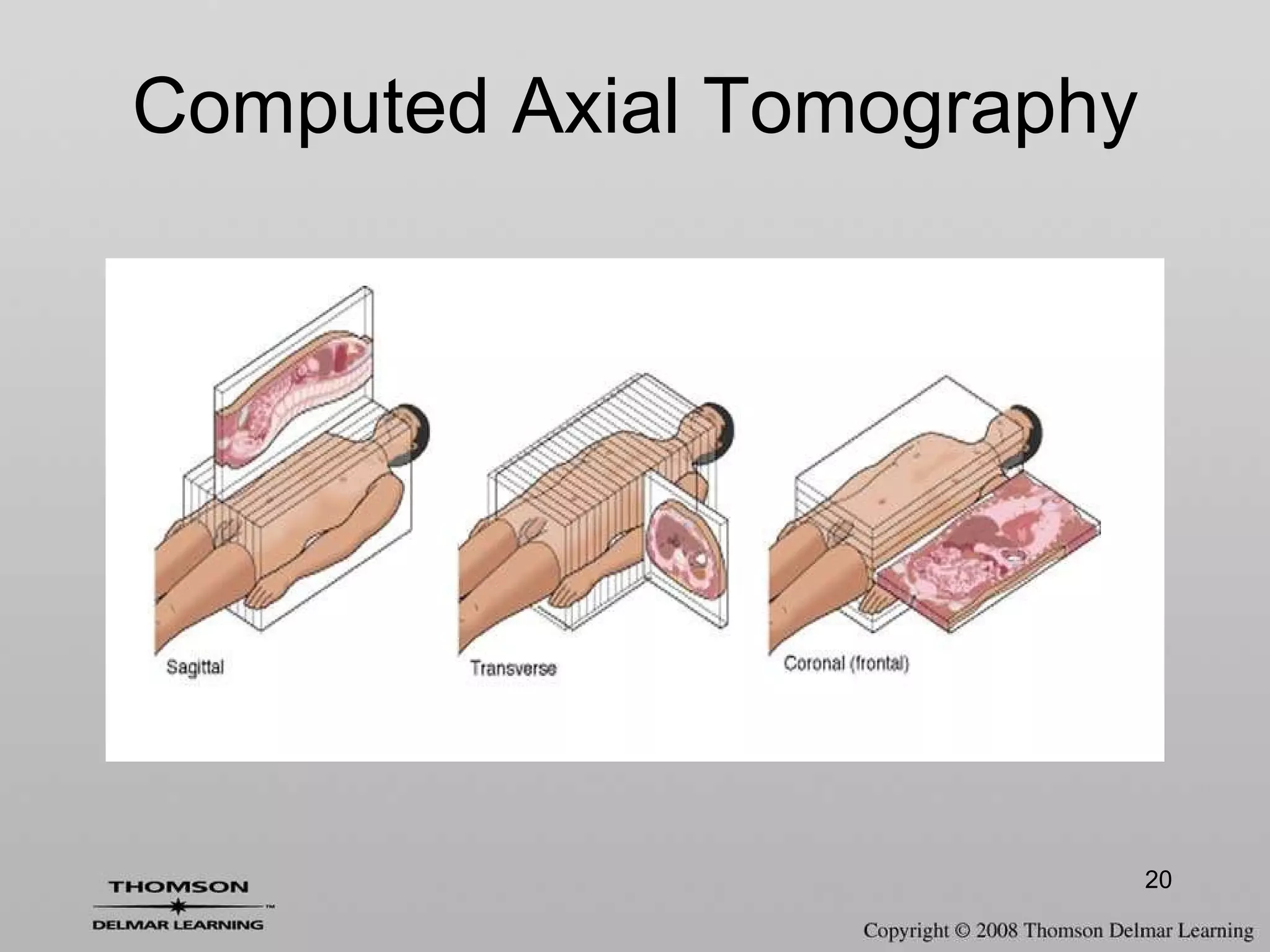
Pronounced (kom- PEW -ted  AK -see-al  toh- MOG -rah-fee) Defined Painless, noninvasive diagnostic X-ray procedure using ionizing radiation that produces a cross-sectional image of the body Computed Axial  Tomography (CT, CAT)
Computed Axial Tomography
Voiding Cystourethrography Pronounced ( VOYD -ing  sis -toh-yoo-ree- THROG -rah-fee) Defined X-ray visualization of the bladder and urethra during the voiding process, after the bladder has been filled with a contrast material
Digital Subtraction Angiography  (DSA) Pronounced ( DIJ -ih-tal  sub- TRAK -shun  an -jee- OG -rah-fee) Defined X-ray images of blood vessels only, appearing without any background, due to the use of a computerized digital video subtraction process
Echocardiography Pronounced ( ek -oh- kar -dee- OG -rah-fee) Defined Diagnostic procedure for studying the structure and motion of the heart via ultrasound Useful in evaluating structural and functional changes in a variety of heart disorders
Fluoroscopy Pronounced ( floor -or- OSS -koh-pee) Defined Radiological technique used to examine the function of an organ or a body part using a fluoroscope
Pronounced ( his -ter-oh- sal -ping- OG -rah-fee) Defined X-ray assessment of uterus and fallopian tubes by injecting a contrast material into these structures Hysterosalpingography
Lymphangiography Pronounced (lim- fan -jee- OG -rah-fee) Defined X-ray assessment of lymphatic system following injection of a contrast medium into lymph vessels in the hand or foot
Magnetic Resonance Imaging  (MRI) Pronounced (mag- NET -ik  REZ -oh-nans  IM -ij-ing) Defined Noninvasive scanning procedure that provides visualization of fluid, soft tissue, and bony structures without the use of radiation
Mammography Pronounced (mam- OG -rah-fee) Defined Process of taking X-rays of the soft tissue of the breast to detect various benign and/or malignant growths before they can be felt
Myelography Pronounced (my-eh- LOG -rah-fee) Defined Introduction of contrast medium into the lumbar subarachnoid space through a lumbar puncture to visualize the spinal cord and vertebral canal through X-ray examination
Positron Emission  Tomography Scan (PET) Pronounced ( POZ -ih-tron  ee- MISH -un  toh- MOG -rah-fee) Defined Noninvasive diagnostic imaging method that demonstrates the biological function of the body before anatomical changes take place Scan produces computerized radiographic images of the body structures when radioactive substances are administered to the patient Substances are inhaled or injected
Pronounced (pye-eh -LOG -rah-fee) (in-trah- VEE -nus) Defined Radiographic procedure that provides visualization of the entire urinary tract: kidneys, ureters, bladder, and urethra Also known as intravenous pyelogram or excretory urogram Pyelography (Intravenous) (IVP)
Radiation Therapy Pronounced (ray-dee- AY -shun  THAIR -ah-pee) Defined Delivery of ionizing radiation to accomplish one or more of the following: Destruction of tumor cells Reduction of tumor size Decrease in pain Relief of obstruction To slow or stop the spread of cancer cells
Radiation Therapy Radiation therapy  Destroys rapidly multiplying cells regardless of whether they are cancerous Goal is to reach maximum tumor control with no, or minimal, normal tissue damage May be delivered by teletherapy (external) May be delivered by brachytherapy (internal)
Radioactive Iodine Uptake Pronounced ( ray -dee-oh- AK -tiv  EYE -oh-dine  UP -tayk) Defined Examination that determines the position, size, shape, and physiological function of the thyroid gland through the use of radionuclear scanning Image of the thyroid is recorded and visualized after a radioactive substance is given
Pronounced ( SCAN -ing) Defined Scanning is the process of recording emission of radioactive waves, using a gamma camera (scanner) After an intravenous injection of a radionuclide material into the particular part of the body being studied Scanning  (Bone, Brain, Liver, Lungs)
Defined Image of the area being studied is displayed by recording concentration or collection of a radioactive substance specifically drawn to that area Scanning  (Bone, Brain, Liver, Lungs)
Scanning Bone  Involves intravenous injection of a radionuclide material absorbed by bone tissue Used to detect spread of cancer to the bones, osteomyelitis, and other destructive changes in the bones
Scanning Brain  Nuclear scanning of cranial contents two hours after an intravenous injection of radioisotopes Useful in diagnosing abnormal findings such as an acute cerebral infarction, cerebral neoplasm, cerebral hemorrhage, brain abscess, aneurysms, cerebral thrombosis, hematomas, hydrocephalus, cancer metastasis to the brain, and bleeds
Scanning Liver  Noninvasive scanning technique that enables the visualization of the shape, size, and consistency of the liver after the IV injection of a radioactive compound Useful in detecting cysts, abscesses, tumors, granulomas, or diffuse infiltrative processes affecting the liver
Scanning Lung  Visual imaging of the distribution of ventilation or blood flow in the lungs by scanning the lungs after the patient has been injected with or has inhaled radioactive material
Scanning Spleen  Noninvasive scanning technique that enables the visualization of the shape, size, and consistency of the spleen after injection of radioactive red blood cells Useful in detecting damage, tumors, and other problems
Single-Photon Emission  Computed Tomography (SPECT) Pronounced (single  FOH -ton  ee- MISH -un  kom- PEW -ted  toh- MOG -rah-fee) Defined Nuclear imaging procedure that shows how blood flows to tissues and organs Tracking of radioactive material allows physician to see perfusion of blood to tissues and organs
Small Bowel Follow-Through Pronounced (Small  Bowel  Follow-Through) Defined Oral administration of a radiopaque contrast medium, barium sulfate, which flows through the GI system X-ray films are obtained at timed intervals to observe progression of barium through small intestines
Tomography Pronounced (toh- MOG -rah-fee) Defined X-ray technique used to construct a detailed cross-section, at a predetermined depth, of a tissue structure Useful in identifying space-occupying lesions in the liver, brain, pancreas, and gallbladder
Pronounced (ull-trah-son- OG -rah-fee) Defined Procedure in which sound waves are transmitted into body structures as a small transducer is passed over the patient’s skin Sound waves are reflected back into the transducer and are interpreted by a computer that converts waves to a composite picture form Ultrasonography (Ultrasound)
Ultrasonography Abdominal ultrasound Use of reflected sound waves to provide reliable visualization of the liver, gallbladder, bile ducts, pancreas, kidneys, bladder, and ureters
Ultrasonography Pelvic ultrasound Noninvasive procedure that uses high-frequency sound waves to examine the abdomen and pelvis Can be used to locate a pelvic mass, an ectopic pregnancy, or an intrauterine device, and to inspect and assess the uterus, ovaries, and fallopian tubes
Renal ultrasound Noninvasive ultrasound of the kidneys that is useful in distinguishing between fluid-filled cysts and solid masses, detecting renal calculi, identifying obstructions, and evaluating transplanted kidneys Thyroid Echogram (ultrasound) Ultrasound examination important in distinguishing solid thyroid nodules from cystic nodules Ultrasonography
Venography Pronounced (vee- NOG -rah-fee) Defined Technique used to prepare an X-ray image of veins Veins are injected with a radiopaque contrast medium  Phlebography
X-rays Pronounced ( ECKS -rays) Defined Use of high-energy electromagnetic waves, passing through the body onto a photographic film, to produce a picture of the internal structures of the body for diagnosis and therapy
X-rays Chest X-ray Visualization of interior of chest Provides diagnostic information about: Tumors, inflammation, accumulation of fluid, accumulation of air, bone fractures, diaphragmatic hernia, size of heart, calcification, placement of centrally located intravenous access devices
Chest X-ray views Posteroanterior (PA) X-rays pass through the posterior (back) to the anterior (front) Lateral X-rays pass through the person’s side Oblique X-rays are taken from different angles Decubitus X-rays are taken with person in recumbent lateral position – aids in localizing fluid X-rays

Chapter20 radiology and diagnostic imaging terminology

  • 1.
    Radiology and Diagnostic Imaging
  • 2.
    Radiology and Diagnostic Imaging Overview X-rays High-energy electromagnetic waves Travel in straight lines Shorter wave length than visible light Able to penetrate solid materials of varying densities Capable of exposing a photographic plate (X-ray film) Much the same way as a camera exposes film
  • 3.
    X-rays Usedto visualize internal organs and structures of body Provide valuable means for verifying presence of illness or disease Radiology Study of the diagnostic and therapeutic uses of X-rays Radiology and Diagnostic Imaging Overview
  • 4.
    PROCEDURES ANDTECHNIQUES Radiology and Diagnostic Imaging
  • 5.
    Pronounced ( an-jee-oh-kar-dee- OG -rah-fee) ( CAR -dee-ak kath -eh-ter-ih- ZAY -shun) Defined Specialized diagnostic procedure in which a catheter is introduced into a large vein or artery Usually of an arm or a leg, and is then threaded through circulatory system to the heart Angiocardiography (Cardiac Catheterization)
  • 6.
    Angiography Pronounced (an -jee- OG -rah-fee) Defined Series of X-ray films allowing visualization of internal structures after the introduction of a radiopaque substance
  • 7.
    Cerebral Angiography Pronounced(seh- REE -bral an -jee- OG -rah-fee) ( SER -eh-bral an -jee- OG -rah-fee) Defined Injection of a radiopaque contrast medium into an arterial blood vessel (carotid, femoral, or brachial) to make visualization of the cerebral vascular system via X-ray possible
  • 8.
    Renal Angiography Pronounced( REE -nal an -jee- OG -rah-fee) Defined X-ray visualization of internal anatomy of the renal blood vessels (blood vessels of the kidney) after injection of a contrast medium
  • 9.
    Arteriography Pronounced (ar -tee-ree- OG -rah-fee) Defined X-ray visualization of arteries following the introduction of a radiopaque contrast medium into the bloodstream through a specific vessel by way of a catheter
  • 10.
    Arthrography Pronounced (ar-THROG -rah-fee) Defined Process of taking X-rays of the inside of a joint, after a contrast medium has been injected into the joint Contrast medium makes the inside of the joint visible
  • 11.
    Barium Enema (BE)Pronounced ( BAH -ree-um EN -eh-mah) Defined Infusion of a radiopaque contrast medium, barium sulfate, into the rectum Contrast medium is retained in lower intestinal tract while X-ray films are obtained of the lower GI tract
  • 12.
    Barium Swallow (UpperGI Series) Pronounced ( BAH -ree-um SWALL -oh) Defined Oral administration of a radiopaque contrast medium, barium sulfate, which flows into the esophagus as the person swallows X-rays are taken as barium sulfate flows into the upper GI tract
  • 13.
    Bronchography Pronounced (brong-KOG -rah-fee) Defined Bronchial examination via X-ray following the coating of the bronchi with a radiopaque substance
  • 14.
    Cholangiography (Intravenous) Pronounced(koh- lan -jee- OG -rah-fee) (in-trah- VEE -nus) Defined Visualizing and outlining of the major bile ducts following an intravenous injection of a contrast medium
  • 15.
    Cholangiography (Percutaneous Transhepatic)Pronounced (koh- lan -jee- OG -rah-fee) ( per -kyoo- TAY -nee-us trans -heh- PAT -ik) Defined Examination of bile duct structure using a needle to pass directly into an intrahepatic bile duct to inject a contrast medium Also known as PTC or PTHC
  • 16.
    Pronounced (koh- lan-jee-oh- pan -kree-ah- TOG -rah-fee) (en-doh- SKOP -ic RET -roh-grayd) Defined Procedure that examines the size of and the filling of the pancreatic and biliary ducts through direct radiographic visualization with a fiberoptic endoscope Cholangiopancreatography (Endoscopic Retrograde)
  • 17.
    Cholecystography (Oral) Pronounced(koh -lee-sis- TOG -rah-fee) Defined Visualization of the gallbladder through X-ray following the oral ingestion of pills containing a radiopaque iodinated dye
  • 18.
    Pronounced ( sin-eh- ray -dee- OG -rah-fee) Defined Diagnostic technique combining the techniques of fluoroscopy, radiography, and cinematography by filming the images that develop on a fluorescent screen with a movie camera Cineradiography
  • 19.
    Pronounced (kom- PEW-ted AK -see-al toh- MOG -rah-fee) Defined Painless, noninvasive diagnostic X-ray procedure using ionizing radiation that produces a cross-sectional image of the body Computed Axial Tomography (CT, CAT)
  • 20.
  • 21.
    Voiding Cystourethrography Pronounced( VOYD -ing sis -toh-yoo-ree- THROG -rah-fee) Defined X-ray visualization of the bladder and urethra during the voiding process, after the bladder has been filled with a contrast material
  • 22.
    Digital Subtraction Angiography (DSA) Pronounced ( DIJ -ih-tal sub- TRAK -shun an -jee- OG -rah-fee) Defined X-ray images of blood vessels only, appearing without any background, due to the use of a computerized digital video subtraction process
  • 23.
    Echocardiography Pronounced (ek -oh- kar -dee- OG -rah-fee) Defined Diagnostic procedure for studying the structure and motion of the heart via ultrasound Useful in evaluating structural and functional changes in a variety of heart disorders
  • 24.
    Fluoroscopy Pronounced (floor -or- OSS -koh-pee) Defined Radiological technique used to examine the function of an organ or a body part using a fluoroscope
  • 25.
    Pronounced ( his-ter-oh- sal -ping- OG -rah-fee) Defined X-ray assessment of uterus and fallopian tubes by injecting a contrast material into these structures Hysterosalpingography
  • 26.
    Lymphangiography Pronounced (lim-fan -jee- OG -rah-fee) Defined X-ray assessment of lymphatic system following injection of a contrast medium into lymph vessels in the hand or foot
  • 27.
    Magnetic Resonance Imaging (MRI) Pronounced (mag- NET -ik REZ -oh-nans IM -ij-ing) Defined Noninvasive scanning procedure that provides visualization of fluid, soft tissue, and bony structures without the use of radiation
  • 28.
    Mammography Pronounced (mam-OG -rah-fee) Defined Process of taking X-rays of the soft tissue of the breast to detect various benign and/or malignant growths before they can be felt
  • 29.
    Myelography Pronounced (my-eh-LOG -rah-fee) Defined Introduction of contrast medium into the lumbar subarachnoid space through a lumbar puncture to visualize the spinal cord and vertebral canal through X-ray examination
  • 30.
    Positron Emission Tomography Scan (PET) Pronounced ( POZ -ih-tron ee- MISH -un toh- MOG -rah-fee) Defined Noninvasive diagnostic imaging method that demonstrates the biological function of the body before anatomical changes take place Scan produces computerized radiographic images of the body structures when radioactive substances are administered to the patient Substances are inhaled or injected
  • 31.
    Pronounced (pye-eh -LOG-rah-fee) (in-trah- VEE -nus) Defined Radiographic procedure that provides visualization of the entire urinary tract: kidneys, ureters, bladder, and urethra Also known as intravenous pyelogram or excretory urogram Pyelography (Intravenous) (IVP)
  • 32.
    Radiation Therapy Pronounced(ray-dee- AY -shun THAIR -ah-pee) Defined Delivery of ionizing radiation to accomplish one or more of the following: Destruction of tumor cells Reduction of tumor size Decrease in pain Relief of obstruction To slow or stop the spread of cancer cells
  • 33.
    Radiation Therapy Radiationtherapy Destroys rapidly multiplying cells regardless of whether they are cancerous Goal is to reach maximum tumor control with no, or minimal, normal tissue damage May be delivered by teletherapy (external) May be delivered by brachytherapy (internal)
  • 34.
    Radioactive Iodine UptakePronounced ( ray -dee-oh- AK -tiv EYE -oh-dine UP -tayk) Defined Examination that determines the position, size, shape, and physiological function of the thyroid gland through the use of radionuclear scanning Image of the thyroid is recorded and visualized after a radioactive substance is given
  • 35.
    Pronounced ( SCAN-ing) Defined Scanning is the process of recording emission of radioactive waves, using a gamma camera (scanner) After an intravenous injection of a radionuclide material into the particular part of the body being studied Scanning (Bone, Brain, Liver, Lungs)
  • 36.
    Defined Image ofthe area being studied is displayed by recording concentration or collection of a radioactive substance specifically drawn to that area Scanning (Bone, Brain, Liver, Lungs)
  • 37.
    Scanning Bone Involves intravenous injection of a radionuclide material absorbed by bone tissue Used to detect spread of cancer to the bones, osteomyelitis, and other destructive changes in the bones
  • 38.
    Scanning Brain Nuclear scanning of cranial contents two hours after an intravenous injection of radioisotopes Useful in diagnosing abnormal findings such as an acute cerebral infarction, cerebral neoplasm, cerebral hemorrhage, brain abscess, aneurysms, cerebral thrombosis, hematomas, hydrocephalus, cancer metastasis to the brain, and bleeds
  • 39.
    Scanning Liver Noninvasive scanning technique that enables the visualization of the shape, size, and consistency of the liver after the IV injection of a radioactive compound Useful in detecting cysts, abscesses, tumors, granulomas, or diffuse infiltrative processes affecting the liver
  • 40.
    Scanning Lung Visual imaging of the distribution of ventilation or blood flow in the lungs by scanning the lungs after the patient has been injected with or has inhaled radioactive material
  • 41.
    Scanning Spleen Noninvasive scanning technique that enables the visualization of the shape, size, and consistency of the spleen after injection of radioactive red blood cells Useful in detecting damage, tumors, and other problems
  • 42.
    Single-Photon Emission Computed Tomography (SPECT) Pronounced (single FOH -ton ee- MISH -un kom- PEW -ted toh- MOG -rah-fee) Defined Nuclear imaging procedure that shows how blood flows to tissues and organs Tracking of radioactive material allows physician to see perfusion of blood to tissues and organs
  • 43.
    Small Bowel Follow-ThroughPronounced (Small Bowel Follow-Through) Defined Oral administration of a radiopaque contrast medium, barium sulfate, which flows through the GI system X-ray films are obtained at timed intervals to observe progression of barium through small intestines
  • 44.
    Tomography Pronounced (toh-MOG -rah-fee) Defined X-ray technique used to construct a detailed cross-section, at a predetermined depth, of a tissue structure Useful in identifying space-occupying lesions in the liver, brain, pancreas, and gallbladder
  • 45.
    Pronounced (ull-trah-son- OG-rah-fee) Defined Procedure in which sound waves are transmitted into body structures as a small transducer is passed over the patient’s skin Sound waves are reflected back into the transducer and are interpreted by a computer that converts waves to a composite picture form Ultrasonography (Ultrasound)
  • 46.
    Ultrasonography Abdominal ultrasoundUse of reflected sound waves to provide reliable visualization of the liver, gallbladder, bile ducts, pancreas, kidneys, bladder, and ureters
  • 47.
    Ultrasonography Pelvic ultrasoundNoninvasive procedure that uses high-frequency sound waves to examine the abdomen and pelvis Can be used to locate a pelvic mass, an ectopic pregnancy, or an intrauterine device, and to inspect and assess the uterus, ovaries, and fallopian tubes
  • 48.
    Renal ultrasound Noninvasiveultrasound of the kidneys that is useful in distinguishing between fluid-filled cysts and solid masses, detecting renal calculi, identifying obstructions, and evaluating transplanted kidneys Thyroid Echogram (ultrasound) Ultrasound examination important in distinguishing solid thyroid nodules from cystic nodules Ultrasonography
  • 49.
    Venography Pronounced (vee-NOG -rah-fee) Defined Technique used to prepare an X-ray image of veins Veins are injected with a radiopaque contrast medium Phlebography
  • 50.
    X-rays Pronounced (ECKS -rays) Defined Use of high-energy electromagnetic waves, passing through the body onto a photographic film, to produce a picture of the internal structures of the body for diagnosis and therapy
  • 51.
    X-rays Chest X-rayVisualization of interior of chest Provides diagnostic information about: Tumors, inflammation, accumulation of fluid, accumulation of air, bone fractures, diaphragmatic hernia, size of heart, calcification, placement of centrally located intravenous access devices
  • 52.
    Chest X-ray viewsPosteroanterior (PA) X-rays pass through the posterior (back) to the anterior (front) Lateral X-rays pass through the person’s side Oblique X-rays are taken from different angles Decubitus X-rays are taken with person in recumbent lateral position – aids in localizing fluid X-rays