Key Concepts:

    Describe the histological similarities and differences
     of the blood vessels

    Explain the pattern and names of the major arteries
     and veins of the pulmonary & systemic circulations

    Describe the circulatory changes that occur at birth.


                                                              Developed by
                                                   John Gallagher, MS, DVM
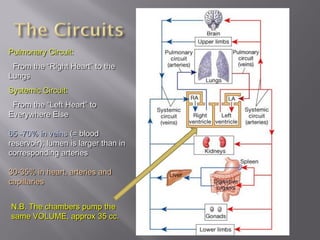
Pulmonary Circuit:
 From the “Right Heart” to the
Lungs
Systemic Circuit:
 From the “Left Heart” to
Everywhere Else

65 -70% in veins (= blood
reservoir); lumen is larger than in
corresponding arteries

30-35% in heart, arteries and
capillaries


N.B. The chambers pump the
same VOLUME, approx 35 cc.
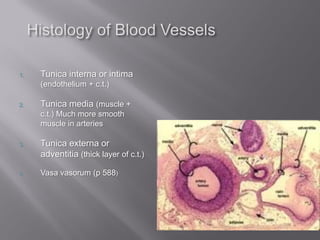
1.   Tunica interna or intima
     (endothelium + c.t.)

2.   Tunica media (muscle +
     c.t.) Much more smooth
     muscle in arteries

3.   Tunica externa or
     adventitia (thick layer of c.t.)

4.   Vasa vasorum (p 588)
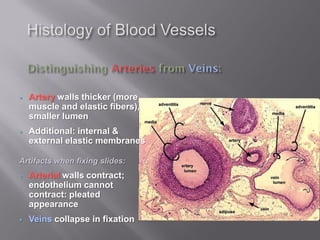
   Artery walls thicker (more
    muscle and elastic fibers),
    smaller lumen
   Additional: internal &
    external elastic membranes

Artifacts when fixing slides:
   Arterial walls contract;
    endothelium cannot
    contract: pleated
    appearance
   Veins collapse in fixation
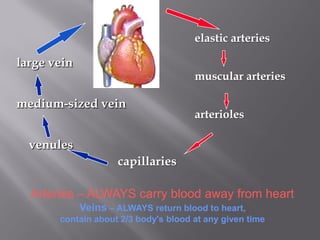
elastic arteries

large vein
                                      muscular arteries

medium-sized vein
                                      arterioles

  venules
                     capillaries

  Arteries – ALWAYS carry blood away from heart
             Veins – ALWAYS return blood to heart,
       contain about 2/3 body's blood at any given time
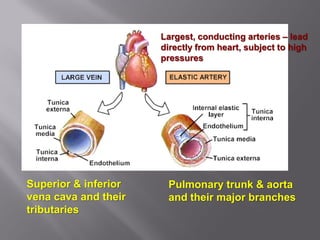
Largest, conducting arteries – lead
                      directly from heart, subject to high
                      pressures


Superior & inferior    Pulmonary trunk & aorta
vena cava and their    and their major branches
tributaries
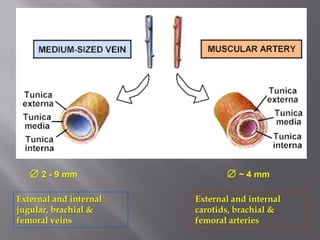
 2 - 9 mm                   ~ 4 mm

External and internal   External and internal
jugular, brachial &     carotids, brachial &
femoral veins           femoral arteries
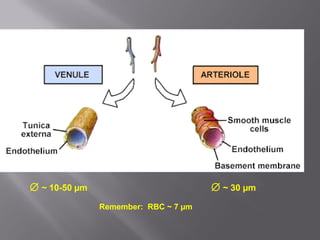
 ~ 10-50 µm                           ~ 30 µm
               Remember: RBC ~ 7 µm
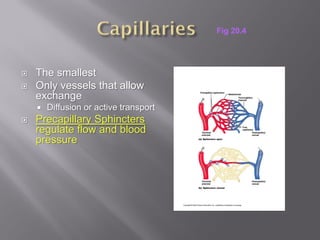
Fig 20.4


   The smallest
   Only vessels that allow
    exchange
       Diffusion or active transport
   Precapillary Sphincters
    regulate flow and blood
    pressure
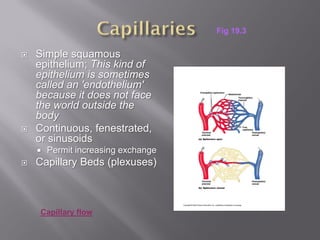
Fig 19.3


   Simple squamous
    epithelium; This kind of
    epithelium is sometimes
    called an 'endothelium'
    because it does not face
    the world outside the
    body
   Continuous, fenestrated,
    or sinusoids
       Permit increasing exchange
   Capillary Beds (plexuses)


    Capillary flow
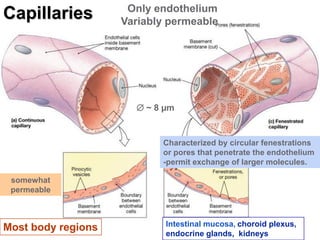
Only endothelium
Capillaries         Variably permeable


                       ~ 8 µm


                           Characterized by circular fenestrations
                           or pores that penetrate the endothelium
                           -permit exchange of larger molecules.
 somewhat
 permeable


                            Intestinal mucosa, choroid plexus,
Most body regions
                            endocrine glands, kidneys
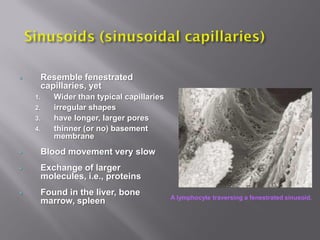
    Resemble fenestrated
     capillaries, yet
    1.   Wider than typical capillaries
    2.   irregular shapes
    3.   have longer, larger pores
    4.   thinner (or no) basement
         membrane
    Blood movement very slow
    Exchange of larger
     molecules, i.e., proteins
    Found in the liver, bone
                                          A lymphocyte traversing a fenestrated sinusoid.
     marrow, spleen
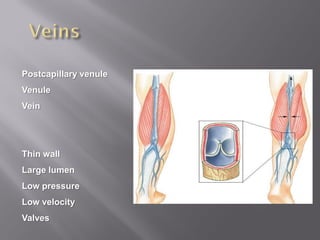
Postcapillary venule
Venule
Vein


Thin wall
Large lumen
Low pressure
Low velocity
Valves
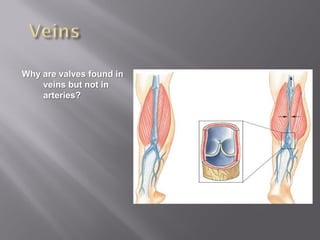
Why are valves found in
    veins but not in
    arteries?
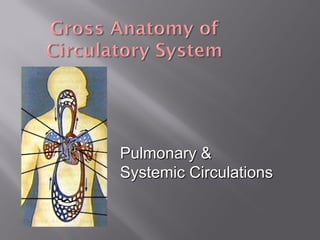
Pulmonary &
Systemic Circulations
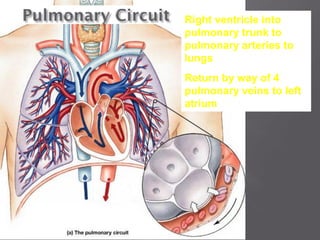
Right ventricle into
pulmonary trunk to
pulmonary arteries to
lungs
Return by way of 4
pulmonary veins to left
atrium
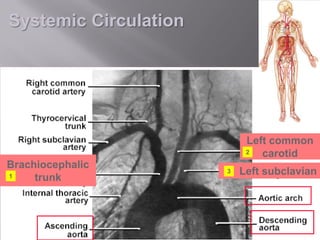
Systemic Circulation


                            Left common
                            2  carotid
Brachiocephalic        3   Left subclavian
1    trunk
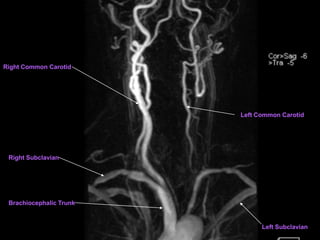
Right Common Carotid


                         Left Common Carotid


 Right Subclavian


 Brachiocephalic Trunk


                               Left Subclavian
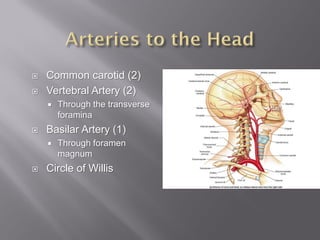
   Common carotid (2)
   Vertebral Artery (2)
       Through the transverse
        foramina
   Basilar Artery (1)
       Through foramen
        magnum
   Circle of Willis
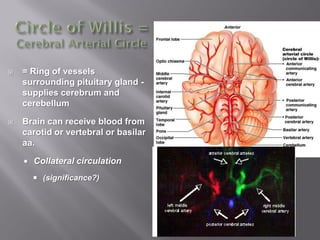
   = Ring of vessels
    surrounding pituitary gland -
    supplies cerebrum and
    cerebellum

   Brain can receive blood from
    carotid or vertebral or basilar
    aa.

       Collateral circulation
         (significance?)
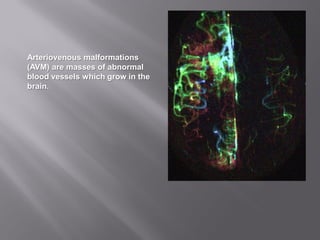
Arteriovenous malformations
(AVM) are masses of abnormal
blood vessels which grow in the
brain.
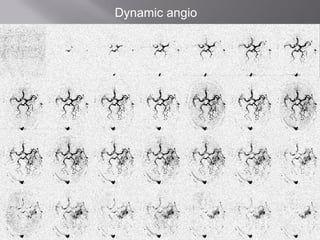
Dynamic angio
   Sclerosis = hardening
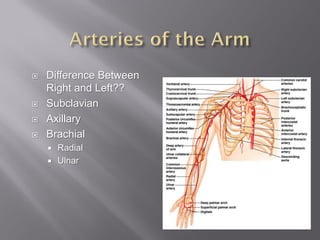
   Difference Between
    Right and Left??
   Subclavian
   Axillary
   Brachial
       Radial
       Ulnar
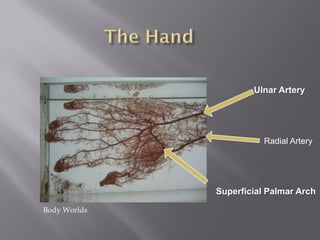
Ulnar Artery


                         Radial Artery


              Superficial Palmar Arch

Body Worlds
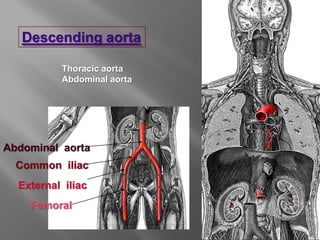
Descending aorta

          Thoracic aorta
          Abdominal aorta


Abdominal aorta
  Common iliac
  External iliac
    Femoral
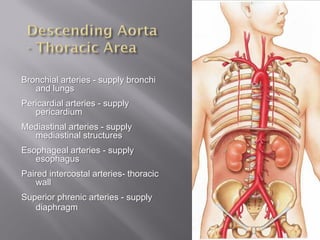
Bronchial arteries - supply bronchi
   and lungs
Pericardial arteries - supply
   pericardium
Mediastinal arteries - supply
  mediastinal structures
Esophageal arteries - supply
   esophagus
Paired intercostal arteries- thoracic
    wall
Superior phrenic arteries - supply
   diaphragm
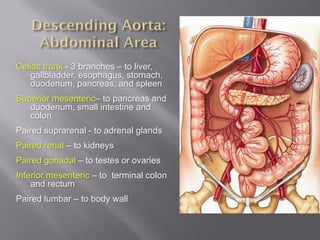
Celiac trunk - 3 branches – to liver,
    gallbladder, esophagus, stomach,
    duodenum, pancreas, and spleen
Superior mesenteric– to pancreas and
   duodenum, small intestine and
   colon
Paired suprarenal - to adrenal glands
Paired renal – to kidneys
Paired gonadal – to testes or ovaries
Inferior mesenteric – to terminal colon
    and rectum
Paired lumbar – to body wall
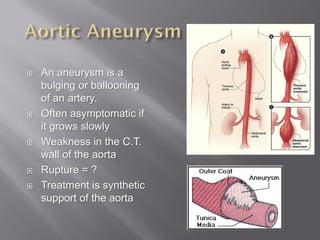
   An aneurysm is a
    bulging or ballooning
    of an artery.
   Often asymptomatic if
    it grows slowly
   Weakness in the C.T.
    wall of the aorta
   Rupture = ?
   Treatment is synthetic
    support of the aorta
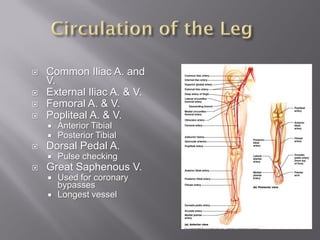
   Common Iliac A. and
    V.
   External Iliac A. & V.
   Femoral A. & V.
   Popliteal A. & V.
       Anterior Tibial
       Posterior Tibial
   Dorsal Pedal A.
       Pulse checking
   Great Saphenous V.
       Used for coronary
        bypasses
       Longest vessel
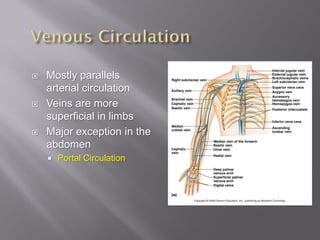
   Mostly parallels
    arterial circulation
   Veins are more
    superficial in limbs
   Major exception in the
    abdomen
       Portal Circulation
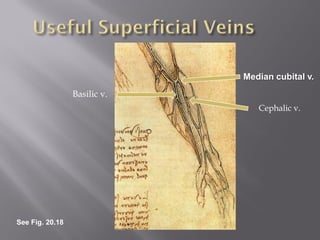
Median cubital v.
                 Basilic v.
                                 Cephalic v.


See Fig. 20.18
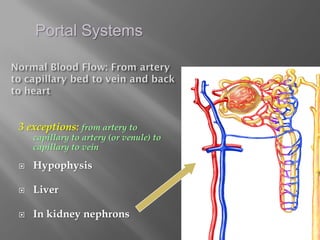
Portal Systems


3 exceptions: from artery to
    capillary to artery (or venule) to
    capillary to vein

   Hypophysis

   Liver

   In kidney nephrons
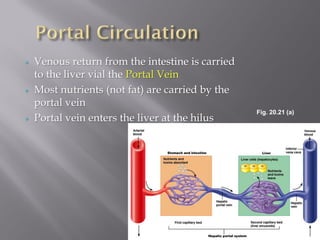
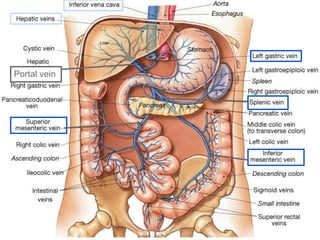
   Venous return from the intestine is carried
    to the liver vial the Portal Vein
   Most nutrients (not fat) are carried by the
    portal vein
                                                  Fig. 20.21 (a)
   Portal vein enters the liver at the hilus
Portal vein
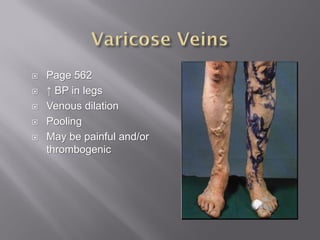
   Page 562
   ↑ BP in legs
   Venous dilation
   Pooling
   May be painful and/or
    thrombogenic
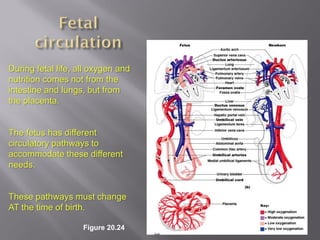
During fetal life, all oxygen and
nutrition comes not from the
intestine and lungs, but from
the placenta.


The fetus has different
circulatory pathways to
accommodate these different
needs.

These pathways must change
AT the time of birth.
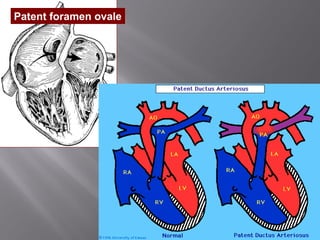
                    Figure 20.24
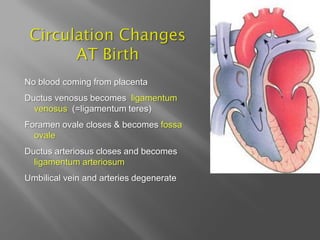
No blood coming from placenta
Ductus venosus becomes ligamentum
  venosus (=ligamentum teres)
Foramen ovale closes & becomes fossa
  ovale
Ductus arteriosus closes and becomes
  ligamentum arteriosum
Umbilical vein and arteries degenerate
Patent foramen ovale
Chapter20 bloodvesselsmarieb

Chapter20 bloodvesselsmarieb

  • 1.
    Key Concepts:  Describe the histological similarities and differences of the blood vessels  Explain the pattern and names of the major arteries and veins of the pulmonary & systemic circulations  Describe the circulatory changes that occur at birth. Developed by John Gallagher, MS, DVM
  • 2.
    Pulmonary Circuit: Fromthe “Right Heart” to the Lungs Systemic Circuit: From the “Left Heart” to Everywhere Else 65 -70% in veins (= blood reservoir); lumen is larger than in corresponding arteries 30-35% in heart, arteries and capillaries N.B. The chambers pump the same VOLUME, approx 35 cc.
  • 3.
    1. Tunica interna or intima (endothelium + c.t.) 2. Tunica media (muscle + c.t.) Much more smooth muscle in arteries 3. Tunica externa or adventitia (thick layer of c.t.) 4. Vasa vasorum (p 588)
  • 4.
    Artery walls thicker (more muscle and elastic fibers), smaller lumen  Additional: internal & external elastic membranes Artifacts when fixing slides:  Arterial walls contract; endothelium cannot contract: pleated appearance  Veins collapse in fixation
  • 5.
    elastic arteries large vein muscular arteries medium-sized vein arterioles venules capillaries Arteries – ALWAYS carry blood away from heart Veins – ALWAYS return blood to heart, contain about 2/3 body's blood at any given time
  • 6.
    Largest, conducting arteries– lead directly from heart, subject to high pressures Superior & inferior Pulmonary trunk & aorta vena cava and their and their major branches tributaries
  • 7.
     2 -9 mm  ~ 4 mm External and internal External and internal jugular, brachial & carotids, brachial & femoral veins femoral arteries
  • 8.
     ~ 10-50µm  ~ 30 µm Remember: RBC ~ 7 µm
  • 9.
    Fig 20.4  The smallest  Only vessels that allow exchange  Diffusion or active transport  Precapillary Sphincters regulate flow and blood pressure
  • 10.
    Fig 19.3  Simple squamous epithelium; This kind of epithelium is sometimes called an 'endothelium' because it does not face the world outside the body  Continuous, fenestrated, or sinusoids  Permit increasing exchange  Capillary Beds (plexuses) Capillary flow
  • 11.
    Only endothelium Capillaries Variably permeable  ~ 8 µm Characterized by circular fenestrations or pores that penetrate the endothelium -permit exchange of larger molecules. somewhat permeable Intestinal mucosa, choroid plexus, Most body regions endocrine glands, kidneys
  • 12.
    Resemble fenestrated capillaries, yet 1. Wider than typical capillaries 2. irregular shapes 3. have longer, larger pores 4. thinner (or no) basement membrane  Blood movement very slow  Exchange of larger molecules, i.e., proteins  Found in the liver, bone A lymphocyte traversing a fenestrated sinusoid. marrow, spleen
  • 13.
    Postcapillary venule Venule Vein Thin wall Largelumen Low pressure Low velocity Valves
  • 14.
    Why are valvesfound in veins but not in arteries?
  • 15.
  • 16.
    Right ventricle into pulmonarytrunk to pulmonary arteries to lungs Return by way of 4 pulmonary veins to left atrium
  • 17.
    Systemic Circulation Left common 2 carotid Brachiocephalic 3 Left subclavian 1 trunk
  • 18.
    Right Common Carotid Left Common Carotid Right Subclavian Brachiocephalic Trunk Left Subclavian
  • 19.
    Common carotid (2)  Vertebral Artery (2)  Through the transverse foramina  Basilar Artery (1)  Through foramen magnum  Circle of Willis
  • 20.
    = Ring of vessels surrounding pituitary gland - supplies cerebrum and cerebellum  Brain can receive blood from carotid or vertebral or basilar aa.  Collateral circulation  (significance?)
  • 21.
    Arteriovenous malformations (AVM) aremasses of abnormal blood vessels which grow in the brain.
  • 22.
  • 23.
    Sclerosis = hardening
  • 24.
    Difference Between Right and Left??  Subclavian  Axillary  Brachial  Radial  Ulnar
  • 25.
    Ulnar Artery Radial Artery Superficial Palmar Arch Body Worlds
  • 26.
    Descending aorta Thoracic aorta Abdominal aorta Abdominal aorta Common iliac External iliac Femoral
  • 27.
    Bronchial arteries -supply bronchi and lungs Pericardial arteries - supply pericardium Mediastinal arteries - supply mediastinal structures Esophageal arteries - supply esophagus Paired intercostal arteries- thoracic wall Superior phrenic arteries - supply diaphragm
  • 28.
    Celiac trunk -3 branches – to liver, gallbladder, esophagus, stomach, duodenum, pancreas, and spleen Superior mesenteric– to pancreas and duodenum, small intestine and colon Paired suprarenal - to adrenal glands Paired renal – to kidneys Paired gonadal – to testes or ovaries Inferior mesenteric – to terminal colon and rectum Paired lumbar – to body wall
  • 29.
    An aneurysm is a bulging or ballooning of an artery.  Often asymptomatic if it grows slowly  Weakness in the C.T. wall of the aorta  Rupture = ?  Treatment is synthetic support of the aorta
  • 30.
    Common Iliac A. and V.  External Iliac A. & V.  Femoral A. & V.  Popliteal A. & V.  Anterior Tibial  Posterior Tibial  Dorsal Pedal A.  Pulse checking  Great Saphenous V.  Used for coronary bypasses  Longest vessel
  • 31.
    Mostly parallels arterial circulation  Veins are more superficial in limbs  Major exception in the abdomen  Portal Circulation
  • 32.
    Median cubital v. Basilic v. Cephalic v. See Fig. 20.18
  • 33.
    Portal Systems 3 exceptions:from artery to capillary to artery (or venule) to capillary to vein  Hypophysis  Liver  In kidney nephrons
  • 34.
    Venous return from the intestine is carried to the liver vial the Portal Vein  Most nutrients (not fat) are carried by the portal vein Fig. 20.21 (a)  Portal vein enters the liver at the hilus
  • 35.
  • 36.
    Page 562  ↑ BP in legs  Venous dilation  Pooling  May be painful and/or thrombogenic
  • 37.
    During fetal life,all oxygen and nutrition comes not from the intestine and lungs, but from the placenta. The fetus has different circulatory pathways to accommodate these different needs. These pathways must change AT the time of birth. Figure 20.24
  • 38.
    No blood comingfrom placenta Ductus venosus becomes ligamentum venosus (=ligamentum teres) Foramen ovale closes & becomes fossa ovale Ductus arteriosus closes and becomes ligamentum arteriosum Umbilical vein and arteries degenerate
  • 39.