IEEE 802.11 Overview
Mustafa Ergen
ergen@eecs.berkeley.edu
UC Berkeley
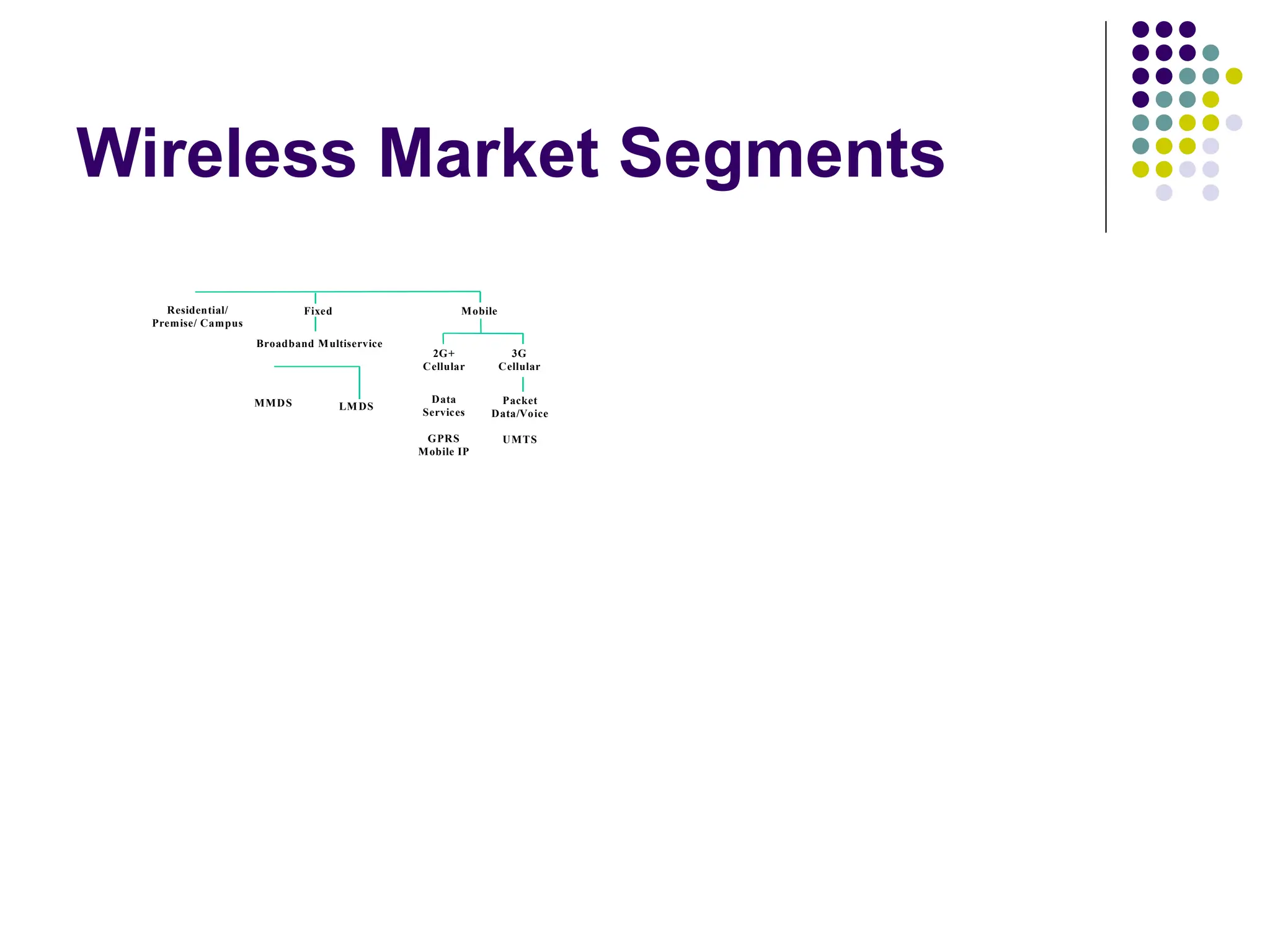
Wireless Market Segments
Wireless Market Segments & Partners
Fixed Mobile
Broadband Multiservice
2G+
Cellular
3G
Cellular
Residential/
Premise/ Campus
LMDS
MMDS
Cisco/
Bosch
Data
Services
GPRS
Mobile IP
Packet
Data/Voice
UMTS
Standardization of Wireless
Networks
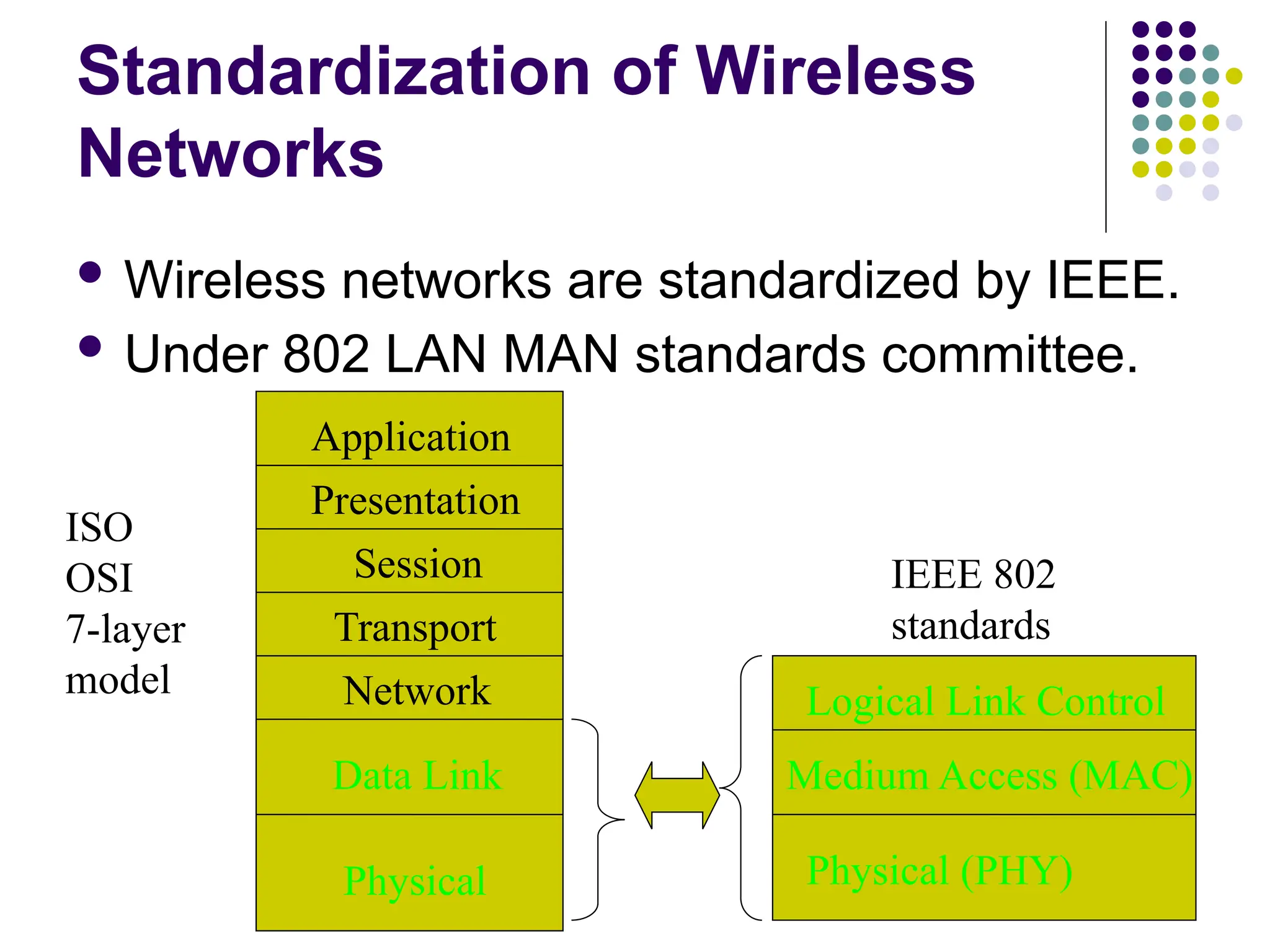
 Wireless networks are standardized by IEEE.
 Under 802 LAN MAN standards committee.
Application
Presentation
Session
Transport
Network
Data Link
Physical
ISO
OSI
7-layer
model
Logical Link Control
Medium Access (MAC)
Physical (PHY)
IEEE 802
standards
IEEE 802.11 Overview
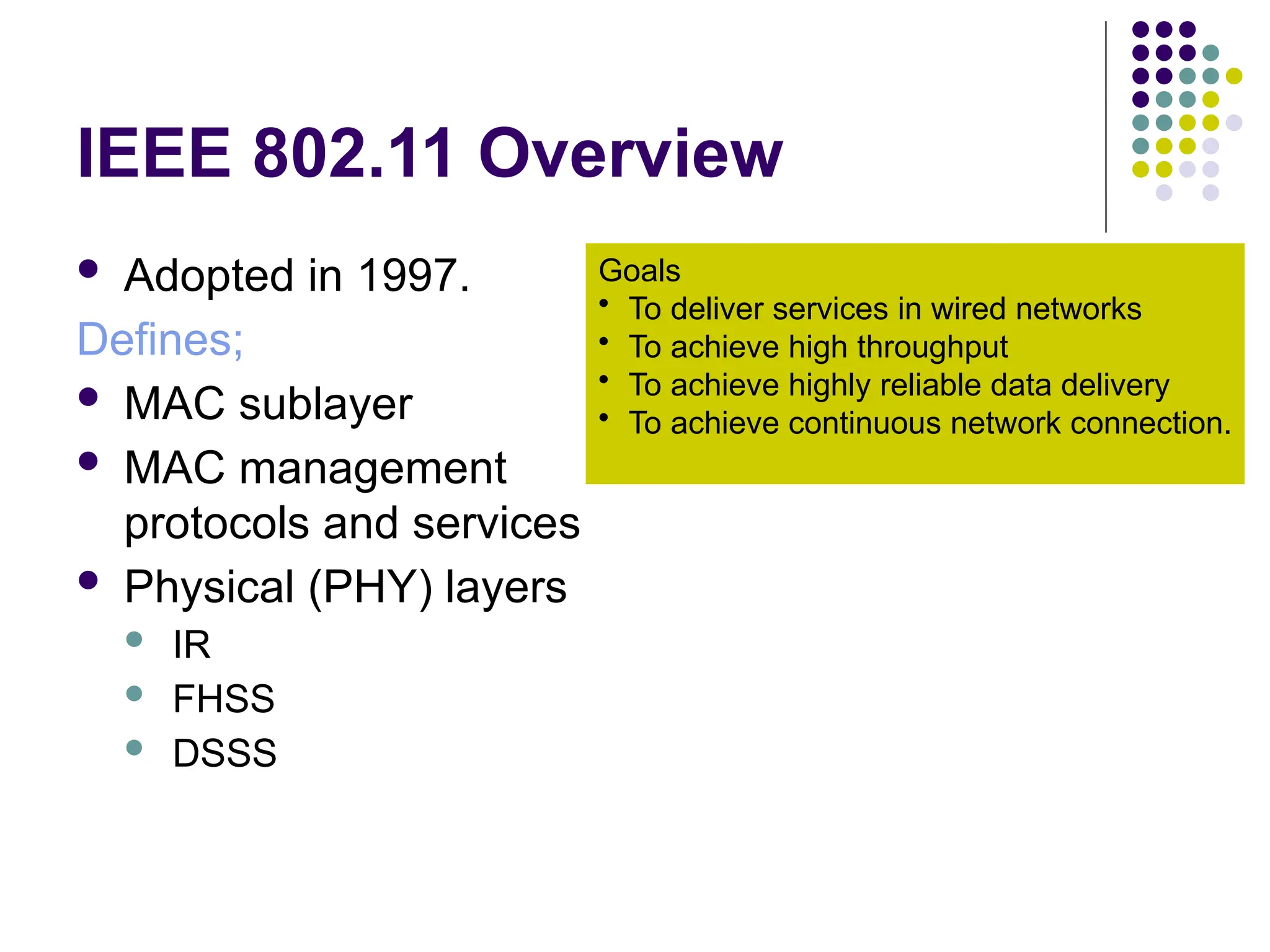
 Adopted in 1997.
Defines;
 MAC sublayer
 MAC management
protocols and services
 Physical (PHY) layers
 IR
 FHSS
 DSSS
Goals
• To deliver services in wired networks
• To achieve high throughput
• To achieve highly reliable data delivery
• To achieve continuous network connection.
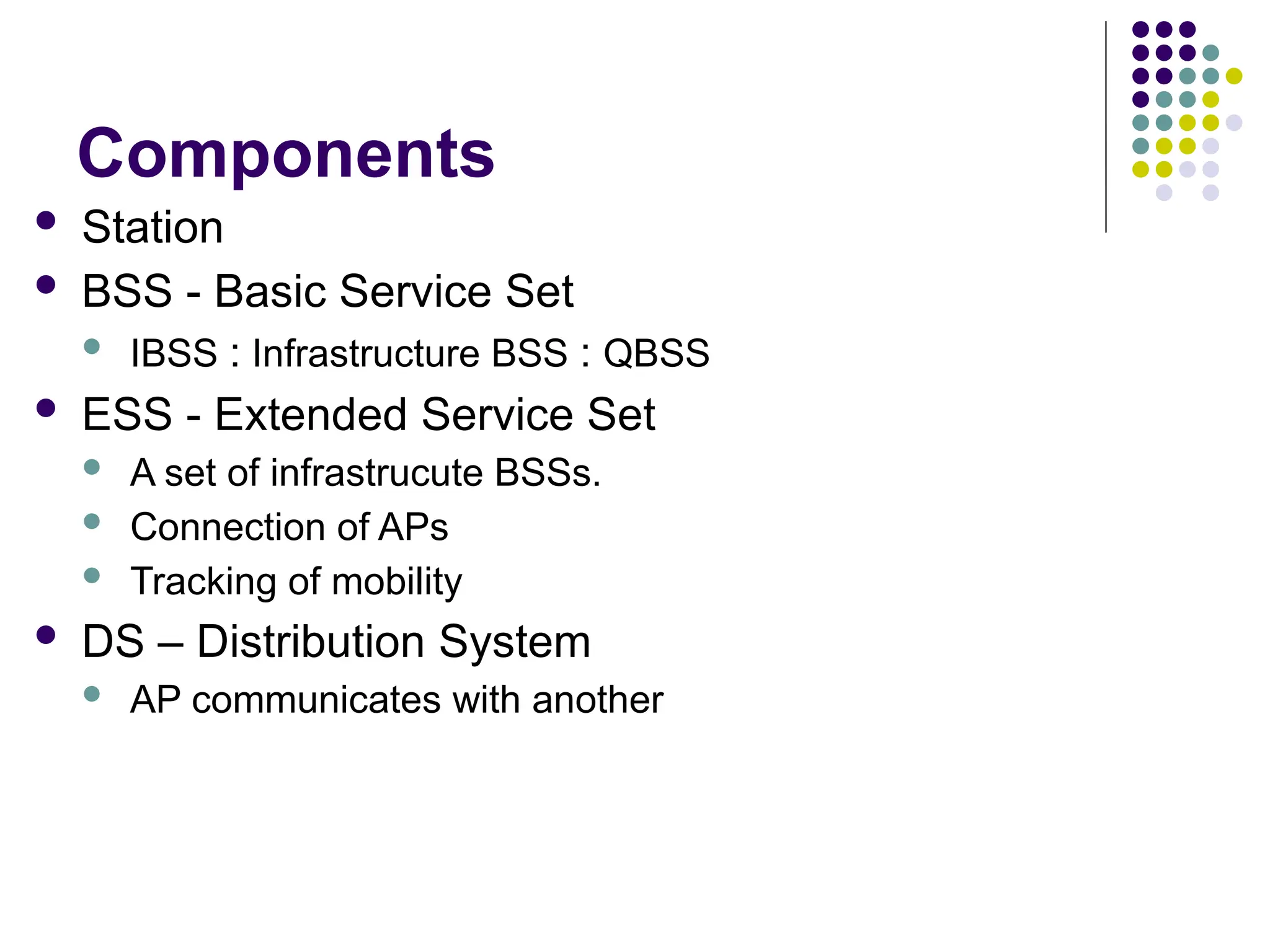
Components
 Station
 BSS - Basic Service Set
 IBSS : Infrastructure BSS : QBSS
 ESS - Extended Service Set
 A set of infrastrucute BSSs.
 Connection of APs
 Tracking of mobility
 DS – Distribution System
 AP communicates with another
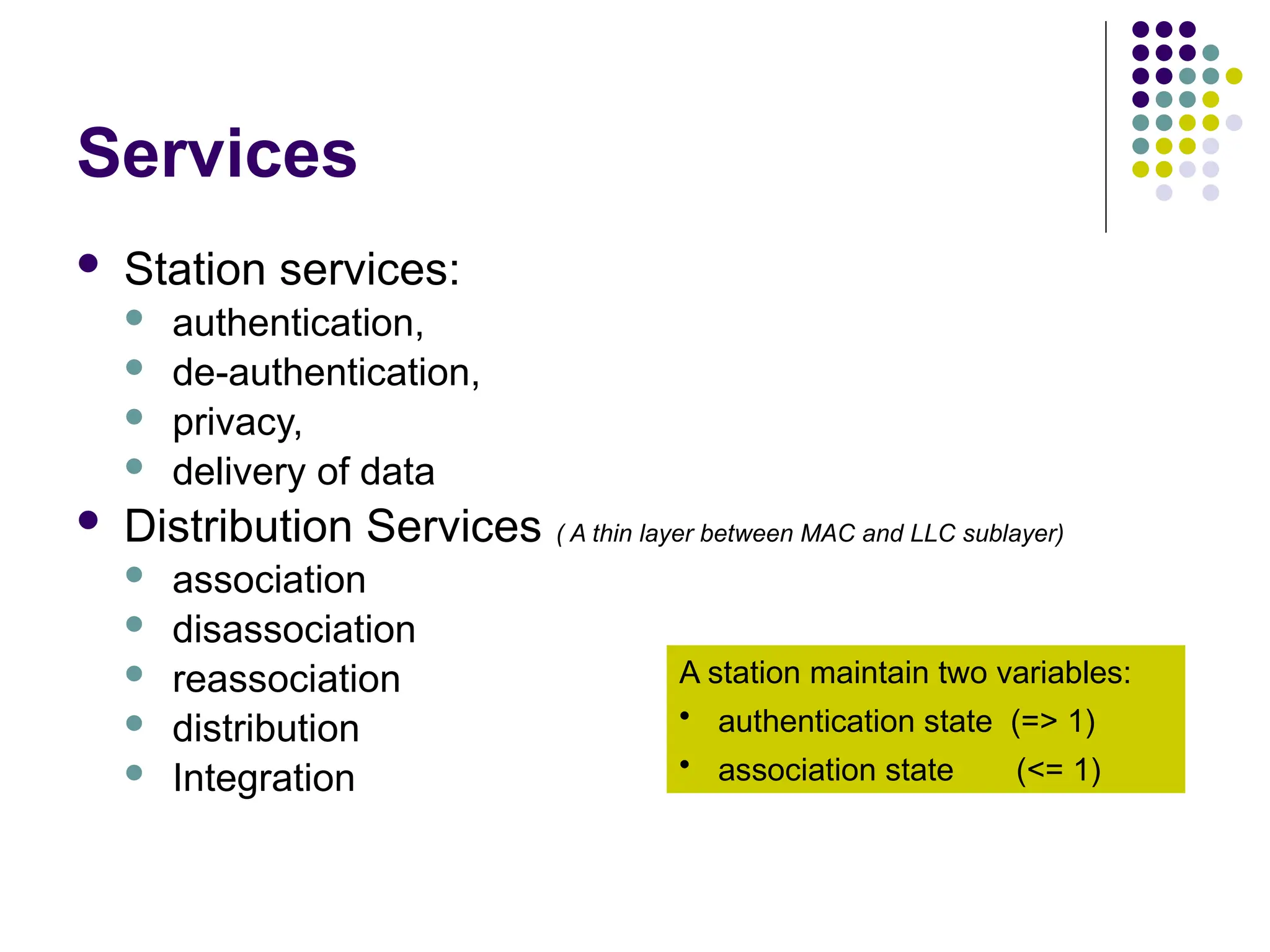
Services
 Station services:
 authentication,
 de-authentication,
 privacy,
 delivery of data
 Distribution Services ( A thin layer between MAC and LLC sublayer)
 association
 disassociation
 reassociation
 distribution
 Integration
A station maintain two variables:
• authentication state (=> 1)
• association state (<= 1)
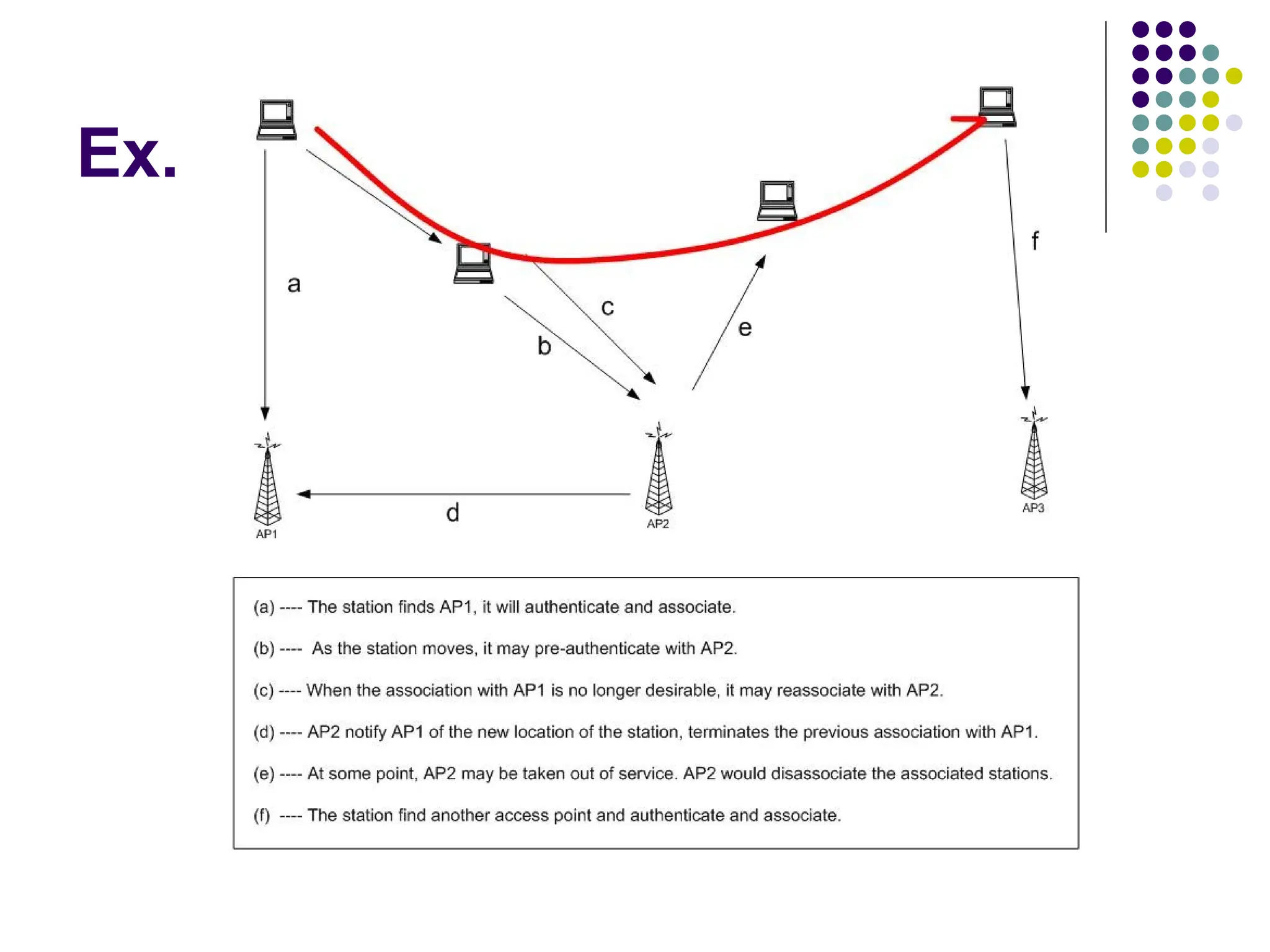
Ex.
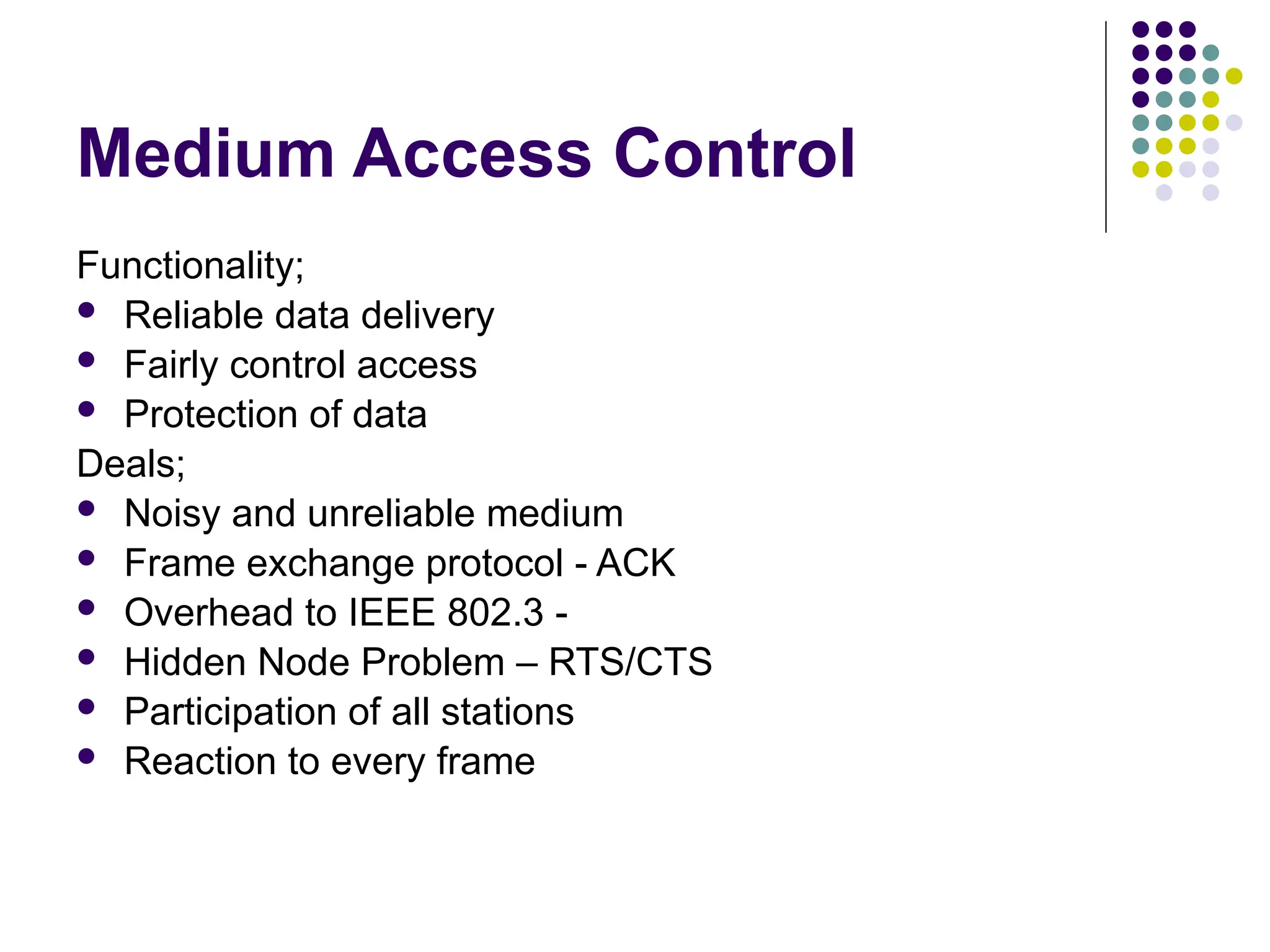
Medium Access Control
Functionality;
 Reliable data delivery
 Fairly control access
 Protection of data
Deals;
 Noisy and unreliable medium
 Frame exchange protocol - ACK
 Overhead to IEEE 802.3 -
 Hidden Node Problem – RTS/CTS
 Participation of all stations
 Reaction to every frame
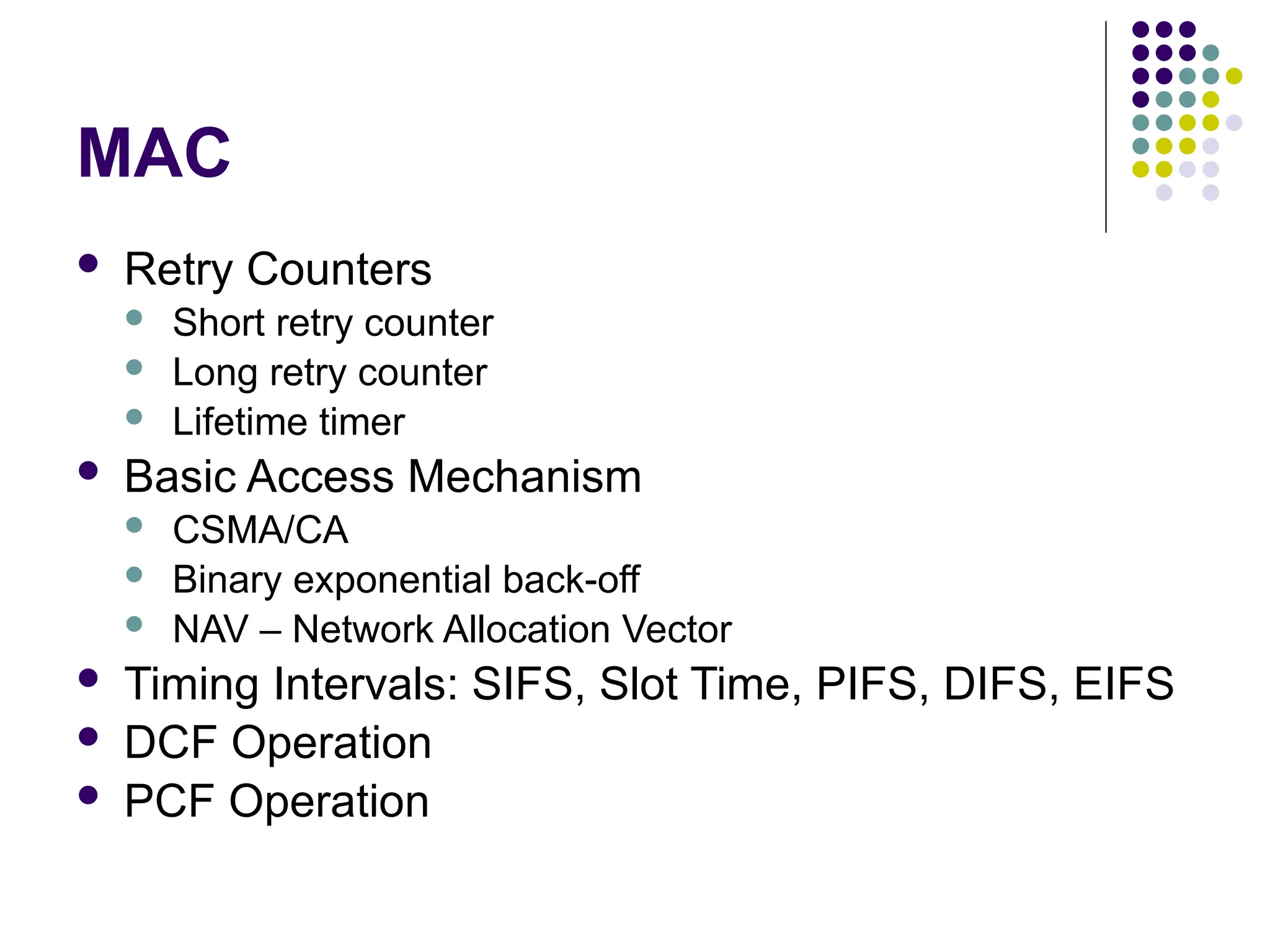
MAC
 Retry Counters
 Short retry counter
 Long retry counter
 Lifetime timer
 Basic Access Mechanism
 CSMA/CA
 Binary exponential back-off
 NAV – Network Allocation Vector
 Timing Intervals: SIFS, Slot Time, PIFS, DIFS, EIFS
 DCF Operation
 PCF Operation
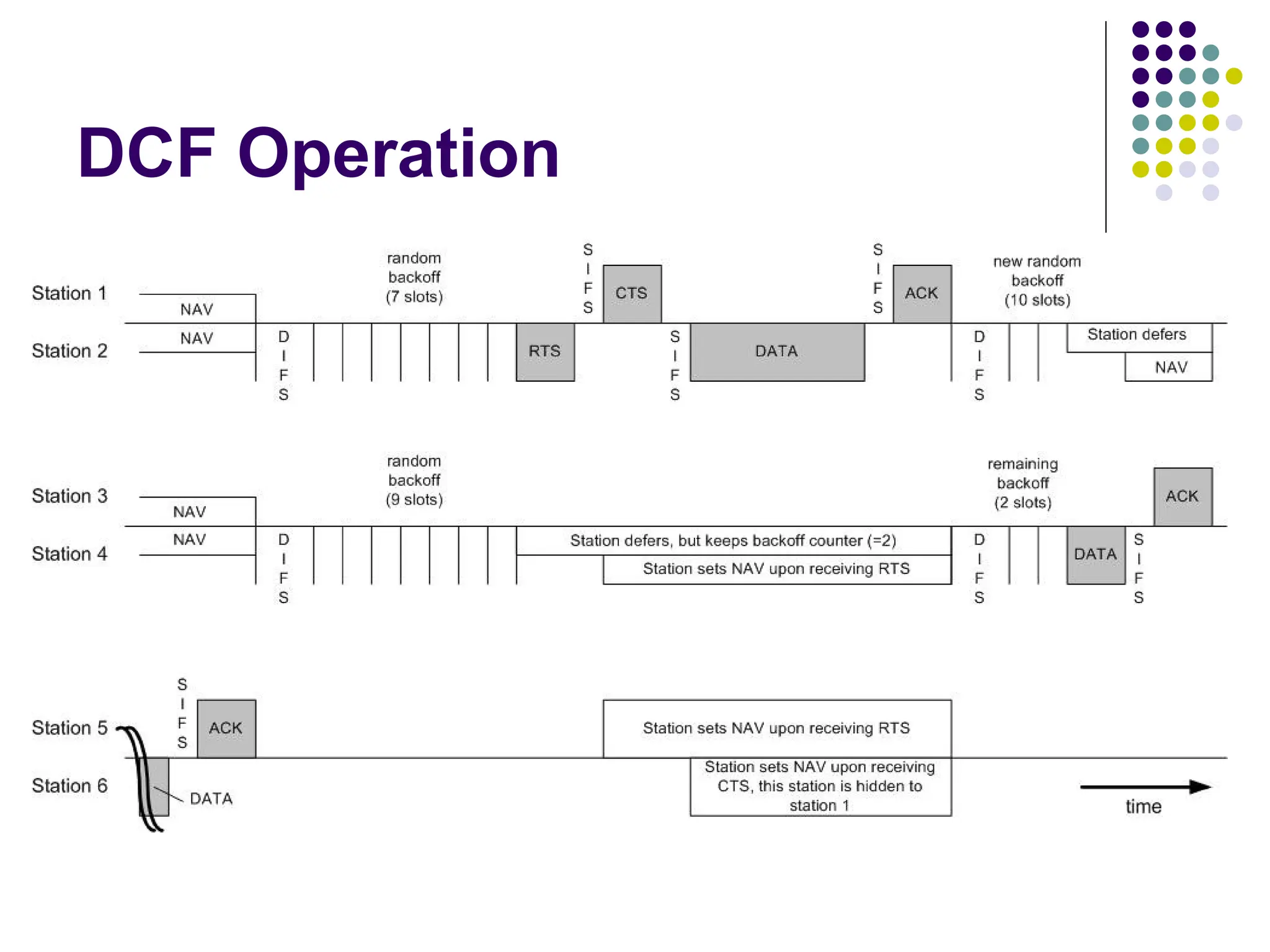
DCF Operation
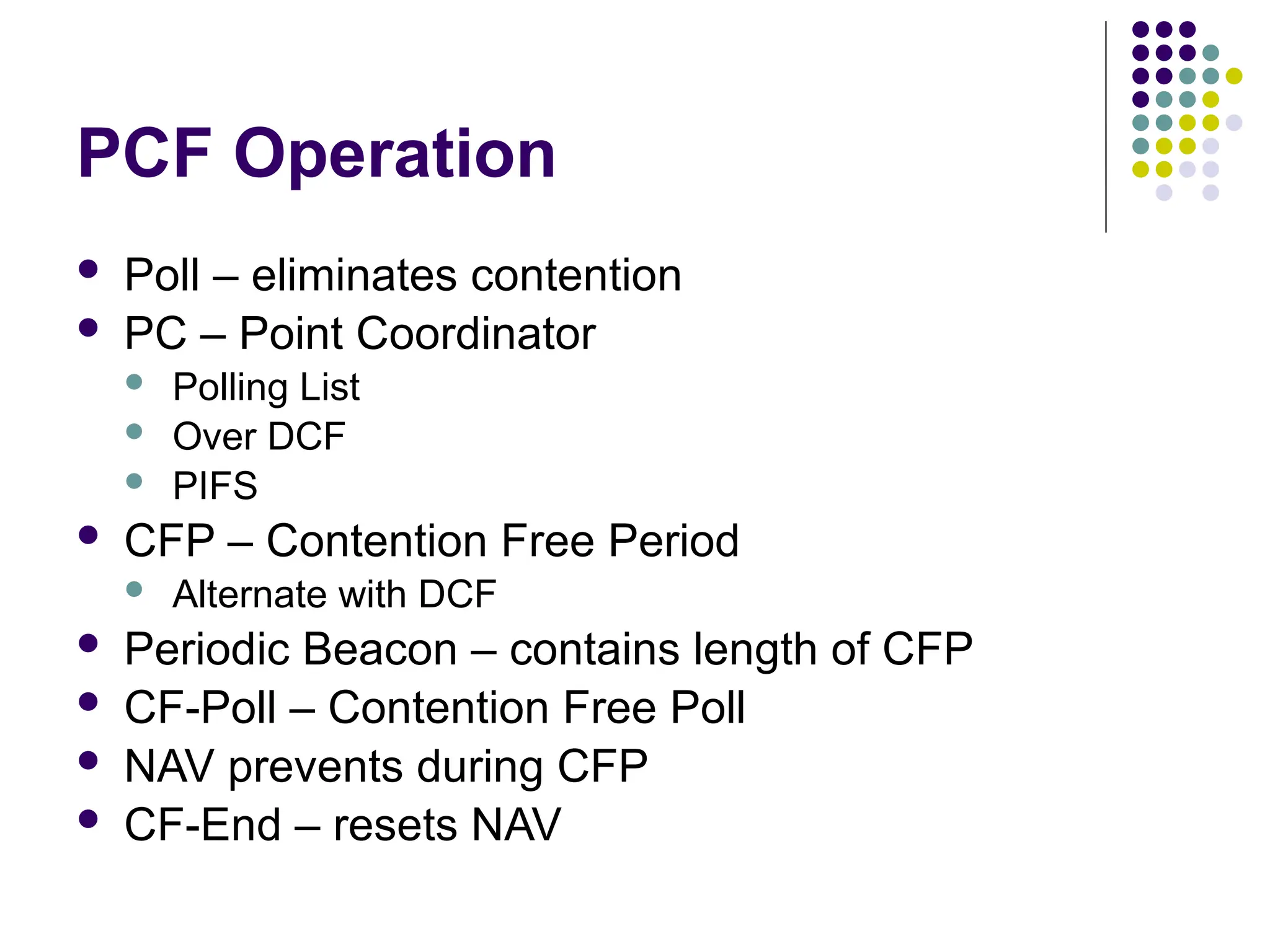
PCF Operation
 Poll – eliminates contention
 PC – Point Coordinator
 Polling List
 Over DCF
 PIFS
 CFP – Contention Free Period
 Alternate with DCF
 Periodic Beacon – contains length of CFP
 CF-Poll – Contention Free Poll
 NAV prevents during CFP
 CF-End – resets NAV
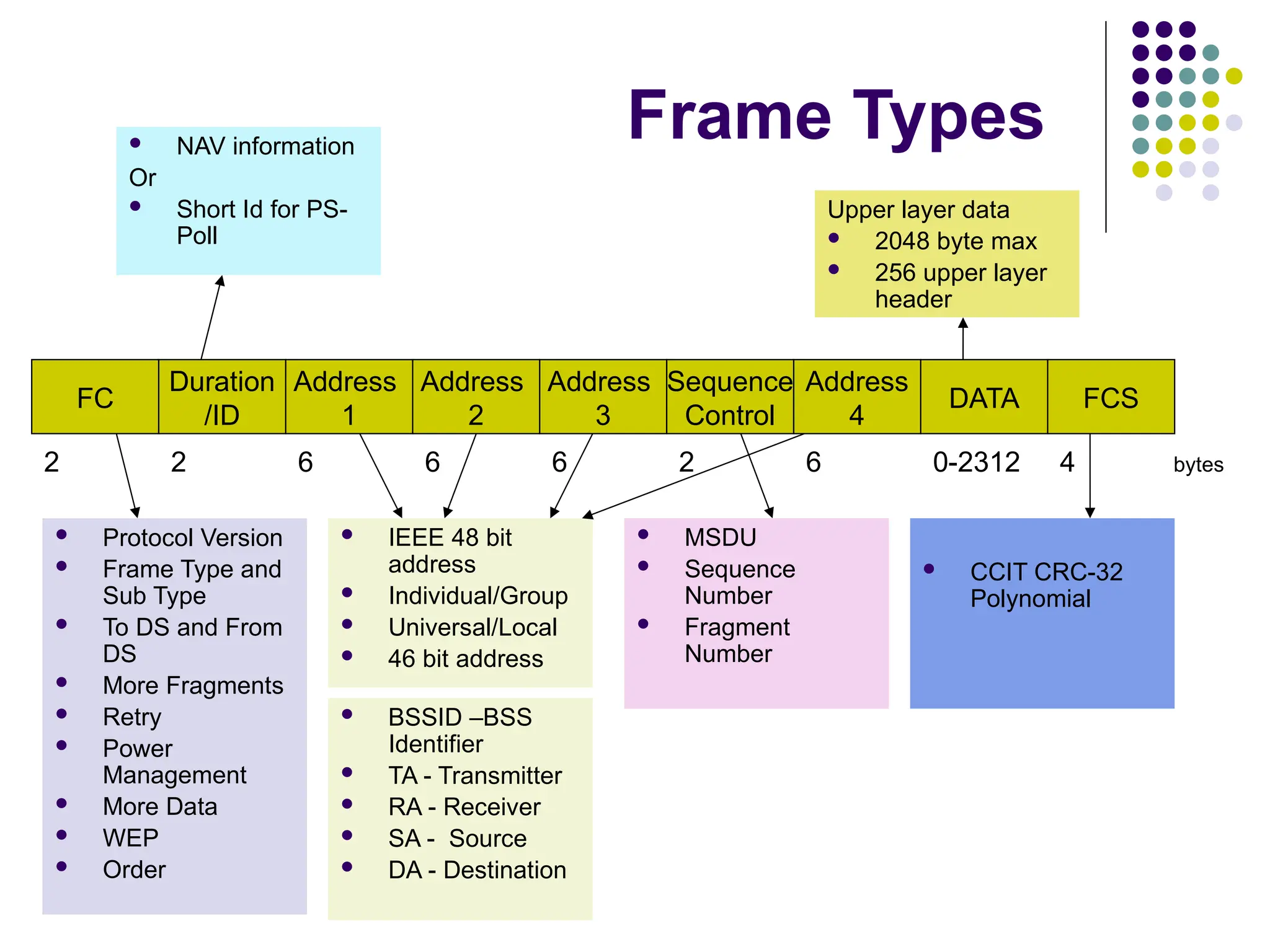
Frame Types
 Protocol Version
 Frame Type and
Sub Type
 To DS and From
DS
 More Fragments
 Retry
 Power
Management
 More Data
 WEP
 Order
FC
Duration
/ID
Address
1
Address
2
Address
3
Sequence
Control
Address
4
DATA FCS
2 2 6 6 6 2 6 0-2312 4 bytes
 NAV information
Or
 Short Id for PS-
Poll
 BSSID –BSS
Identifier
 TA - Transmitter
 RA - Receiver
 SA - Source
 DA - Destination
 IEEE 48 bit
address
 Individual/Group
 Universal/Local
 46 bit address
 MSDU
 Sequence
Number
 Fragment
Number
 CCIT CRC-32
Polynomial
Upper layer data
 2048 byte max
 256 upper layer
header
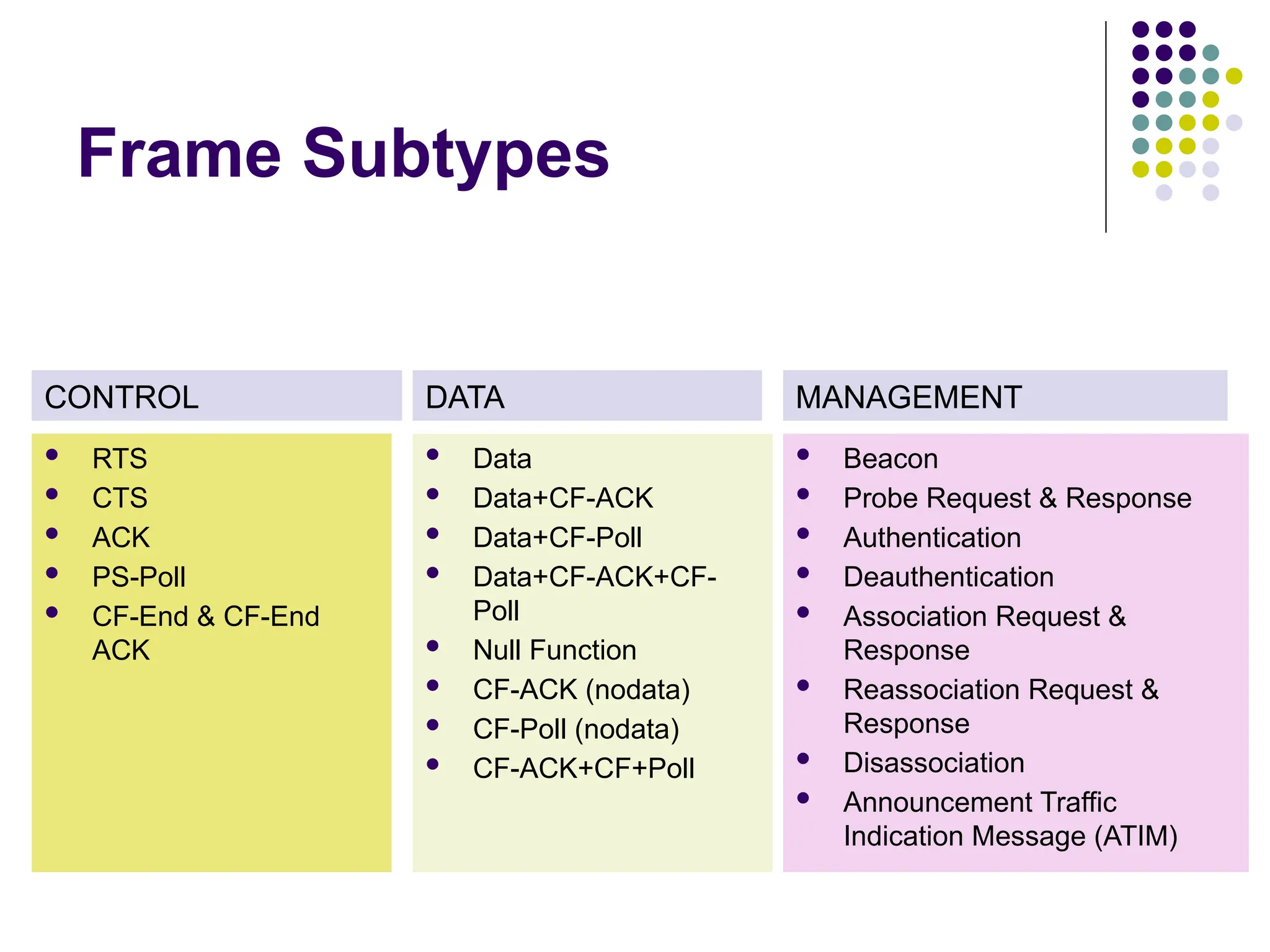
Frame Subtypes
 RTS
 CTS
 ACK
 PS-Poll
 CF-End & CF-End
ACK
 Data
 Data+CF-ACK
 Data+CF-Poll
 Data+CF-ACK+CF-
Poll
 Null Function
 CF-ACK (nodata)
 CF-Poll (nodata)
 CF-ACK+CF+Poll
 Beacon
 Probe Request & Response
 Authentication
 Deauthentication
 Association Request &
Response
 Reassociation Request &
Response
 Disassociation
 Announcement Traffic
Indication Message (ATIM)
CONTROL DATA MANAGEMENT
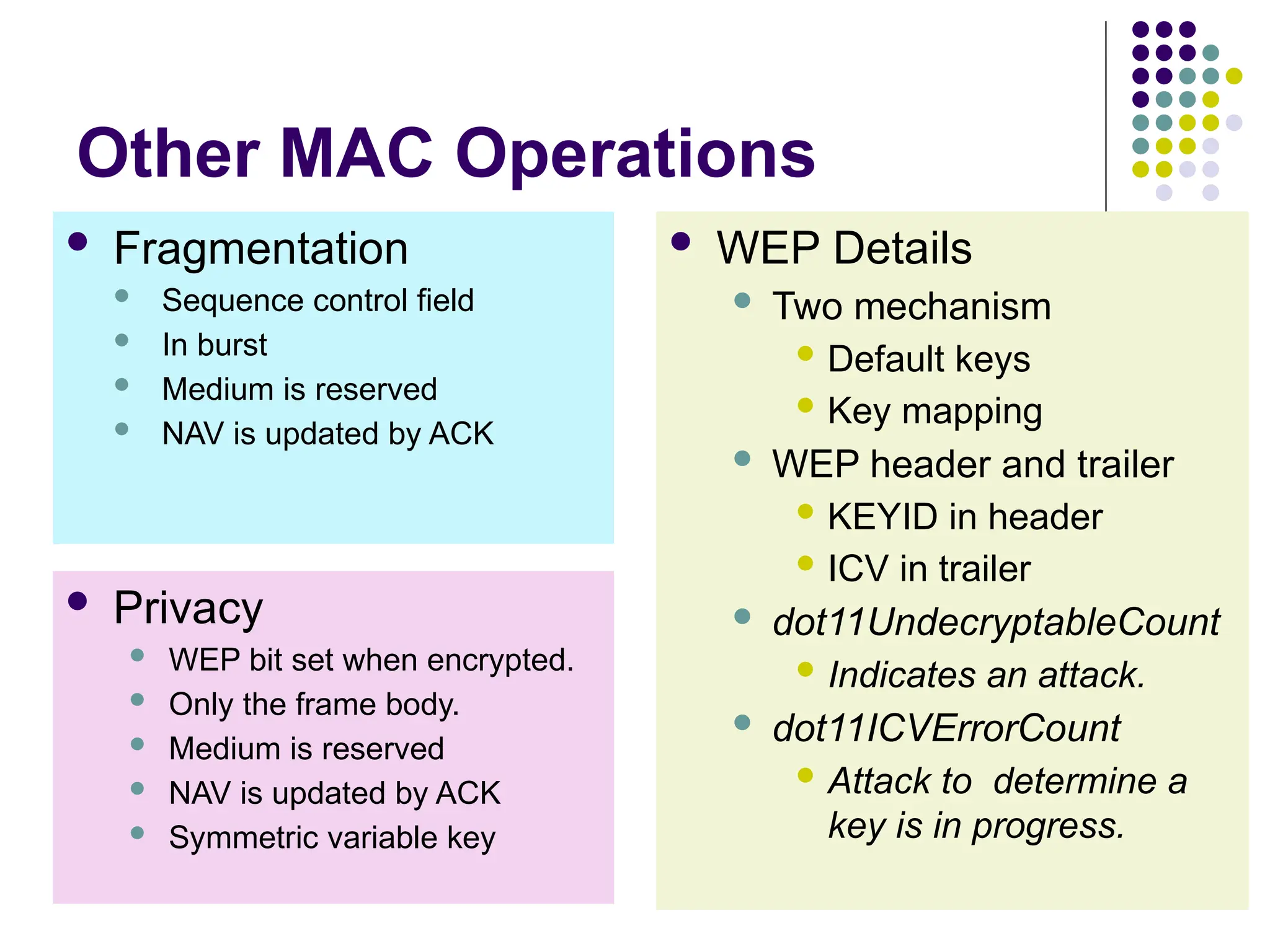
Other MAC Operations
 Fragmentation
 Sequence control field
 In burst
 Medium is reserved
 NAV is updated by ACK
 Privacy
 WEP bit set when encrypted.
 Only the frame body.
 Medium is reserved
 NAV is updated by ACK
 Symmetric variable key
 WEP Details
 Two mechanism
 Default keys
 Key mapping
 WEP header and trailer
 KEYID in header
 ICV in trailer
 dot11UndecryptableCount
 Indicates an attack.
 dot11ICVErrorCount
 Attack to determine a
key is in progress.
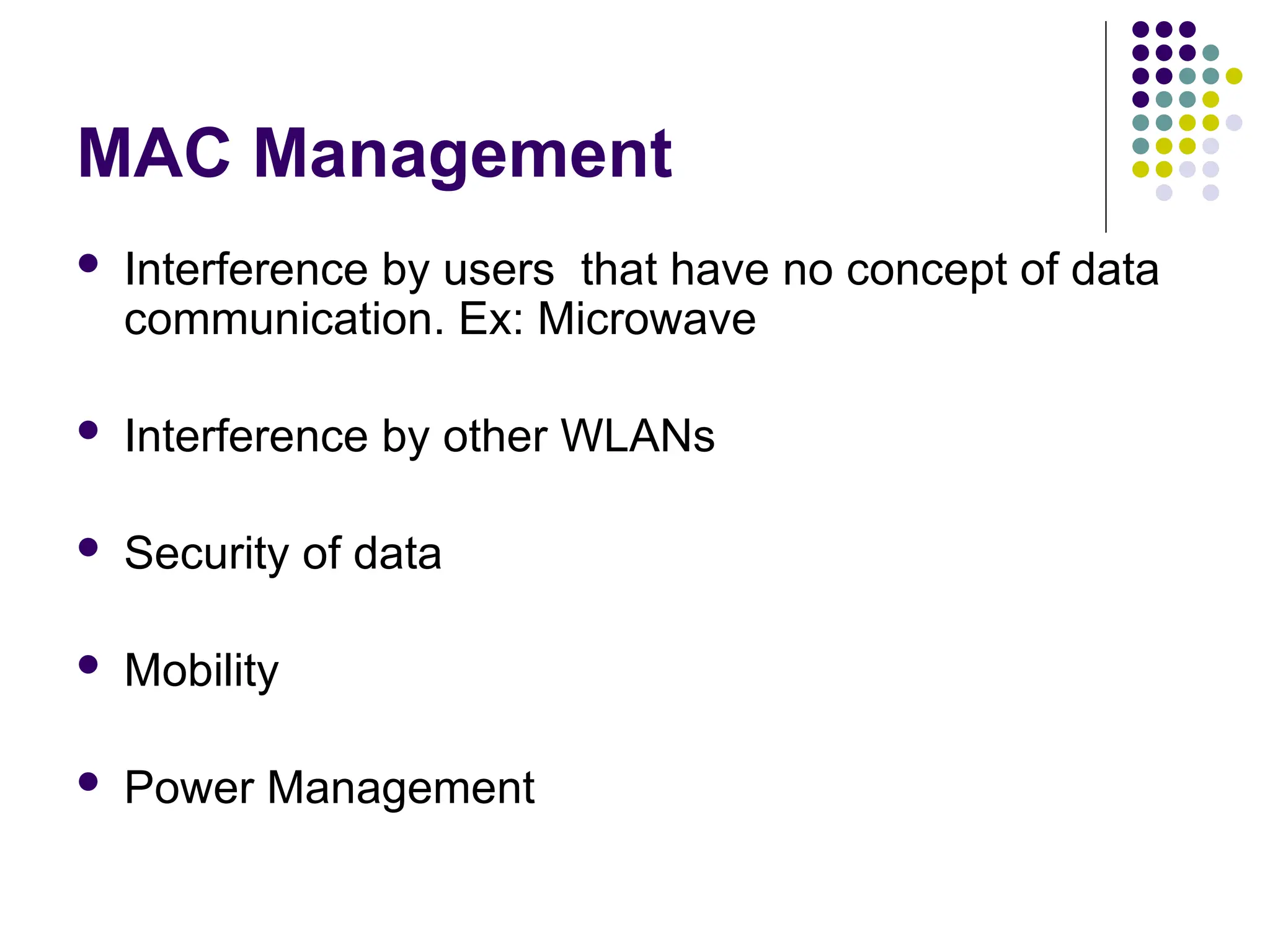
MAC Management
 Interference by users that have no concept of data
communication. Ex: Microwave
 Interference by other WLANs
 Security of data
 Mobility
 Power Management
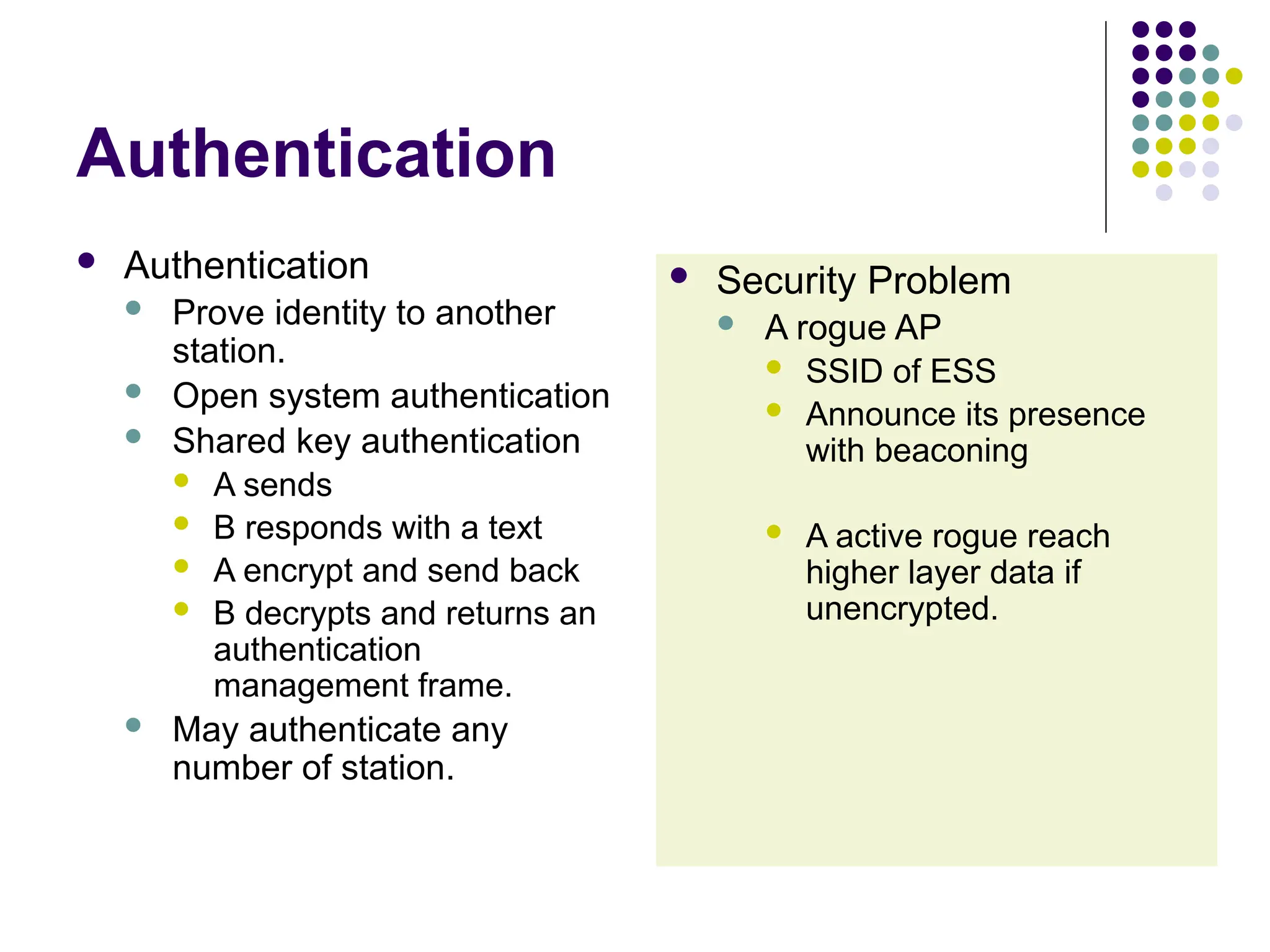
Authentication
 Authentication
 Prove identity to another
station.
 Open system authentication
 Shared key authentication
 A sends
 B responds with a text
 A encrypt and send back
 B decrypts and returns an
authentication
management frame.
 May authenticate any
number of station.
 Security Problem
 A rogue AP
 SSID of ESS
 Announce its presence
with beaconing
 A active rogue reach
higher layer data if
unencrypted.
Association
 Association
 Transparent mobility
 After authentication
 Association request to an AP
 After established, forward data
 To BSS, if DA is in the BSS.
 To DS, if DA is outside the BSS.
 To AP, if DA is in another BSS.
 To “portal”, if DC is outside the ESS.
 Portal : transfer point : track mobility. (AP, bridge, or router) transfer 802.1h
 New AP after reassociation, communicates with the old AP.
Address Filtering
 More than one WLAN
 Three Addresses
 Receiver examine the
DA, BSSID
Privacy MAC Function
 WEP Mechanism
Power Management
 Independent BSS
 Distributed
 Data frame handshake
 Wake up every beacon.
 Awake a period of ATIM after each
beacon.
 Send ACK if receive ATIM frame &
awake until the end of next ATIM.
 Estimate the power saving station,
and delay until the next ATIM.
 Multicast frame : No ACK : optional
Overhead
 Sender
 Announcement
frame
 Buffer
 Power
consumption in
ATIM
 Receiver
 Awake for every
Beacon and ATIM
Power Management
 Infrastructure BSS
 Centralized in the AP.
 Greater power saving
 Mobile Station sleeps for a
number of beacon periods.
 Awake for multicast indicated in
DTIM in Beacon.
 AP buffer, indicate in TIM
 Mobile requests by PS-Poll
Synchronization
 Timer Synchronization in an Infrastructure BSS
 Beacon contains TSF
 Station updates its with the TSF in beacon.
 Timer Synchronization in an IBSS
 Distributed. Starter of the BSS send TSF zero and increments.
 Each Station sends a Beacon
 Station updates if the TSF is bigger.
 Small number of stations: the fastest timer value
 Large number of stations: slower timer value due to collision.
 Synchronization with Frequency Hopping PHY Layers
 Changes in a frequency hopping PHY layer occurs periodically (the dwell
meriod).
 Change to new channel when the TSF timer value, modulo the dwell period,
is zero
Scanning & Joining
 Scanning
 Passive Scanning : only listens for Beacon and get
info of the BSS. Power is saved.
 Active Scanning: transmit and elicit response from
APs. If IBSS, last station that transmitted beacon
responds. Time is saved.
 Joining a BSS
 Syncronization in TSF and frequency : Adopt PHY
parameters : The BSSID : WEP : Beacon Period :
DTIM
Combining Management Tools
 Combine Power Saving Periods with Scanning
 Instead of entering power saving mode, perform
active scanning.
 Gather information about its environments.
 Preauthentication
 Scans and initiate an authentication
 Reduces the time
The Physical Layer
 PLCP: frame exchange between the MAC and PHY
 PMD: uses signal carrier and spread spectrum modulation to
transmit data frames over the media.
 Direct Sequence Spread Spectrum (DSSS) PHY
 2.4 GHz : RF : 1 – 2 Mbps
 The Frequency Hopping Spread Spectrum (FHSS) PHY
 110KHz deviation : RF : PMD controls channel hopping : 2
Mbps
 Infrared (IR) PHY
 Indoor : IR : 1 and 2 Mbps
 The OFDM PHY – IEEE 802.11a
 5.0 GHz : 6-54 Mbps :
 High Rate DSSS PHY – IEEE 802.11b
 2.4 GHz : 5.5 Mbps – 11 Mbps :
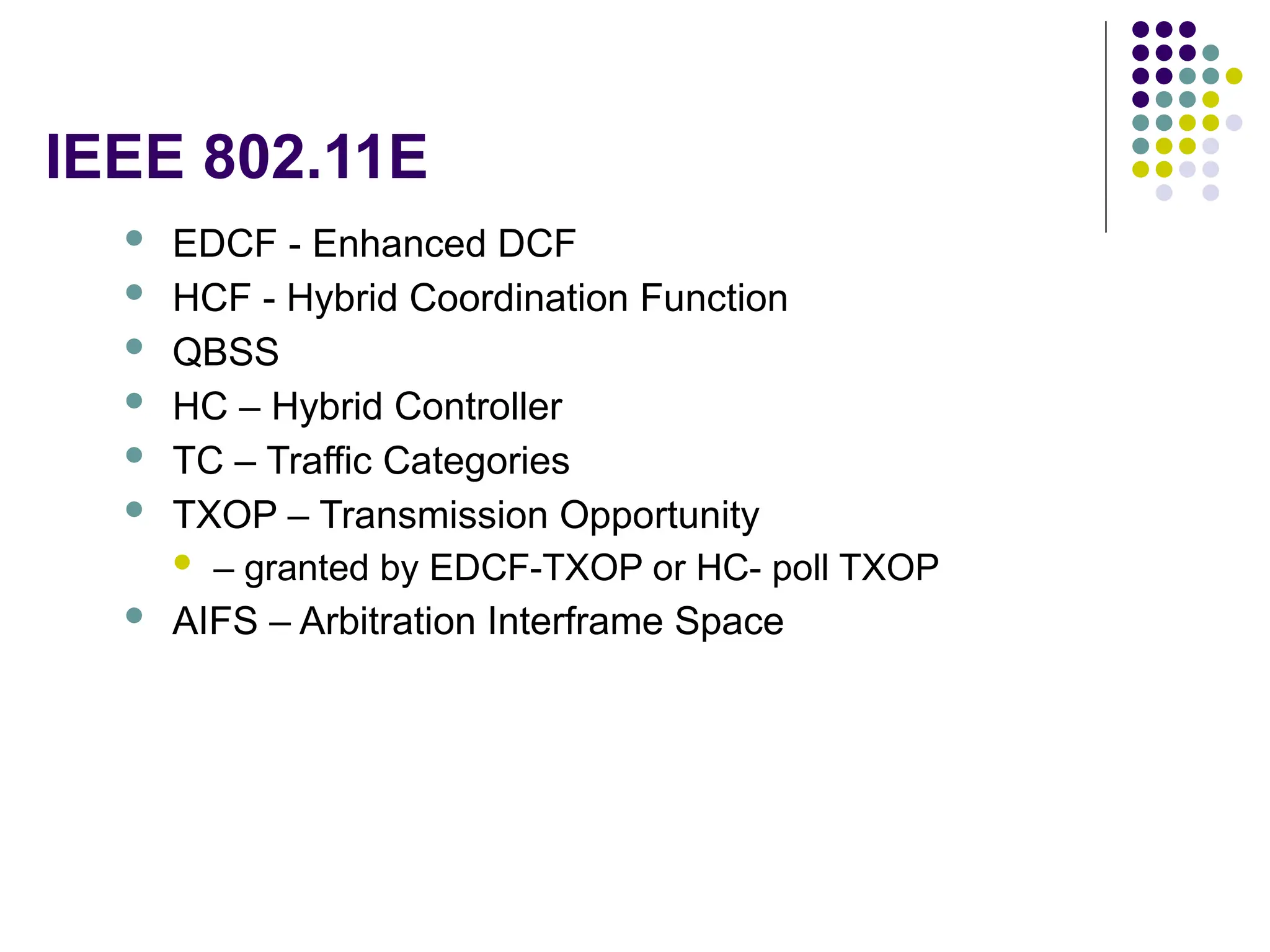
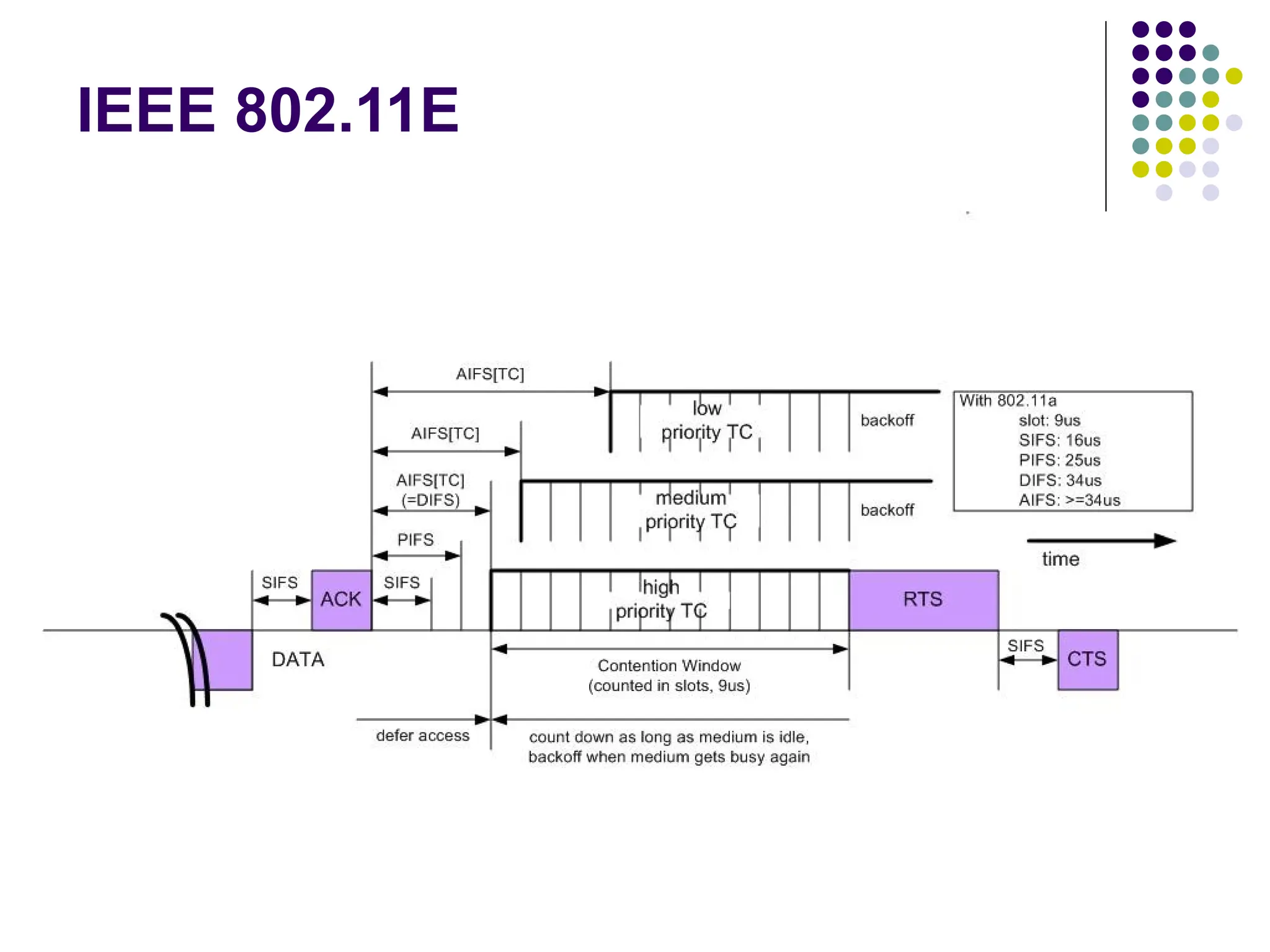
IEEE 802.11E
 EDCF - Enhanced DCF
 HCF - Hybrid Coordination Function
 QBSS
 HC – Hybrid Controller
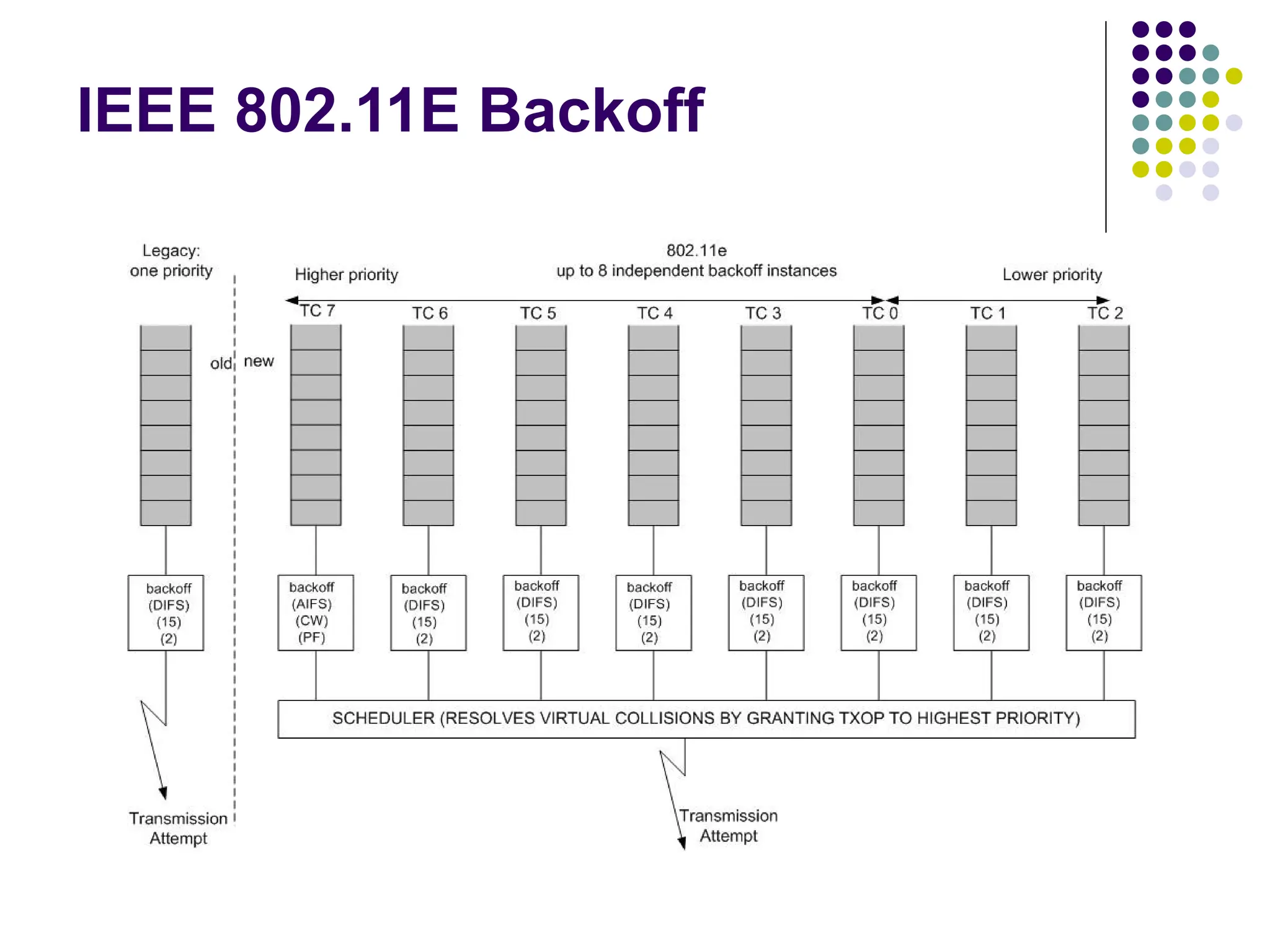
 TC – Traffic Categories
 TXOP – Transmission Opportunity
 – granted by EDCF-TXOP or HC- poll TXOP
 AIFS – Arbitration Interframe Space
IEEE 802.11E
IEEE 802.11E Backoff
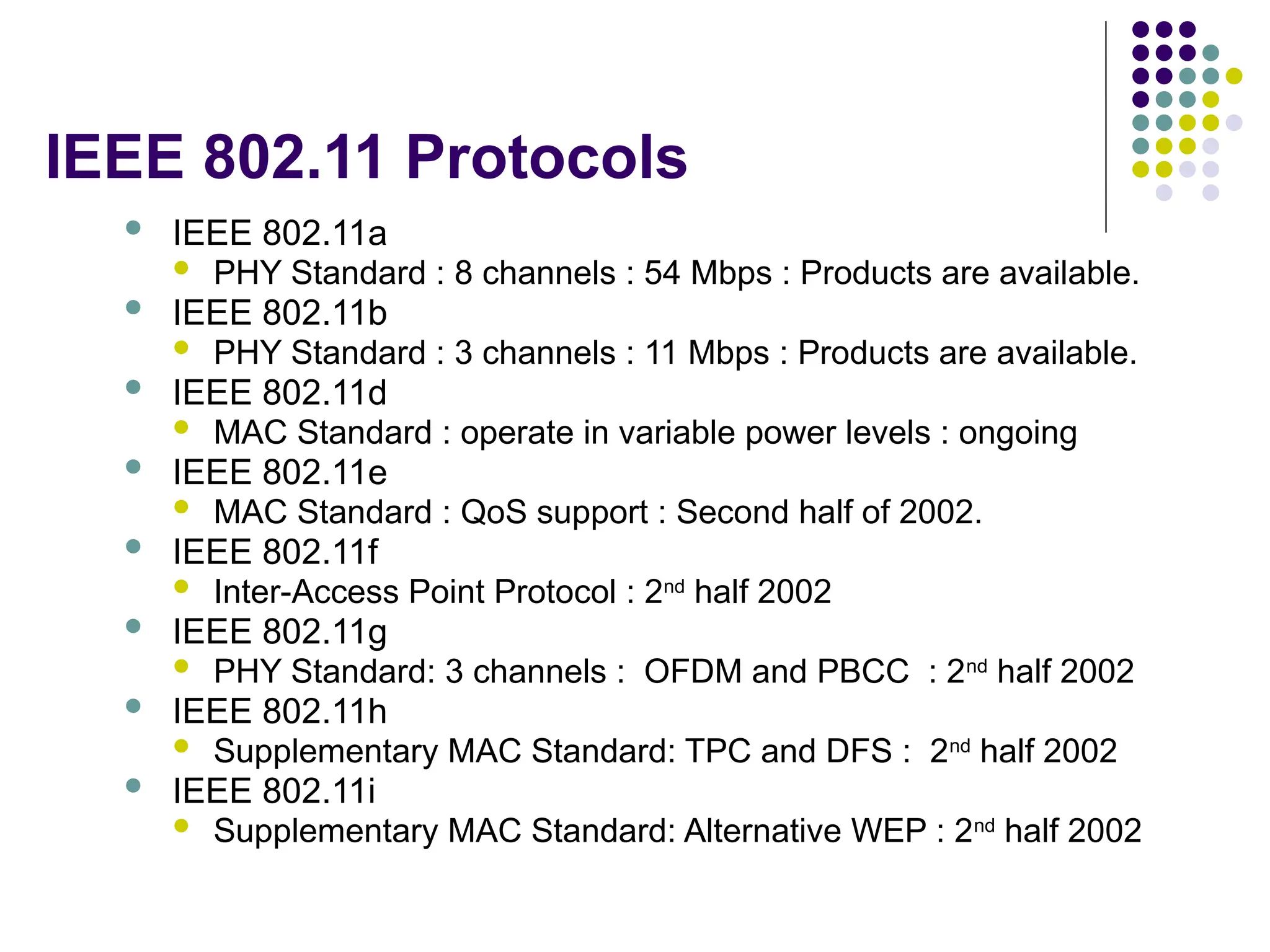
IEEE 802.11 Protocols
 IEEE 802.11a
 PHY Standard : 8 channels : 54 Mbps : Products are available.
 IEEE 802.11b
 PHY Standard : 3 channels : 11 Mbps : Products are available.
 IEEE 802.11d
 MAC Standard : operate in variable power levels : ongoing
 IEEE 802.11e
 MAC Standard : QoS support : Second half of 2002.
 IEEE 802.11f
 Inter-Access Point Protocol : 2nd
half 2002
 IEEE 802.11g
 PHY Standard: 3 channels : OFDM and PBCC : 2nd
half 2002
 IEEE 802.11h
 Supplementary MAC Standard: TPC and DFS : 2nd
half 2002
 IEEE 802.11i
 Supplementary MAC Standard: Alternative WEP : 2nd
half 2002
APPENDIX
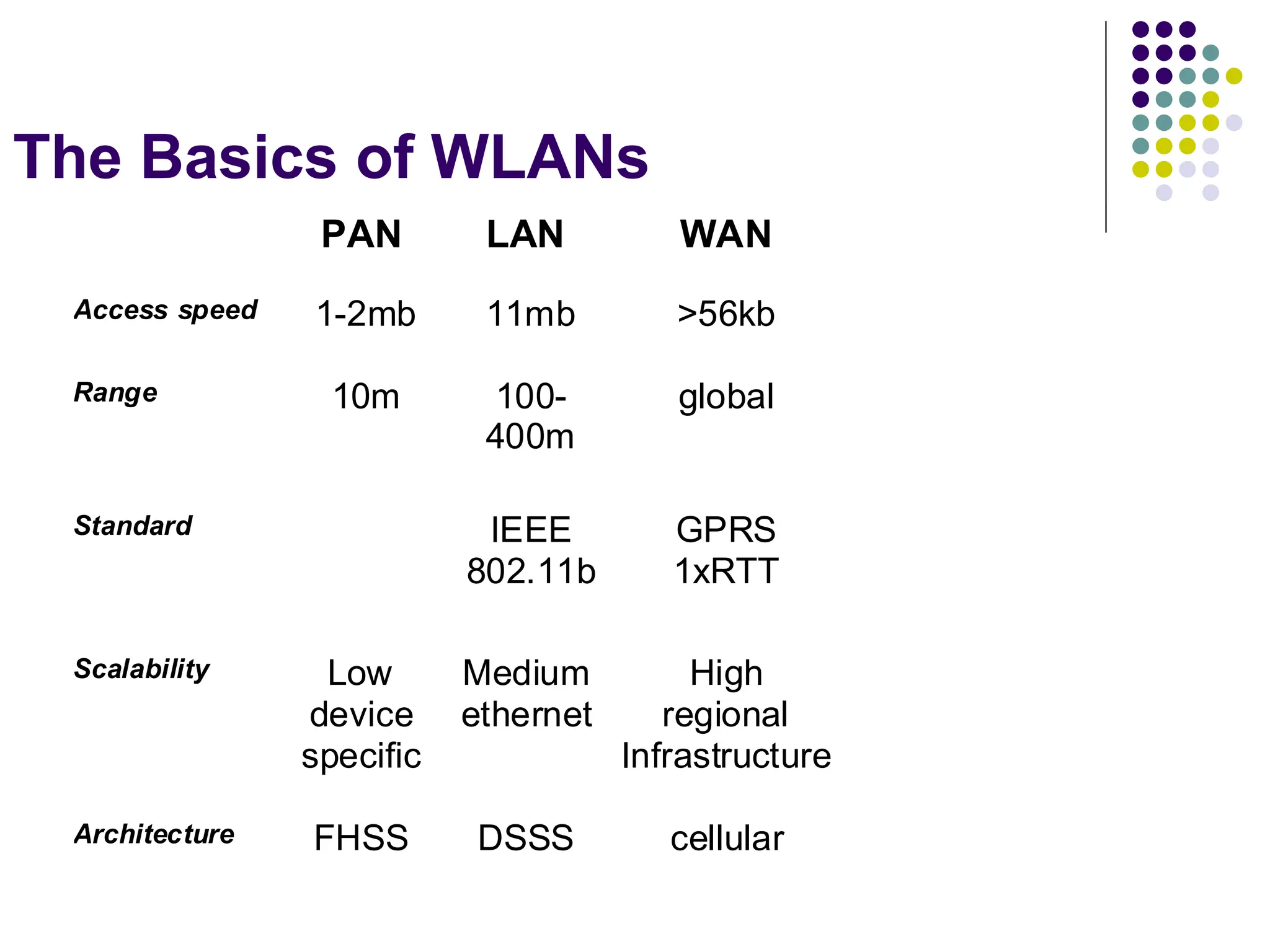
The Basics of WLANs
PAN LAN WAN
Access speed 1-2mb 11mb >56kb
Range 10m 100-
400m
global
Standard IEEE
802.11b
GPRS
1xRTT
Scalability Low
device
specific
Medium
ethernet
High
regional
Infrastructure
Architecture FHSS DSSS cellular
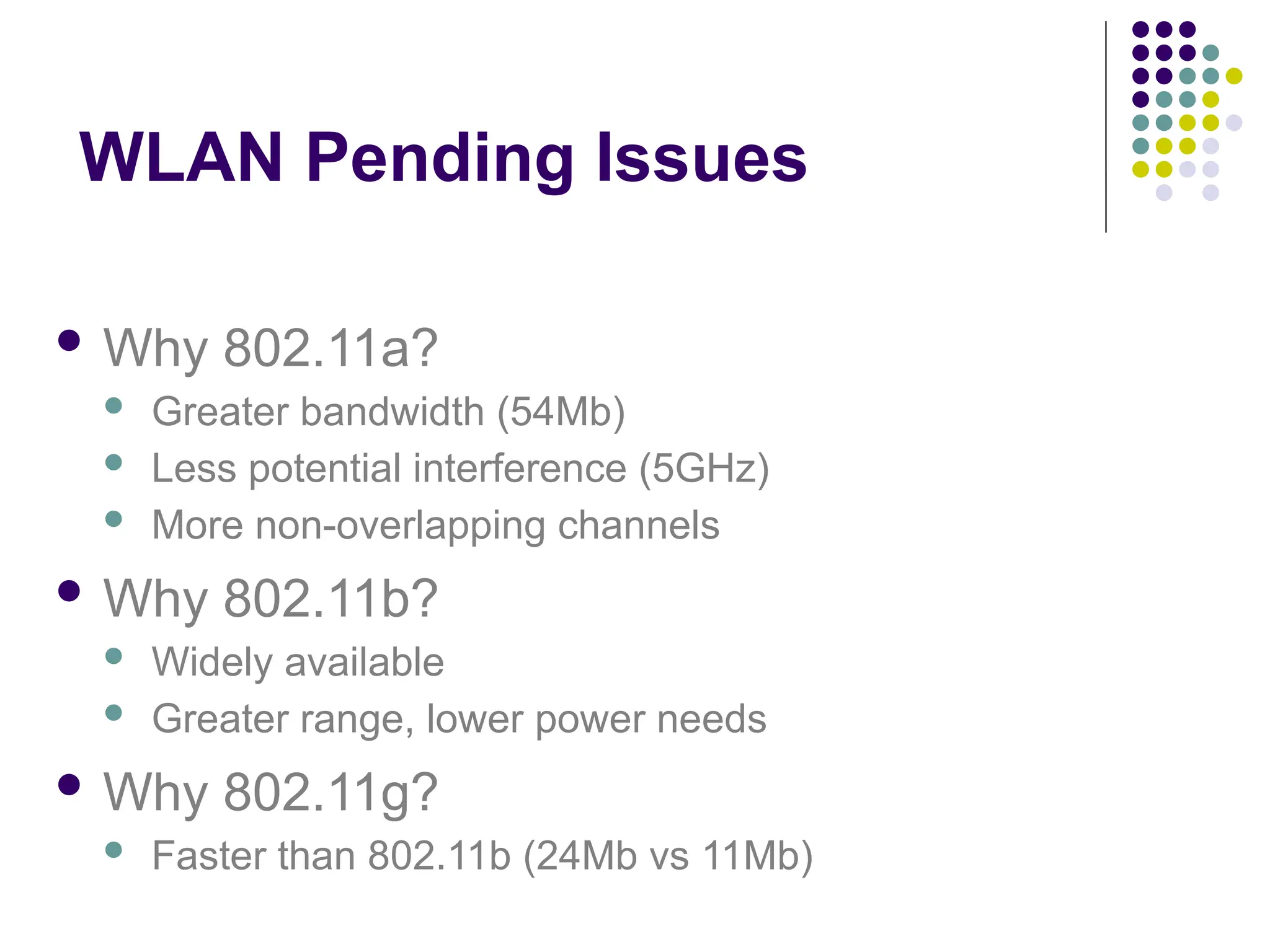
WLAN Pending Issues
 Why 802.11a?
 Greater bandwidth (54Mb)
 Less potential interference (5GHz)
 More non-overlapping channels
 Why 802.11b?
 Widely available
 Greater range, lower power needs
 Why 802.11g?
 Faster than 802.11b (24Mb vs 11Mb)
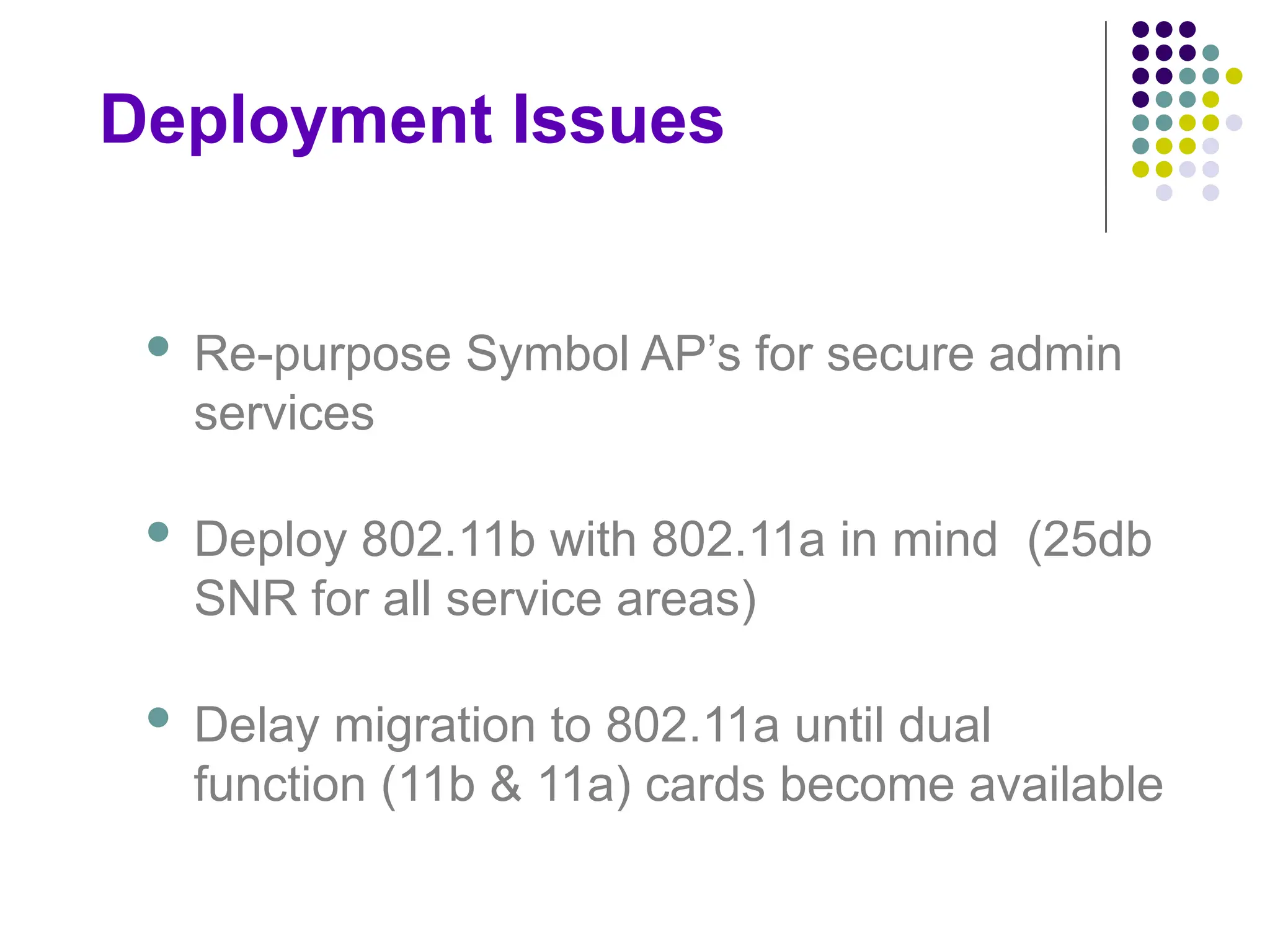
Deployment Issues
 Re-purpose Symbol AP’s for secure admin
services
 Deploy 802.11b with 802.11a in mind (25db
SNR for all service areas)
 Delay migration to 802.11a until dual
function (11b & 11a) cards become available
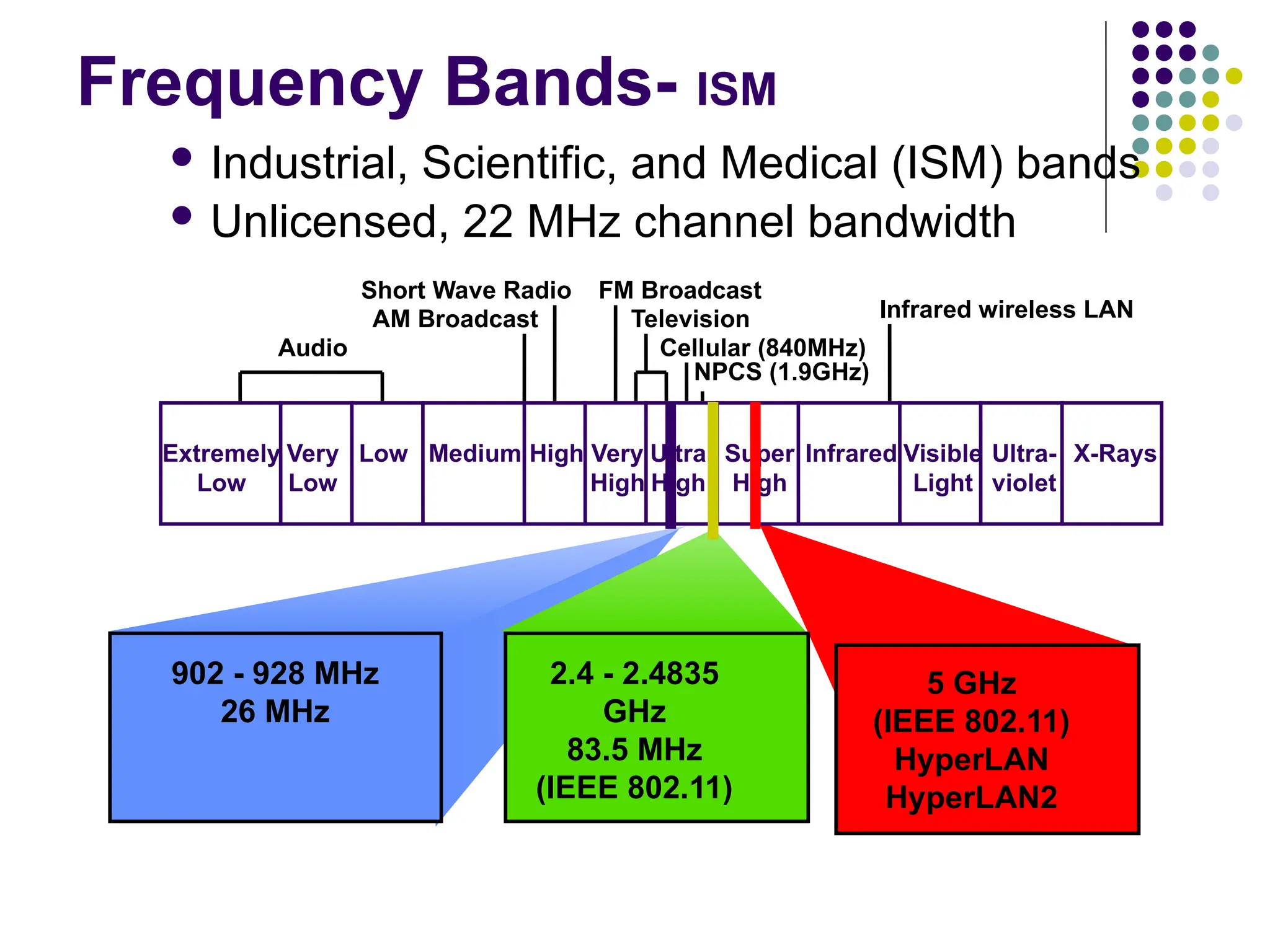
Frequency Bands- ISM
Extremely
Low
Very
Low
Low Medium High Very
High
Ultra
High
Super
High
Infrared Visible
Light
Ultra-
violet
X-Rays
Audio
AM Broadcast
Short Wave Radio FM Broadcast
Television Infrared wireless LAN
902 - 928 MHz
26 MHz
Cellular (840MHz)
NPCS (1.9GHz)
2.4 - 2.4835
GHz
83.5 MHz
(IEEE 802.11)
5 GHz
(IEEE 802.11)
HyperLAN
HyperLAN2
 Industrial, Scientific, and Medical (ISM) bands
 Unlicensed, 22 MHz channel bandwidth
IEEE 802.11i Enhanced Security
Description Enhancements to the 802.11 MAC standard to increase
the security; addresses new encryption methods and
upper layer authentication
Importance High: weakness of WEP encryption is damaging the
802.11 standard perception in the market
Related
standards
This applies to 802.11b, 802.11a and 802.11g systems.
802.1x is key reference for upper layer authentication
Status +
Roadmap
Enhanced encryption software will replace WEP
software; This is on a recommended best practice
/voluntary basis; development in TgI: first draft Mar 2001;
next draft due Mar 2002; stable draft: July 2002; final
standard: Jan 2003
Products
affected
Client and AP cards (Controller chip, Firmware, Driver)
AP kernel, RG kernel, BG kernel
Agere’s activity Actively proposing WEP improvement methods,
participating in all official/interim meetings
Key players Agere/Microsoft/Agere/Cisco/Atheros/Intel/3Com/
Intersil/Symbol/Certicom/RSA/Funk
Key issues Mode of AES to use for encryption (CTR/CBC [CBC MIC]
or OCB [MIC and Encryption function])
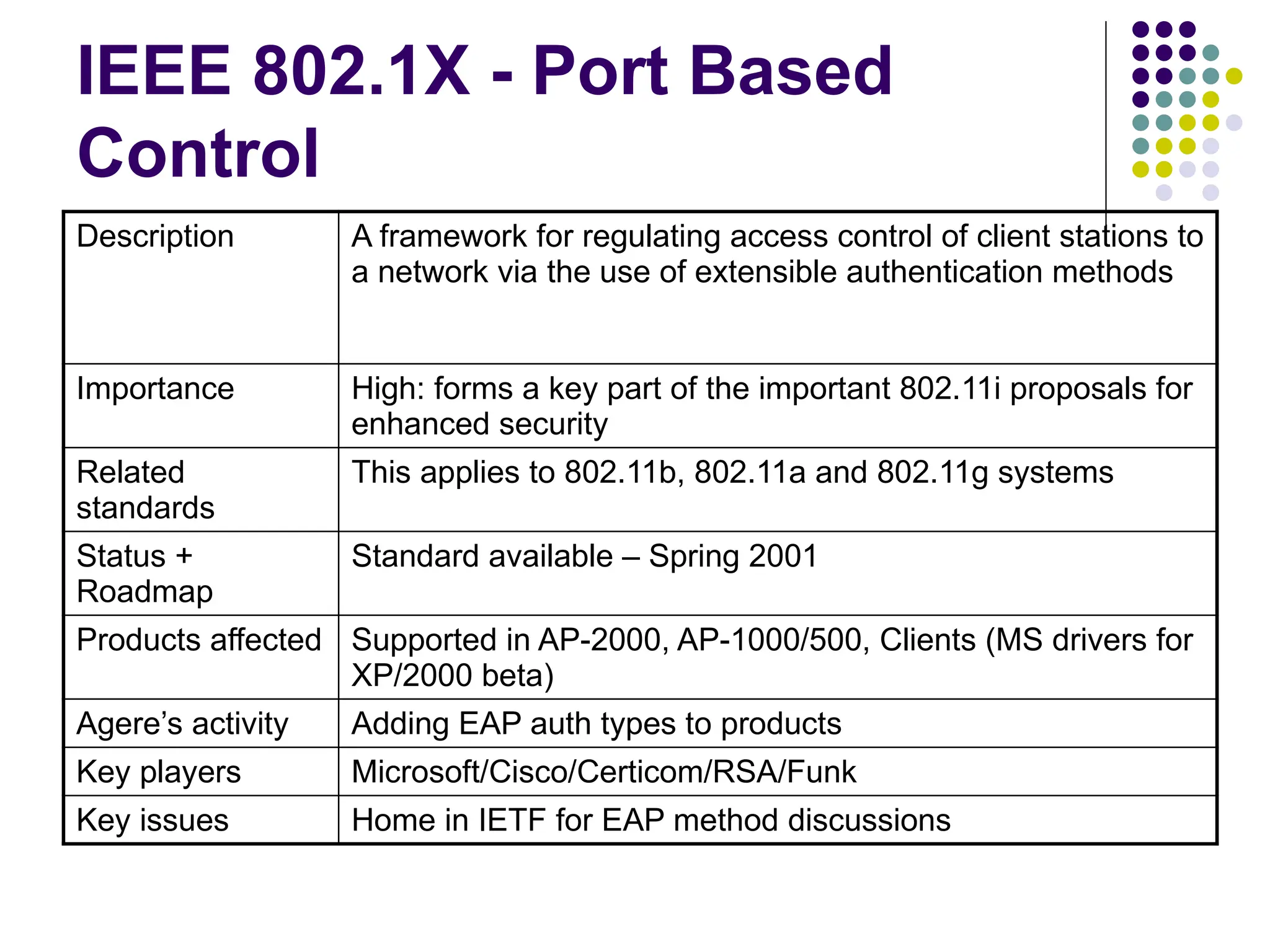
IEEE 802.1X - Port Based
Control
Description A framework for regulating access control of client stations to
a network via the use of extensible authentication methods
Importance High: forms a key part of the important 802.11i proposals for
enhanced security
Related
standards
This applies to 802.11b, 802.11a and 802.11g systems
Status +
Roadmap
Standard available – Spring 2001
Products affected Supported in AP-2000, AP-1000/500, Clients (MS drivers for
XP/2000 beta)
Agere’s activity Adding EAP auth types to products
Key players Microsoft/Cisco/Certicom/RSA/Funk
Key issues Home in IETF for EAP method discussions
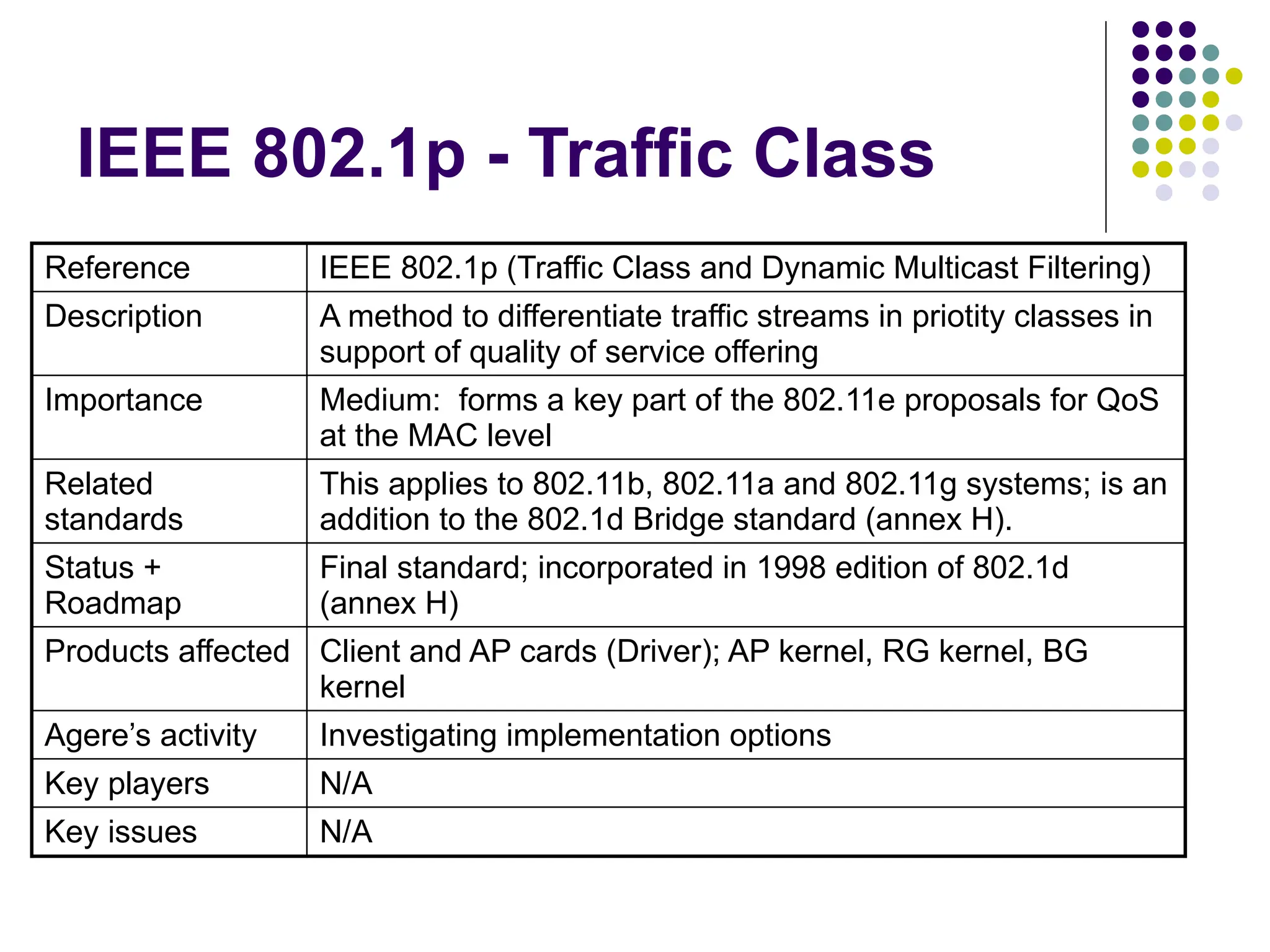
IEEE 802.1p - Traffic Class
Reference IEEE 802.1p (Traffic Class and Dynamic Multicast Filtering)
Description A method to differentiate traffic streams in priotity classes in
support of quality of service offering
Importance Medium: forms a key part of the 802.11e proposals for QoS
at the MAC level
Related
standards
This applies to 802.11b, 802.11a and 802.11g systems; is an
addition to the 802.1d Bridge standard (annex H).
Status +
Roadmap
Final standard; incorporated in 1998 edition of 802.1d
(annex H)
Products affected Client and AP cards (Driver); AP kernel, RG kernel, BG
kernel
Agere’s activity Investigating implementation options
Key players N/A
Key issues N/A
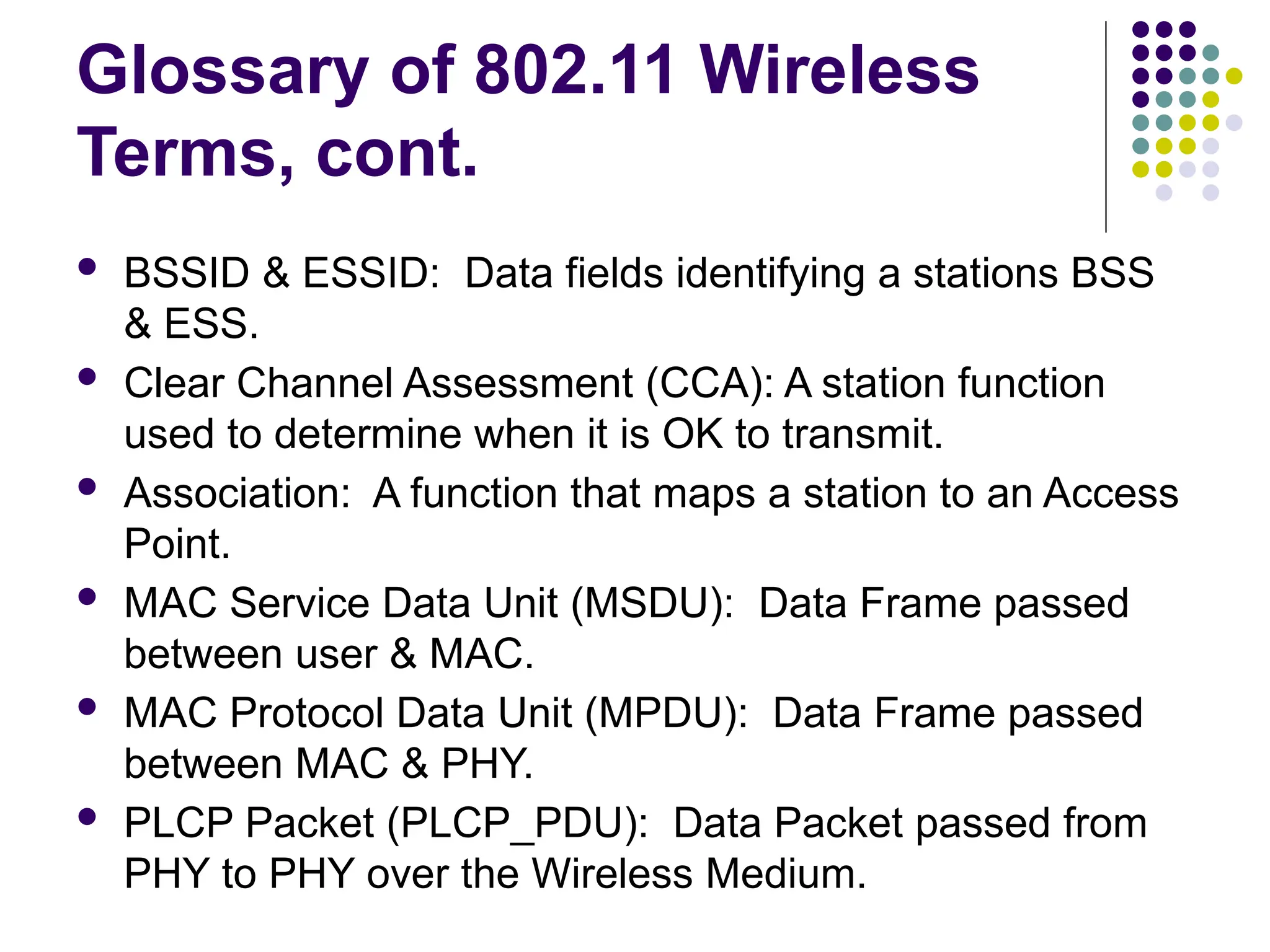
Glossary of 802.11 Wireless
Terms, cont.
 BSSID & ESSID: Data fields identifying a stations BSS
& ESS.
 Clear Channel Assessment (CCA): A station function
used to determine when it is OK to transmit.
 Association: A function that maps a station to an Access
Point.
 MAC Service Data Unit (MSDU): Data Frame passed
between user & MAC.
 MAC Protocol Data Unit (MPDU): Data Frame passed
between MAC & PHY.
 PLCP Packet (PLCP_PDU): Data Packet passed from
PHY to PHY over the Wireless Medium.
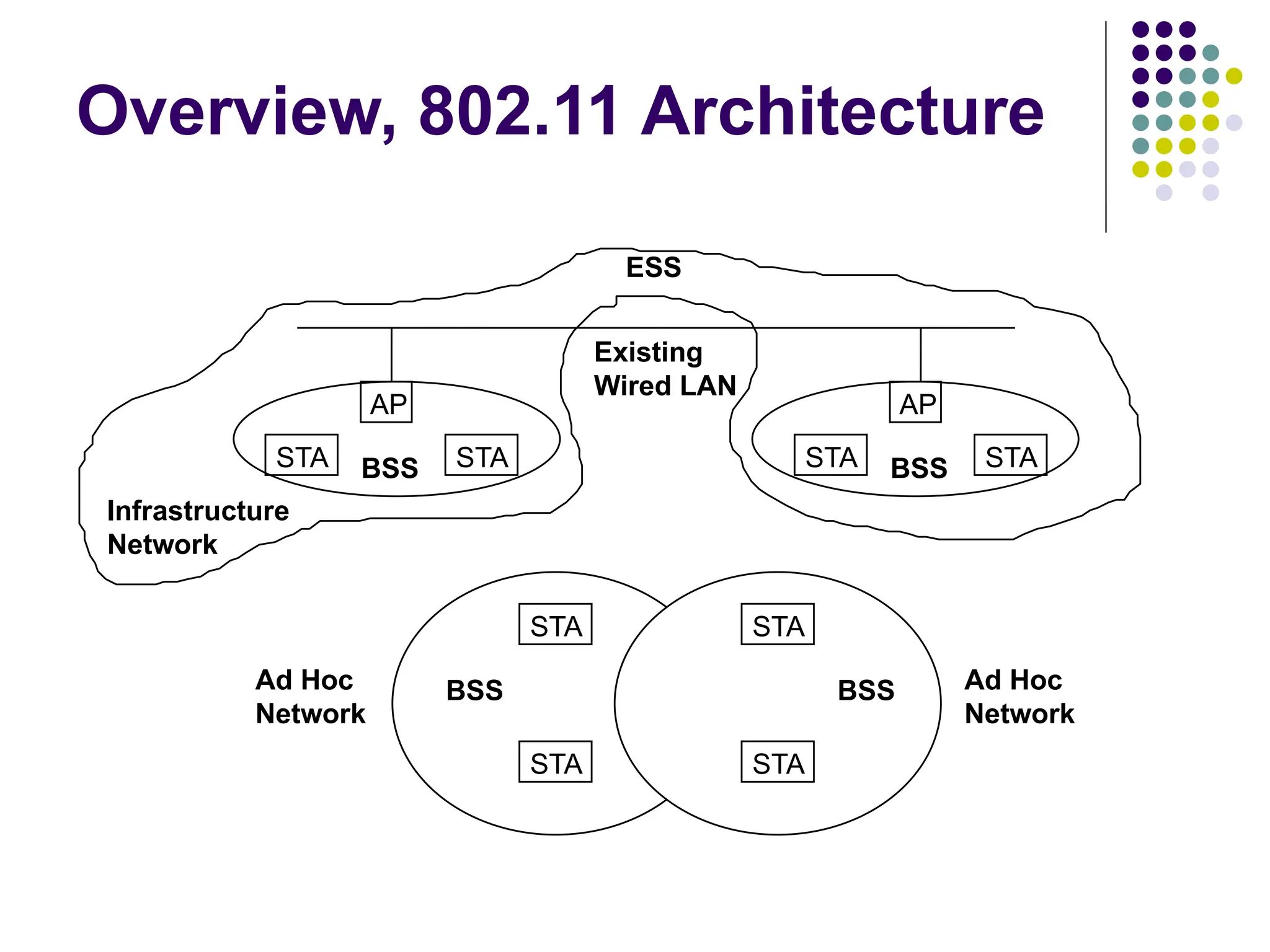
Overview, 802.11 Architecture
STA
STA
STA STA
STA
STA
STA STA
AP
AP
ESS
BSS
BSS
BSS
BSS
Existing
Wired LAN
Infrastructure
Network
Ad Hoc
Network
Ad Hoc
Network
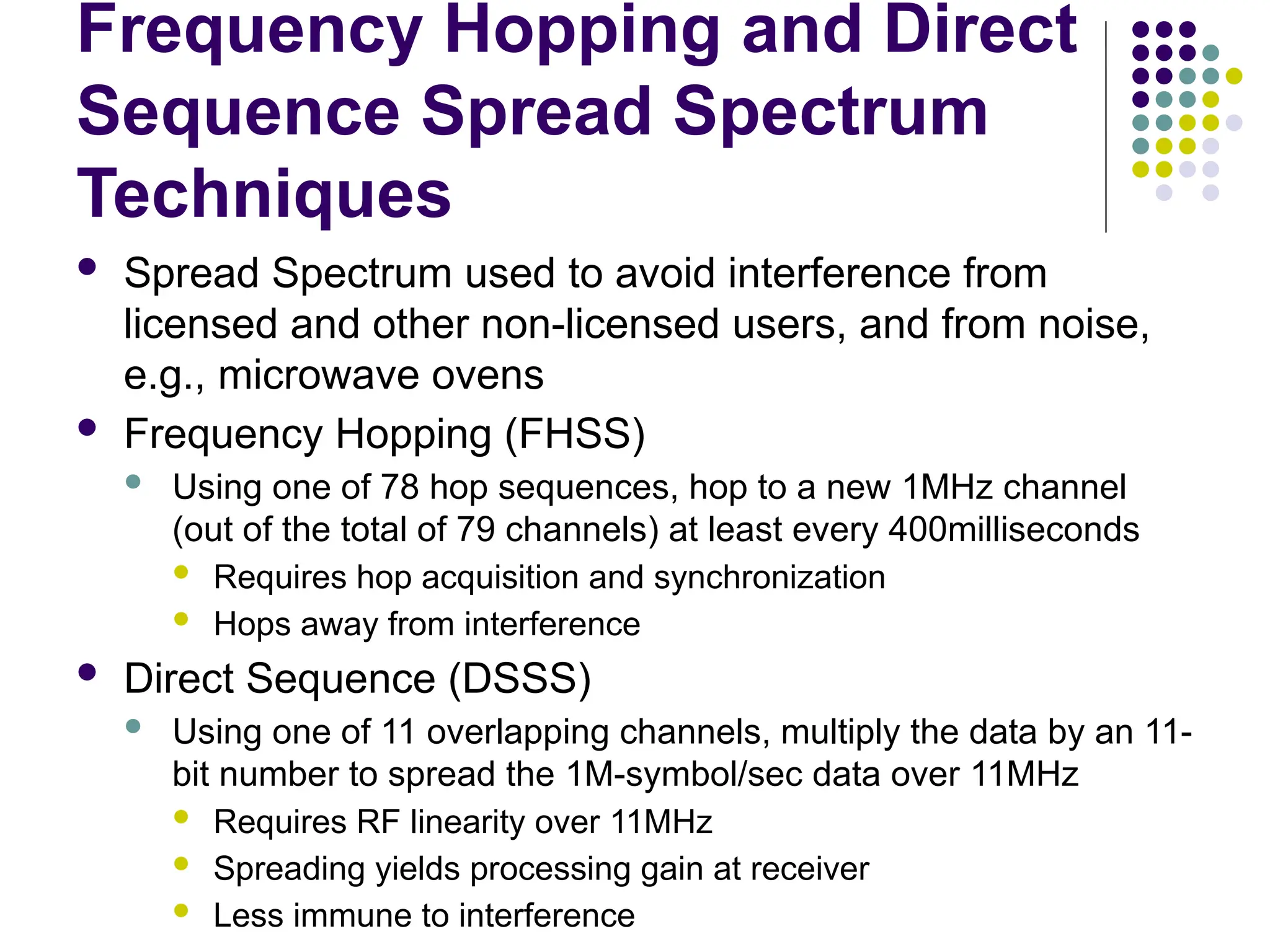
Frequency Hopping and Direct
Sequence Spread Spectrum
Techniques
 Spread Spectrum used to avoid interference from
licensed and other non-licensed users, and from noise,
e.g., microwave ovens
 Frequency Hopping (FHSS)
 Using one of 78 hop sequences, hop to a new 1MHz channel
(out of the total of 79 channels) at least every 400milliseconds
 Requires hop acquisition and synchronization
 Hops away from interference
 Direct Sequence (DSSS)
 Using one of 11 overlapping channels, multiply the data by an 11-
bit number to spread the 1M-symbol/sec data over 11MHz
 Requires RF linearity over 11MHz
 Spreading yields processing gain at receiver
 Less immune to interference
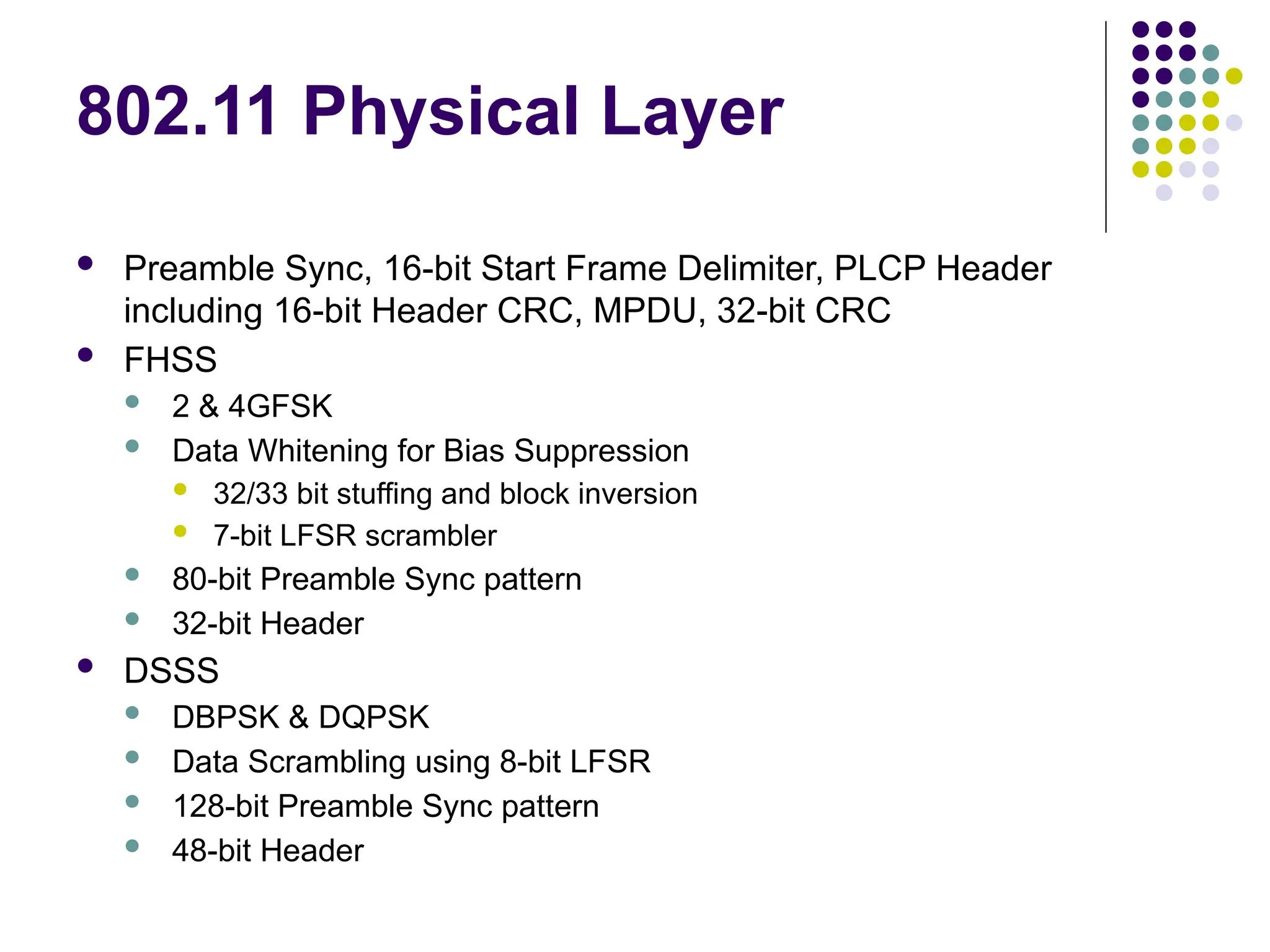
802.11 Physical Layer
 Preamble Sync, 16-bit Start Frame Delimiter, PLCP Header
including 16-bit Header CRC, MPDU, 32-bit CRC
 FHSS
 2 & 4GFSK
 Data Whitening for Bias Suppression
 32/33 bit stuffing and block inversion
 7-bit LFSR scrambler
 80-bit Preamble Sync pattern
 32-bit Header
 DSSS
 DBPSK & DQPSK
 Data Scrambling using 8-bit LFSR
 128-bit Preamble Sync pattern
 48-bit Header
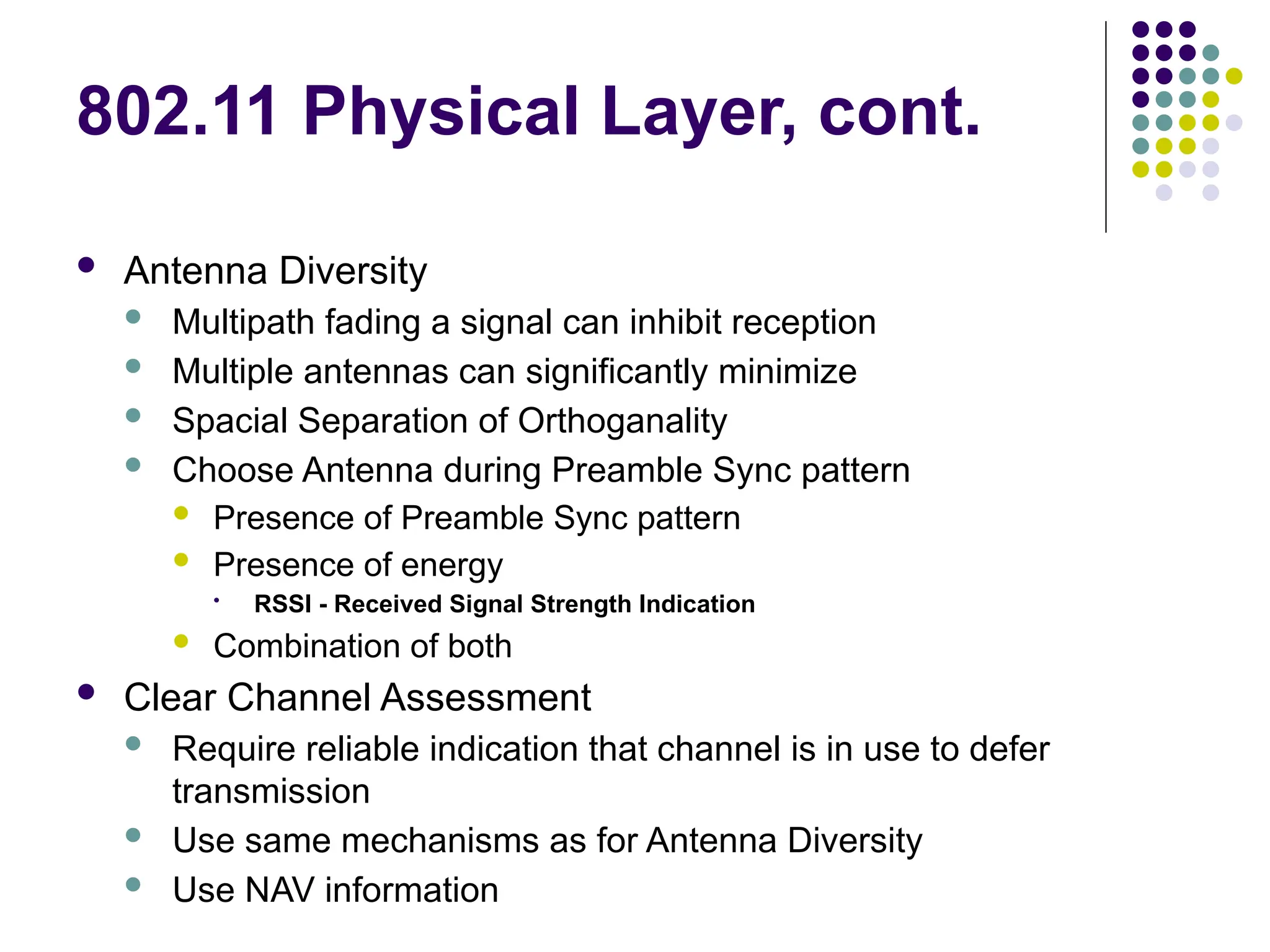
802.11 Physical Layer, cont.
 Antenna Diversity
 Multipath fading a signal can inhibit reception
 Multiple antennas can significantly minimize
 Spacial Separation of Orthoganality
 Choose Antenna during Preamble Sync pattern
 Presence of Preamble Sync pattern
 Presence of energy
• RSSI - Received Signal Strength Indication
 Combination of both
 Clear Channel Assessment
 Require reliable indication that channel is in use to defer
transmission
 Use same mechanisms as for Antenna Diversity
 Use NAV information
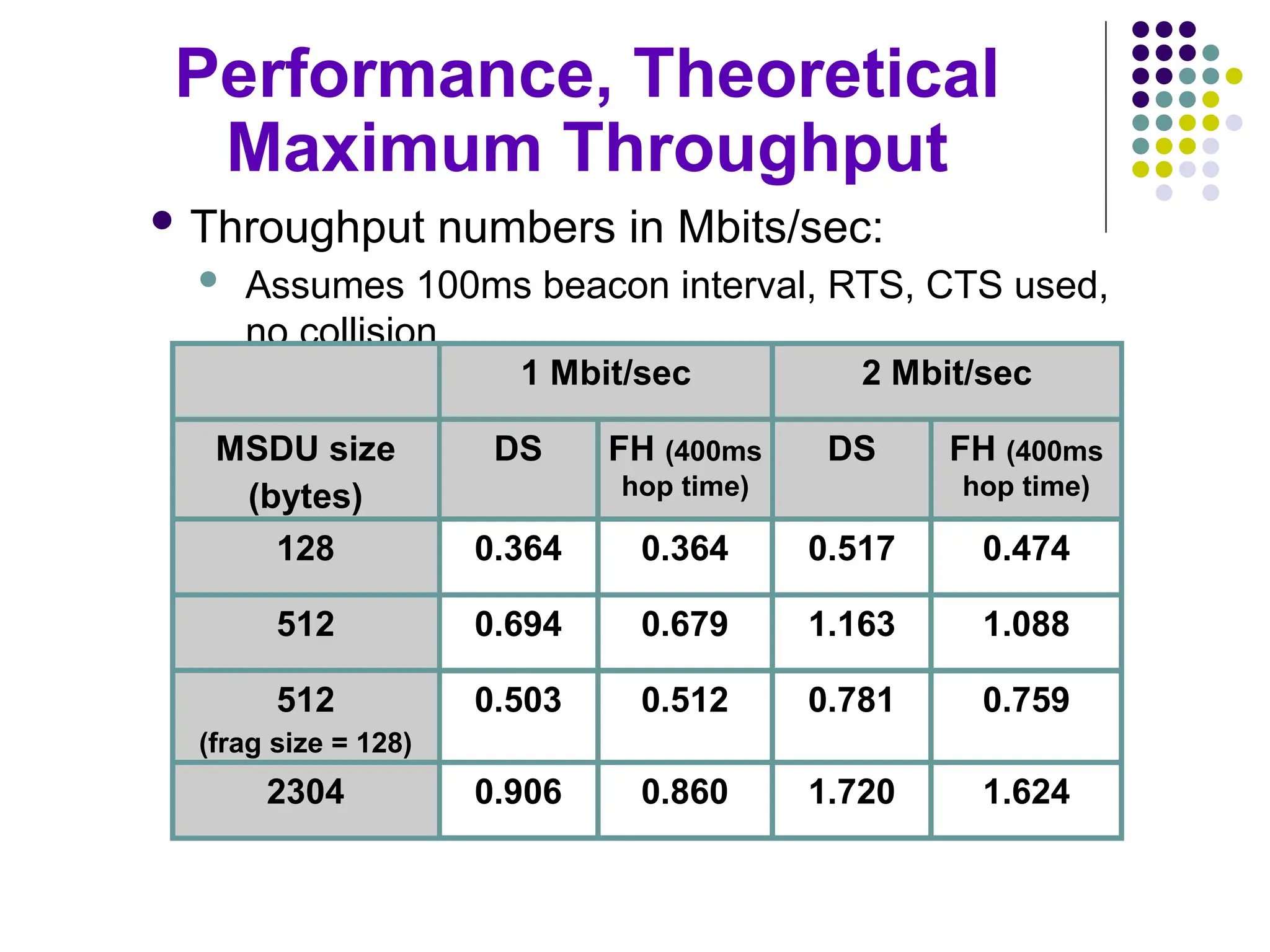
Performance, Theoretical
Maximum Throughput
 Throughput numbers in Mbits/sec:
 Assumes 100ms beacon interval, RTS, CTS used,
no collision
 Slide courtesy of Matt Fischer, AMD
1 Mbit/sec 2 Mbit/sec
MSDU size
(bytes)
DS FH (400ms
hop time)
DS FH (400ms
hop time)
128 0.364 0.364 0.517 0.474
512 0.694 0.679 1.163 1.088
512
(frag size = 128)
0.503 0.512 0.781 0.759
2304 0.906 0.860 1.720 1.624

IEEE-802.11overview.pptx ieee 802 11 overview

  • 1.
    IEEE 802.11 Overview MustafaErgen ergen@eecs.berkeley.edu UC Berkeley
  • 2.
    Wireless Market Segments WirelessMarket Segments & Partners Fixed Mobile Broadband Multiservice 2G+ Cellular 3G Cellular Residential/ Premise/ Campus LMDS MMDS Cisco/ Bosch Data Services GPRS Mobile IP Packet Data/Voice UMTS
  • 3.
    Standardization of Wireless Networks Wireless networks are standardized by IEEE.  Under 802 LAN MAN standards committee. Application Presentation Session Transport Network Data Link Physical ISO OSI 7-layer model Logical Link Control Medium Access (MAC) Physical (PHY) IEEE 802 standards
  • 4.
    IEEE 802.11 Overview Adopted in 1997. Defines;  MAC sublayer  MAC management protocols and services  Physical (PHY) layers  IR  FHSS  DSSS Goals • To deliver services in wired networks • To achieve high throughput • To achieve highly reliable data delivery • To achieve continuous network connection.
  • 5.
    Components  Station  BSS- Basic Service Set  IBSS : Infrastructure BSS : QBSS  ESS - Extended Service Set  A set of infrastrucute BSSs.  Connection of APs  Tracking of mobility  DS – Distribution System  AP communicates with another
  • 6.
    Services  Station services: authentication,  de-authentication,  privacy,  delivery of data  Distribution Services ( A thin layer between MAC and LLC sublayer)  association  disassociation  reassociation  distribution  Integration A station maintain two variables: • authentication state (=> 1) • association state (<= 1)
  • 7.
  • 8.
    Medium Access Control Functionality; Reliable data delivery  Fairly control access  Protection of data Deals;  Noisy and unreliable medium  Frame exchange protocol - ACK  Overhead to IEEE 802.3 -  Hidden Node Problem – RTS/CTS  Participation of all stations  Reaction to every frame
  • 9.
    MAC  Retry Counters Short retry counter  Long retry counter  Lifetime timer  Basic Access Mechanism  CSMA/CA  Binary exponential back-off  NAV – Network Allocation Vector  Timing Intervals: SIFS, Slot Time, PIFS, DIFS, EIFS  DCF Operation  PCF Operation
  • 10.
  • 11.
    PCF Operation  Poll– eliminates contention  PC – Point Coordinator  Polling List  Over DCF  PIFS  CFP – Contention Free Period  Alternate with DCF  Periodic Beacon – contains length of CFP  CF-Poll – Contention Free Poll  NAV prevents during CFP  CF-End – resets NAV
  • 12.
    Frame Types  ProtocolVersion  Frame Type and Sub Type  To DS and From DS  More Fragments  Retry  Power Management  More Data  WEP  Order FC Duration /ID Address 1 Address 2 Address 3 Sequence Control Address 4 DATA FCS 2 2 6 6 6 2 6 0-2312 4 bytes  NAV information Or  Short Id for PS- Poll  BSSID –BSS Identifier  TA - Transmitter  RA - Receiver  SA - Source  DA - Destination  IEEE 48 bit address  Individual/Group  Universal/Local  46 bit address  MSDU  Sequence Number  Fragment Number  CCIT CRC-32 Polynomial Upper layer data  2048 byte max  256 upper layer header
  • 13.
    Frame Subtypes  RTS CTS  ACK  PS-Poll  CF-End & CF-End ACK  Data  Data+CF-ACK  Data+CF-Poll  Data+CF-ACK+CF- Poll  Null Function  CF-ACK (nodata)  CF-Poll (nodata)  CF-ACK+CF+Poll  Beacon  Probe Request & Response  Authentication  Deauthentication  Association Request & Response  Reassociation Request & Response  Disassociation  Announcement Traffic Indication Message (ATIM) CONTROL DATA MANAGEMENT
  • 14.
    Other MAC Operations Fragmentation  Sequence control field  In burst  Medium is reserved  NAV is updated by ACK  Privacy  WEP bit set when encrypted.  Only the frame body.  Medium is reserved  NAV is updated by ACK  Symmetric variable key  WEP Details  Two mechanism  Default keys  Key mapping  WEP header and trailer  KEYID in header  ICV in trailer  dot11UndecryptableCount  Indicates an attack.  dot11ICVErrorCount  Attack to determine a key is in progress.
  • 15.
    MAC Management  Interferenceby users that have no concept of data communication. Ex: Microwave  Interference by other WLANs  Security of data  Mobility  Power Management
  • 16.
    Authentication  Authentication  Proveidentity to another station.  Open system authentication  Shared key authentication  A sends  B responds with a text  A encrypt and send back  B decrypts and returns an authentication management frame.  May authenticate any number of station.  Security Problem  A rogue AP  SSID of ESS  Announce its presence with beaconing  A active rogue reach higher layer data if unencrypted.
  • 17.
    Association  Association  Transparentmobility  After authentication  Association request to an AP  After established, forward data  To BSS, if DA is in the BSS.  To DS, if DA is outside the BSS.  To AP, if DA is in another BSS.  To “portal”, if DC is outside the ESS.  Portal : transfer point : track mobility. (AP, bridge, or router) transfer 802.1h  New AP after reassociation, communicates with the old AP.
  • 18.
    Address Filtering  Morethan one WLAN  Three Addresses  Receiver examine the DA, BSSID Privacy MAC Function  WEP Mechanism
  • 19.
    Power Management  IndependentBSS  Distributed  Data frame handshake  Wake up every beacon.  Awake a period of ATIM after each beacon.  Send ACK if receive ATIM frame & awake until the end of next ATIM.  Estimate the power saving station, and delay until the next ATIM.  Multicast frame : No ACK : optional Overhead  Sender  Announcement frame  Buffer  Power consumption in ATIM  Receiver  Awake for every Beacon and ATIM
  • 20.
    Power Management  InfrastructureBSS  Centralized in the AP.  Greater power saving  Mobile Station sleeps for a number of beacon periods.  Awake for multicast indicated in DTIM in Beacon.  AP buffer, indicate in TIM  Mobile requests by PS-Poll
  • 21.
    Synchronization  Timer Synchronizationin an Infrastructure BSS  Beacon contains TSF  Station updates its with the TSF in beacon.  Timer Synchronization in an IBSS  Distributed. Starter of the BSS send TSF zero and increments.  Each Station sends a Beacon  Station updates if the TSF is bigger.  Small number of stations: the fastest timer value  Large number of stations: slower timer value due to collision.  Synchronization with Frequency Hopping PHY Layers  Changes in a frequency hopping PHY layer occurs periodically (the dwell meriod).  Change to new channel when the TSF timer value, modulo the dwell period, is zero
  • 22.
    Scanning & Joining Scanning  Passive Scanning : only listens for Beacon and get info of the BSS. Power is saved.  Active Scanning: transmit and elicit response from APs. If IBSS, last station that transmitted beacon responds. Time is saved.  Joining a BSS  Syncronization in TSF and frequency : Adopt PHY parameters : The BSSID : WEP : Beacon Period : DTIM
  • 23.
    Combining Management Tools Combine Power Saving Periods with Scanning  Instead of entering power saving mode, perform active scanning.  Gather information about its environments.  Preauthentication  Scans and initiate an authentication  Reduces the time
  • 24.
    The Physical Layer PLCP: frame exchange between the MAC and PHY  PMD: uses signal carrier and spread spectrum modulation to transmit data frames over the media.  Direct Sequence Spread Spectrum (DSSS) PHY  2.4 GHz : RF : 1 – 2 Mbps  The Frequency Hopping Spread Spectrum (FHSS) PHY  110KHz deviation : RF : PMD controls channel hopping : 2 Mbps  Infrared (IR) PHY  Indoor : IR : 1 and 2 Mbps  The OFDM PHY – IEEE 802.11a  5.0 GHz : 6-54 Mbps :  High Rate DSSS PHY – IEEE 802.11b  2.4 GHz : 5.5 Mbps – 11 Mbps :
  • 25.
    IEEE 802.11E  EDCF- Enhanced DCF  HCF - Hybrid Coordination Function  QBSS  HC – Hybrid Controller  TC – Traffic Categories  TXOP – Transmission Opportunity  – granted by EDCF-TXOP or HC- poll TXOP  AIFS – Arbitration Interframe Space
  • 26.
  • 27.
  • 28.
    IEEE 802.11 Protocols IEEE 802.11a  PHY Standard : 8 channels : 54 Mbps : Products are available.  IEEE 802.11b  PHY Standard : 3 channels : 11 Mbps : Products are available.  IEEE 802.11d  MAC Standard : operate in variable power levels : ongoing  IEEE 802.11e  MAC Standard : QoS support : Second half of 2002.  IEEE 802.11f  Inter-Access Point Protocol : 2nd half 2002  IEEE 802.11g  PHY Standard: 3 channels : OFDM and PBCC : 2nd half 2002  IEEE 802.11h  Supplementary MAC Standard: TPC and DFS : 2nd half 2002  IEEE 802.11i  Supplementary MAC Standard: Alternative WEP : 2nd half 2002
  • 29.
  • 30.
    The Basics ofWLANs PAN LAN WAN Access speed 1-2mb 11mb >56kb Range 10m 100- 400m global Standard IEEE 802.11b GPRS 1xRTT Scalability Low device specific Medium ethernet High regional Infrastructure Architecture FHSS DSSS cellular
  • 31.
    WLAN Pending Issues Why 802.11a?  Greater bandwidth (54Mb)  Less potential interference (5GHz)  More non-overlapping channels  Why 802.11b?  Widely available  Greater range, lower power needs  Why 802.11g?  Faster than 802.11b (24Mb vs 11Mb)
  • 32.
    Deployment Issues  Re-purposeSymbol AP’s for secure admin services  Deploy 802.11b with 802.11a in mind (25db SNR for all service areas)  Delay migration to 802.11a until dual function (11b & 11a) cards become available
  • 33.
    Frequency Bands- ISM Extremely Low Very Low LowMedium High Very High Ultra High Super High Infrared Visible Light Ultra- violet X-Rays Audio AM Broadcast Short Wave Radio FM Broadcast Television Infrared wireless LAN 902 - 928 MHz 26 MHz Cellular (840MHz) NPCS (1.9GHz) 2.4 - 2.4835 GHz 83.5 MHz (IEEE 802.11) 5 GHz (IEEE 802.11) HyperLAN HyperLAN2  Industrial, Scientific, and Medical (ISM) bands  Unlicensed, 22 MHz channel bandwidth
  • 34.
    IEEE 802.11i EnhancedSecurity Description Enhancements to the 802.11 MAC standard to increase the security; addresses new encryption methods and upper layer authentication Importance High: weakness of WEP encryption is damaging the 802.11 standard perception in the market Related standards This applies to 802.11b, 802.11a and 802.11g systems. 802.1x is key reference for upper layer authentication Status + Roadmap Enhanced encryption software will replace WEP software; This is on a recommended best practice /voluntary basis; development in TgI: first draft Mar 2001; next draft due Mar 2002; stable draft: July 2002; final standard: Jan 2003 Products affected Client and AP cards (Controller chip, Firmware, Driver) AP kernel, RG kernel, BG kernel Agere’s activity Actively proposing WEP improvement methods, participating in all official/interim meetings Key players Agere/Microsoft/Agere/Cisco/Atheros/Intel/3Com/ Intersil/Symbol/Certicom/RSA/Funk Key issues Mode of AES to use for encryption (CTR/CBC [CBC MIC] or OCB [MIC and Encryption function])
  • 35.
    IEEE 802.1X -Port Based Control Description A framework for regulating access control of client stations to a network via the use of extensible authentication methods Importance High: forms a key part of the important 802.11i proposals for enhanced security Related standards This applies to 802.11b, 802.11a and 802.11g systems Status + Roadmap Standard available – Spring 2001 Products affected Supported in AP-2000, AP-1000/500, Clients (MS drivers for XP/2000 beta) Agere’s activity Adding EAP auth types to products Key players Microsoft/Cisco/Certicom/RSA/Funk Key issues Home in IETF for EAP method discussions
  • 36.
    IEEE 802.1p -Traffic Class Reference IEEE 802.1p (Traffic Class and Dynamic Multicast Filtering) Description A method to differentiate traffic streams in priotity classes in support of quality of service offering Importance Medium: forms a key part of the 802.11e proposals for QoS at the MAC level Related standards This applies to 802.11b, 802.11a and 802.11g systems; is an addition to the 802.1d Bridge standard (annex H). Status + Roadmap Final standard; incorporated in 1998 edition of 802.1d (annex H) Products affected Client and AP cards (Driver); AP kernel, RG kernel, BG kernel Agere’s activity Investigating implementation options Key players N/A Key issues N/A
  • 37.
    Glossary of 802.11Wireless Terms, cont.  BSSID & ESSID: Data fields identifying a stations BSS & ESS.  Clear Channel Assessment (CCA): A station function used to determine when it is OK to transmit.  Association: A function that maps a station to an Access Point.  MAC Service Data Unit (MSDU): Data Frame passed between user & MAC.  MAC Protocol Data Unit (MPDU): Data Frame passed between MAC & PHY.  PLCP Packet (PLCP_PDU): Data Packet passed from PHY to PHY over the Wireless Medium.
  • 38.
    Overview, 802.11 Architecture STA STA STASTA STA STA STA STA AP AP ESS BSS BSS BSS BSS Existing Wired LAN Infrastructure Network Ad Hoc Network Ad Hoc Network
  • 39.
    Frequency Hopping andDirect Sequence Spread Spectrum Techniques  Spread Spectrum used to avoid interference from licensed and other non-licensed users, and from noise, e.g., microwave ovens  Frequency Hopping (FHSS)  Using one of 78 hop sequences, hop to a new 1MHz channel (out of the total of 79 channels) at least every 400milliseconds  Requires hop acquisition and synchronization  Hops away from interference  Direct Sequence (DSSS)  Using one of 11 overlapping channels, multiply the data by an 11- bit number to spread the 1M-symbol/sec data over 11MHz  Requires RF linearity over 11MHz  Spreading yields processing gain at receiver  Less immune to interference
  • 40.
    802.11 Physical Layer Preamble Sync, 16-bit Start Frame Delimiter, PLCP Header including 16-bit Header CRC, MPDU, 32-bit CRC  FHSS  2 & 4GFSK  Data Whitening for Bias Suppression  32/33 bit stuffing and block inversion  7-bit LFSR scrambler  80-bit Preamble Sync pattern  32-bit Header  DSSS  DBPSK & DQPSK  Data Scrambling using 8-bit LFSR  128-bit Preamble Sync pattern  48-bit Header
  • 41.
    802.11 Physical Layer,cont.  Antenna Diversity  Multipath fading a signal can inhibit reception  Multiple antennas can significantly minimize  Spacial Separation of Orthoganality  Choose Antenna during Preamble Sync pattern  Presence of Preamble Sync pattern  Presence of energy • RSSI - Received Signal Strength Indication  Combination of both  Clear Channel Assessment  Require reliable indication that channel is in use to defer transmission  Use same mechanisms as for Antenna Diversity  Use NAV information
  • 42.
    Performance, Theoretical Maximum Throughput Throughput numbers in Mbits/sec:  Assumes 100ms beacon interval, RTS, CTS used, no collision  Slide courtesy of Matt Fischer, AMD 1 Mbit/sec 2 Mbit/sec MSDU size (bytes) DS FH (400ms hop time) DS FH (400ms hop time) 128 0.364 0.364 0.517 0.474 512 0.694 0.679 1.163 1.088 512 (frag size = 128) 0.503 0.512 0.781 0.759 2304 0.906 0.860 1.720 1.624

Editor's Notes

  • #3 Same organization that came up with IEEE 802.3 Ethernet, which is responsible for success of Internet