CE 315: Design of Concrete Structures I


         Dr. Tahsin Reza Hossain
          Professor, Room No-649
      Email: tahsin@ce.buet.ac.bd
Syllabus
• Fundamental behaviour of reinforced concrete
• Introduction to WSD and USD methods
• Analysis and design of singly reinforced,
  doubly reinforced and T-beams according to
  WSD and USD methods
• Shear and Diagonal tension
• Bond and anchorage according to WSD and
  USD methods
• One-way slab
Books
• Design of Concrete Structures
  – Nilson, Darwin, Dolan     14th Ed
• Structural Concrete- Theory and Design
  – Hassoun, Al-Manaseer 4th Ed
• Reinforced Concrete- Mechanics & Design
  – Wight & McGregor 5th Ed

  Many more……..
Concrete, Reinforced Concrete (RC),
      Prestressed Concrete (PC)
• What is concrete? Constituents?
   – Stone like material, cement, coarse and fine aggregate,
     water, admixture
• A bit of history
• Advantages, disadvantages
   – Easy to make, relatively low-cost, formabilty, weather and
     fire resistant, good comp strength
   – Weak in tension
• Reinforced concrete-mild steel
• Where to place the reinforcement-examples
• Prestressed concrete
Roman Pantheon, unreinforced concrete
 dome, diameter 43.3m, 25BC, 125AD
Structural forms: buildings
•Beam
•Column
•Slab
Loads
•Dead load         attached
•Live load         not attached
•Environmental load
   •Wind
   •Earthquake
   •Snow, soil pressure, temperature


   •Building codes- ACI, BNBC, IS, Eurocode
Wind
Load
Earthquake
   Loads
Serviceability, Strength and Structural Safety


• To serve its purpose, a structure must be safe
  against collapse and serviceable in use

• Strength of the structure be adequate for all
  loads

• Serviceability – deflection small, hairline
  cracks, minimum vibration
Strength and safety
       • If loads and moments,
         shears, axial force can be
         predicted accurately,
         safety can be ensured by
         providing a carrying
         capacity just barely in
         excess of the known
         demand.
       • Capacity= Demand
Uncertainity
• There are a number of sources of uncertainty
  in Analysis, Design and Construction
• Read 7 points

• Consideration given to consequence of failure
• Nature of failure is also important
Variability of Loads,
Strength, safety
Load can be considered as
random variable
Form of distribution curve
(probability density function) can
be determined from large scale
load survey

Probability of occurrence
Area under curve is probability of
occurrence
Qd design load
Sd Design strength


M is also a random variable
Beta between 3 and 4
corresponds to a probability of
failure of 1:100,000
Partial safety factor

           • Strength reduction factor X
             Nominal Strength >
             Load Factor X Design Load


            Why partial factors are
             different
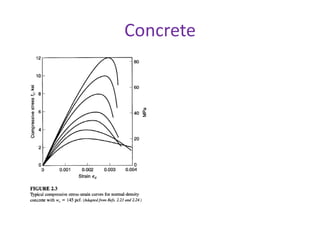
Concrete
Steel
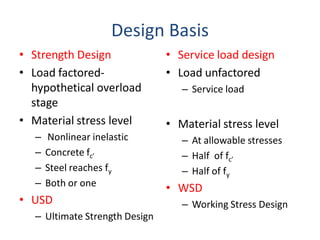
Design Basis
• Strength Design               • Service load design
• Load factored-                • Load unfactored
  hypothetical overload            – Service load
  stage
• Material stress level         • Material stress level
   –   Nonlinear inelastic         – At allowable stresses
   –   Concrete fc’                – Half of fc’
   –   Steel reaches fy            – Half of fy
   –   Both or one
                                • WSD
• USD                              – Working Stress Design
   – Ultimate Strength Design
Design Codes and Specifications
• International Building Code- consensus code
• American Concrete Institute ACI Code- Building
  Code requirement for Structural Concrete -318-
  2008
• AASHTO- American Association of State Highway
  and Transportation Officials- for bridges
• American Railway Engineering and Maintenance
  of Way Association –AREMA-Manual of Railway
  Engineering
Bangladesh National Building Code
• BNBC
• First in 1993
• Up-gradation is in progress
Safety provision of ACI/BNBC Code
Load factors


Probability of overload 1/1000
Strength reduction factor


Probability of understrength 1/100
• Probability of Structural failure
              1/100,000
Fundamental Assumption for RC Behavior

1.   Equilibrium
2.   Strain in steel=Strain in surrounding concrete
3.   Plane cross section remain plane
4.   Concrete does not resist any tension
5.   The theory is based on the actual stress-
     strain relationship of concrete and steel or
     some simplified equivalent.

Read last para
Behaviour of members subject to Axial Loads

• Fundamental behaviour illustrated

• Axial Compression
  – Economical to make concrete carry most loads
  – Steel reinforcement is always provided
     • Bending may exist
     • Cross section reduced
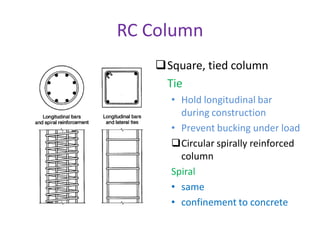
RC Column
    Square, tied column
     Tie
      • Hold longitudinal bar
        during construction
      • Prevent bucking under load
      Circular spirally reinforced
        column
      Spiral
      • same
      • confinement to concrete
fc’=4,000 psi
fy= 60,000psi

         •Slow loading
         •Fast loading
         •0.85fc’
Elastic behaviour
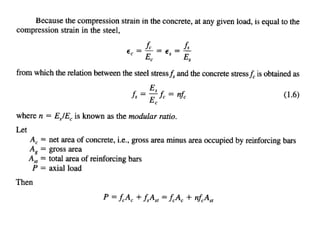
• Up to fc’/2, concrete behave elastic
• Also stress and strain proportional
• Range extends to a strain of 0.0005

• Steel is elastic nearly to yield 60 ksi, strain 0.002
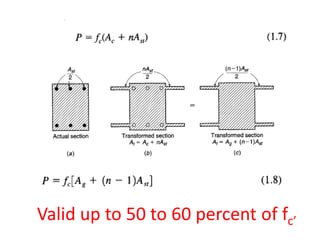
Valid up to 50 to 60 percent of fc’
Inelastic range
Strength
Strength
Axial Tension
• If tension is small, both steel and concrete are
  elastic


• Larger load than that cracks concrete

• At steel yields

Chapter1

  • 1.
    CE 315: Designof Concrete Structures I Dr. Tahsin Reza Hossain Professor, Room No-649 Email: tahsin@ce.buet.ac.bd
  • 2.
    Syllabus • Fundamental behaviourof reinforced concrete • Introduction to WSD and USD methods • Analysis and design of singly reinforced, doubly reinforced and T-beams according to WSD and USD methods • Shear and Diagonal tension • Bond and anchorage according to WSD and USD methods • One-way slab
  • 3.
    Books • Design ofConcrete Structures – Nilson, Darwin, Dolan 14th Ed • Structural Concrete- Theory and Design – Hassoun, Al-Manaseer 4th Ed • Reinforced Concrete- Mechanics & Design – Wight & McGregor 5th Ed Many more……..
  • 4.
    Concrete, Reinforced Concrete(RC), Prestressed Concrete (PC) • What is concrete? Constituents? – Stone like material, cement, coarse and fine aggregate, water, admixture • A bit of history • Advantages, disadvantages – Easy to make, relatively low-cost, formabilty, weather and fire resistant, good comp strength – Weak in tension • Reinforced concrete-mild steel • Where to place the reinforcement-examples • Prestressed concrete
  • 5.
    Roman Pantheon, unreinforcedconcrete dome, diameter 43.3m, 25BC, 125AD
  • 6.
  • 13.
    Loads •Dead load attached •Live load not attached •Environmental load •Wind •Earthquake •Snow, soil pressure, temperature •Building codes- ACI, BNBC, IS, Eurocode
  • 16.
  • 17.
  • 18.
    Serviceability, Strength andStructural Safety • To serve its purpose, a structure must be safe against collapse and serviceable in use • Strength of the structure be adequate for all loads • Serviceability – deflection small, hairline cracks, minimum vibration
  • 19.
    Strength and safety • If loads and moments, shears, axial force can be predicted accurately, safety can be ensured by providing a carrying capacity just barely in excess of the known demand. • Capacity= Demand
  • 20.
    Uncertainity • There area number of sources of uncertainty in Analysis, Design and Construction • Read 7 points • Consideration given to consequence of failure • Nature of failure is also important
  • 21.
    Variability of Loads, Strength,safety Load can be considered as random variable Form of distribution curve (probability density function) can be determined from large scale load survey Probability of occurrence Area under curve is probability of occurrence Qd design load Sd Design strength M is also a random variable Beta between 3 and 4 corresponds to a probability of failure of 1:100,000
  • 22.
    Partial safety factor • Strength reduction factor X Nominal Strength > Load Factor X Design Load Why partial factors are different
  • 23.
  • 24.
  • 25.
    Design Basis • StrengthDesign • Service load design • Load factored- • Load unfactored hypothetical overload – Service load stage • Material stress level • Material stress level – Nonlinear inelastic – At allowable stresses – Concrete fc’ – Half of fc’ – Steel reaches fy – Half of fy – Both or one • WSD • USD – Working Stress Design – Ultimate Strength Design
  • 26.
    Design Codes andSpecifications • International Building Code- consensus code • American Concrete Institute ACI Code- Building Code requirement for Structural Concrete -318- 2008 • AASHTO- American Association of State Highway and Transportation Officials- for bridges • American Railway Engineering and Maintenance of Way Association –AREMA-Manual of Railway Engineering
  • 27.
    Bangladesh National BuildingCode • BNBC • First in 1993 • Up-gradation is in progress
  • 28.
    Safety provision ofACI/BNBC Code
  • 29.
  • 30.
  • 31.
    • Probability ofStructural failure 1/100,000
  • 32.
    Fundamental Assumption forRC Behavior 1. Equilibrium 2. Strain in steel=Strain in surrounding concrete 3. Plane cross section remain plane 4. Concrete does not resist any tension 5. The theory is based on the actual stress- strain relationship of concrete and steel or some simplified equivalent. Read last para
  • 33.
    Behaviour of memberssubject to Axial Loads • Fundamental behaviour illustrated • Axial Compression – Economical to make concrete carry most loads – Steel reinforcement is always provided • Bending may exist • Cross section reduced
  • 34.
    RC Column Square, tied column Tie • Hold longitudinal bar during construction • Prevent bucking under load Circular spirally reinforced column Spiral • same • confinement to concrete
  • 35.
    fc’=4,000 psi fy= 60,000psi •Slow loading •Fast loading •0.85fc’
  • 36.
    Elastic behaviour • Upto fc’/2, concrete behave elastic • Also stress and strain proportional • Range extends to a strain of 0.0005 • Steel is elastic nearly to yield 60 ksi, strain 0.002
  • 38.
    Valid up to50 to 60 percent of fc’
  • 41.
  • 42.
  • 43.
  • 44.
    Axial Tension • Iftension is small, both steel and concrete are elastic • Larger load than that cracks concrete • At steel yields