Mirror
Sylvia Plath
MRINAL DWIVEDI
Sylvia Life
• Sylvia was born on October
27, 1932 in Newton,
Massachusetts.
• She married Hughes on
June 16, 1956
Sylvia Life
• Sylvia and Ted had two
children Frieda and Nicholas
(1960, 1962)
• 1962 She learned of Ted’s
infidelity and they
separated.
• Committed suicide on
February 11, 1963.
Summary
Stanza I Addressed by an inanimate
object
– Sets out to define itself and
its function
– Has no preconceptions
because it is without
memory or ability to reason.
– It is omnivorous – swallows
everything it confronts
without making judgments
that might blur, mist, or
distort.
It is god-like in its
objectivity and
incapability of
emotional response.
Most of the time it
meditates on the
opposite wall, faithfully
reproducing its colors
and design until
darkness intrudes or
intervenes
Summary
Stanza II
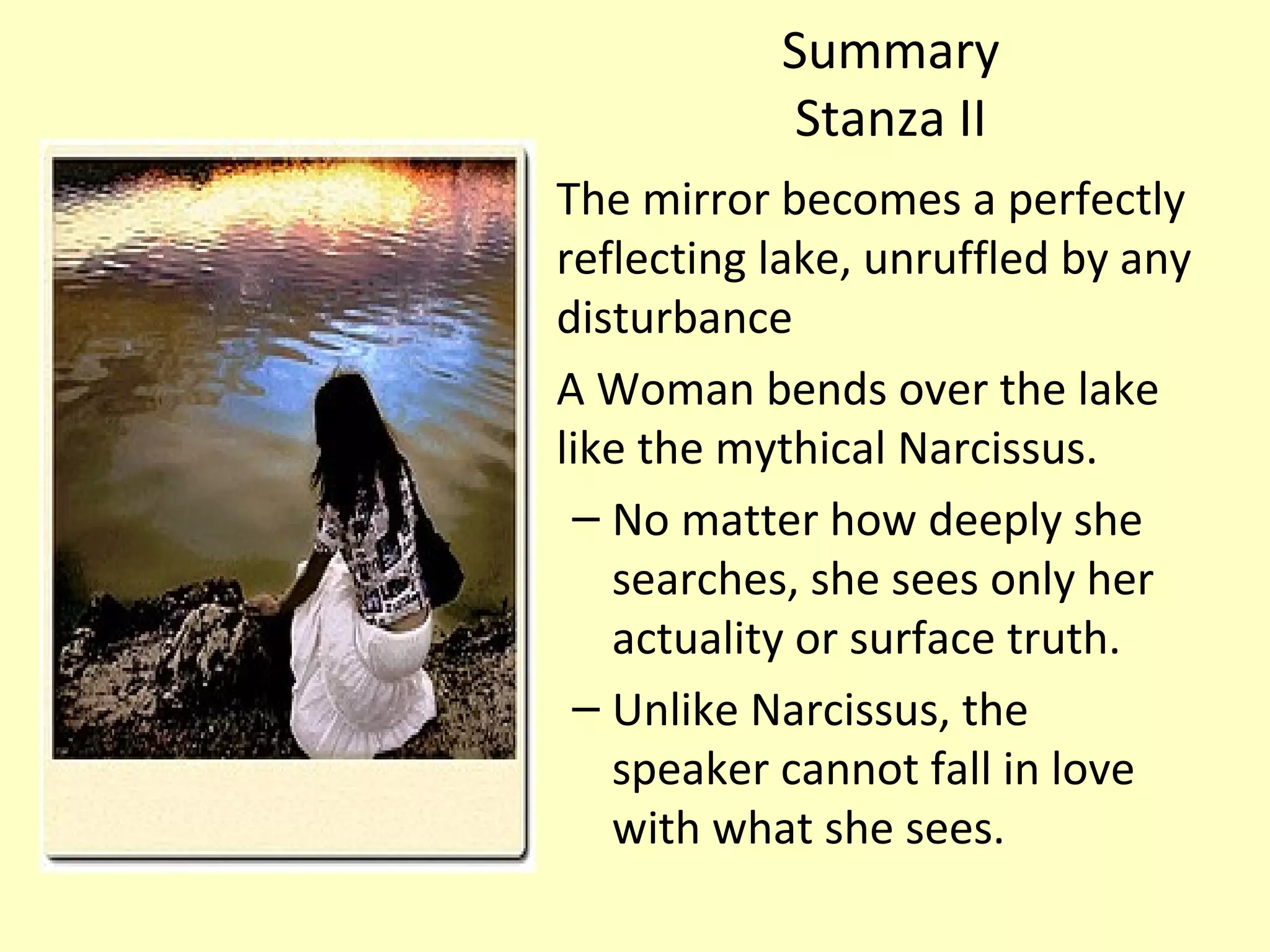
The mirror becomes a perfectly
reflecting lake, unruffled by any
disturbance
A Woman bends over the lake
like the mythical Narcissus.
– No matter how deeply she
searches, she sees only her
actuality or surface truth.
– Unlike Narcissus, the
speaker cannot fall in love
with what she sees.
• The candles and moon to which the
woman turns are liars capable of lending
untruthful shadows and romantic
highlights – unlike the lake
surface/mirror, which renders only
faithful images.
Unhappy by what she
sees, she weeps and
wrings her hands.
– The youth and
beauty once
reflected during
her morning visits
are drowned in the
metaphorical
depths of the lake.
– What slowly
emerges from
those depths is the
terrifying fact that
she is aging.
Chapter Mirror CLASS 10

Chapter Mirror CLASS 10

  • 1.
  • 2.
    Sylvia Life • Sylviawas born on October 27, 1932 in Newton, Massachusetts. • She married Hughes on June 16, 1956
  • 4.
    Sylvia Life • Sylviaand Ted had two children Frieda and Nicholas (1960, 1962) • 1962 She learned of Ted’s infidelity and they separated. • Committed suicide on February 11, 1963.
  • 5.
    Summary Stanza I Addressedby an inanimate object – Sets out to define itself and its function – Has no preconceptions because it is without memory or ability to reason. – It is omnivorous – swallows everything it confronts without making judgments that might blur, mist, or distort.
  • 6.
    It is god-likein its objectivity and incapability of emotional response. Most of the time it meditates on the opposite wall, faithfully reproducing its colors and design until darkness intrudes or intervenes
  • 7.
    Summary Stanza II The mirrorbecomes a perfectly reflecting lake, unruffled by any disturbance A Woman bends over the lake like the mythical Narcissus. – No matter how deeply she searches, she sees only her actuality or surface truth. – Unlike Narcissus, the speaker cannot fall in love with what she sees.
  • 8.
    • The candlesand moon to which the woman turns are liars capable of lending untruthful shadows and romantic highlights – unlike the lake surface/mirror, which renders only faithful images.
  • 9.
    Unhappy by whatshe sees, she weeps and wrings her hands. – The youth and beauty once reflected during her morning visits are drowned in the metaphorical depths of the lake. – What slowly emerges from those depths is the terrifying fact that she is aging.