SCIENTIFIC METHODS IN RESEARCH
1.BASE TERMINOLOGY
• Methodology - the study of the methods involved
in some field, in problem solving
• Method - a (systematic ?) codified series of steps
taken to complete a certain task or to reach a
certain objective
TERMS
 The scientific method is a body of techniques for
investigating phenomena, acquiring new knowledge,
or correcting and integrating previous knowledge.
 The Oxford English Dictionary defines the scientific
method as "a method or procedure that has
characterized natural science since the 17th century,
consisting in systematic observation, measurement, and
experiment, and the formulation, testing, and
modification of hypotheses."
DEFFINITION
NATURE OF SCIENTIFIC METHOD
The “scientific method” attempts to minimize the influence
of the researchers' bias on the outcome of an experiment
 The researcher may have a preference for one
outcome or another, and it is important that this
preference not bias the results or their interpretation.
 Sometimes "common sense" and "logic" tempt us
into believing that no test is needed.
 Another common mistake is to ignore or rule out
data which do not support the hypothesis
But there is no single, universal formal “scientific
method” .There are several variants and each
researcher needs to tune the process to the nature of
the problem and his / her working methods
2. OVERVIEW OF5
RESEARCH METHODS
3. STEPS OF THE
SCIENTIFIC METHOD
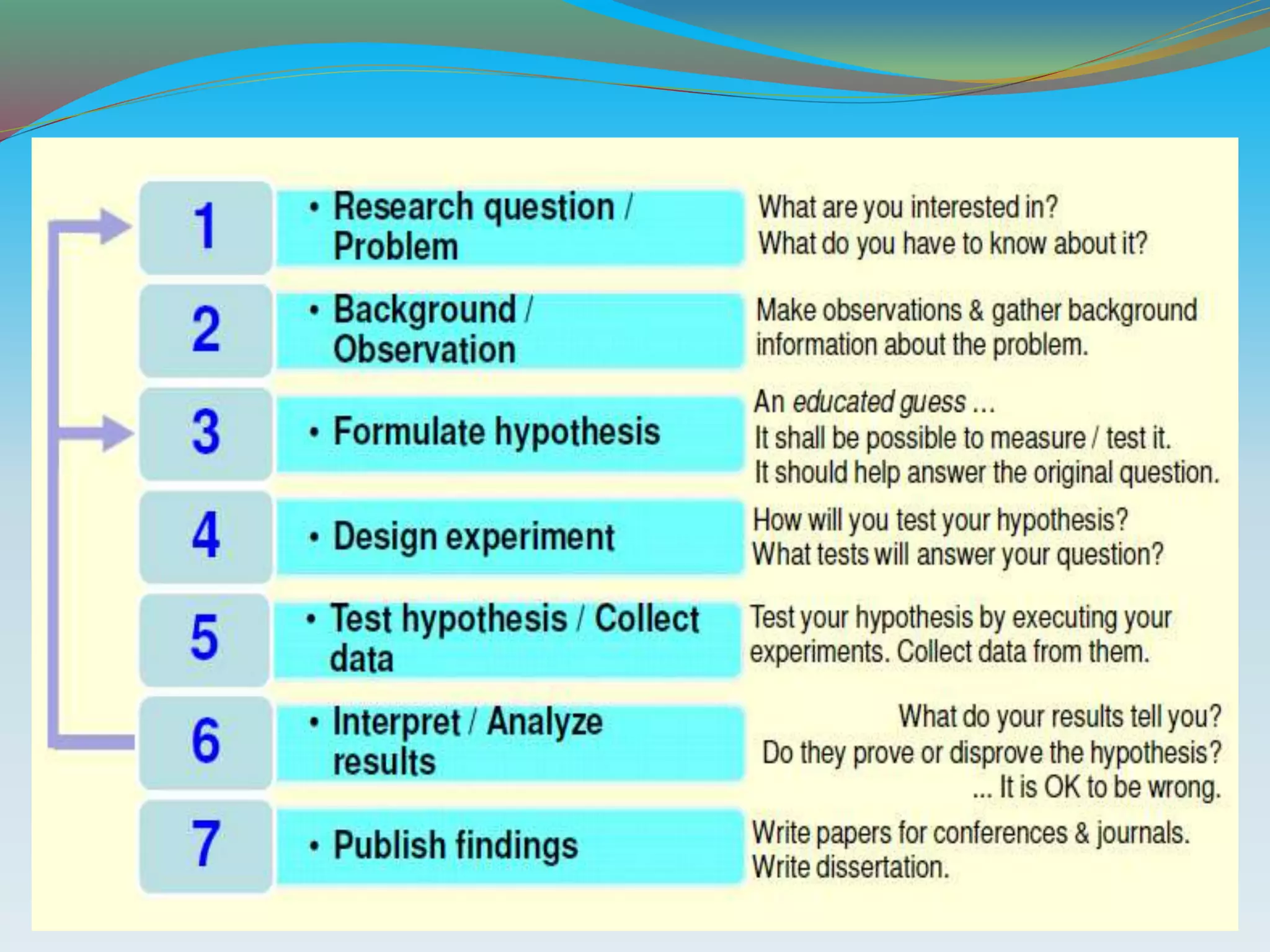
Step 1: Formulate Research question /
Problem
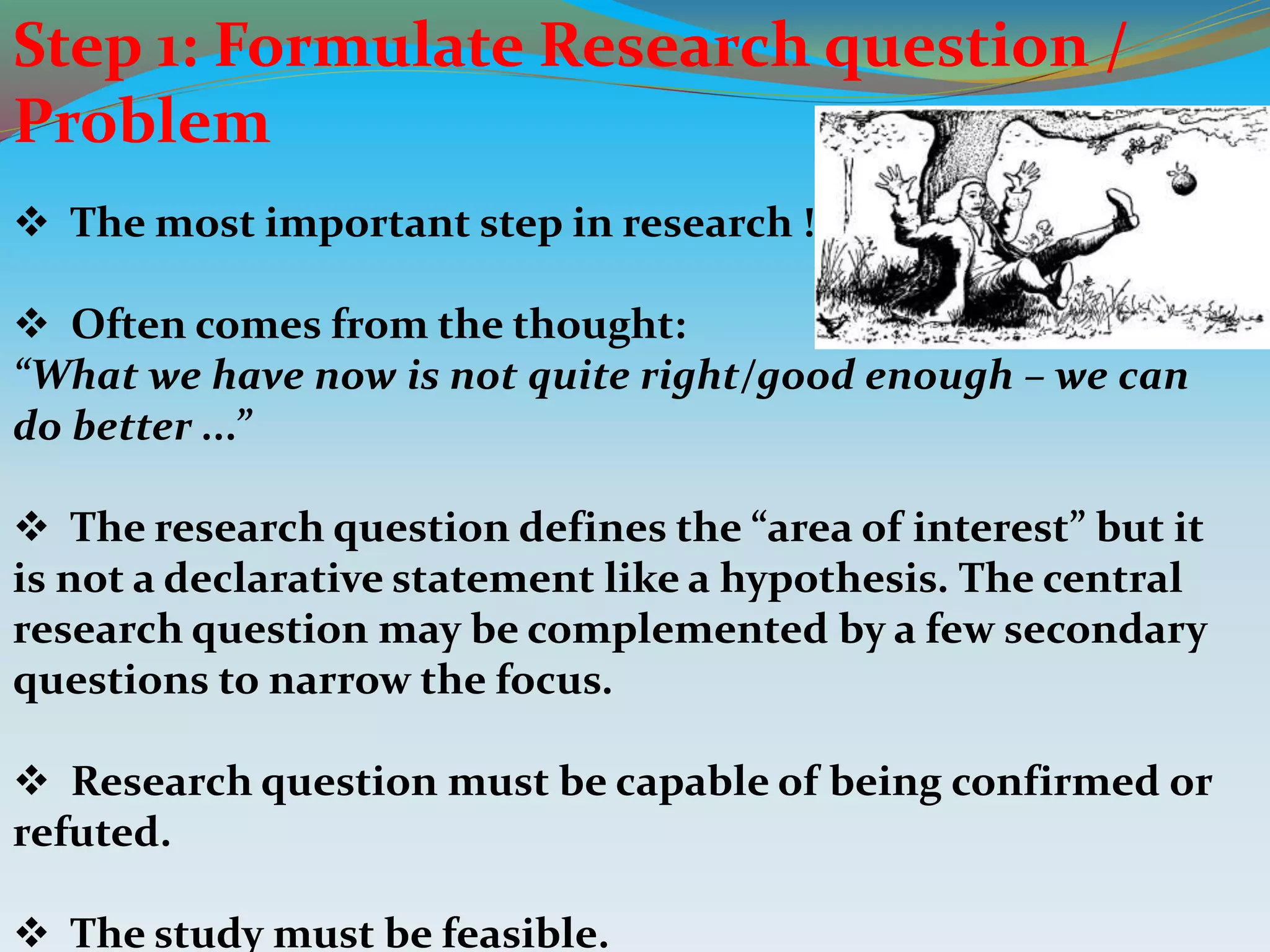
 The most important step in research !
 Often comes from the thought:
“What we have now is not quite right/good enough – we can
do better ...”
 The research question defines the “area of interest” but it
is not a declarative statement like a hypothesis. The central

research question may be complemented by a few secondary
questions to narrow the focus.
 Research question must be capable of being confirmed or
refuted.
 The study must be feasible.
Step 2: Background / Observation
 How has the work been done previously?
 What similar work has been leading up to this point?
 Study state of the art
(literature review, projects, informal discussions, etc).
 Optional realization of preliminary experiments.
 What distinguishes previous work from what you
want to do?
 Who / What will be impacted by this research?
Step 3: Formulate hypothesis
 A scientific hypothesis states the ‘predicted’ (educated
guess) relationship amongst variables.
 Serve to bring clarity, specificity and focus to a research
problem
... But are not essential
... You can conduct valid research without constructing a
hypothesis
... On the other hand you can construct as many hypothesis
as appropriate
Characteristics of a hypothesis
 Should be simple, specific and conceptually clear.
... ambiguity would make verification almost
impossible.
 Should be capable of verification.
... i.e. There are methods and techniques for data
collection and analysis.
 Should be related to the existing body of knowledge.
... i.e. Able to add to the existing knowledge.
 Should be operationalisable
... i.e. Expressed in terms that can be measured
Step 4: Design experiment
 Includes planning in detail all the steps of th
experimental phase.
 Identify the variables that will be manipulated and
measured –the research outcomes must be measurable.
In other words: What needs to be controlled in order to get
an unbiased answer to the research question.
 Therefore: it is necessary to not only design a prototype /
system but also the thesis validation method !
How to validate the thesis?
 The plan should allow others to repeat it.
It should be feasible...!
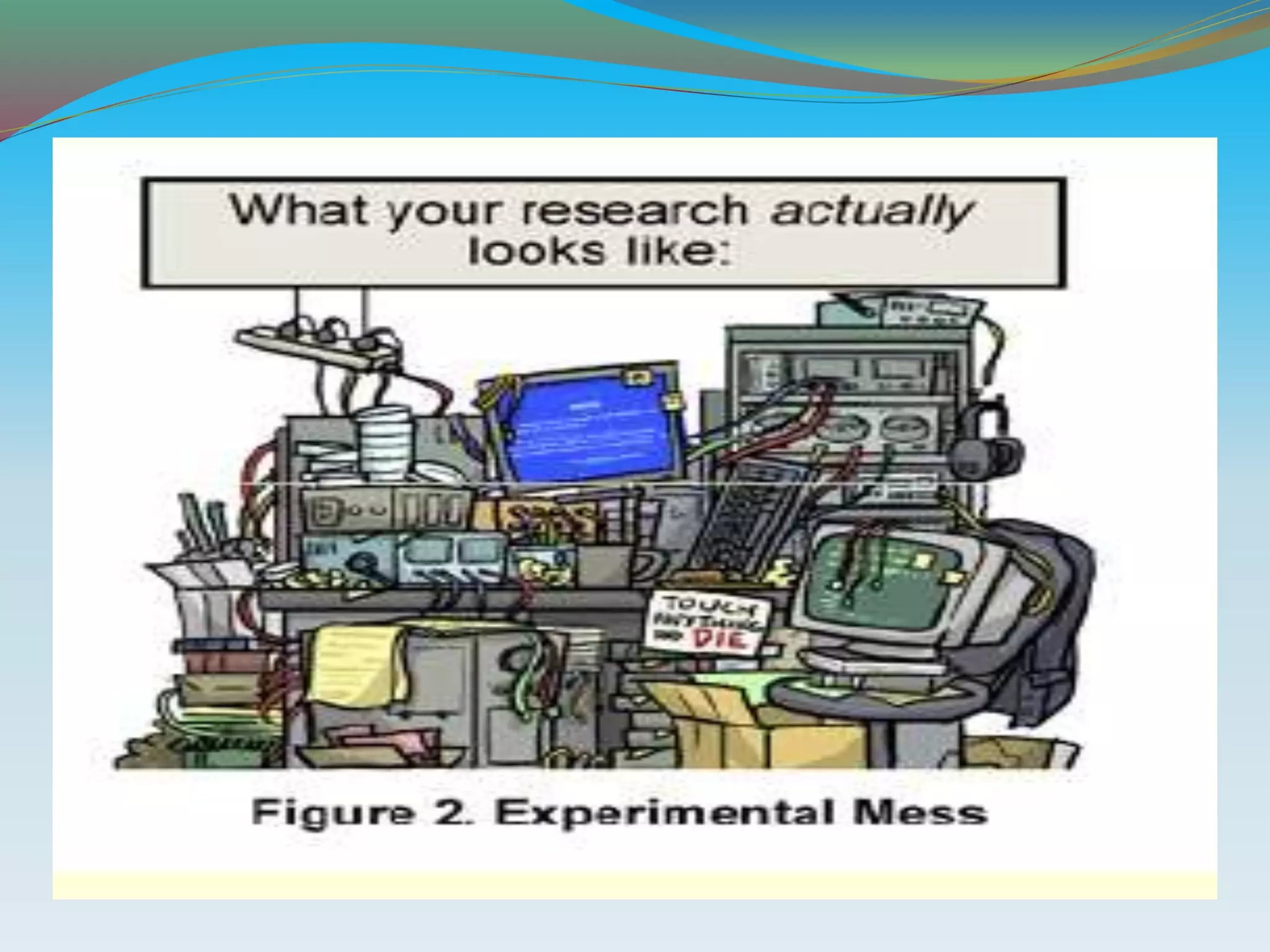
 Plan intermediate milestones.
Step 5: Test hypothesis / Collect data
 Doing it !
 Implementation of methods (e.g. prototyping) and
auxiliary tools (e.g. simulation)
 Pilot testing and refinement.
 Field vs. Laboratory work.
 Any ethical considerations ?
 Confirm results by retesting !
Step 6: Interpret / Analyze results
 What did your experiment show?
 Qualitative data analysis.
 Quantitative data analysis.
 Descriptive and inferential statistics, clustering, ...
What might weaken your confidence in the results (critical
spirit)?
Discussion regarding
1. Literature
2. Research objectives
3. Research questions.
 Consider next step
 Recommendations for further research
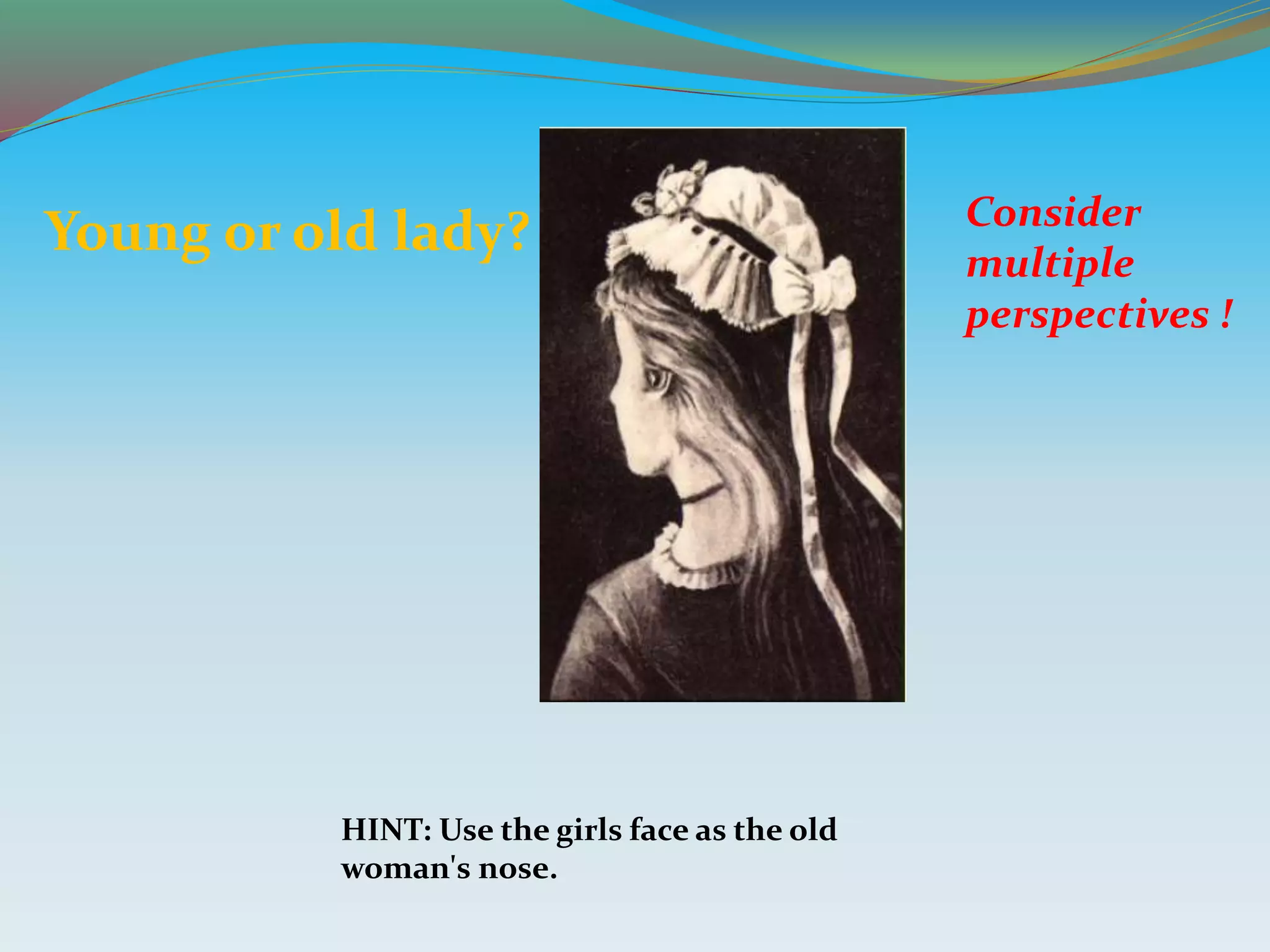
Consider
multiple
perspectives !
Young or old lady?
HINT: Use the girls face as the old
woman's nose.
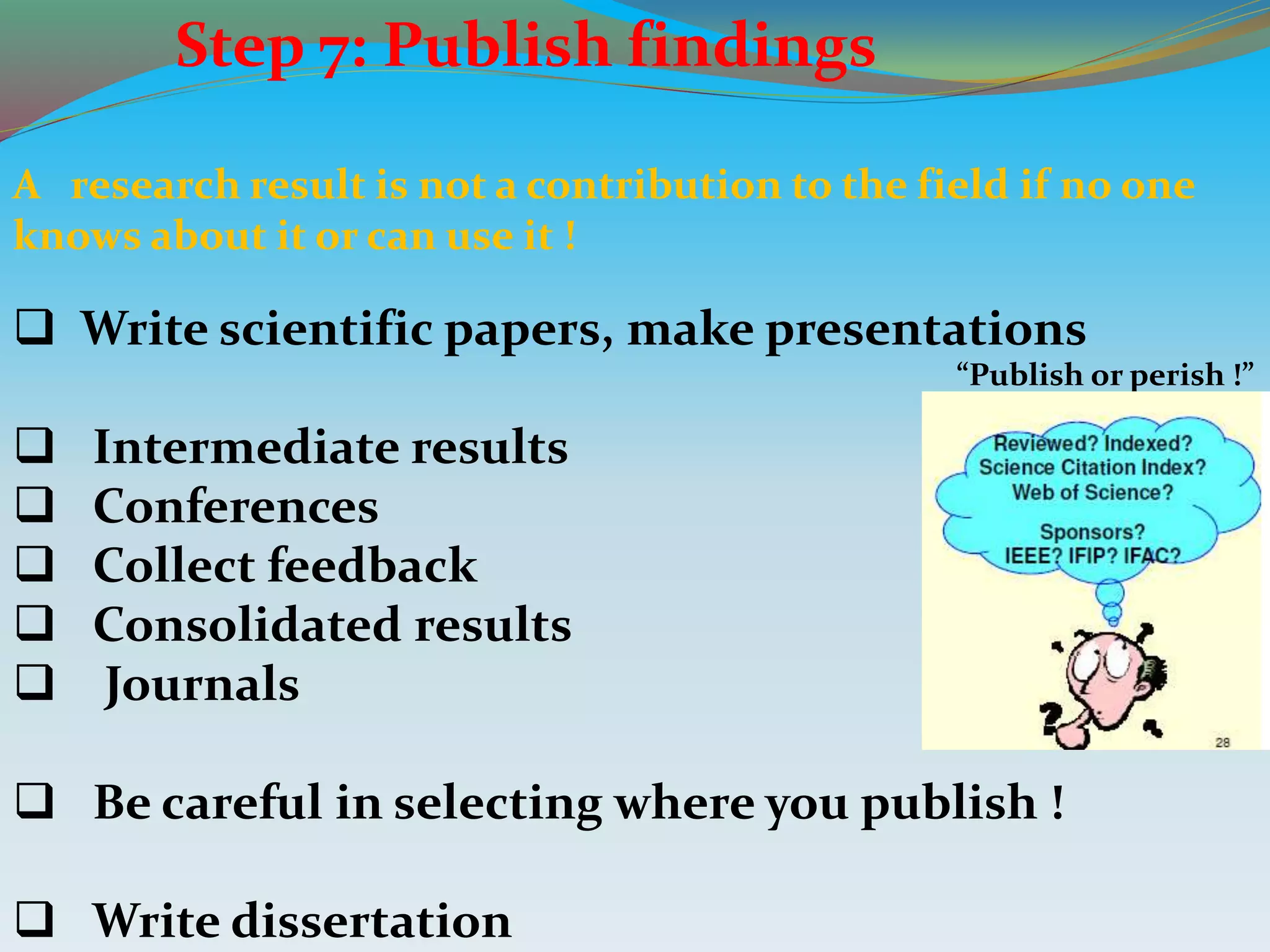
Step 7: Publish findings
A research result is not a contribution to the field if no one
knows about it or can use it !
 Write scientific papers, make presentations
 Intermediate results
 Conferences
 Collect feedback
 Consolidated results
 Journals
 Be careful in selecting where you publish !
 Write dissertation
“Publish or perish !”
It should be contestable,
A strong thesis is provocative;
it takes a stand and justifies the discussion you will present.
It is specific and focused.
A strong thesis proves a point without discussing
It clearly asserts your own conclusion based on evidence
It provides the reader with a map to guide him/her through
your work.
It anticipates and refutes the counter-arguments
It avoids vague language. It avoids the first person.
Attributes of a good thesis
How do you know if you've got a solid tentative thesis?
Try these five tests:
 Does the thesis inspire a reasonable reader to ask, "How?" or
Why?“
 Would a reasonable reader NOT respond with "Duh!" or "So
what?"or "Gee, no kidding!" or "Who cares?“
Does the thesis avoid general phrasing and/or sweeping words
such as "all" or "none" or "every"?
 Does the thesis lead the reader toward the topic sentences
(the subtopics needed to prove the thesis)?
Can the thesis be adequately developed in the required length
of the paper or dissertation?
Is it a good thesis ?
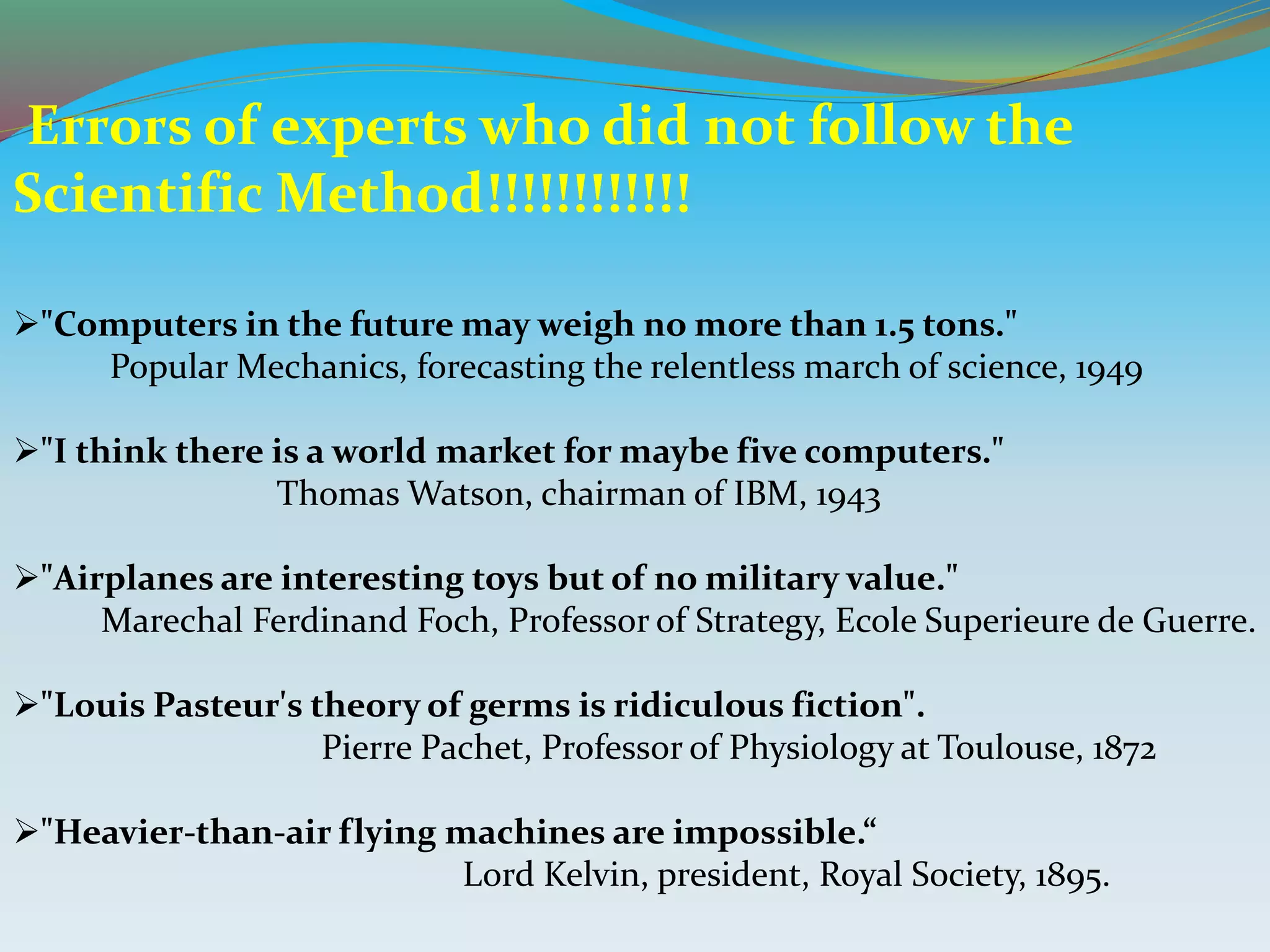
Errors of experts who did not follow the
Scientific Method!!!!!!!!!!!!
"Computers in the future may weigh no more than 1.5 tons."
Popular Mechanics, forecasting the relentless march of science, 1949
"I think there is a world market for maybe five computers."
Thomas Watson, chairman of IBM, 1943
"Airplanes are interesting toys but of no military value."
Marechal Ferdinand Foch, Professor of Strategy, Ecole Superieure de Guerre.
"Louis Pasteur's theory of germs is ridiculous fiction".
Pierre Pachet, Professor of Physiology at Toulouse, 1872
"Heavier-than-air flying machines are impossible.“
Lord Kelvin, president, Royal Society, 1895.
REFFERENCES
THANK YOU

research methadology

  • 1.
  • 2.
  • 3.
    • Methodology -the study of the methods involved in some field, in problem solving • Method - a (systematic ?) codified series of steps taken to complete a certain task or to reach a certain objective TERMS
  • 4.
     The scientificmethod is a body of techniques for investigating phenomena, acquiring new knowledge, or correcting and integrating previous knowledge.  The Oxford English Dictionary defines the scientific method as "a method or procedure that has characterized natural science since the 17th century, consisting in systematic observation, measurement, and experiment, and the formulation, testing, and modification of hypotheses." DEFFINITION
  • 5.
    NATURE OF SCIENTIFICMETHOD The “scientific method” attempts to minimize the influence of the researchers' bias on the outcome of an experiment  The researcher may have a preference for one outcome or another, and it is important that this preference not bias the results or their interpretation.  Sometimes "common sense" and "logic" tempt us into believing that no test is needed.  Another common mistake is to ignore or rule out data which do not support the hypothesis
  • 6.
    But there isno single, universal formal “scientific method” .There are several variants and each researcher needs to tune the process to the nature of the problem and his / her working methods
  • 7.
  • 9.
    3. STEPS OFTHE SCIENTIFIC METHOD
  • 10.
    Step 1: FormulateResearch question / Problem  The most important step in research !  Often comes from the thought: “What we have now is not quite right/good enough – we can do better ...”  The research question defines the “area of interest” but it is not a declarative statement like a hypothesis. The central research question may be complemented by a few secondary questions to narrow the focus.  Research question must be capable of being confirmed or refuted.  The study must be feasible.
  • 11.
    Step 2: Background/ Observation  How has the work been done previously?  What similar work has been leading up to this point?  Study state of the art (literature review, projects, informal discussions, etc).  Optional realization of preliminary experiments.  What distinguishes previous work from what you want to do?  Who / What will be impacted by this research?
  • 12.
    Step 3: Formulatehypothesis  A scientific hypothesis states the ‘predicted’ (educated guess) relationship amongst variables.  Serve to bring clarity, specificity and focus to a research problem ... But are not essential ... You can conduct valid research without constructing a hypothesis ... On the other hand you can construct as many hypothesis as appropriate
  • 13.
    Characteristics of ahypothesis  Should be simple, specific and conceptually clear. ... ambiguity would make verification almost impossible.  Should be capable of verification. ... i.e. There are methods and techniques for data collection and analysis.  Should be related to the existing body of knowledge. ... i.e. Able to add to the existing knowledge.  Should be operationalisable ... i.e. Expressed in terms that can be measured
  • 14.
    Step 4: Designexperiment  Includes planning in detail all the steps of th experimental phase.  Identify the variables that will be manipulated and measured –the research outcomes must be measurable. In other words: What needs to be controlled in order to get an unbiased answer to the research question.  Therefore: it is necessary to not only design a prototype / system but also the thesis validation method ! How to validate the thesis?  The plan should allow others to repeat it. It should be feasible...!  Plan intermediate milestones.
  • 16.
    Step 5: Testhypothesis / Collect data  Doing it !  Implementation of methods (e.g. prototyping) and auxiliary tools (e.g. simulation)  Pilot testing and refinement.  Field vs. Laboratory work.  Any ethical considerations ?  Confirm results by retesting !
  • 17.
    Step 6: Interpret/ Analyze results  What did your experiment show?  Qualitative data analysis.  Quantitative data analysis.  Descriptive and inferential statistics, clustering, ... What might weaken your confidence in the results (critical spirit)? Discussion regarding 1. Literature 2. Research objectives 3. Research questions.  Consider next step  Recommendations for further research
  • 18.
    Consider multiple perspectives ! Young orold lady? HINT: Use the girls face as the old woman's nose.
  • 19.
    Step 7: Publishfindings A research result is not a contribution to the field if no one knows about it or can use it !  Write scientific papers, make presentations  Intermediate results  Conferences  Collect feedback  Consolidated results  Journals  Be careful in selecting where you publish !  Write dissertation “Publish or perish !”
  • 20.
    It should becontestable, A strong thesis is provocative; it takes a stand and justifies the discussion you will present. It is specific and focused. A strong thesis proves a point without discussing It clearly asserts your own conclusion based on evidence It provides the reader with a map to guide him/her through your work. It anticipates and refutes the counter-arguments It avoids vague language. It avoids the first person. Attributes of a good thesis
  • 21.
    How do youknow if you've got a solid tentative thesis? Try these five tests:  Does the thesis inspire a reasonable reader to ask, "How?" or Why?“  Would a reasonable reader NOT respond with "Duh!" or "So what?"or "Gee, no kidding!" or "Who cares?“ Does the thesis avoid general phrasing and/or sweeping words such as "all" or "none" or "every"?  Does the thesis lead the reader toward the topic sentences (the subtopics needed to prove the thesis)? Can the thesis be adequately developed in the required length of the paper or dissertation? Is it a good thesis ?
  • 26.
    Errors of expertswho did not follow the Scientific Method!!!!!!!!!!!! "Computers in the future may weigh no more than 1.5 tons." Popular Mechanics, forecasting the relentless march of science, 1949 "I think there is a world market for maybe five computers." Thomas Watson, chairman of IBM, 1943 "Airplanes are interesting toys but of no military value." Marechal Ferdinand Foch, Professor of Strategy, Ecole Superieure de Guerre. "Louis Pasteur's theory of germs is ridiculous fiction". Pierre Pachet, Professor of Physiology at Toulouse, 1872 "Heavier-than-air flying machines are impossible.“ Lord Kelvin, president, Royal Society, 1895.
  • 27.
  • 28.