Lecture: Medical Terminology
Lecturer: Abdulkadir Ahmed
Mo’alim
Topic: Chapter one Introduction
Please VISIT daada channel
official
Introduction
• Medical terminology is the study of medical
terms or is the language of health care
industry.
Objectives
To provide basic information about the structure and
function of each body system.
To provide a clear, concise, understanding of commonly
used medical terms
1. introducing the foundation of medical terminology
2. presenting techniques for breaking complex medical
term into:
a) root b) prefixes c) suffix
3. providing variety of exercise to enable student to learn
to spell define and use medical term
Building blocks of medical
terminology
• Objective
• Briefly define root, prefixes, suffixes,
combining form and combining vowels
• Analyze medical term by identifying the root
prefix and suffix
• Combine root and suffix
• Building medical term using root prefixes,
suffixes and combining
Over view
• Learning medical terminology is very like learning
a foreign language.
• You begin by studying the rules of language,
progressing to learn words.
• Move on to putting the words together to form
sentence in finally developing the ability to
communicate using language.
• It’s impossible to memorize language but you
can memorize the roles and word part associated
with the language.
Most medical terms are derived from Greek
and Latin
Medical terms contain three basic parts a)
root b) prefixes c) suffix
This chapter introduce root, prefixes and
suffixes and the rule of combination the word
parts (word element).
1. Root
Root is foundation of medical term; all medical
roots have at least one root.
Root is identifies a part of the body or color
Prefixes and suffixes change the meaning of
word that have same root.
Some common body part roots are the
following:
•Arthr/o = joint
•cardi/o = heart
•derm/o or dermat/o = skin
•Gastr/o = stomach
Some common roots denotes color
• Cyno =blue or bluish
• eosin/o = rosy
• erythr/o = red
• Leuk/o = white
• melan/o = black
• xanth/o = yellow
• All medical terms have combining form that is
created when root is combined with a vowel.
The vowel is called combining vowel is usually
an o and occasionally i or e. the combining
vowel is used to join word element and help
easy pronunciation of medical term.
The combining form of root is used:
• a) When join root with root e.g: cardi+ o +
vascular = cardiovascular
• b) When join root with suffixes that begin with
a consonant e.g: cardiomegaly
2. prefixes
• is a word element or part that is added to the
beginning of the word root
• All medical terms do not have prefixes. In a
list of word parts, prefixes are
• easily identified because they are written with
a hyphen after the prefixes.
• Many prefixes associated with medical term
keep their English meaning
• E.g. Pre: before post: after anti: against
Example of prefixes
• Ante-: before hemi-: half multi-: many neo-:
new sub-: under bellow
• Prefixes are added to a word root with
additional vowel.
3. Suffixes
• Suffix is a word element or part is added to
the end of the word root
• All medical terms must have suffix to
complete the term except when the root
• can stand alone as a word itself.
• Suffixes indicate whether medical term is a
noun or an adjective
Example of suffixes:
• -ac; -al; -ar; -ary = pertaining to; like -ic; iac; =
pertaining to
• - iod = like, resembling
• -ectomy = surgical removal, excision
• - itis = inflammation
• -megaly = enlargement
• -pathy = disease
Combining roots, prefixes, and
suffixes
• Combining roots, prefixes, and suffixes is the
basic way to create medical terms. A few rules
apply to this process, Review the following
rules and examples and complete the
exercises.
• 1) When combining more than one root in a
medical term, the combining form of the root
is usually used between the roots.
• Example: cardiogastric = pertaining to the heart
and stomach
• Note that the combining form of cardi/o is used
to join the roots cardi and gastr.
• 2) When combining a root with a suffix that
begins with a consonant (any later other than a,
e, I, o, u, and y), the combining form of the root
must be used to connect the suffix and root.
• Example: gastromegaly =enlarged stomach or
enlargement of the stomach.
• The root gastr means stomach, and the suffix
-megaly means enlarged. Note how using the
combining form gastr/o aids in the
pronunciation of this term.
• Imagine how difficult it would be to say
gastrmegaly!
• 3) When combining a root with a suffix that
begins with a vowel, the combining form is
not used.
• Example: gastrectomy= surgical removal of
the stomach. Because the suffix –ectomy,
which means surgical removal, begins with a
vowel, the root gastr is used to create the
medical term. Pronunciation is much
smoother with out the combining vowel.
4) There will always be some exceptions to these
rules. For example, when combining word roots
and one of the roots begins with a vowel, the
combining vowel is retained, as with the term
gastroenterology. The root gastr keeps the
combining vowel”o” when combined with root
enter.
• Gastroenterology literally means the study of the
stomach and intestines, which are major organs
of the digestive system.
Pronunciation Rule
Pronunciation medical terms seems difficult
because medical terms are often very long. A
comprehensive medical dictionary is available
tool for learning the pronunciation and
meaning of medical terms. There are several
rules that provide guidance for term
pronunciation. Pronunciations are written
phonetically (by sound) with the primary
accented syllables presented in bold
uppercase letters.
• Secondary accented syllable are presented in
bold lowercase letters.
• Medical terms with two syllable are usually
accented on the first syllable example: gastric
= GASS-trik
• Medical term with more than two syllable are
usually accented on the third to the last or
next to the last syllable example: a) gastritis
• =gass-TRY-tis next to the last syllable accented
rule b) gastromegaly = gass-tro-MEG-ah-lee
the third to the last syllable accented rule.
• The vowel in the accented syllable is
pronounced with along vowel sound when the
syllable ends with a vowel example: gastritis =
gass-TRY-tis tri is pronounced with a long i
sound.
• The vowel in the accented syllable is
pronounced with a short sound when the
syllable ends with a consonant. Example:
cardiomegaly= kar-dee-oh-MEG-ah-lee is
pronounced with a short e sound.
• The will always be acceptions to these rule.
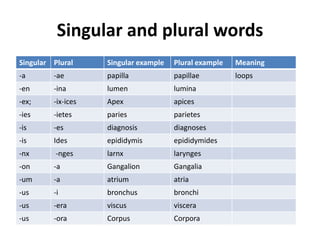
Singular and plural words
• In English language singular are often made
plural by adding s or es to the word
• example: tree singular threes: plural box:
singular boxes: plural But the medical terms
are different from English. Not the word
ending changes to form the plural.
Singular and plural words
Singular Plural Singular example Plural example Meaning
-a -ae papilla papillae loops
-en -ina lumen lumina
-ex; -ix-ices Apex apices
-ies -ietes paries parietes
-is -es diagnosis diagnoses
-is Ides epididymis epididymides
-nx -nges larnx larynges
-on -a Gangalion Gangalia
-um -a atrium atria
-us -i bronchus bronchi
-us -era viscus viscera
-us -ora Corpus Corpora
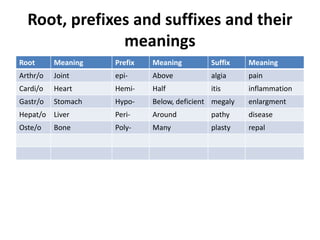
Root, prefixes and suffixes and their
meanings
Root Meaning Prefix Meaning Suffix Meaning
Arthr/o Joint epi- Above algia pain
Cardi/o Heart Hemi- Half itis inflammation
Gastr/o Stomach Hypo- Below, deficient megaly enlargment
Hepat/o Liver Peri- Around pathy disease
Oste/o Bone Poly- Many plasty repal
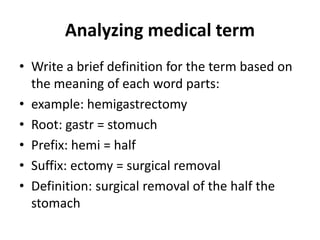
Analyzing medical term
• Write a brief definition for the term based on
the meaning of each word parts:
• example: hemigastrectomy
• Root: gastr = stomuch
• Prefix: hemi = half
• Suffix: ectomy = surgical removal
• Definition: surgical removal of the half the
stomach
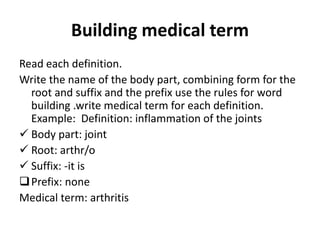
Building medical term
Read each definition.
Write the name of the body part, combining form for the
root and suffix and the prefix use the rules for word
building .write medical term for each definition.
Example: Definition: inflammation of the joints
 Body part: joint
 Root: arthr/o
 Suffix: -it is
Prefix: none
Medical term: arthritis
THE END
•Any Questions
•Commnets
•daada.ahmed@gmail.com
Don’t Forget Subscribe
Daada Channel Official
•Thank you

Medical terms update

  • 1.
    Lecture: Medical Terminology Lecturer:Abdulkadir Ahmed Mo’alim Topic: Chapter one Introduction Please VISIT daada channel official
  • 2.
    Introduction • Medical terminologyis the study of medical terms or is the language of health care industry.
  • 3.
    Objectives To provide basicinformation about the structure and function of each body system. To provide a clear, concise, understanding of commonly used medical terms 1. introducing the foundation of medical terminology 2. presenting techniques for breaking complex medical term into: a) root b) prefixes c) suffix 3. providing variety of exercise to enable student to learn to spell define and use medical term
  • 4.
    Building blocks ofmedical terminology • Objective • Briefly define root, prefixes, suffixes, combining form and combining vowels • Analyze medical term by identifying the root prefix and suffix • Combine root and suffix • Building medical term using root prefixes, suffixes and combining
  • 5.
    Over view • Learningmedical terminology is very like learning a foreign language. • You begin by studying the rules of language, progressing to learn words. • Move on to putting the words together to form sentence in finally developing the ability to communicate using language. • It’s impossible to memorize language but you can memorize the roles and word part associated with the language.
  • 6.
    Most medical termsare derived from Greek and Latin Medical terms contain three basic parts a) root b) prefixes c) suffix This chapter introduce root, prefixes and suffixes and the rule of combination the word parts (word element).
  • 7.
    1. Root Root isfoundation of medical term; all medical roots have at least one root. Root is identifies a part of the body or color Prefixes and suffixes change the meaning of word that have same root.
  • 8.
    Some common bodypart roots are the following: •Arthr/o = joint •cardi/o = heart •derm/o or dermat/o = skin •Gastr/o = stomach
  • 9.
    Some common rootsdenotes color • Cyno =blue or bluish • eosin/o = rosy • erythr/o = red • Leuk/o = white • melan/o = black • xanth/o = yellow
  • 10.
    • All medicalterms have combining form that is created when root is combined with a vowel. The vowel is called combining vowel is usually an o and occasionally i or e. the combining vowel is used to join word element and help easy pronunciation of medical term.
  • 11.
    The combining formof root is used: • a) When join root with root e.g: cardi+ o + vascular = cardiovascular • b) When join root with suffixes that begin with a consonant e.g: cardiomegaly
  • 12.
    2. prefixes • isa word element or part that is added to the beginning of the word root • All medical terms do not have prefixes. In a list of word parts, prefixes are • easily identified because they are written with a hyphen after the prefixes. • Many prefixes associated with medical term keep their English meaning • E.g. Pre: before post: after anti: against
  • 13.
    Example of prefixes •Ante-: before hemi-: half multi-: many neo-: new sub-: under bellow • Prefixes are added to a word root with additional vowel.
  • 14.
    3. Suffixes • Suffixis a word element or part is added to the end of the word root • All medical terms must have suffix to complete the term except when the root • can stand alone as a word itself. • Suffixes indicate whether medical term is a noun or an adjective
  • 15.
    Example of suffixes: •-ac; -al; -ar; -ary = pertaining to; like -ic; iac; = pertaining to • - iod = like, resembling • -ectomy = surgical removal, excision • - itis = inflammation • -megaly = enlargement • -pathy = disease
  • 17.
    Combining roots, prefixes,and suffixes • Combining roots, prefixes, and suffixes is the basic way to create medical terms. A few rules apply to this process, Review the following rules and examples and complete the exercises. • 1) When combining more than one root in a medical term, the combining form of the root is usually used between the roots.
  • 18.
    • Example: cardiogastric= pertaining to the heart and stomach • Note that the combining form of cardi/o is used to join the roots cardi and gastr. • 2) When combining a root with a suffix that begins with a consonant (any later other than a, e, I, o, u, and y), the combining form of the root must be used to connect the suffix and root. • Example: gastromegaly =enlarged stomach or enlargement of the stomach.
  • 19.
    • The rootgastr means stomach, and the suffix -megaly means enlarged. Note how using the combining form gastr/o aids in the pronunciation of this term. • Imagine how difficult it would be to say gastrmegaly! • 3) When combining a root with a suffix that begins with a vowel, the combining form is not used.
  • 20.
    • Example: gastrectomy=surgical removal of the stomach. Because the suffix –ectomy, which means surgical removal, begins with a vowel, the root gastr is used to create the medical term. Pronunciation is much smoother with out the combining vowel.
  • 21.
    4) There willalways be some exceptions to these rules. For example, when combining word roots and one of the roots begins with a vowel, the combining vowel is retained, as with the term gastroenterology. The root gastr keeps the combining vowel”o” when combined with root enter. • Gastroenterology literally means the study of the stomach and intestines, which are major organs of the digestive system.
  • 22.
    Pronunciation Rule Pronunciation medicalterms seems difficult because medical terms are often very long. A comprehensive medical dictionary is available tool for learning the pronunciation and meaning of medical terms. There are several rules that provide guidance for term pronunciation. Pronunciations are written phonetically (by sound) with the primary accented syllables presented in bold uppercase letters.
  • 23.
    • Secondary accentedsyllable are presented in bold lowercase letters. • Medical terms with two syllable are usually accented on the first syllable example: gastric = GASS-trik • Medical term with more than two syllable are usually accented on the third to the last or next to the last syllable example: a) gastritis
  • 24.
    • =gass-TRY-tis nextto the last syllable accented rule b) gastromegaly = gass-tro-MEG-ah-lee the third to the last syllable accented rule. • The vowel in the accented syllable is pronounced with along vowel sound when the syllable ends with a vowel example: gastritis = gass-TRY-tis tri is pronounced with a long i sound.
  • 25.
    • The vowelin the accented syllable is pronounced with a short sound when the syllable ends with a consonant. Example: cardiomegaly= kar-dee-oh-MEG-ah-lee is pronounced with a short e sound. • The will always be acceptions to these rule.
  • 26.
    Singular and pluralwords • In English language singular are often made plural by adding s or es to the word • example: tree singular threes: plural box: singular boxes: plural But the medical terms are different from English. Not the word ending changes to form the plural.
  • 27.
    Singular and pluralwords Singular Plural Singular example Plural example Meaning -a -ae papilla papillae loops -en -ina lumen lumina -ex; -ix-ices Apex apices -ies -ietes paries parietes -is -es diagnosis diagnoses -is Ides epididymis epididymides -nx -nges larnx larynges -on -a Gangalion Gangalia -um -a atrium atria -us -i bronchus bronchi -us -era viscus viscera -us -ora Corpus Corpora
  • 28.
    Root, prefixes andsuffixes and their meanings Root Meaning Prefix Meaning Suffix Meaning Arthr/o Joint epi- Above algia pain Cardi/o Heart Hemi- Half itis inflammation Gastr/o Stomach Hypo- Below, deficient megaly enlargment Hepat/o Liver Peri- Around pathy disease Oste/o Bone Poly- Many plasty repal
  • 29.
    Analyzing medical term •Write a brief definition for the term based on the meaning of each word parts: • example: hemigastrectomy • Root: gastr = stomuch • Prefix: hemi = half • Suffix: ectomy = surgical removal • Definition: surgical removal of the half the stomach
  • 30.
    Building medical term Readeach definition. Write the name of the body part, combining form for the root and suffix and the prefix use the rules for word building .write medical term for each definition. Example: Definition: inflammation of the joints  Body part: joint  Root: arthr/o  Suffix: -it is Prefix: none Medical term: arthritis
  • 31.
  • 32.
    Don’t Forget Subscribe DaadaChannel Official •Thank you