M.Sc. 3rd Semester, Life Science(Botany)
Dept. of Life Science & Bioinformatics, AUS
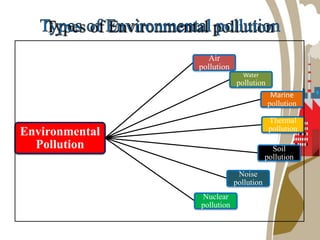
Environmental
Pollution
Air
pollution
Thermal
pollution
Nuclear
pollution
Soil
pollution
Noise
pollution
Water
pollution
Marine
pollution
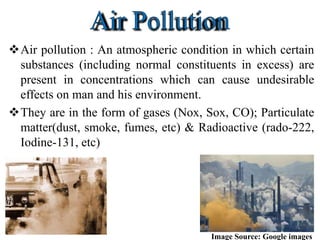
Air pollution : An atmospheric condition in which certain
substances (including normal constituents in excess) are
present in concentrations which can cause undesirable
effects on man and his environment.
They are in the form of gases (Nox, Sox, CO); Particulate
matter(dust, smoke, fumes, etc) & Radioactive (rado-222,
Iodine-131, etc)
Image Source: Google images
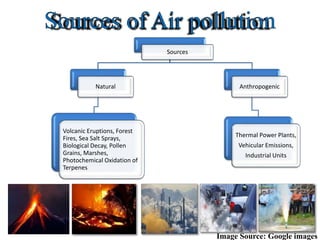
Sources
Natural
Volcanic Eruptions, Forest
Fires, Sea Salt Sprays,
Biological Decay, Pollen
Grains, Marshes,
Photochemical Oxidation of
Terpenes
Anthropogenic
Thermal Power Plants,
Vehicular Emissions,
Industrial Units
Image Source: Google images
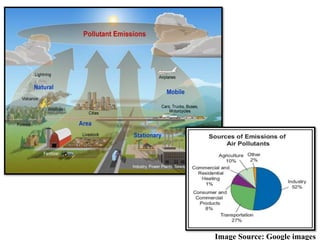
dDifferent sources of Pollution
Image Source: Google images
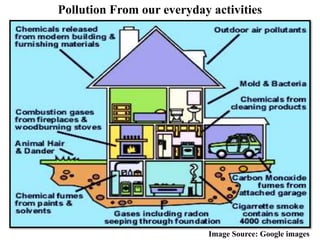
Pollution From our everyday activities
Effect on Human health
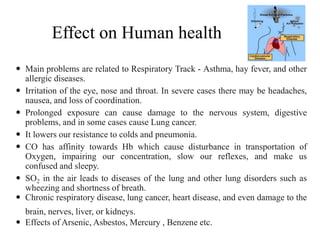
 Main problems are related to Respiratory Track - Asthma, hay fever, and other
allergic diseases.
 Irritation of the eye, nose and throat. In severe cases there may be headaches,
nausea, and loss of coordination.
 Prolonged exposure can cause damage to the nervous system, digestive
problems, and in some cases cause Lung cancer.
 It lowers our resistance to colds and pneumonia.
 CO has affinity towards Hb which cause disturbance in transportation of
Oxygen, impairing our concentration, slow our reflexes, and make us
confused and sleepy.
 SO2 in the air leads to diseases of the lung and other lung disorders such as
wheezing and shortness of breath.
 Chronic respiratory disease, lung cancer, heart disease, and even damage to the
brain, nerves, liver, or kidneys.
 Effects of Arsenic, Asbestos, Mercury , Benzene etc.
Effect on Plants
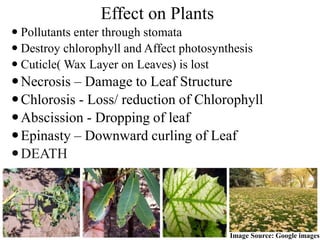
 Pollutants enter through stomata
 Destroy chlorophyll and Affect photosynthesis
 Cuticle( Wax Layer on Leaves) is lost
Necrosis – Damage to Leaf Structure
Chlorosis - Loss/ reduction of Chlorophyll
Abscission - Dropping of leaf
Epinasty – Downward curling of Leaf
DEATH
Image Source: Google images
Effect on Animals and materials
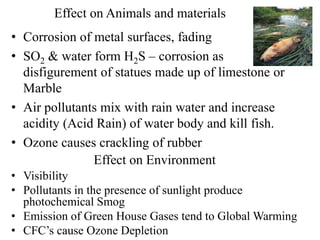
• Corrosion of metal surfaces, fading
• SO2 & water form H2S – corrosion as well as
disfigurement of statues made up of limestone or
Marble
• Air pollutants mix with rain water and increase
acidity (Acid Rain) of water body and kill fish.
• Ozone causes crackling of rubber
Effect on Environment
• Visibility
• Pollutants in the presence of sunlight produce
photochemical Smog
• Emission of Green House Gases tend to Global Warming
• CFC’s cause Ozone Depletion
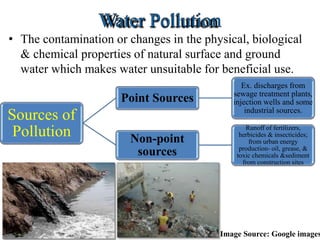
• The contamination or changes in the physical, biological
& chemical properties of natural surface and ground
water which makes water unsuitable for beneficial use.
Sources of
Pollution
Point Sources
Ex. discharges from
sewage treatment plants,
injection wells and some
industrial sources.
Non-point
sources
Runoff of fertilizers,
herbicides & insecticides;
from urban energy
production- oil, grease, &
toxic chemicals &sediment
from construction sites
Image Source: Google images
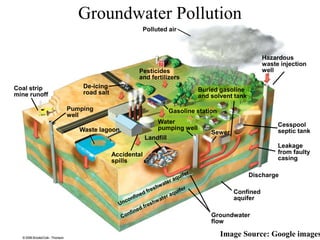
Coal strip
mine runoff
Pumping
well
Waste lagoon
Accidental
spills
Groundwater
flow
Confined
aquifer
Discharge
Leakage
from faulty
casing
Hazardous
waste injection
wellPesticides
and fertilizers
Gasoline station
Buried gasoline
and solvent tank
Sewer
Cesspool
septic tank
De-icing
road salt
Water
pumping well
Landfill
Polluted air
Groundwater Pollution
Image Source: Google images
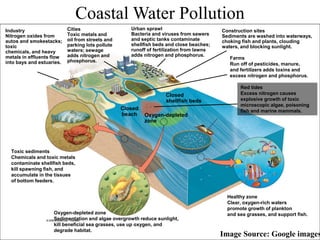
Industry
Nitrogen oxides from
autos and smokestacks;
toxic
chemicals, and heavy
metals in effluents flow
into bays and estuaries.
Cities
Toxic metals and
oil from streets and
parking lots pollute
waters; sewage
adds nitrogen and
phosphorus.
Urban sprawl
Bacteria and viruses from sewers
and septic tanks contaminate
shellfish beds and close beaches;
runoff of fertilization from lawns
adds nitrogen and phosphorus.
Construction sites
Sediments are washed into waterways,
choking fish and plants, clouding
waters, and blocking sunlight.
Farms
Run off of pesticides, manure,
and fertilizers adds toxins and
excess nitrogen and phosphorus.
Red tides
Excess nitrogen causes
explosive growth of toxic
microscopic algae, poisoning
fish and marine mammals.
Healthy zone
Clear, oxygen-rich waters
promote growth of plankton
and sea grasses, and support fish.
Toxic sediments
Chemicals and toxic metals
contaminate shellfish beds,
kill spawning fish, and
accumulate in the tissues
of bottom feeders.
Closed
shellfish beds
Closed
beach Oxygen-depleted
zone
Coastal Water Pollution
Oxygen-depleted zone
Sedimentation and algae overgrowth reduce sunlight,
kill beneficial sea grasses, use up oxygen, and
degrade habitat.
Image Source: Google images
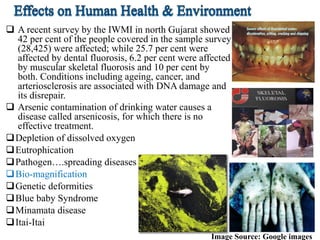
 A recent survey by the IWMI in north Gujarat showed
42 per cent of the people covered in the sample survey
(28,425) were affected; while 25.7 per cent were
affected by dental fluorosis, 6.2 per cent were affected
by muscular skeletal fluorosis and 10 per cent by
both. Conditions including ageing, cancer, and
arteriosclerosis are associated with DNA damage and
its disrepair.
 Arsenic contamination of drinking water causes a
disease called arsenicosis, for which there is no
effective treatment.
Depletion of dissolved oxygen
Eutrophication
Pathogen….spreading diseases
Bio-magnification
Genetic deformities
Blue baby Syndrome
Minamata disease
Itai-Itai
Image Source: Google images
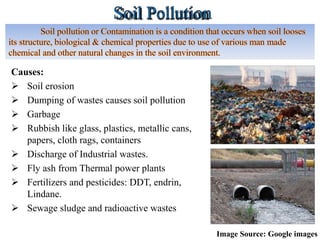
Causes:
 Soil erosion
 Dumping of wastes causes soil pollution
 Garbage
 Rubbish like glass, plastics, metallic cans,
papers, cloth rags, containers
 Discharge of Industrial wastes.
 Fly ash from Thermal power plants
 Fertilizers and pesticides: DDT, endrin,
Lindane.
 Sewage sludge and radioactive wastes
Image Source: Google images
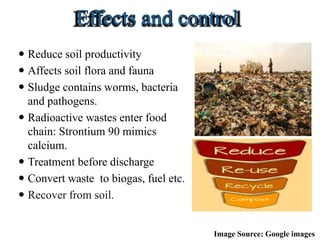
 Reduce soil productivity
 Affects soil flora and fauna
 Sludge contains worms, bacteria
and pathogens.
 Radioactive wastes enter food
chain: Strontium 90 mimics
calcium.
 Treatment before discharge
 Convert waste to biogas, fuel etc.
 Recover from soil.
Image Source: Google images
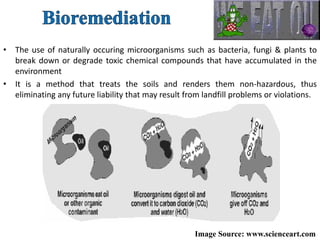
• The use of naturally occuring microorganisms such as bacteria, fungi & plants to
break down or degrade toxic chemical compounds that have accumulated in the
environment
• It is a method that treats the soils and renders them non-hazardous, thus
eliminating any future liability that may result from landfill problems or violations.
Image Source: www.scienceart.com
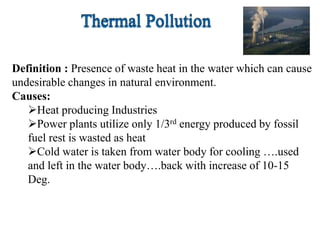
Definition : Presence of waste heat in the water which can cause
undesirable changes in natural environment.
Causes:
Heat producing Industries
Power plants utilize only 1/3rd energy produced by fossil
fuel rest is wasted as heat
Cold water is taken from water body for cooling ….used
and left in the water body….back with increase of 10-15
Deg.
Thermal Pollution Effects…?
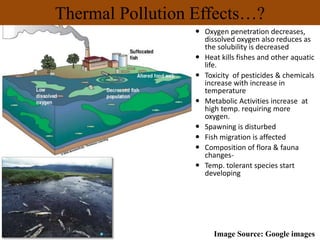
 Oxygen penetration decreases,
dissolved oxygen also reduces as
the solubility is decreased
 Heat kills fishes and other aquatic
life.
 Toxicity of pesticides & chemicals
increase with increase in
temperature
 Metabolic Activities increase at
high temp. requiring more
oxygen.
 Spawning is disturbed
 Fish migration is affected
 Composition of flora & fauna
changes-
 Temp. tolerant species start
developing
Image Source: Google images
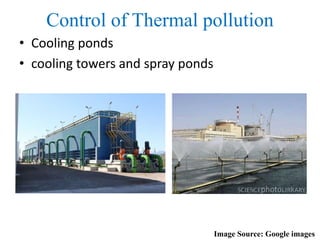
Control of Thermal pollution
• Cooling ponds
• cooling towers and spray ponds
Image Source: Google images
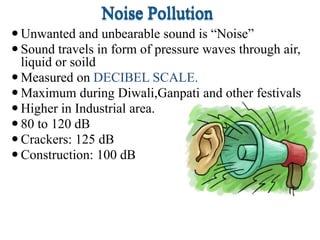
 Unwanted and unbearable sound is “Noise”
 Sound travels in form of pressure waves through air,
liquid or soild
 Measured on DECIBEL SCALE.
 Maximum during Diwali,Ganpati and other festivals
 Higher in Industrial area.
 80 to 120 dB
 Crackers: 125 dB
 Construction: 100 dB
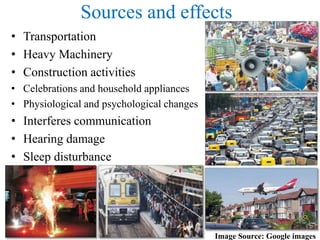
Sources and effects
• Transportation
• Heavy Machinery
• Construction activities
• Celebrations and household appliances
• Physiological and psychological changes
• Interferes communication
• Hearing damage
• Sleep disturbance
Image Source: Google images
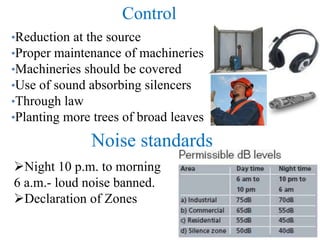
Control
•Reduction at the source
•Proper maintenance of machineries
•Machineries should be covered
•Use of sound absorbing silencers
•Through law
•Planting more trees of broad leaves
Noise standards
Night 10 p.m. to morning
6 a.m.- loud noise banned.
Declaration of Zones
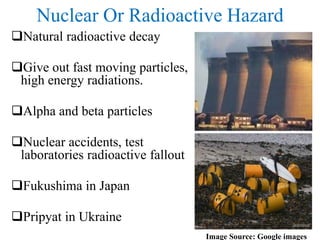
Nuclear Or Radioactive Hazard
Natural radioactive decay
Give out fast moving particles,
high energy radiations.
Alpha and beta particles
Nuclear accidents, test
laboratories radioactive fallout
Fukushima in Japan
Pripyat in Ukraine
Image Source: Google images
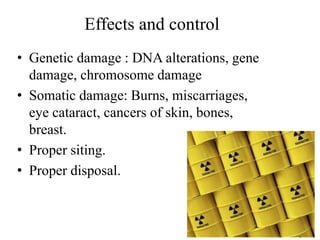
Effects and control
• Genetic damage : DNA alterations, gene
damage, chromosome damage
• Somatic damage: Burns, miscarriages,
eye cataract, cancers of skin, bones,
breast.
• Proper siting.
• Proper disposal.
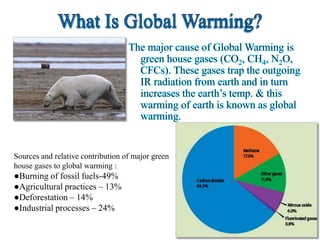
Sources and relative contribution of major green
house gases to global warming :
●Burning of fossil fuels-49%
●Agricultural practices – 13%
●Deforestation – 14%
●Industrial processes – 24%
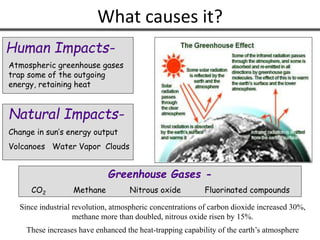
What causes it?
Human Impacts-
Atmospheric greenhouse gases
trap some of the outgoing
energy, retaining heat
Since industrial revolution, atmospheric concentrations of carbon dioxide increased 30%,
methane more than doubled, nitrous oxide risen by 15%.
These increases have enhanced the heat-trapping capability of the earth’s atmosphere
Greenhouse Gases -
CO2 Methane Nitrous oxide Fluorinated compounds
Natural Impacts-
Change in sun’s energy output
Volcanoes Water Vapor Clouds
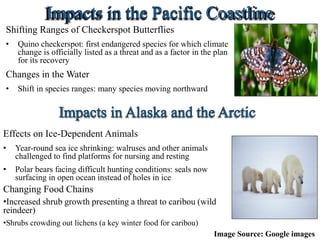
Shifting Ranges of Checkerspot Butterflies
• Quino checkerspot: first endangered species for which climate
change is officially listed as a threat and as a factor in the plan
for its recovery
Changes in the Water
• Shift in species ranges: many species moving northward
Effects on Ice-Dependent Animals
• Year-round sea ice shrinking: walruses and other animals
challenged to find platforms for nursing and resting
• Polar bears facing difficult hunting conditions: seals now
surfacing in open ocean instead of holes in ice
Changing Food Chains
•Increased shrub growth presenting a threat to caribou (wild
reindeer)
•Shrubs crowding out lichens (a key winter food for caribou)
Image Source: Google images
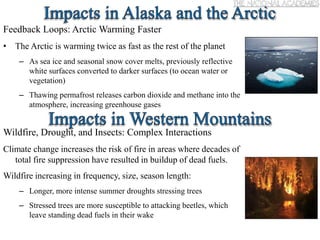
Feedback Loops: Arctic Warming Faster
• The Arctic is warming twice as fast as the rest of the planet
– As sea ice and seasonal snow cover melts, previously reflective
white surfaces converted to darker surfaces (to ocean water or
vegetation)
– Thawing permafrost releases carbon dioxide and methane into the
atmosphere, increasing greenhouse gases
Wildfire, Drought, and Insects: Complex Interactions
Climate change increases the risk of fire in areas where decades of
total fire suppression have resulted in buildup of dead fuels.
Wildfire increasing in frequency, size, season length:
– Longer, more intense summer droughts stressing trees
– Stressed trees are more susceptible to attacking beetles, which
leave standing dead fuels in their wake
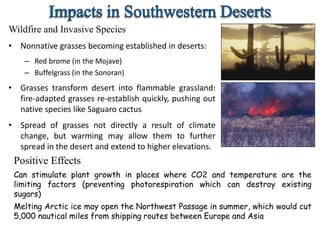
Wildfire and Invasive Species
• Nonnative grasses becoming established in deserts:
– Red brome (in the Mojave)
– Buffelgrass (in the Sonoran)
• Grasses transform desert into flammable grassland:
fire-adapted grasses re-establish quickly, pushing out
native species like Saguaro cactus
• Spread of grasses not directly a result of climate
change, but warming may allow them to further
spread in the desert and extend to higher elevations.
Positive Effects
Can stimulate plant growth in places where CO2 and temperature are the
limiting factors (preventing photorespiration which can destroy existing
sugars)
Melting Arctic ice may open the Northwest Passage in summer, which would cut
5,000 nautical miles from shipping routes between Europe and Asia
Kyoto Protocol
• 1997, Kyoto, Japan  developed countries
agreed to specific targets for cutting their
emissions of greenhouse gases
• Industrialized countries committed to an overall
reduction of emissions of greenhouse gases to
5.2% below 1990 levels for the period 2008 -
2012
• Objective is the stabilization of greenhouse gas
concentrations in the atmosphere at a level that
would prevent dangerous anthropogenic
interference with the climate system
So how can each of us slow global
warming now?
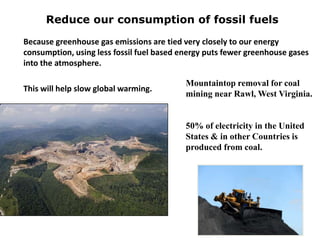
Because greenhouse gas emissions are tied very closely to our energy
consumption, using less fossil fuel based energy puts fewer greenhouse gases
into the atmosphere.
This will help slow global warming.
Reduce our consumption of fossil fuels
Mountaintop removal for coal
mining near Rawl, West Virginia.
50% of electricity in the United
States & in other Countries is
produced from coal.
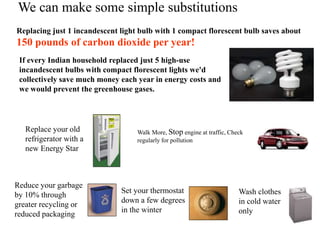
We can make some simple substitutions
Replacing just 1 incandescent light bulb with 1 compact florescent bulb saves about
150 pounds of carbon dioxide per year!
If every Indian household replaced just 5 high-use
incandescent bulbs with compact florescent lights we'd
collectively save much money each year in energy costs and
we would prevent the greenhouse gases.
Replace your old
refrigerator with a
new Energy Star
Walk More, Stop engine at traffic, Check
regularly for pollution
Reduce your garbage
by 10% through
greater recycling or
reduced packaging
Set your thermostat
down a few degrees
in the winter
Wash clothes
in cold water
only
Conclusion
• Global Change is multifaceted (climate, nitrogen, land use, invasive, biodiversity,
air quality, etc.)
• The greenhouse effect is a natural process which is necessary to maintain living
conditions on the planet
• However, the natural planetary greenhouse effect has been augmented by human
activities, including primarily fossil fuel use and deforestation.
• Responsibility to improve environmental conditions lies upon all of us as
individuals
• Concentrate on preventing environmental degradation before it starts
• Alternatives are feasible and can be used
• Global warming is affecting plants, animals, humans and the earth. We need to
learn how to conserve our use of fossil fuels to minimize carbon dioxide
production. This will slow down the effects of global warming
Thank you?

Environmental pollution & global warming

  • 1.
    M.Sc. 3rd Semester,Life Science(Botany) Dept. of Life Science & Bioinformatics, AUS
  • 3.
  • 4.
    Air pollution :An atmospheric condition in which certain substances (including normal constituents in excess) are present in concentrations which can cause undesirable effects on man and his environment. They are in the form of gases (Nox, Sox, CO); Particulate matter(dust, smoke, fumes, etc) & Radioactive (rado-222, Iodine-131, etc) Image Source: Google images
  • 5.
    Sources Natural Volcanic Eruptions, Forest Fires,Sea Salt Sprays, Biological Decay, Pollen Grains, Marshes, Photochemical Oxidation of Terpenes Anthropogenic Thermal Power Plants, Vehicular Emissions, Industrial Units Image Source: Google images
  • 6.
  • 7.
    dDifferent sources ofPollution Image Source: Google images Pollution From our everyday activities
  • 8.
    Effect on Humanhealth  Main problems are related to Respiratory Track - Asthma, hay fever, and other allergic diseases.  Irritation of the eye, nose and throat. In severe cases there may be headaches, nausea, and loss of coordination.  Prolonged exposure can cause damage to the nervous system, digestive problems, and in some cases cause Lung cancer.  It lowers our resistance to colds and pneumonia.  CO has affinity towards Hb which cause disturbance in transportation of Oxygen, impairing our concentration, slow our reflexes, and make us confused and sleepy.  SO2 in the air leads to diseases of the lung and other lung disorders such as wheezing and shortness of breath.  Chronic respiratory disease, lung cancer, heart disease, and even damage to the brain, nerves, liver, or kidneys.  Effects of Arsenic, Asbestos, Mercury , Benzene etc.
  • 9.
    Effect on Plants Pollutants enter through stomata  Destroy chlorophyll and Affect photosynthesis  Cuticle( Wax Layer on Leaves) is lost Necrosis – Damage to Leaf Structure Chlorosis - Loss/ reduction of Chlorophyll Abscission - Dropping of leaf Epinasty – Downward curling of Leaf DEATH Image Source: Google images
  • 10.
    Effect on Animalsand materials • Corrosion of metal surfaces, fading • SO2 & water form H2S – corrosion as well as disfigurement of statues made up of limestone or Marble • Air pollutants mix with rain water and increase acidity (Acid Rain) of water body and kill fish. • Ozone causes crackling of rubber Effect on Environment • Visibility • Pollutants in the presence of sunlight produce photochemical Smog • Emission of Green House Gases tend to Global Warming • CFC’s cause Ozone Depletion
  • 11.
    • The contaminationor changes in the physical, biological & chemical properties of natural surface and ground water which makes water unsuitable for beneficial use. Sources of Pollution Point Sources Ex. discharges from sewage treatment plants, injection wells and some industrial sources. Non-point sources Runoff of fertilizers, herbicides & insecticides; from urban energy production- oil, grease, & toxic chemicals &sediment from construction sites Image Source: Google images
  • 12.
    Coal strip mine runoff Pumping well Wastelagoon Accidental spills Groundwater flow Confined aquifer Discharge Leakage from faulty casing Hazardous waste injection wellPesticides and fertilizers Gasoline station Buried gasoline and solvent tank Sewer Cesspool septic tank De-icing road salt Water pumping well Landfill Polluted air Groundwater Pollution Image Source: Google images
  • 13.
    Industry Nitrogen oxides from autosand smokestacks; toxic chemicals, and heavy metals in effluents flow into bays and estuaries. Cities Toxic metals and oil from streets and parking lots pollute waters; sewage adds nitrogen and phosphorus. Urban sprawl Bacteria and viruses from sewers and septic tanks contaminate shellfish beds and close beaches; runoff of fertilization from lawns adds nitrogen and phosphorus. Construction sites Sediments are washed into waterways, choking fish and plants, clouding waters, and blocking sunlight. Farms Run off of pesticides, manure, and fertilizers adds toxins and excess nitrogen and phosphorus. Red tides Excess nitrogen causes explosive growth of toxic microscopic algae, poisoning fish and marine mammals. Healthy zone Clear, oxygen-rich waters promote growth of plankton and sea grasses, and support fish. Toxic sediments Chemicals and toxic metals contaminate shellfish beds, kill spawning fish, and accumulate in the tissues of bottom feeders. Closed shellfish beds Closed beach Oxygen-depleted zone Coastal Water Pollution Oxygen-depleted zone Sedimentation and algae overgrowth reduce sunlight, kill beneficial sea grasses, use up oxygen, and degrade habitat. Image Source: Google images
  • 14.
     A recentsurvey by the IWMI in north Gujarat showed 42 per cent of the people covered in the sample survey (28,425) were affected; while 25.7 per cent were affected by dental fluorosis, 6.2 per cent were affected by muscular skeletal fluorosis and 10 per cent by both. Conditions including ageing, cancer, and arteriosclerosis are associated with DNA damage and its disrepair.  Arsenic contamination of drinking water causes a disease called arsenicosis, for which there is no effective treatment. Depletion of dissolved oxygen Eutrophication Pathogen….spreading diseases Bio-magnification Genetic deformities Blue baby Syndrome Minamata disease Itai-Itai Image Source: Google images
  • 15.
    Causes:  Soil erosion Dumping of wastes causes soil pollution  Garbage  Rubbish like glass, plastics, metallic cans, papers, cloth rags, containers  Discharge of Industrial wastes.  Fly ash from Thermal power plants  Fertilizers and pesticides: DDT, endrin, Lindane.  Sewage sludge and radioactive wastes Image Source: Google images
  • 16.
     Reduce soilproductivity  Affects soil flora and fauna  Sludge contains worms, bacteria and pathogens.  Radioactive wastes enter food chain: Strontium 90 mimics calcium.  Treatment before discharge  Convert waste to biogas, fuel etc.  Recover from soil. Image Source: Google images
  • 17.
    • The useof naturally occuring microorganisms such as bacteria, fungi & plants to break down or degrade toxic chemical compounds that have accumulated in the environment • It is a method that treats the soils and renders them non-hazardous, thus eliminating any future liability that may result from landfill problems or violations. Image Source: www.scienceart.com
  • 18.
    Definition : Presenceof waste heat in the water which can cause undesirable changes in natural environment. Causes: Heat producing Industries Power plants utilize only 1/3rd energy produced by fossil fuel rest is wasted as heat Cold water is taken from water body for cooling ….used and left in the water body….back with increase of 10-15 Deg.
  • 19.
    Thermal Pollution Effects…? Oxygen penetration decreases, dissolved oxygen also reduces as the solubility is decreased  Heat kills fishes and other aquatic life.  Toxicity of pesticides & chemicals increase with increase in temperature  Metabolic Activities increase at high temp. requiring more oxygen.  Spawning is disturbed  Fish migration is affected  Composition of flora & fauna changes-  Temp. tolerant species start developing Image Source: Google images
  • 20.
    Control of Thermalpollution • Cooling ponds • cooling towers and spray ponds Image Source: Google images
  • 21.
     Unwanted andunbearable sound is “Noise”  Sound travels in form of pressure waves through air, liquid or soild  Measured on DECIBEL SCALE.  Maximum during Diwali,Ganpati and other festivals  Higher in Industrial area.  80 to 120 dB  Crackers: 125 dB  Construction: 100 dB
  • 22.
    Sources and effects •Transportation • Heavy Machinery • Construction activities • Celebrations and household appliances • Physiological and psychological changes • Interferes communication • Hearing damage • Sleep disturbance Image Source: Google images
  • 23.
    Control •Reduction at thesource •Proper maintenance of machineries •Machineries should be covered •Use of sound absorbing silencers •Through law •Planting more trees of broad leaves Noise standards Night 10 p.m. to morning 6 a.m.- loud noise banned. Declaration of Zones
  • 24.
    Nuclear Or RadioactiveHazard Natural radioactive decay Give out fast moving particles, high energy radiations. Alpha and beta particles Nuclear accidents, test laboratories radioactive fallout Fukushima in Japan Pripyat in Ukraine Image Source: Google images
  • 25.
    Effects and control •Genetic damage : DNA alterations, gene damage, chromosome damage • Somatic damage: Burns, miscarriages, eye cataract, cancers of skin, bones, breast. • Proper siting. • Proper disposal.
  • 26.
    Sources and relativecontribution of major green house gases to global warming : ●Burning of fossil fuels-49% ●Agricultural practices – 13% ●Deforestation – 14% ●Industrial processes – 24%
  • 27.
    What causes it? HumanImpacts- Atmospheric greenhouse gases trap some of the outgoing energy, retaining heat Since industrial revolution, atmospheric concentrations of carbon dioxide increased 30%, methane more than doubled, nitrous oxide risen by 15%. These increases have enhanced the heat-trapping capability of the earth’s atmosphere Greenhouse Gases - CO2 Methane Nitrous oxide Fluorinated compounds Natural Impacts- Change in sun’s energy output Volcanoes Water Vapor Clouds
  • 28.
    Shifting Ranges ofCheckerspot Butterflies • Quino checkerspot: first endangered species for which climate change is officially listed as a threat and as a factor in the plan for its recovery Changes in the Water • Shift in species ranges: many species moving northward Effects on Ice-Dependent Animals • Year-round sea ice shrinking: walruses and other animals challenged to find platforms for nursing and resting • Polar bears facing difficult hunting conditions: seals now surfacing in open ocean instead of holes in ice Changing Food Chains •Increased shrub growth presenting a threat to caribou (wild reindeer) •Shrubs crowding out lichens (a key winter food for caribou) Image Source: Google images
  • 29.
    Feedback Loops: ArcticWarming Faster • The Arctic is warming twice as fast as the rest of the planet – As sea ice and seasonal snow cover melts, previously reflective white surfaces converted to darker surfaces (to ocean water or vegetation) – Thawing permafrost releases carbon dioxide and methane into the atmosphere, increasing greenhouse gases Wildfire, Drought, and Insects: Complex Interactions Climate change increases the risk of fire in areas where decades of total fire suppression have resulted in buildup of dead fuels. Wildfire increasing in frequency, size, season length: – Longer, more intense summer droughts stressing trees – Stressed trees are more susceptible to attacking beetles, which leave standing dead fuels in their wake
  • 30.
    Wildfire and InvasiveSpecies • Nonnative grasses becoming established in deserts: – Red brome (in the Mojave) – Buffelgrass (in the Sonoran) • Grasses transform desert into flammable grassland: fire-adapted grasses re-establish quickly, pushing out native species like Saguaro cactus • Spread of grasses not directly a result of climate change, but warming may allow them to further spread in the desert and extend to higher elevations. Positive Effects Can stimulate plant growth in places where CO2 and temperature are the limiting factors (preventing photorespiration which can destroy existing sugars) Melting Arctic ice may open the Northwest Passage in summer, which would cut 5,000 nautical miles from shipping routes between Europe and Asia
  • 31.
    Kyoto Protocol • 1997,Kyoto, Japan  developed countries agreed to specific targets for cutting their emissions of greenhouse gases • Industrialized countries committed to an overall reduction of emissions of greenhouse gases to 5.2% below 1990 levels for the period 2008 - 2012 • Objective is the stabilization of greenhouse gas concentrations in the atmosphere at a level that would prevent dangerous anthropogenic interference with the climate system
  • 32.
    So how caneach of us slow global warming now?
  • 33.
    Because greenhouse gasemissions are tied very closely to our energy consumption, using less fossil fuel based energy puts fewer greenhouse gases into the atmosphere. This will help slow global warming. Reduce our consumption of fossil fuels Mountaintop removal for coal mining near Rawl, West Virginia. 50% of electricity in the United States & in other Countries is produced from coal.
  • 34.
    We can makesome simple substitutions Replacing just 1 incandescent light bulb with 1 compact florescent bulb saves about 150 pounds of carbon dioxide per year! If every Indian household replaced just 5 high-use incandescent bulbs with compact florescent lights we'd collectively save much money each year in energy costs and we would prevent the greenhouse gases. Replace your old refrigerator with a new Energy Star Walk More, Stop engine at traffic, Check regularly for pollution Reduce your garbage by 10% through greater recycling or reduced packaging Set your thermostat down a few degrees in the winter Wash clothes in cold water only
  • 35.
    Conclusion • Global Changeis multifaceted (climate, nitrogen, land use, invasive, biodiversity, air quality, etc.) • The greenhouse effect is a natural process which is necessary to maintain living conditions on the planet • However, the natural planetary greenhouse effect has been augmented by human activities, including primarily fossil fuel use and deforestation. • Responsibility to improve environmental conditions lies upon all of us as individuals • Concentrate on preventing environmental degradation before it starts • Alternatives are feasible and can be used • Global warming is affecting plants, animals, humans and the earth. We need to learn how to conserve our use of fossil fuels to minimize carbon dioxide production. This will slow down the effects of global warming
  • 36.