Chapter 8:
System software
WITH MRSAEM
www.mrsaem.com | www.sirsaem.com | 1
A Level
System
software
Chapter
8
www.mrsaem.com | www.sirsaem.com | mrsaem@yahoo.com
2
A Level
System
software
Chapter
8
www.mrsaem.com | www.sirsaem.com | mrsaem@yahoo.com
3
A Level
System
software
Chapter
8
1.Process Management:
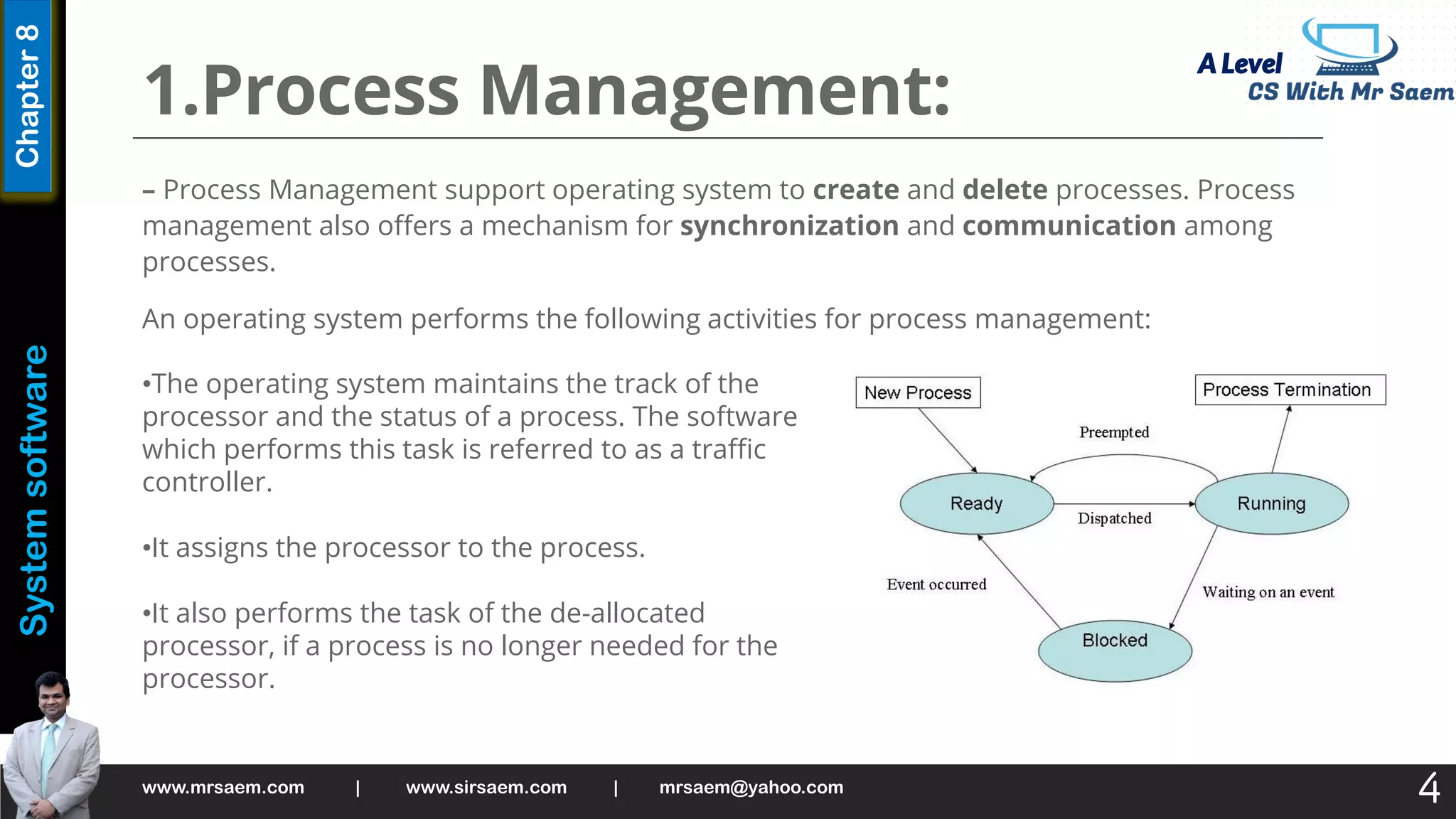
– Process Management support operating system to create and delete processes. Process
management also offers a mechanism for synchronization and communication among
processes.
An operating system performs the following activities for process management:
www.mrsaem.com | www.sirsaem.com | mrsaem@yahoo.com
4
•The operating system maintains the track of the
processor and the status of a process. The software
which performs this task is referred to as a traffic
controller.
•It assigns the processor to the process.
•It also performs the task of the de-allocated
processor, if a process is no longer needed for the
processor.
A Level
System
software
Chapter
8
2. Memory Management:
•Operating system helps to allocate the memory at the time when the process request for memory.
•If process no longer needs memory, then de-allocates the memory.
•In multiprogramming, the task of memory allocation to the processes is done with the help of
Operating System.
www.mrsaem.com | www.sirsaem.com | mrsaem@yahoo.com
5
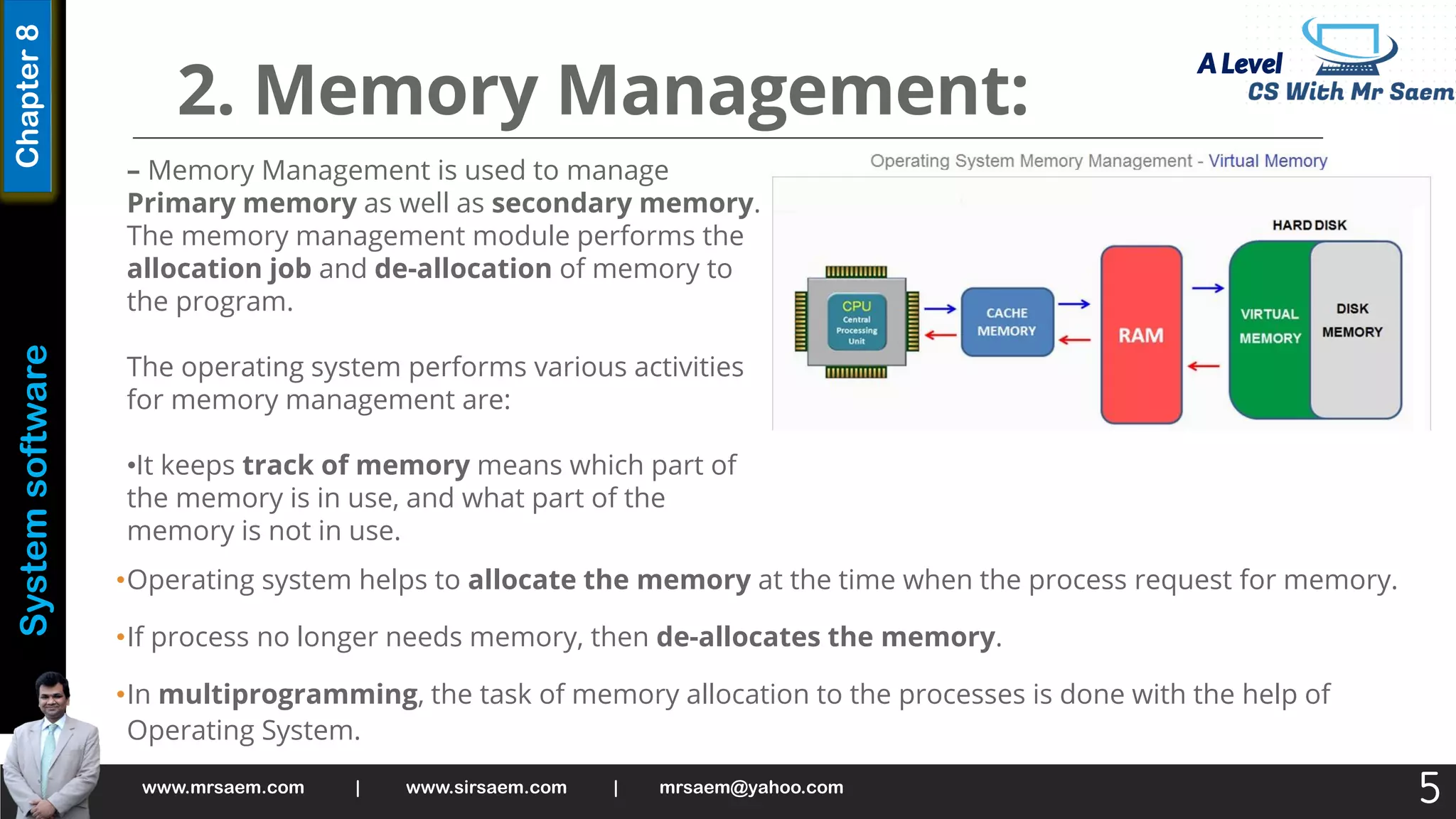
– Memory Management is used to manage
Primary memory as well as secondary memory.
The memory management module performs the
allocation job and de-allocation of memory to
the program.
The operating system performs various activities
for memory management are:
•It keeps track of memory means which part of
the memory is in use, and what part of the
memory is not in use.
A Level
System
software
Chapter
8
3. File Management:
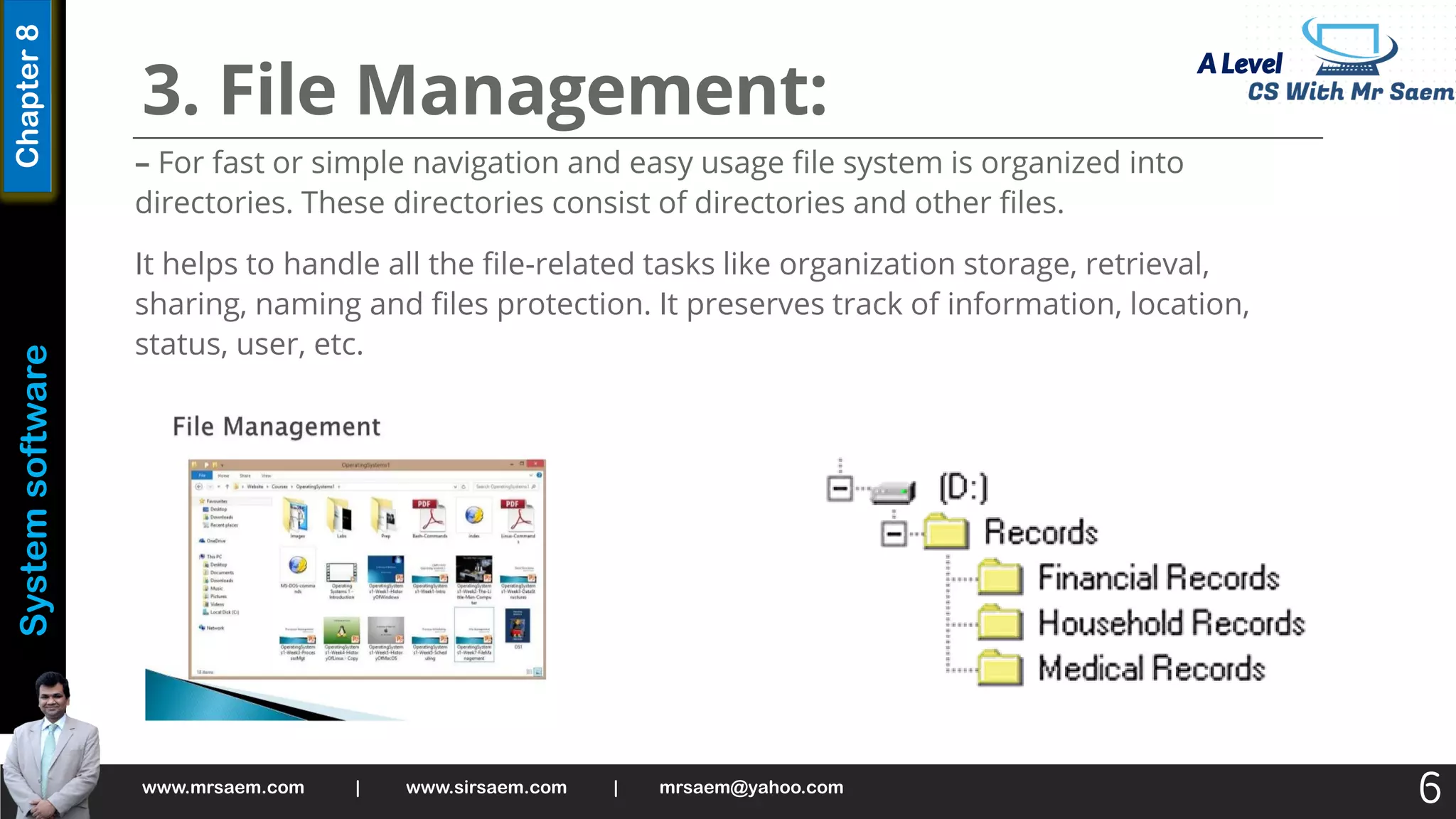
– For fast or simple navigation and easy usage file system is organized into
directories. These directories consist of directories and other files.
It helps to handle all the file-related tasks like organization storage, retrieval,
sharing, naming and files protection. It preserves track of information, location,
status, user, etc.
www.mrsaem.com | www.sirsaem.com | mrsaem@yahoo.com
6
A Level
System
software
Chapter
8
4. Device/ Hardware Management:
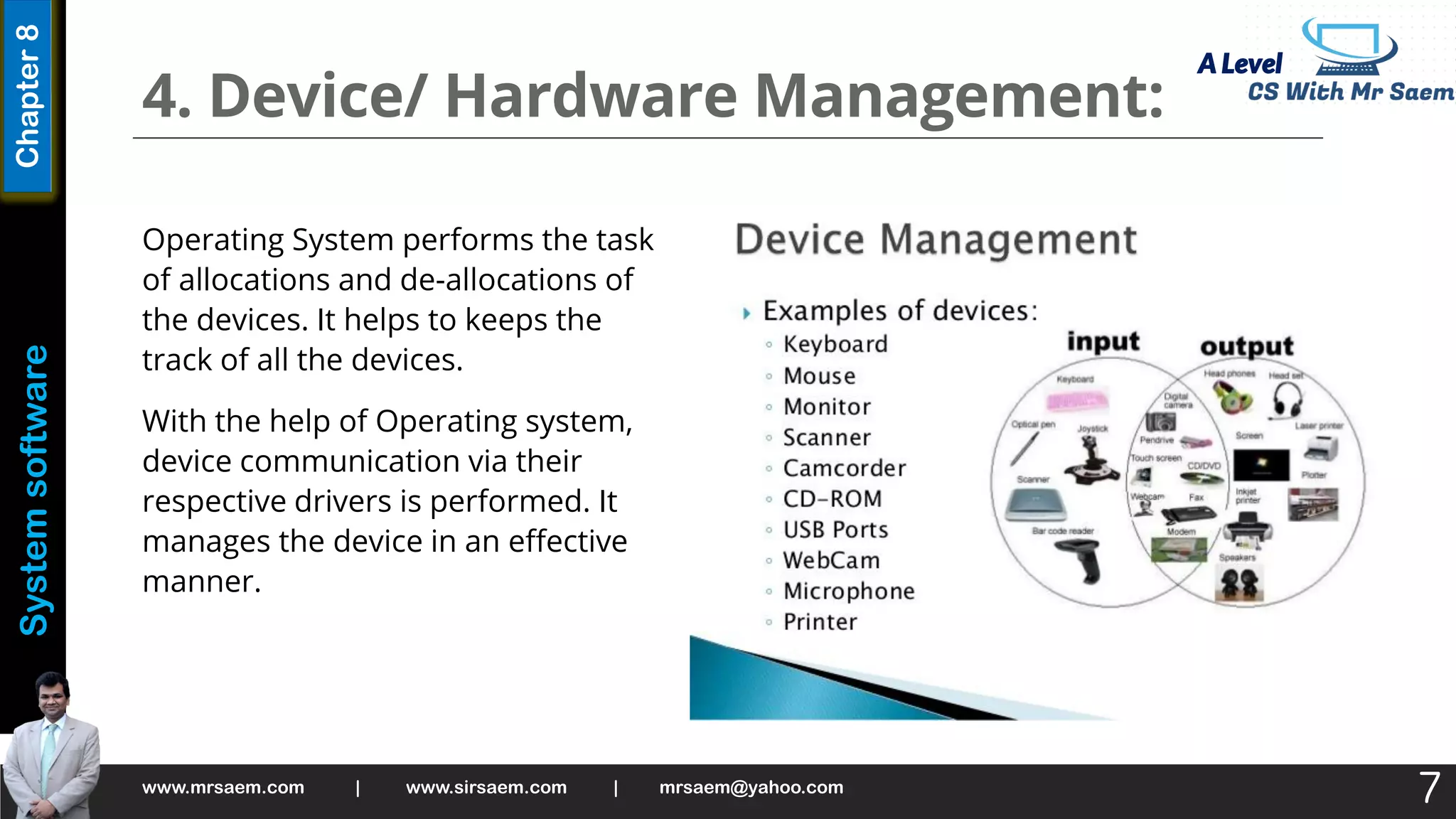
Operating System performs the task
of allocations and de-allocations of
the devices. It helps to keeps the
track of all the devices.
With the help of Operating system,
device communication via their
respective drivers is performed. It
manages the device in an effective
manner.
www.mrsaem.com | www.sirsaem.com | mrsaem@yahoo.com
7
A Level
System
software
Chapter
8
The functions of hardware management include • communicating with all input and output
devices using device drivers
• translating data from a file (defined by the operating system) into a format that the
input/output device can understand using device drivers
• ensuring each hardware resource has a priority so that it can be used and released as required.
The management of input/output devices is essentially the control and management of queues
and buffers. For example, when printing out a document, the printer management
• locates and loads the printer driver into memory
• sends data to a printer buffer ready for printing
• sends data to a printer queue (if the printer is busy or the print job has a low priority) before
sending to the printer buffer
• sends various control commands to the printer throughout the printing process • receives and
handles error messages and interrupts from the printer.
www.mrsaem.com | www.sirsaem.com | mrsaem@yahoo.com
8
A Level
System
software
Chapter
8
5. Secondary Storage Management:
– Operating System is responsible
for secondary storage management.
The System has various levels of
storage that consist of primary
storage, secondary storage, and
cache storage.
The set of instruction and data are
stored in primary memory or cache
memory so that the program which
is running can reference it.
www.mrsaem.com | www.sirsaem.com | mrsaem@yahoo.com
9
A Level
System
software
Chapter
8
6. Security:
Security management is another part of a typical operating system.
The function of security management is to ensure the integrity, confidentiality and availability of data. This can
be achieved by
• carrying out operating system updates as and when they become available
• ensuring that antivirus software (and other security software) is always up-to-date
• communicating with, for example, a firewall to check all traffic to and from the computer
• making use of privileges to prevent users entering ‘private areas’ on a computer which permits multi-user
activity (this is done by setting up user accounts and making use of passwords and user IDs)
. This helps to ensure the privacy of data
• maintaining access rights for all users
• offering the ability for the recovery of data (and system restore) when it has been lost or corrupted
• helping to prevent illegal intrusion to the computer system (also ensuring the privacy of data
www.mrsaem.com | www.sirsaem.com | mrsaem@yahoo.com
10
A Level
System
software
Chapter
8
www.mrsaem.com | www.sirsaem.com | mrsaem@yahoo.com
11
A Level
System
software
Chapter
8
7. Coordination between other software and user:
– The operating system also performs the task of coordination between other
software and users.
OS directs as well as allocates assemblers, interpreters, compilers, and other
software to different computer system users.
www.mrsaem.com | www.sirsaem.com | mrsaem@yahoo.com
12
A Level
System
software
Chapter
8
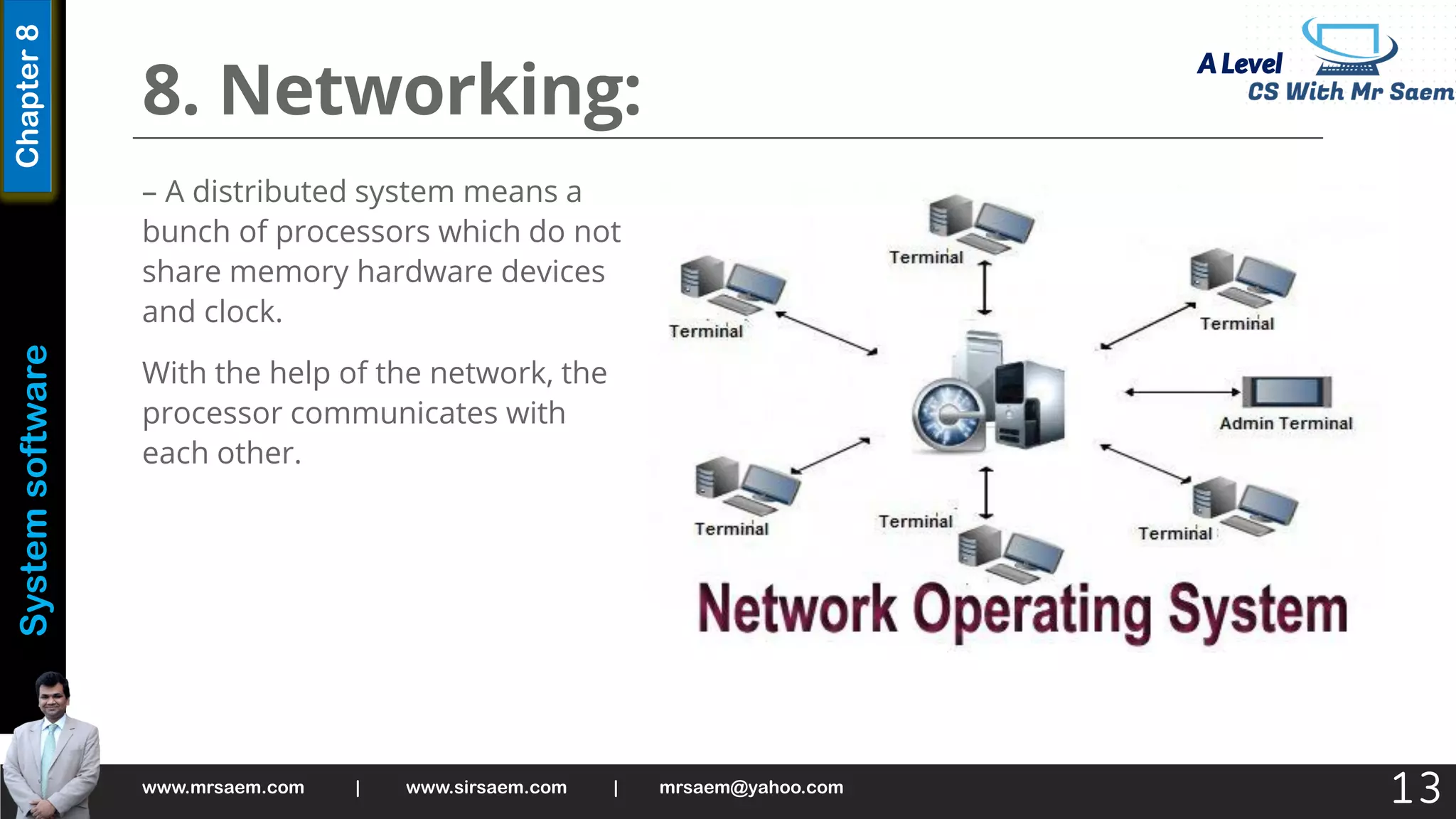
8. Networking:
– A distributed system means a
bunch of processors which do not
share memory hardware devices
and clock.
With the help of the network, the
processor communicates with
each other.
www.mrsaem.com | www.sirsaem.com | mrsaem@yahoo.com
13
A Level
System
software
Chapter
8
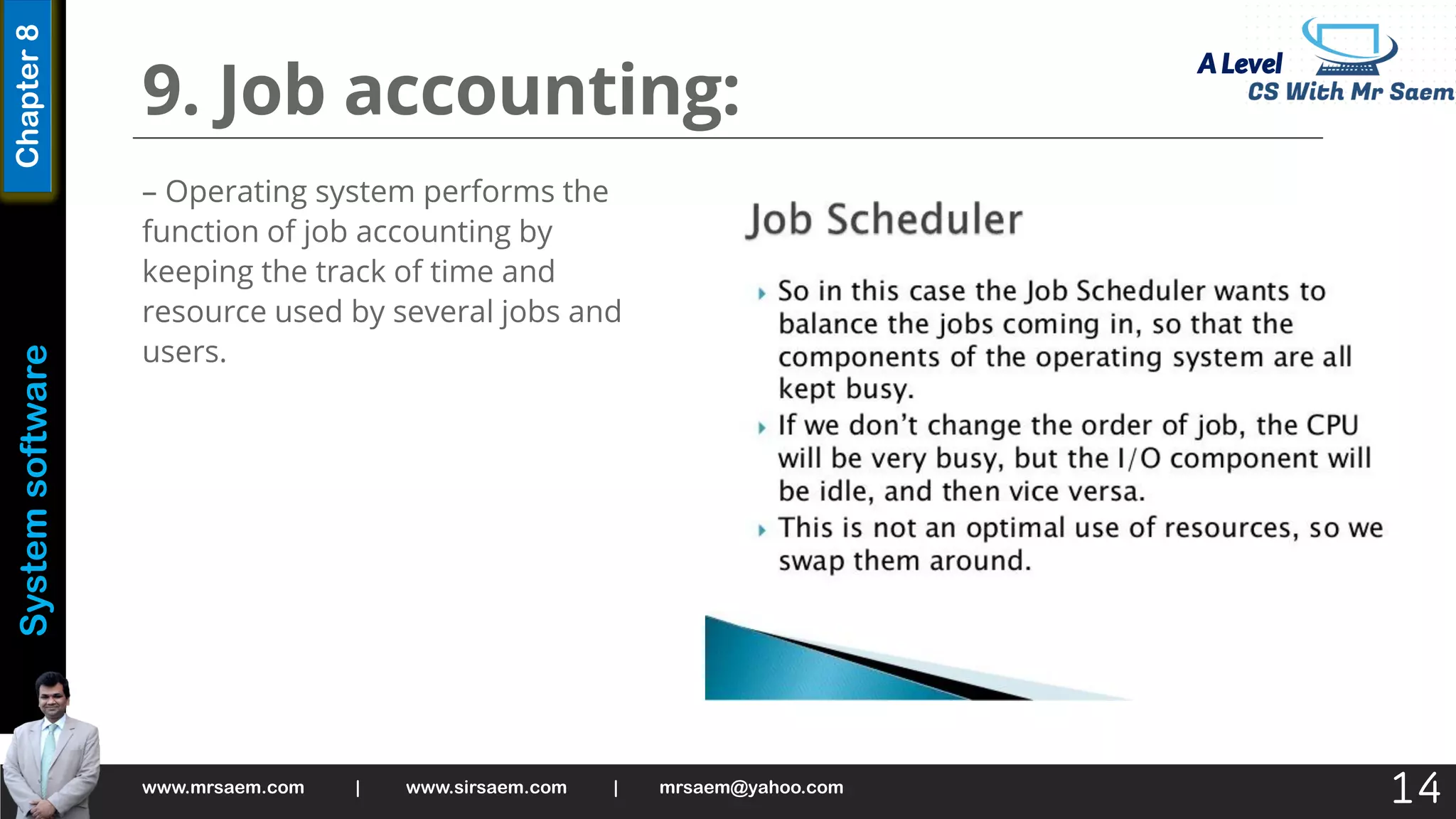
9. Job accounting:
– Operating system performs the
function of job accounting by
keeping the track of time and
resource used by several jobs and
users.
www.mrsaem.com | www.sirsaem.com | mrsaem@yahoo.com
14
A Level
System
software
Chapter
8
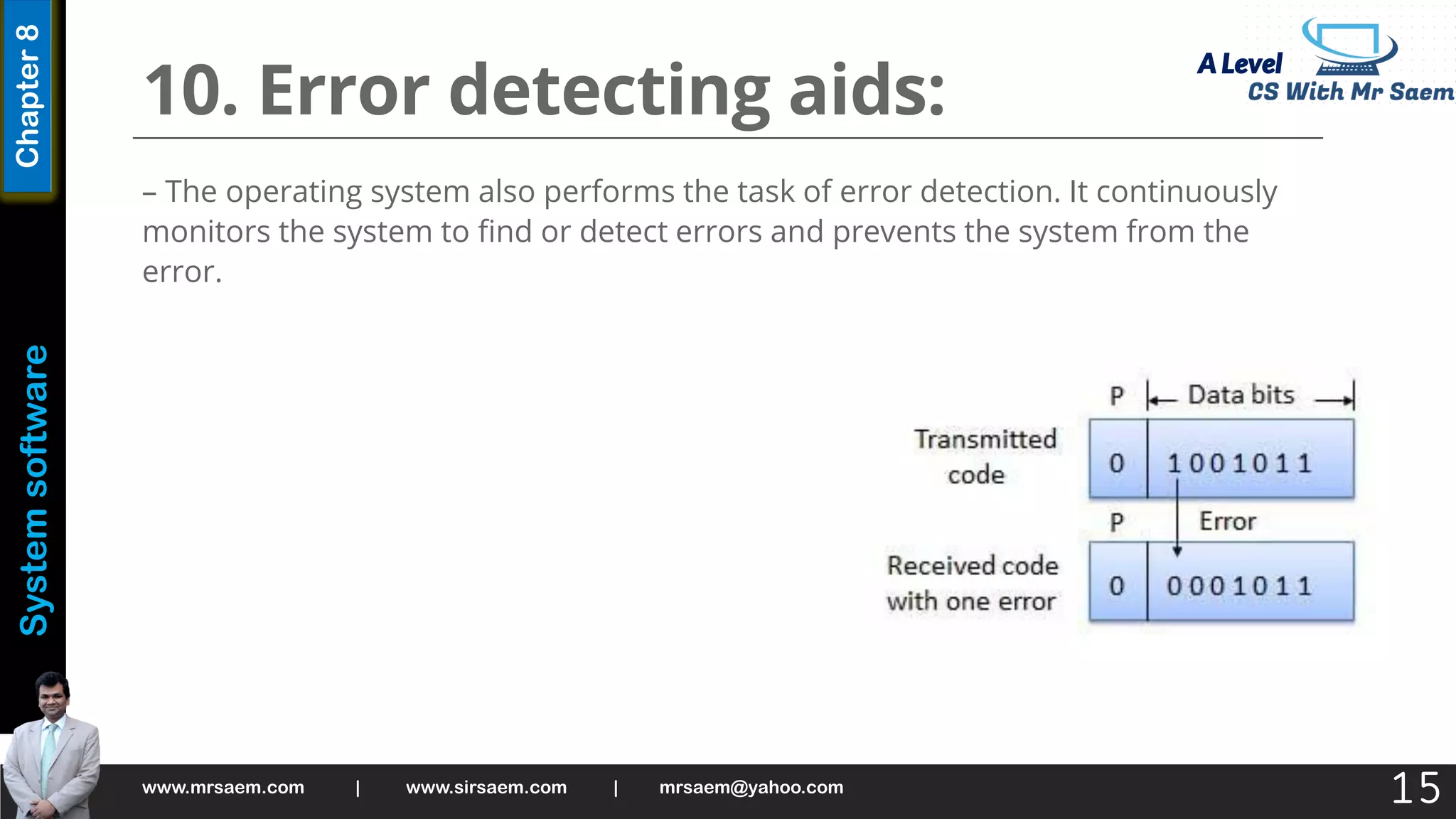
10. Error detecting aids:
– The operating system also performs the task of error detection. It continuously
monitors the system to find or detect errors and prevents the system from the
error.
www.mrsaem.com | www.sirsaem.com | mrsaem@yahoo.com
15
A Level
System
software
Chapter
8
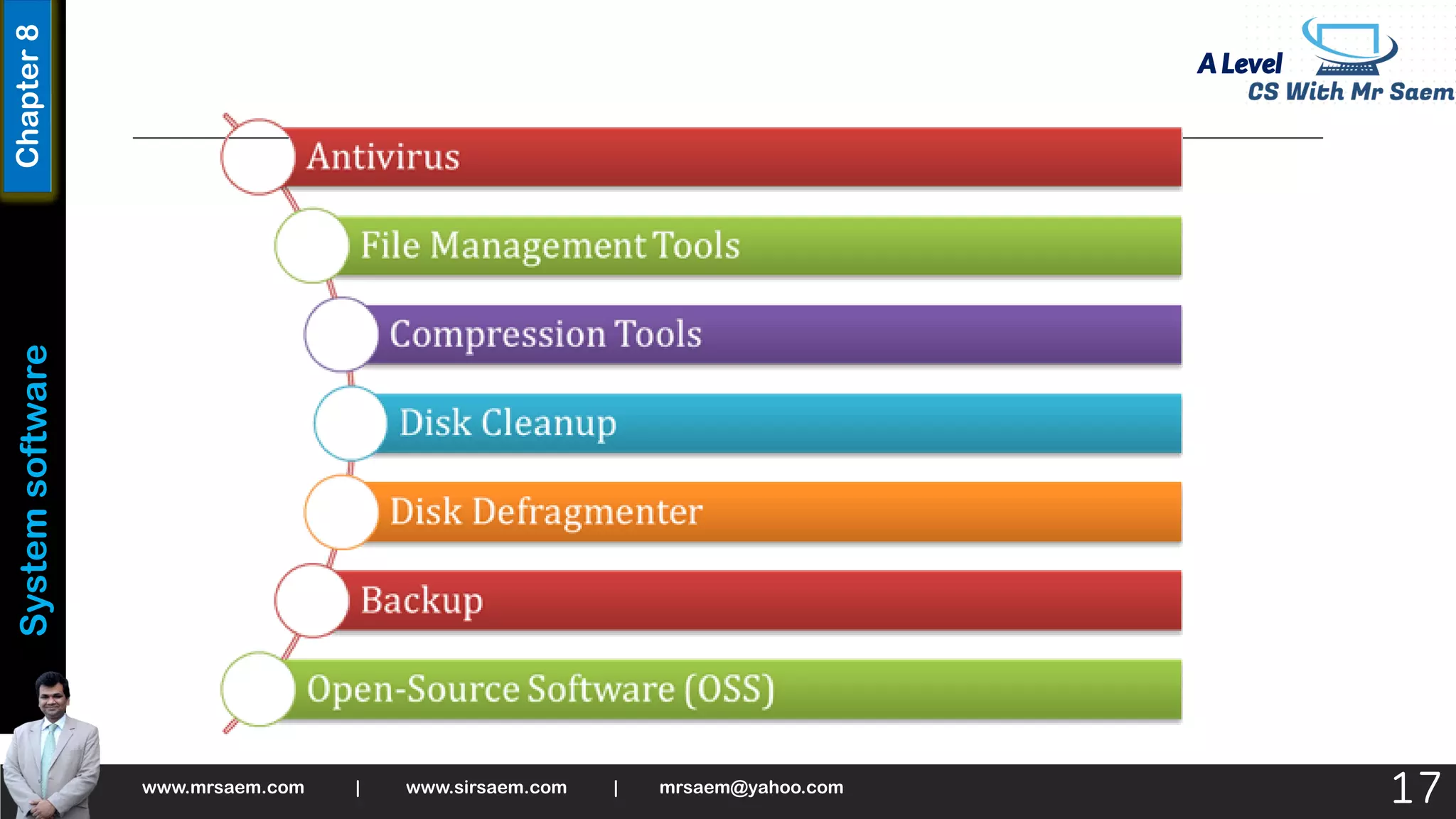
Utility programs
Utility programs is system software designed to help analyze, configure, optimize or
maintain a computer.
Utility software, along with operating system software, is a type of system software
used to support the computer infrastructure, distinguishing it from application
software which is aimed at directly performing tasks that benefit ordinary users.
www.mrsaem.com | www.sirsaem.com | mrsaem@yahoo.com
16
A Level
System
software
Chapter
8
www.mrsaem.com | www.sirsaem.com | mrsaem@yahoo.com
17
A Level
System
software
Chapter
8
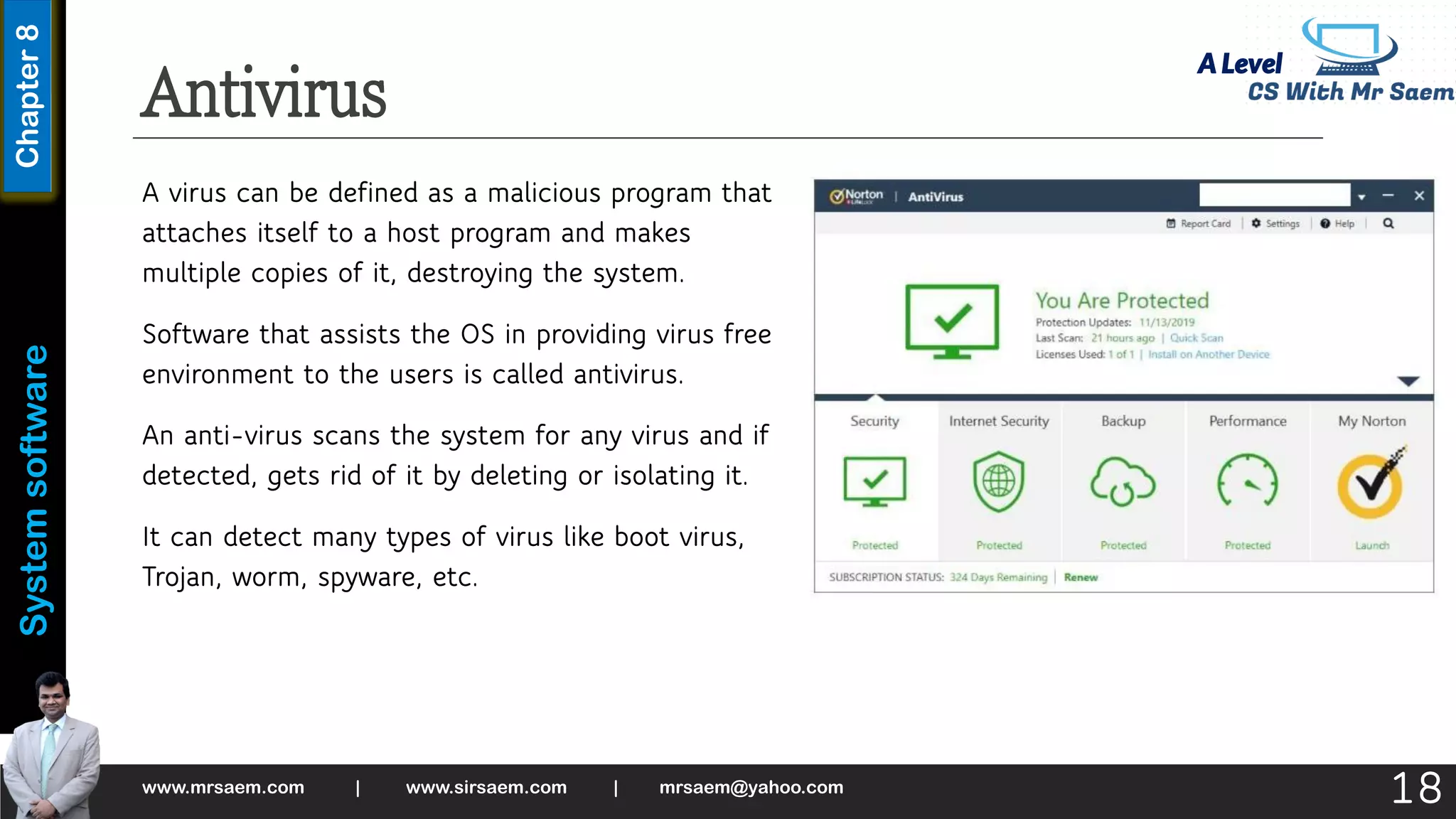
Antivirus
A virus can be defined as a malicious program that
attaches itself to a host program and makes
multiple copies of it, destroying the system.
Software that assists the OS in providing virus free
environment to the users is called antivirus.
An anti-virus scans the system for any virus and if
detected, gets rid of it by deleting or isolating it.
It can detect many types of virus like boot virus,
Trojan, worm, spyware, etc.
www.mrsaem.com | www.sirsaem.com | mrsaem@yahoo.com
18
A Level
System
software
Chapter
8
File management tools
File management is an important function of operating systems as all data and instructions are
stored in the computer in form of files.
Utility software providing regular file management tasks like browse, search, update, preview,
etc. are called file management tools.
Windows Explorer in Windows OS, Google desktop, Directory Opus, Double Commander, etc. are
examples of such tools.
www.mrsaem.com | www.sirsaem.com | mrsaem@yahoo.com
19
A Level
System
software
Chapter
8
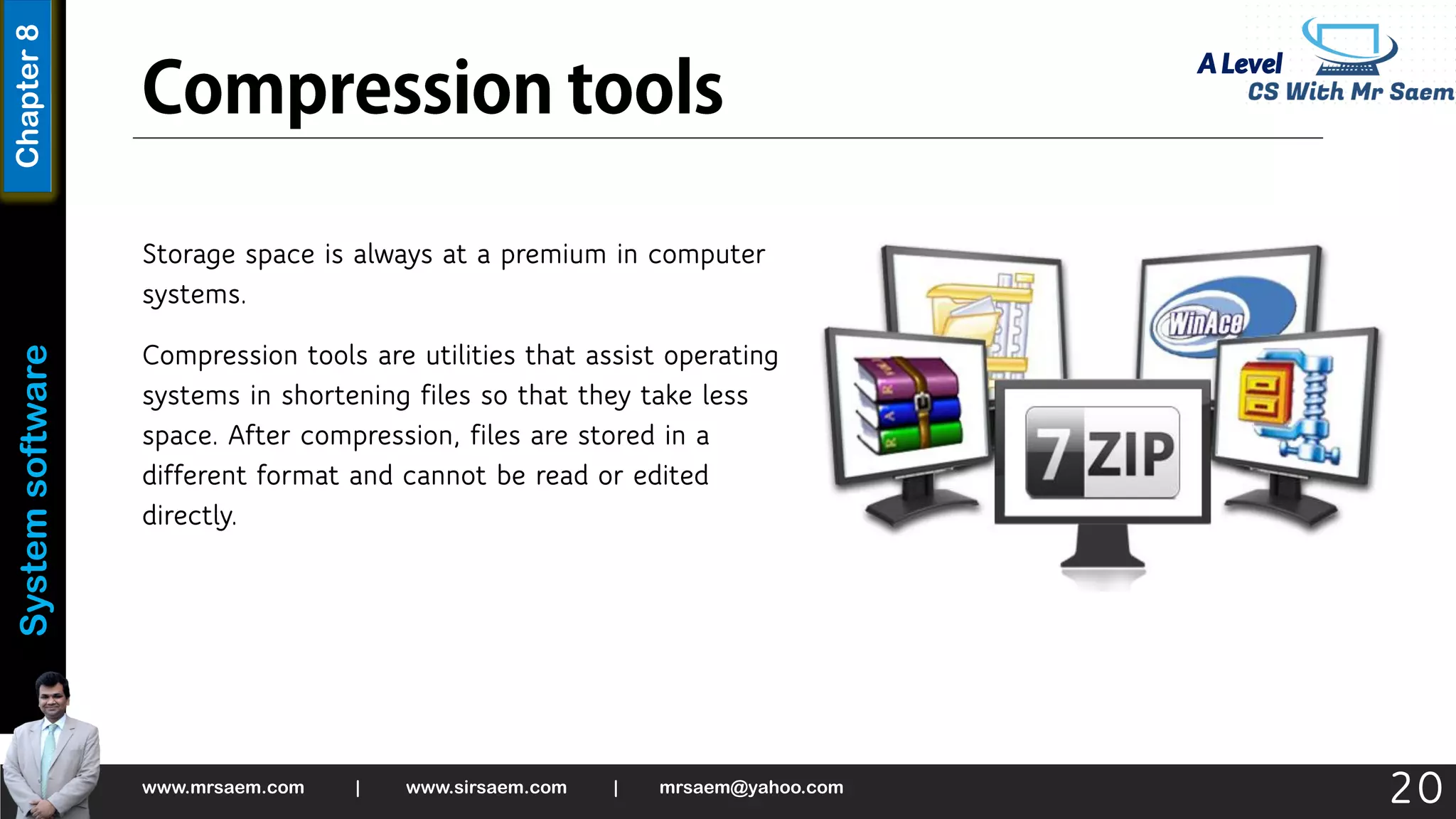
Storage space is always at a premium in computer
systems.
Compression tools are utilities that assist operating
systems in shortening files so that they take less
space. After compression, files are stored in a
different format and cannot be read or edited
directly.
www.mrsaem.com | www.sirsaem.com | mrsaem@yahoo.com
20
A Level
System
software
Chapter
8
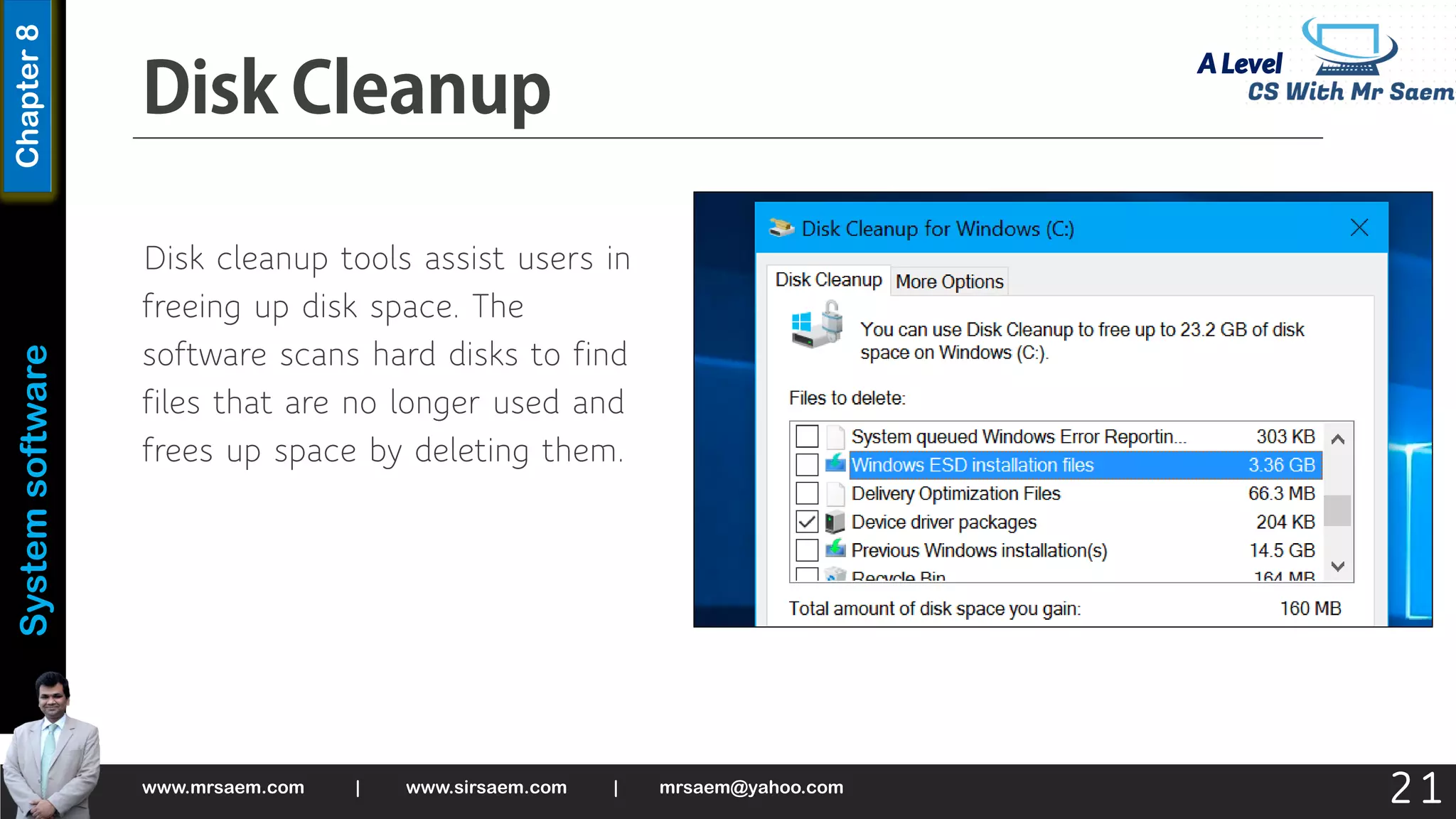
Disk cleanup tools assist users in
freeing up disk space. The
software scans hard disks to find
files that are no longer used and
frees up space by deleting them.
www.mrsaem.com | www.sirsaem.com | mrsaem@yahoo.com
21
A Level
System
software
Chapter
8
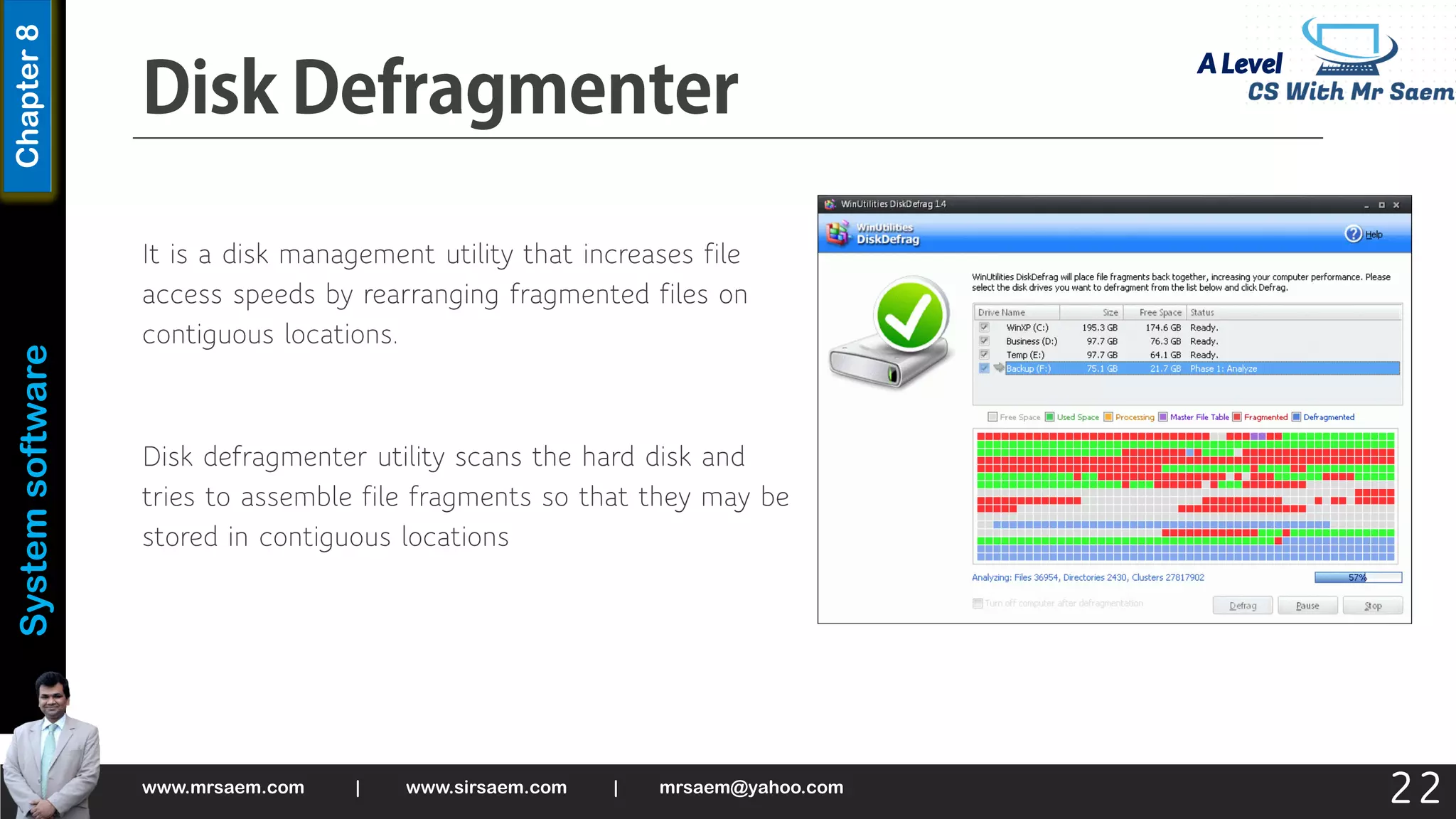
It is a disk management utility that increases file
access speeds by rearranging fragmented files on
contiguous locations.
Disk defragmenter utility scans the hard disk and
tries to assemble file fragments so that they may be
stored in contiguous locations
www.mrsaem.com | www.sirsaem.com | mrsaem@yahoo.com
22
A Level
System
software
Chapter
8
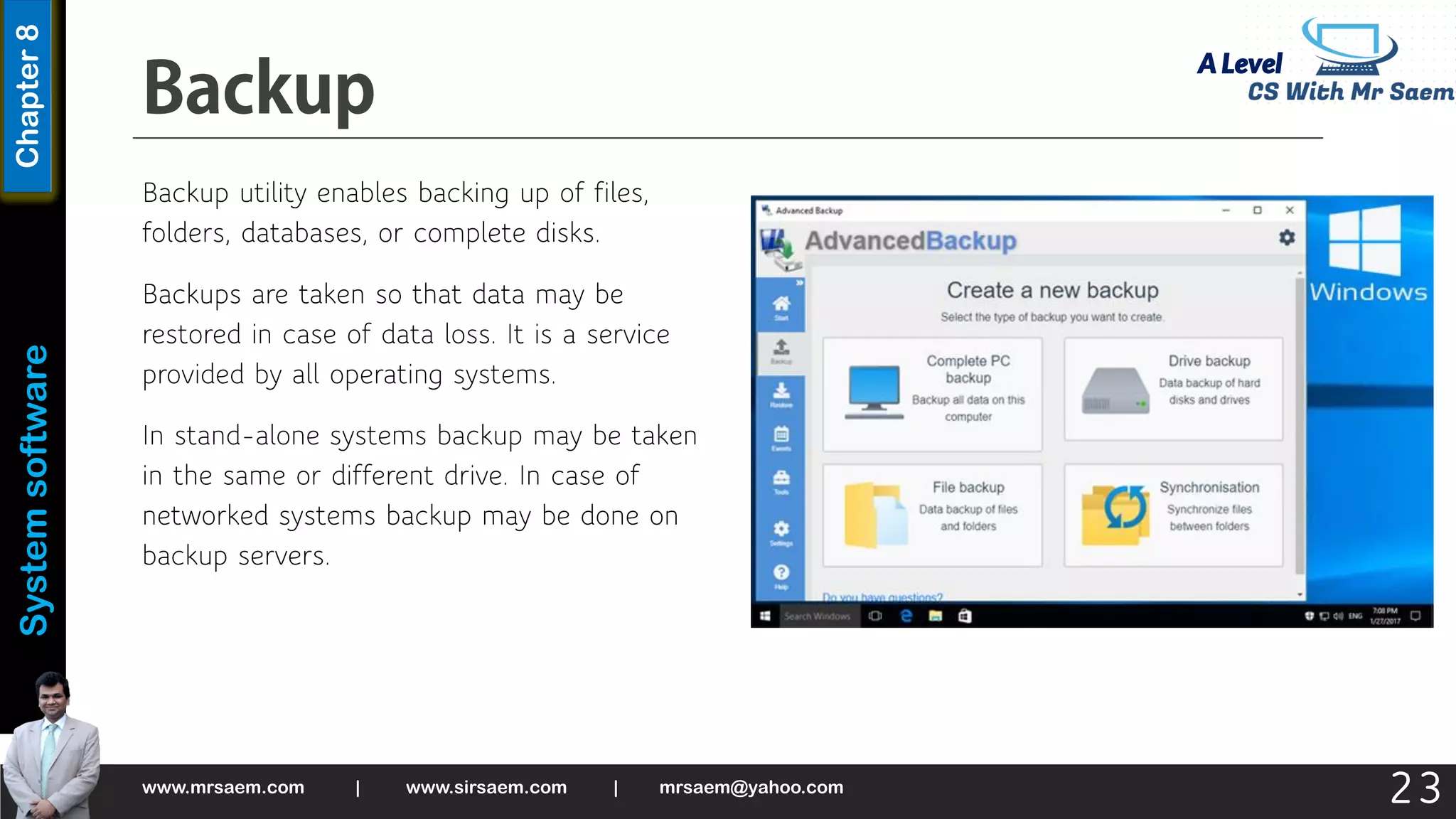
Backup utility enables backing up of files,
folders, databases, or complete disks.
Backups are taken so that data may be
restored in case of data loss. It is a service
provided by all operating systems.
In stand-alone systems backup may be taken
in the same or different drive. In case of
networked systems backup may be done on
backup servers.
www.mrsaem.com | www.sirsaem.com | mrsaem@yahoo.com
23
A Level
System
software
Chapter
8
it is also good practice to use the operating system back-up utility.
This utility will
• allow a schedule for backing up files to be made
• only carry out a back-up procedure if there have been any changes made to a file.
For total security, there should be three versions of a file:
1 The current (working) version stored on the internal HDD.
2 A locally backed up copy of the file (stored on a portable SSD, for example).
3 A remote back-up version stored well away from the computer (using cloud storage, for example).
Windows environment offers the following facilities using the back-up utility: •
The ability to create a restore point (this restores a computer to its state at some point in the past; this
can be very useful if a very important file has been deleted and cannot be recovered by any of the other
utilities). •
www.mrsaem.com | www.sirsaem.com | mrsaem@yahoo.com
24
A Level
System
software
Chapter
8
Library Programs
The ‘programs’ in a program library are usually subroutines created to carry out particular tasks. A
programmer can use these within their own programs.
• Collections of resources used to develop software
• Made up of pre-written code & functions, subroutines
• Provide services to other more complex programs.
• Example: the design of a program running on Windows 7 o All programs run on Windows use
Windows GUI library o Produces same “feel” when running any program.
The source code is written in a programming language of choice. If a compiler is used for the
translation and no errors are found, the compiler produces object code (machine code). This code
cannot be executed by itself. Instead it has to be linked with the code for any subroutines used by it.
It is possible to carry out the linking before loading the full code into memory and running it.
www.mrsaem.com | www.sirsaem.com | mrsaem@yahoo.com
25

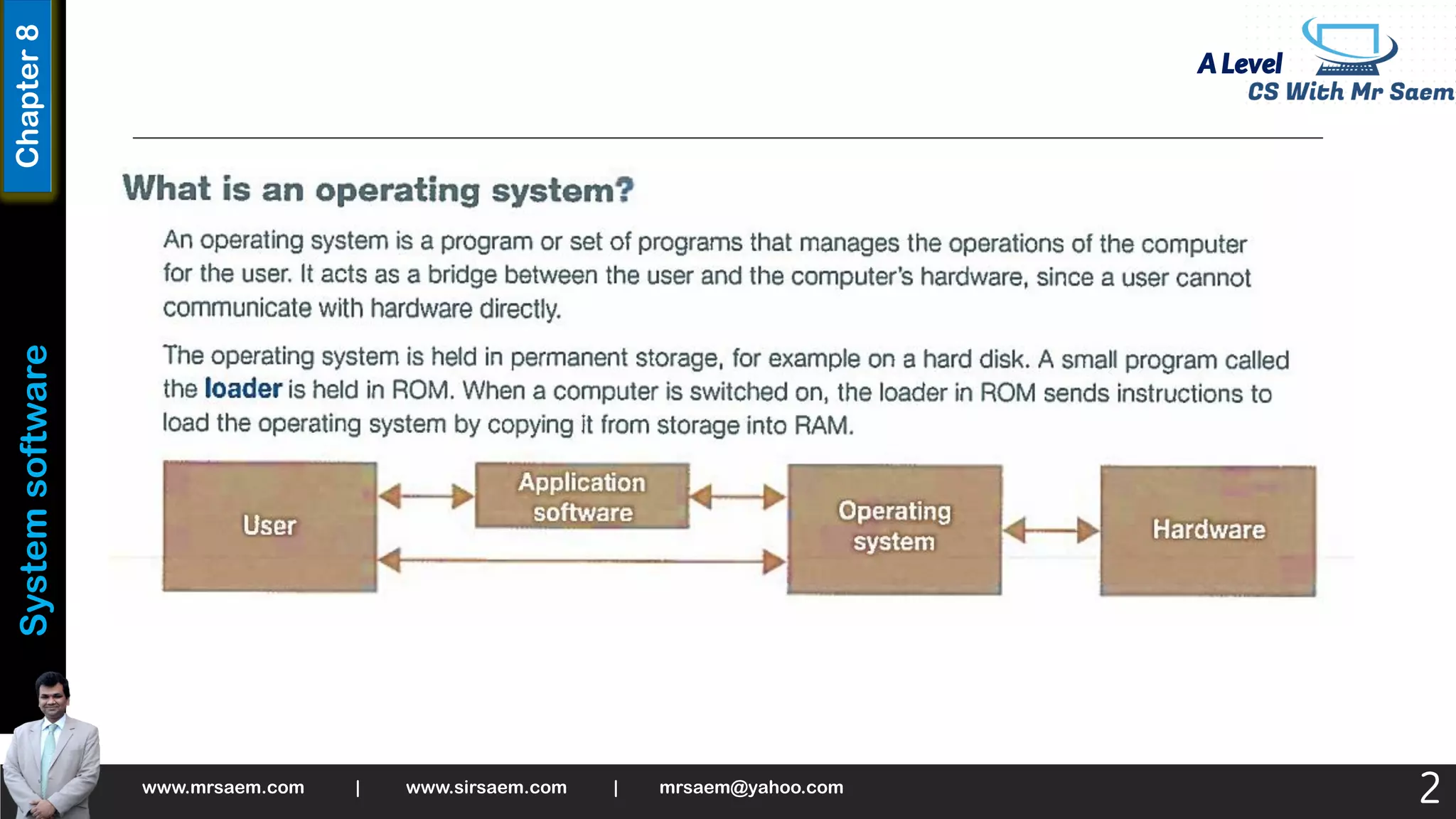
Chapter 8 system soft ware

  • 1.
    Chapter 8: System software WITHMRSAEM www.mrsaem.com | www.sirsaem.com | 1
  • 2.
    A Level System software Chapter 8 www.mrsaem.com |www.sirsaem.com | mrsaem@yahoo.com 2
  • 3.
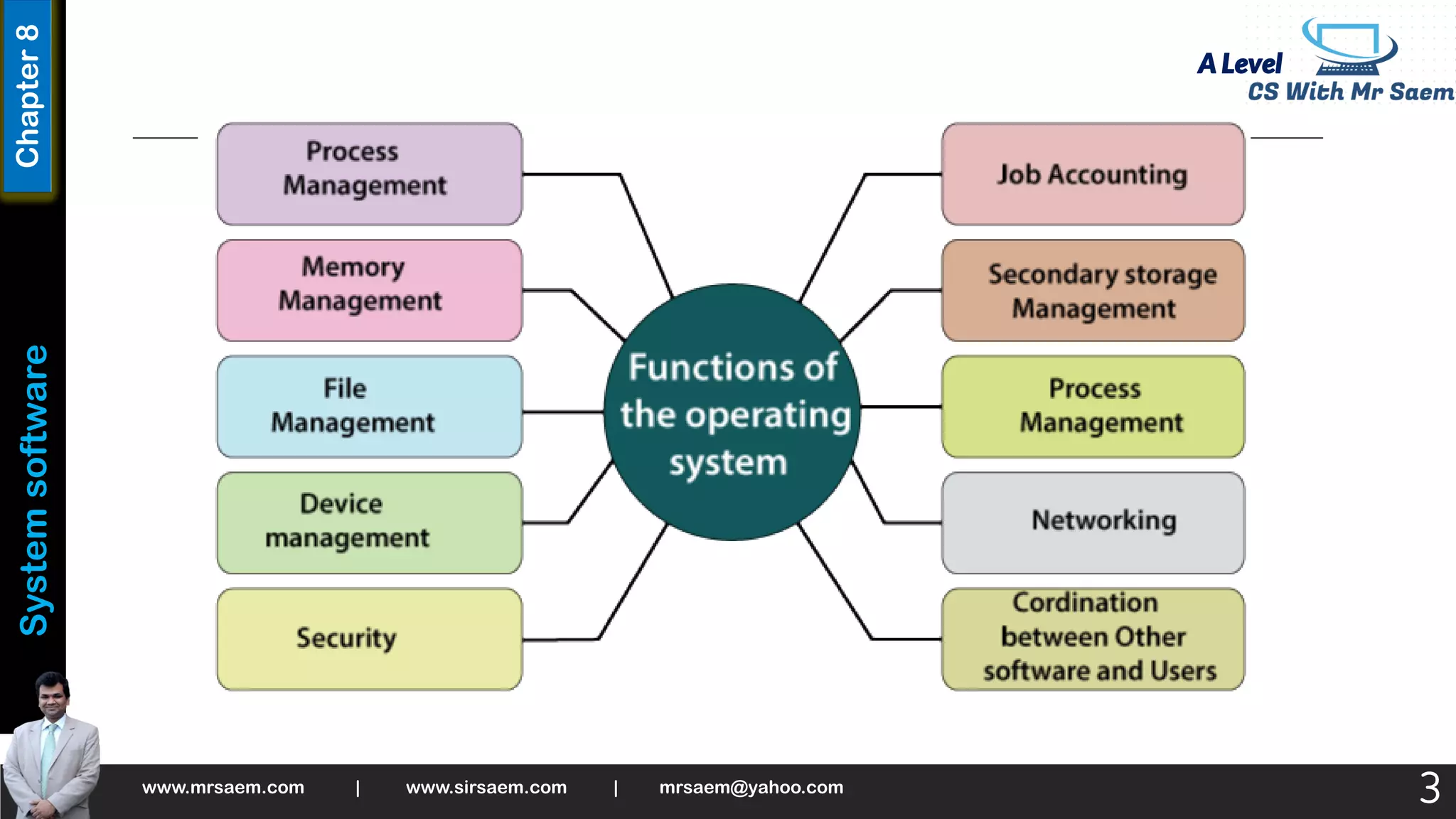
    A Level System software Chapter 8 www.mrsaem.com |www.sirsaem.com | mrsaem@yahoo.com 3
  • 4.
    A Level System software Chapter 8 1.Process Management: –Process Management support operating system to create and delete processes. Process management also offers a mechanism for synchronization and communication among processes. An operating system performs the following activities for process management: www.mrsaem.com | www.sirsaem.com | mrsaem@yahoo.com 4 •The operating system maintains the track of the processor and the status of a process. The software which performs this task is referred to as a traffic controller. •It assigns the processor to the process. •It also performs the task of the de-allocated processor, if a process is no longer needed for the processor.
  • 5.
    A Level System software Chapter 8 2. MemoryManagement: •Operating system helps to allocate the memory at the time when the process request for memory. •If process no longer needs memory, then de-allocates the memory. •In multiprogramming, the task of memory allocation to the processes is done with the help of Operating System. www.mrsaem.com | www.sirsaem.com | mrsaem@yahoo.com 5 – Memory Management is used to manage Primary memory as well as secondary memory. The memory management module performs the allocation job and de-allocation of memory to the program. The operating system performs various activities for memory management are: •It keeps track of memory means which part of the memory is in use, and what part of the memory is not in use.
  • 6.
    A Level System software Chapter 8 3. FileManagement: – For fast or simple navigation and easy usage file system is organized into directories. These directories consist of directories and other files. It helps to handle all the file-related tasks like organization storage, retrieval, sharing, naming and files protection. It preserves track of information, location, status, user, etc. www.mrsaem.com | www.sirsaem.com | mrsaem@yahoo.com 6
  • 7.
    A Level System software Chapter 8 4. Device/Hardware Management: Operating System performs the task of allocations and de-allocations of the devices. It helps to keeps the track of all the devices. With the help of Operating system, device communication via their respective drivers is performed. It manages the device in an effective manner. www.mrsaem.com | www.sirsaem.com | mrsaem@yahoo.com 7
  • 8.
    A Level System software Chapter 8 The functionsof hardware management include • communicating with all input and output devices using device drivers • translating data from a file (defined by the operating system) into a format that the input/output device can understand using device drivers • ensuring each hardware resource has a priority so that it can be used and released as required. The management of input/output devices is essentially the control and management of queues and buffers. For example, when printing out a document, the printer management • locates and loads the printer driver into memory • sends data to a printer buffer ready for printing • sends data to a printer queue (if the printer is busy or the print job has a low priority) before sending to the printer buffer • sends various control commands to the printer throughout the printing process • receives and handles error messages and interrupts from the printer. www.mrsaem.com | www.sirsaem.com | mrsaem@yahoo.com 8
  • 9.
    A Level System software Chapter 8 5. SecondaryStorage Management: – Operating System is responsible for secondary storage management. The System has various levels of storage that consist of primary storage, secondary storage, and cache storage. The set of instruction and data are stored in primary memory or cache memory so that the program which is running can reference it. www.mrsaem.com | www.sirsaem.com | mrsaem@yahoo.com 9
  • 10.
    A Level System software Chapter 8 6. Security: Securitymanagement is another part of a typical operating system. The function of security management is to ensure the integrity, confidentiality and availability of data. This can be achieved by • carrying out operating system updates as and when they become available • ensuring that antivirus software (and other security software) is always up-to-date • communicating with, for example, a firewall to check all traffic to and from the computer • making use of privileges to prevent users entering ‘private areas’ on a computer which permits multi-user activity (this is done by setting up user accounts and making use of passwords and user IDs) . This helps to ensure the privacy of data • maintaining access rights for all users • offering the ability for the recovery of data (and system restore) when it has been lost or corrupted • helping to prevent illegal intrusion to the computer system (also ensuring the privacy of data www.mrsaem.com | www.sirsaem.com | mrsaem@yahoo.com 10
  • 11.
    A Level System software Chapter 8 www.mrsaem.com |www.sirsaem.com | mrsaem@yahoo.com 11
  • 12.
    A Level System software Chapter 8 7. Coordinationbetween other software and user: – The operating system also performs the task of coordination between other software and users. OS directs as well as allocates assemblers, interpreters, compilers, and other software to different computer system users. www.mrsaem.com | www.sirsaem.com | mrsaem@yahoo.com 12
  • 13.
    A Level System software Chapter 8 8. Networking: –A distributed system means a bunch of processors which do not share memory hardware devices and clock. With the help of the network, the processor communicates with each other. www.mrsaem.com | www.sirsaem.com | mrsaem@yahoo.com 13
  • 14.
    A Level System software Chapter 8 9. Jobaccounting: – Operating system performs the function of job accounting by keeping the track of time and resource used by several jobs and users. www.mrsaem.com | www.sirsaem.com | mrsaem@yahoo.com 14
  • 15.
    A Level System software Chapter 8 10. Errordetecting aids: – The operating system also performs the task of error detection. It continuously monitors the system to find or detect errors and prevents the system from the error. www.mrsaem.com | www.sirsaem.com | mrsaem@yahoo.com 15
  • 16.
    A Level System software Chapter 8 Utility programs Utilityprograms is system software designed to help analyze, configure, optimize or maintain a computer. Utility software, along with operating system software, is a type of system software used to support the computer infrastructure, distinguishing it from application software which is aimed at directly performing tasks that benefit ordinary users. www.mrsaem.com | www.sirsaem.com | mrsaem@yahoo.com 16
  • 17.
    A Level System software Chapter 8 www.mrsaem.com |www.sirsaem.com | mrsaem@yahoo.com 17
  • 18.
    A Level System software Chapter 8 Antivirus A viruscan be defined as a malicious program that attaches itself to a host program and makes multiple copies of it, destroying the system. Software that assists the OS in providing virus free environment to the users is called antivirus. An anti-virus scans the system for any virus and if detected, gets rid of it by deleting or isolating it. It can detect many types of virus like boot virus, Trojan, worm, spyware, etc. www.mrsaem.com | www.sirsaem.com | mrsaem@yahoo.com 18
  • 19.
    A Level System software Chapter 8 File managementtools File management is an important function of operating systems as all data and instructions are stored in the computer in form of files. Utility software providing regular file management tasks like browse, search, update, preview, etc. are called file management tools. Windows Explorer in Windows OS, Google desktop, Directory Opus, Double Commander, etc. are examples of such tools. www.mrsaem.com | www.sirsaem.com | mrsaem@yahoo.com 19
  • 20.
    A Level System software Chapter 8 Storage spaceis always at a premium in computer systems. Compression tools are utilities that assist operating systems in shortening files so that they take less space. After compression, files are stored in a different format and cannot be read or edited directly. www.mrsaem.com | www.sirsaem.com | mrsaem@yahoo.com 20
  • 21.
    A Level System software Chapter 8 Disk cleanuptools assist users in freeing up disk space. The software scans hard disks to find files that are no longer used and frees up space by deleting them. www.mrsaem.com | www.sirsaem.com | mrsaem@yahoo.com 21
  • 22.
    A Level System software Chapter 8 It isa disk management utility that increases file access speeds by rearranging fragmented files on contiguous locations. Disk defragmenter utility scans the hard disk and tries to assemble file fragments so that they may be stored in contiguous locations www.mrsaem.com | www.sirsaem.com | mrsaem@yahoo.com 22
  • 23.
    A Level System software Chapter 8 Backup utilityenables backing up of files, folders, databases, or complete disks. Backups are taken so that data may be restored in case of data loss. It is a service provided by all operating systems. In stand-alone systems backup may be taken in the same or different drive. In case of networked systems backup may be done on backup servers. www.mrsaem.com | www.sirsaem.com | mrsaem@yahoo.com 23
  • 24.
    A Level System software Chapter 8 it isalso good practice to use the operating system back-up utility. This utility will • allow a schedule for backing up files to be made • only carry out a back-up procedure if there have been any changes made to a file. For total security, there should be three versions of a file: 1 The current (working) version stored on the internal HDD. 2 A locally backed up copy of the file (stored on a portable SSD, for example). 3 A remote back-up version stored well away from the computer (using cloud storage, for example). Windows environment offers the following facilities using the back-up utility: • The ability to create a restore point (this restores a computer to its state at some point in the past; this can be very useful if a very important file has been deleted and cannot be recovered by any of the other utilities). • www.mrsaem.com | www.sirsaem.com | mrsaem@yahoo.com 24
  • 25.
    A Level System software Chapter 8 Library Programs The‘programs’ in a program library are usually subroutines created to carry out particular tasks. A programmer can use these within their own programs. • Collections of resources used to develop software • Made up of pre-written code & functions, subroutines • Provide services to other more complex programs. • Example: the design of a program running on Windows 7 o All programs run on Windows use Windows GUI library o Produces same “feel” when running any program. The source code is written in a programming language of choice. If a compiler is used for the translation and no errors are found, the compiler produces object code (machine code). This code cannot be executed by itself. Instead it has to be linked with the code for any subroutines used by it. It is possible to carry out the linking before loading the full code into memory and running it. www.mrsaem.com | www.sirsaem.com | mrsaem@yahoo.com 25