Software
Introduction
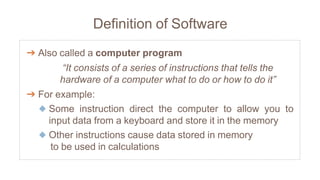
Definition of Software
➔ Also called a computer program
“It consists of a series of instructions that tells the
hardware of a computer what to do or how to do it”
➔ For example:
◆ Some instruction direct the computer to allow you to
input data from a keyboard and store it in the memory
◆ Other instructions cause data stored in memory
to be used in calculations
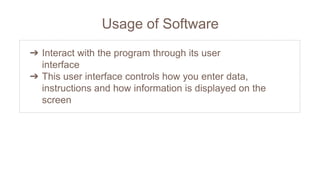
Usage of Software
➔ Interact with the program through its user
interface
➔ This user interface controls how you enter data,
instructions and how information is displayed on the
screen
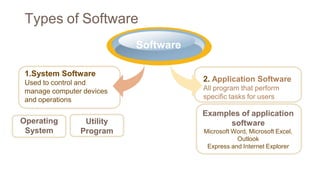
Types of Software
2. Application Software
All program that perform
specific tasks for users
1.System Software
Used to control and
manage computer devices
and operations
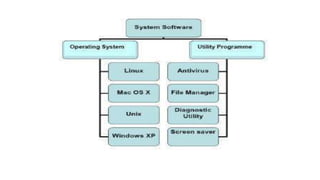
Software
Operating
System
Utility
Program
Examples of application
software
Microsoft Word, Microsoft Excel,
Outlook
Express and Internet Explorer
System Software
Operating System
“program that is loaded into the computer and coordinates all
the activities among computer hardware devices”
- controls the hardware in the computer ,
- Peripherals,
- manages memory and files
- enables the user to communicate with the
computer and other software
Examples:
Microsoft Windows, Macintosh OS X, Linux , Unix and
also DOS
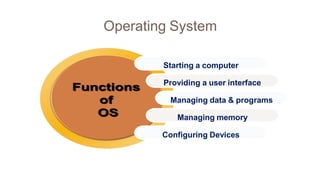
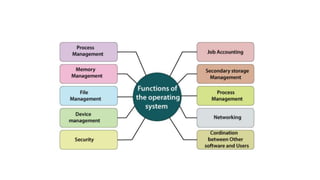
Operating System
Starting a computer
Providing a user interface
Managing data & programs
Managing memory
Configuring Devices
Operating System
Starting a Computer
◆ first function of an operating system
◆ When start a computer, it loads the operating system into
the computer's memory. This process is called booting
◆ Booting means to load and initialize the operating
system on a computer machine. It can happen in two
ways which is warm boot or cold boot
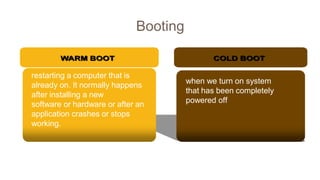
Booting
when we turn on system
that has been completely
powered off
restarting a computer that is
already on. It normally happens
after installing a new
software or hardware or after an
application crashes or stops
working.
Operating System Functions
1. Controls how the user enters data and instruction and
2. How information is displayed
3. Providing a user interface
4. Managing data & program
5. Multitasking operating systems enable users to work with
two or more application programs at the same time
Operating System Functions
User interface typically enables users:
a. to start an application program
b. to manage disks and files such as formatting, copying
and renaming
c. to shut down the computer safely by following the
correct procedures
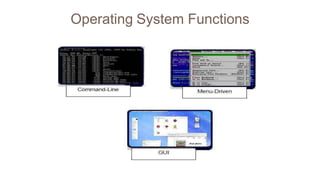
The three (3) types of user interface are
Command-Line,
Menu-Driven and Graphical, User Interface (GUI)
Operating System Functions
Memory Management
★ optimizing the use of Random Access Memory (RAM)
★ allocating data and instruction to an area of memory while
being processed
★ monitoring the contents of memory
★ releasing data and instructions from being monitored in
memory when the process is done
Operating System Functions
Configuring Devices
★ Handling input and output, as well as enabling
communication with input and output devices
★ Most operating systems come with drivers for popular input
and output devices
★ These drivers install new devices and check whenever
there is conflict with these devices
System Software
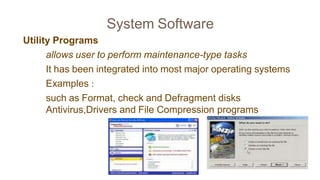
Utility Programs
allows user to perform maintenance-type tasks
It has been integrated into most major operating systems
Examples :
such as Format, check and Defragment disks
Antivirus,Drivers and File Compression programs
Utility Programs
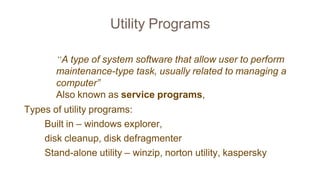
“A type of system software that allow user to perform
maintenance-type task, usually related to managing a
computer”
Also known as service programs,
Types of utility programs:
Built in – windows explorer,
disk cleanup, disk defragmenter
Stand-alone utility – winzip, norton utility, kaspersky
Utility Programs
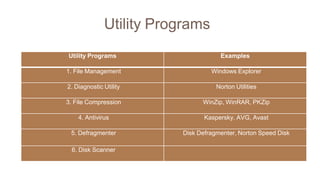
Utility Programs Examples
1. File Management Windows Explorer
2. Diagnostic Utility Norton Utilities
3. File Compression WinZip, WinRAR, PKZip
4. Antivirus Kaspersky, AVG, Avast
5. Defragmenter Disk Defragmenter, Norton Speed Disk
6. Disk Scanner
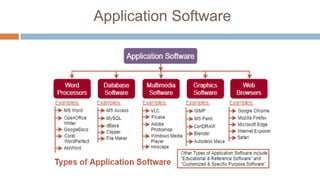
Application Software
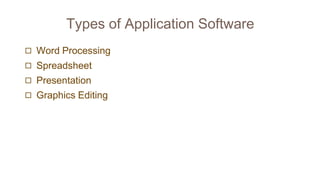
Types of Application Software
◻ Word Processing
◻ Spreadsheet
◻ Presentation
◻ Graphics Editing
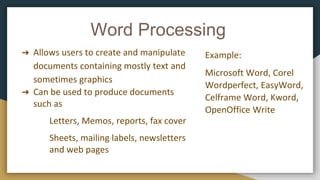
Word Processing
Example:
Microsoft Word, Corel
Wordperfect, EasyWord,
Celframe Word, Kword,
OpenOffice Write
➔ Allows users to create and manipulate
documents containing mostly text and
sometimes graphics
➔ Can be used to produce documents
such as
Letters, Memos, reports, fax cover
Sheets, mailing labels, newsletters
and web pages

Software.pptx

  • 1.
  • 2.
    Definition of Software ➔Also called a computer program “It consists of a series of instructions that tells the hardware of a computer what to do or how to do it” ➔ For example: ◆ Some instruction direct the computer to allow you to input data from a keyboard and store it in the memory ◆ Other instructions cause data stored in memory to be used in calculations
  • 3.
    Usage of Software ➔Interact with the program through its user interface ➔ This user interface controls how you enter data, instructions and how information is displayed on the screen
  • 4.
    Types of Software 2.Application Software All program that perform specific tasks for users 1.System Software Used to control and manage computer devices and operations Software Operating System Utility Program Examples of application software Microsoft Word, Microsoft Excel, Outlook Express and Internet Explorer
  • 5.
    System Software Operating System “programthat is loaded into the computer and coordinates all the activities among computer hardware devices” - controls the hardware in the computer , - Peripherals, - manages memory and files - enables the user to communicate with the computer and other software Examples: Microsoft Windows, Macintosh OS X, Linux , Unix and also DOS
  • 6.
    Operating System Starting acomputer Providing a user interface Managing data & programs Managing memory Configuring Devices
  • 7.
    Operating System Starting aComputer ◆ first function of an operating system ◆ When start a computer, it loads the operating system into the computer's memory. This process is called booting ◆ Booting means to load and initialize the operating system on a computer machine. It can happen in two ways which is warm boot or cold boot
  • 8.
    Booting when we turnon system that has been completely powered off restarting a computer that is already on. It normally happens after installing a new software or hardware or after an application crashes or stops working.
  • 9.
    Operating System Functions 1.Controls how the user enters data and instruction and 2. How information is displayed 3. Providing a user interface 4. Managing data & program 5. Multitasking operating systems enable users to work with two or more application programs at the same time
  • 10.
    Operating System Functions Userinterface typically enables users: a. to start an application program b. to manage disks and files such as formatting, copying and renaming c. to shut down the computer safely by following the correct procedures The three (3) types of user interface are Command-Line, Menu-Driven and Graphical, User Interface (GUI)
  • 11.
  • 12.
    Operating System Functions MemoryManagement ★ optimizing the use of Random Access Memory (RAM) ★ allocating data and instruction to an area of memory while being processed ★ monitoring the contents of memory ★ releasing data and instructions from being monitored in memory when the process is done
  • 13.
    Operating System Functions ConfiguringDevices ★ Handling input and output, as well as enabling communication with input and output devices ★ Most operating systems come with drivers for popular input and output devices ★ These drivers install new devices and check whenever there is conflict with these devices
  • 15.
    System Software Utility Programs allowsuser to perform maintenance-type tasks It has been integrated into most major operating systems Examples : such as Format, check and Defragment disks Antivirus,Drivers and File Compression programs
  • 16.
    Utility Programs “A typeof system software that allow user to perform maintenance-type task, usually related to managing a computer” Also known as service programs, Types of utility programs: Built in – windows explorer, disk cleanup, disk defragmenter Stand-alone utility – winzip, norton utility, kaspersky
  • 17.
    Utility Programs Utility ProgramsExamples 1. File Management Windows Explorer 2. Diagnostic Utility Norton Utilities 3. File Compression WinZip, WinRAR, PKZip 4. Antivirus Kaspersky, AVG, Avast 5. Defragmenter Disk Defragmenter, Norton Speed Disk 6. Disk Scanner
  • 19.
  • 20.
    Types of ApplicationSoftware ◻ Word Processing ◻ Spreadsheet ◻ Presentation ◻ Graphics Editing
  • 21.
    Word Processing Example: Microsoft Word,Corel Wordperfect, EasyWord, Celframe Word, Kword, OpenOffice Write ➔ Allows users to create and manipulate documents containing mostly text and sometimes graphics ➔ Can be used to produce documents such as Letters, Memos, reports, fax cover Sheets, mailing labels, newsletters and web pages