CHAPTER 8
IMPORTING,
EXPORTING, AND
SOURCING
INTRODUCTION
 Export marketing is the integrated marketing of
goods and services that are destined for customers
in international markets.
 Export marketing requires:
1. An understand of the target market environment
2. The use of marketing research and identification of
market potential
3. Decisions concerning product design, pricing,
distribution
ORGANIZATION EXPORT ACTIVITIES
 Research has shown that exporting is essentially a
development process that can be divided into following
distinct stages:
1. The firm is unwilling to export
2. The firm fills unsolicited export orders but does not
pursue unsolicited orders.
3. The firm explores the feasibility of exporting
4. The firm exports to one or more markets on trial basis.
5. The firm is an experienced exporters to one or more
markets.
6. The firm pursues country or region-focused marketing
based on certain criteria.
7. The firm evaluates global market potential before
screening for the “best” target markets to include in its
marketing strategy and plan.
NATIONAL POLICIES GOVERNING EXPORTS
AND IMPORTS
 Nations have combined two opposing policy attitudes toward
of goods across national boundaries:
1. Government Programs That Support Export
2. Governmental Actions to Discourage Imports and Block Market
Access
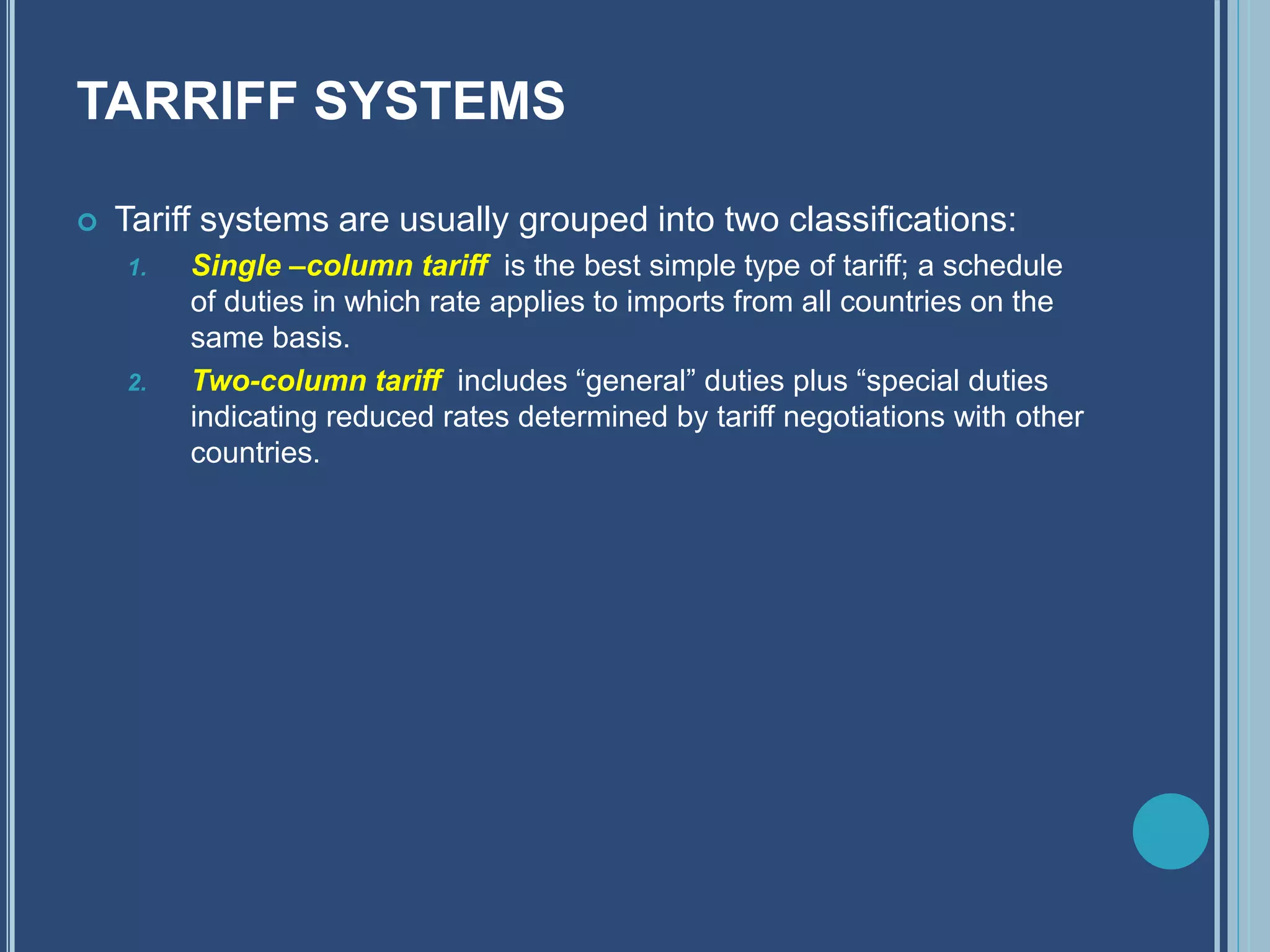
TARRIFF SYSTEMS
 Tariff systems are usually grouped into two classifications:
1. Single –column tariff is the best simple type of tariff; a schedule
of duties in which rate applies to imports from all countries on the
same basis.
2. Two-column tariff includes “general” duties plus “special duties
indicating reduced rates determined by tariff negotiations with other
countries.
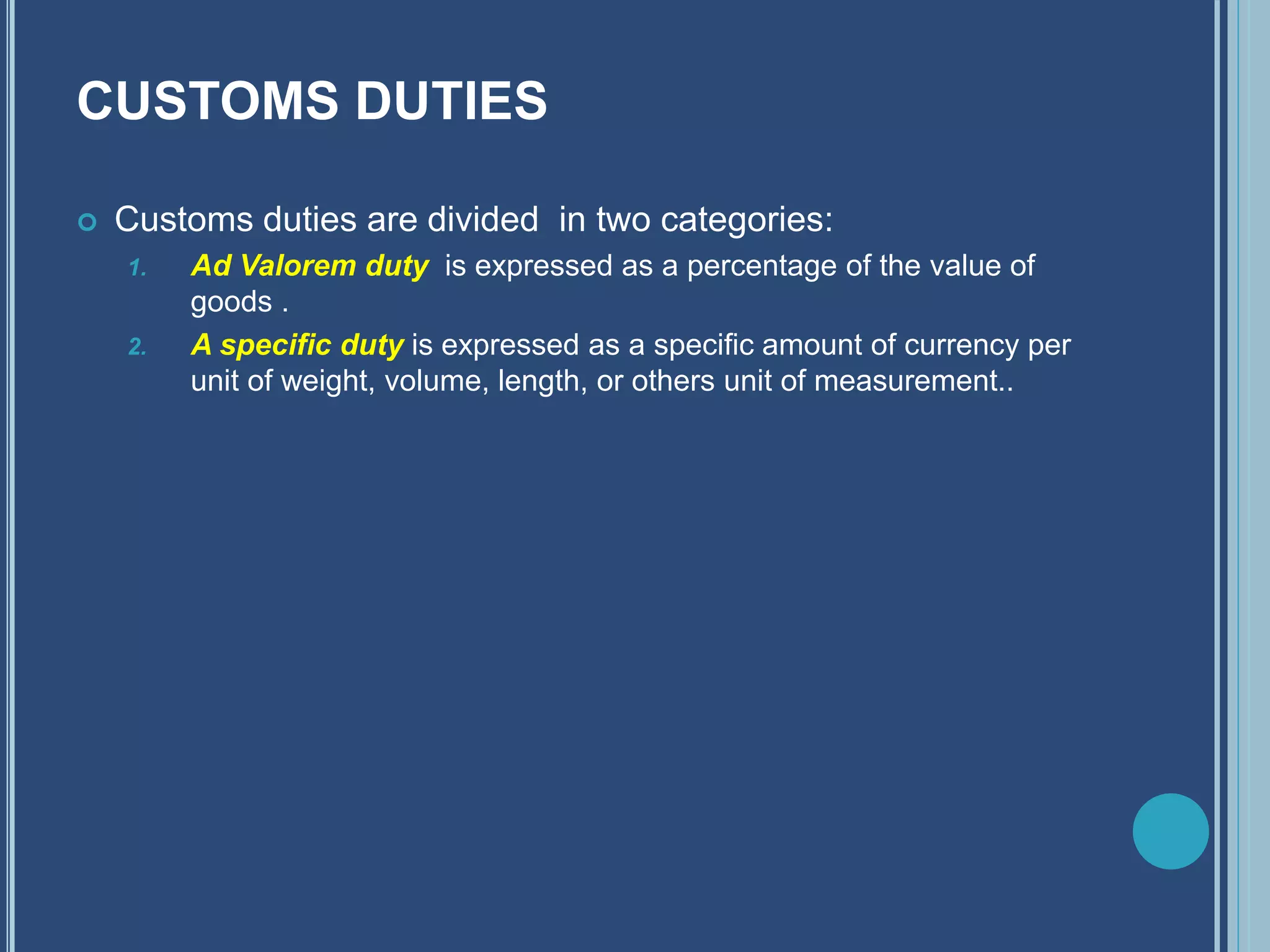
CUSTOMS DUTIES
 Customs duties are divided in two categories:
1. Ad Valorem duty is expressed as a percentage of the value of
goods .
2. A specific duty is expressed as a specific amount of currency per
unit of weight, volume, length, or others unit of measurement..
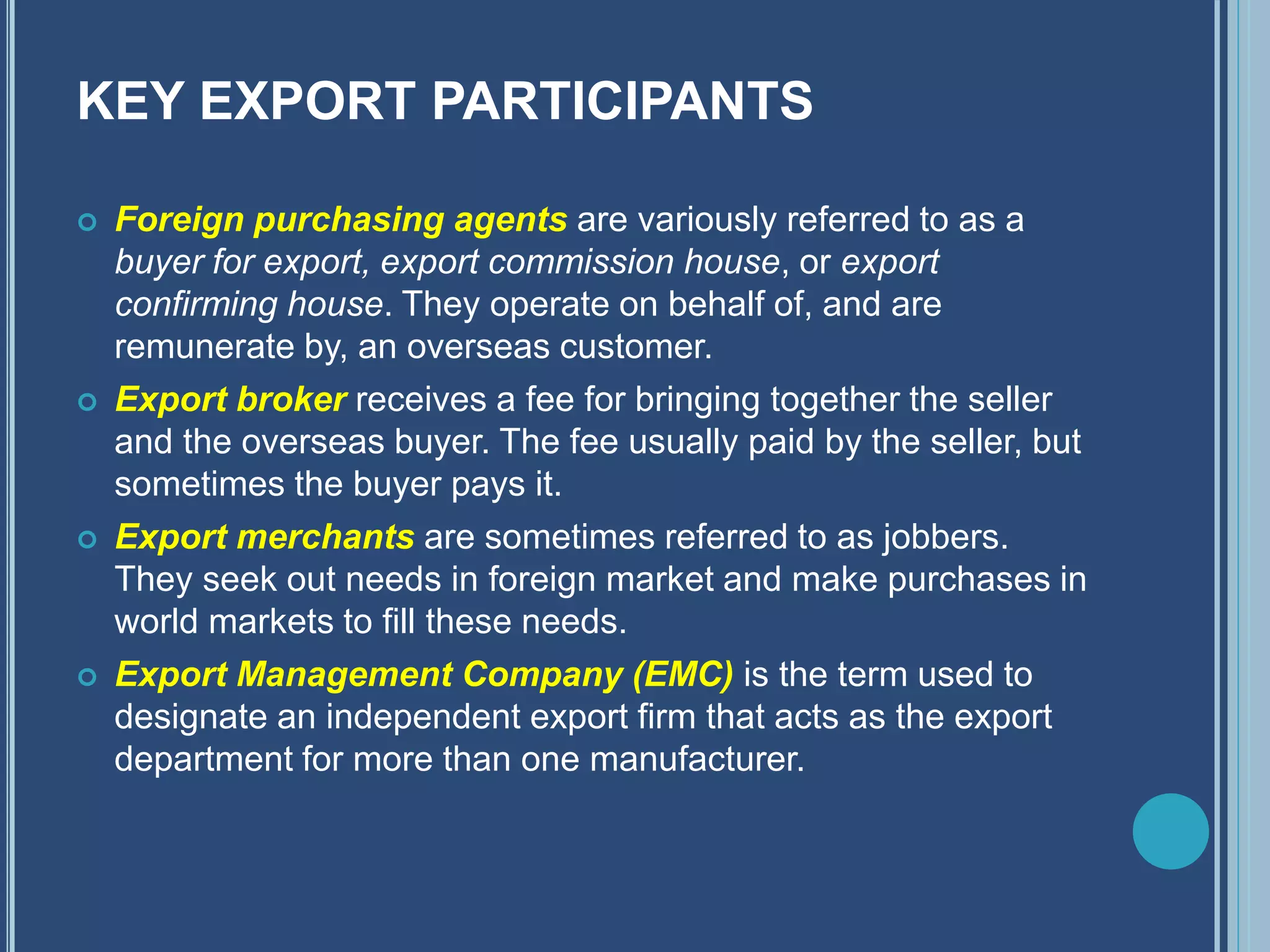
KEY EXPORT PARTICIPANTS
 Foreign purchasing agents are variously referred to as a
buyer for export, export commission house, or export
confirming house. They operate on behalf of, and are
remunerate by, an overseas customer.
 Export broker receives a fee for bringing together the seller
and the overseas buyer. The fee usually paid by the seller, but
sometimes the buyer pays it.
 Export merchants are sometimes referred to as jobbers.
They seek out needs in foreign market and make purchases in
world markets to fill these needs.
 Export Management Company (EMC) is the term used to
designate an independent export firm that acts as the export
department for more than one manufacturer.
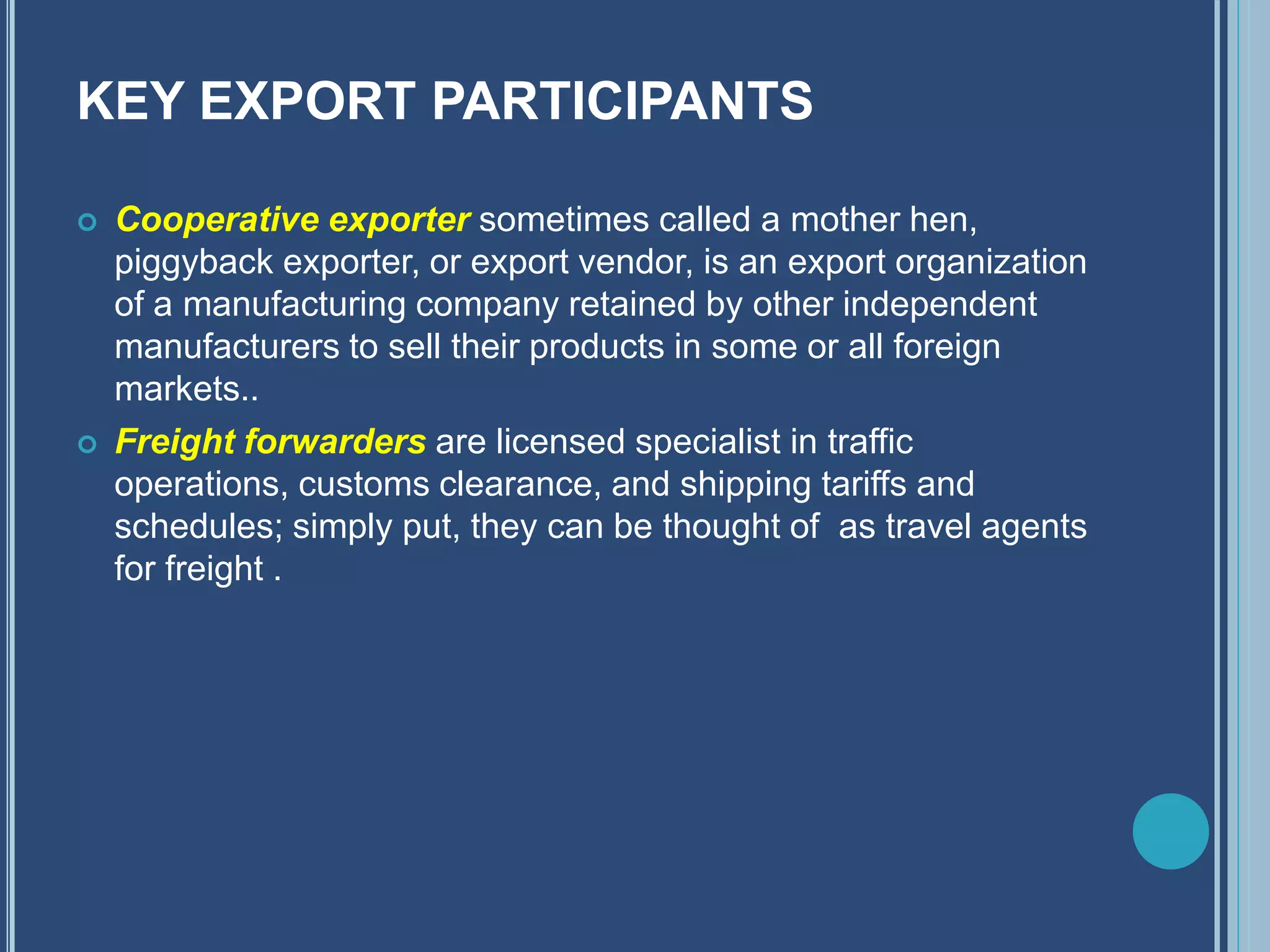
KEY EXPORT PARTICIPANTS
 Cooperative exporter sometimes called a mother hen,
piggyback exporter, or export vendor, is an export organization
of a manufacturing company retained by other independent
manufacturers to sell their products in some or all foreign
markets..
 Freight forwarders are licensed specialist in traffic
operations, customs clearance, and shipping tariffs and
schedules; simply put, they can be thought of as travel agents
for freight .
DOCUMENTARY CREDIT
 Documentary credit ( Letters of Credit or L/C) are widely used
as a payment method in international trade.
 A Letter of Credit is essentially document stating that a bank
has substituted its creditworthiness for that of the
importer/buyer.
 The actual payment process is set in motion when
exporter/seller physically ships the goods and submits the
necessary documents as requested in the L/C
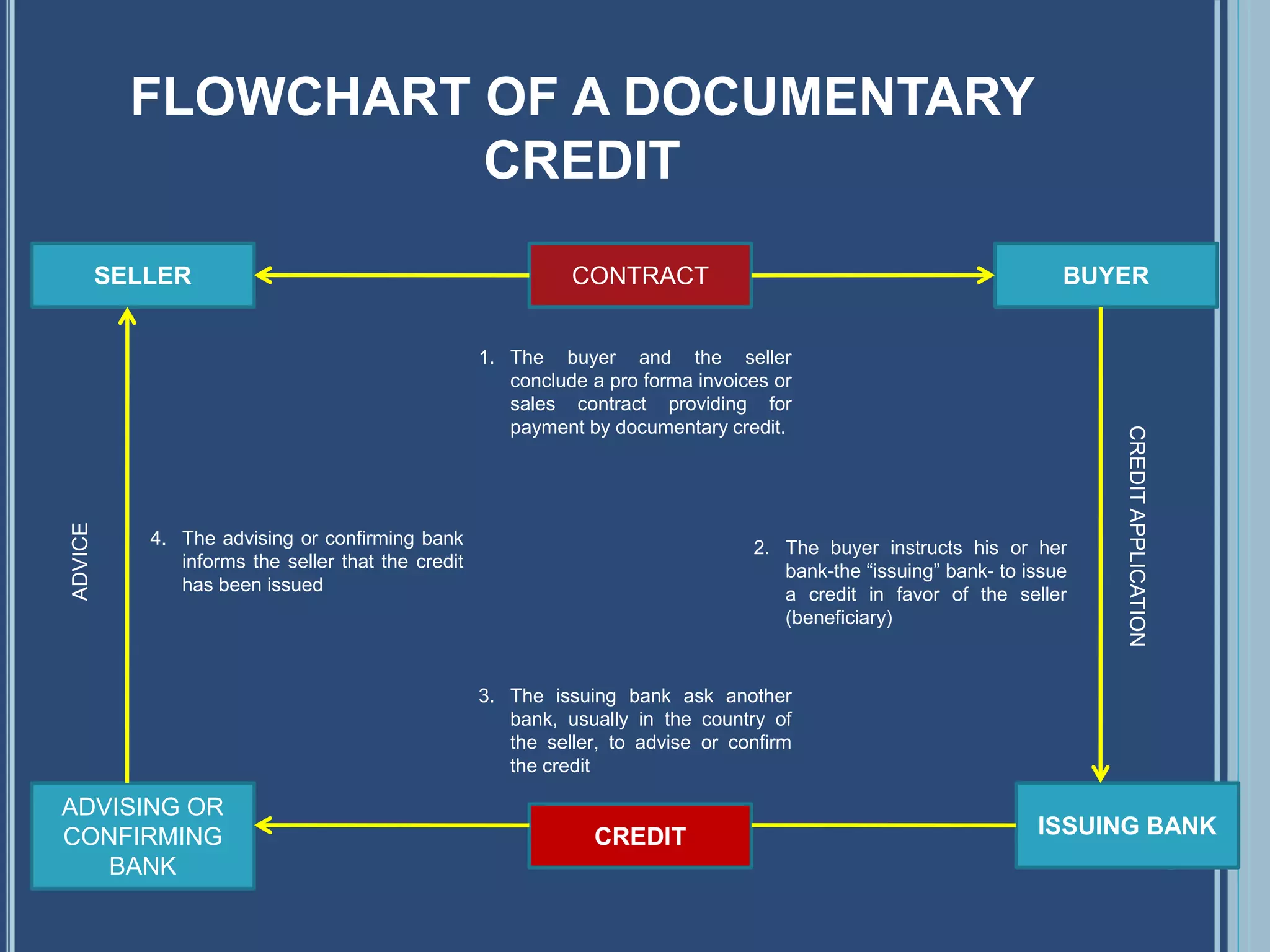
FLOWCHART OF A DOCUMENTARY
CREDIT
SELLER CONTRACT BUYER
ADVISING OR
CONFIRMING
BANK
CREDIT ISSUING BANK
1. The buyer and the seller
conclude a pro forma invoices or
sales contract providing for
payment by documentary credit.
2. The buyer instructs his or her
bank-the “issuing” bank- to issue
a credit in favor of the seller
(beneficiary)
3. The issuing bank ask another
bank, usually in the country of
the seller, to advise or confirm
the credit
4. The advising or confirming bank
informs the seller that the credit
has been issued
ADVICE
CREDITAPPLICATION
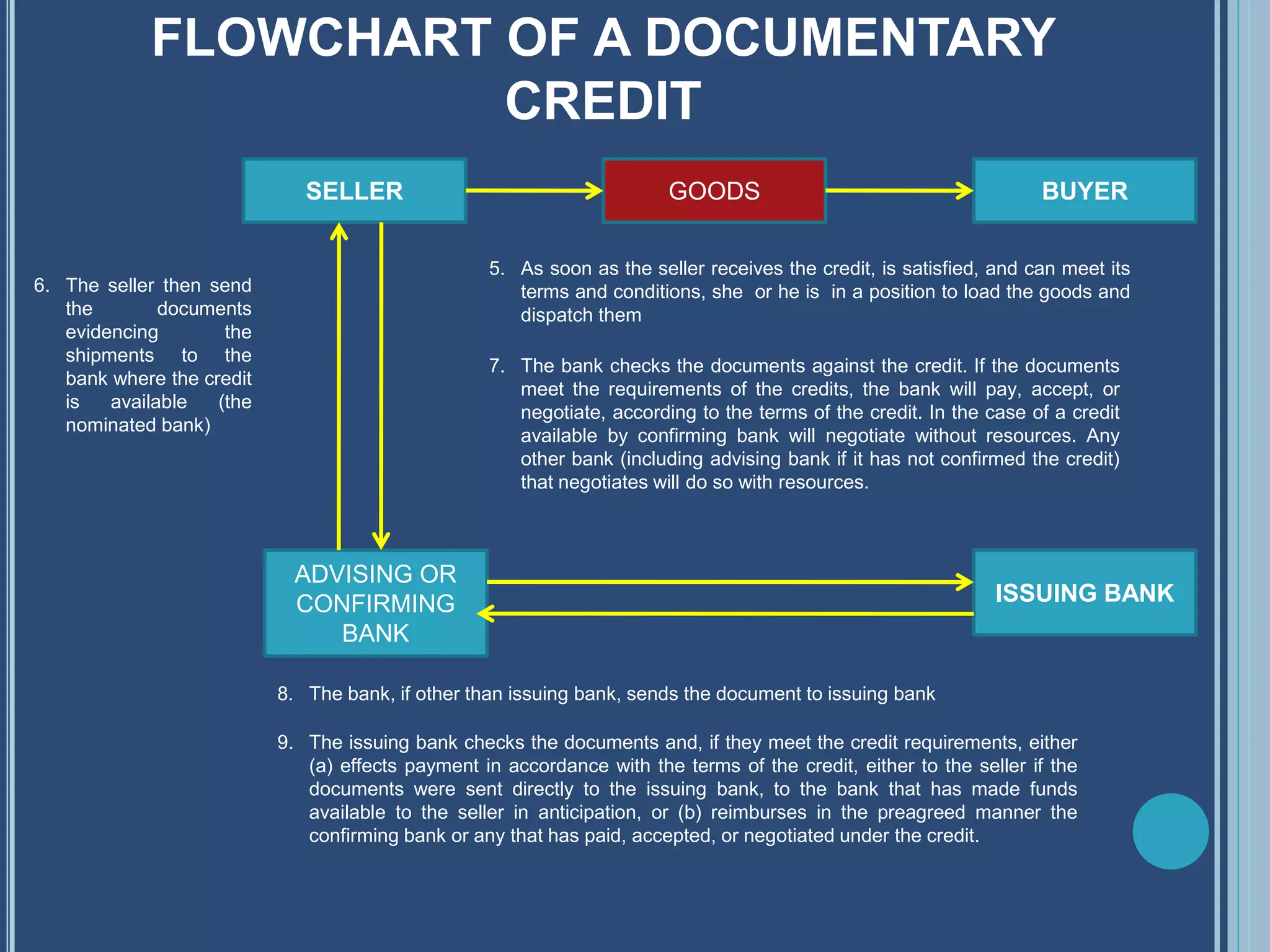
FLOWCHART OF A DOCUMENTARY
CREDIT
GOODSSELLER BUYER
ADVISING OR
CONFIRMING
BANK
ISSUING BANK
5. As soon as the seller receives the credit, is satisfied, and can meet its
terms and conditions, she or he is in a position to load the goods and
dispatch them
7. The bank checks the documents against the credit. If the documents
meet the requirements of the credits, the bank will pay, accept, or
negotiate, according to the terms of the credit. In the case of a credit
available by confirming bank will negotiate without resources. Any
other bank (including advising bank if it has not confirmed the credit)
that negotiates will do so with resources.
6. The seller then send
the documents
evidencing the
shipments to the
bank where the credit
is available (the
nominated bank)
8. The bank, if other than issuing bank, sends the document to issuing bank
9. The issuing bank checks the documents and, if they meet the credit requirements, either
(a) effects payment in accordance with the terms of the credit, either to the seller if the
documents were sent directly to the issuing bank, to the bank that has made funds
available to the seller in anticipation, or (b) reimburses in the preagreed manner the
confirming bank or any that has paid, accepted, or negotiated under the credit.
SOURCING
 In global marketing, the issue of customer value is
inextribically tied to the sourcing decision: whether a
company makes or buys the products.
GUIDE SOURCING DECISSION
 Several factors may figure in the sourcing decission:
1. Management Vision
2. Factor Cost and Condition
3. Customer Needs
4. Public Opinion
5. Logistics
6. Country Infrastructure
7. Political Factors
8. Exchange rates

Chapter 8 - Importing, Exporting and Sourcing

  • 1.
  • 2.
    INTRODUCTION  Export marketingis the integrated marketing of goods and services that are destined for customers in international markets.  Export marketing requires: 1. An understand of the target market environment 2. The use of marketing research and identification of market potential 3. Decisions concerning product design, pricing, distribution
  • 3.
    ORGANIZATION EXPORT ACTIVITIES Research has shown that exporting is essentially a development process that can be divided into following distinct stages: 1. The firm is unwilling to export 2. The firm fills unsolicited export orders but does not pursue unsolicited orders. 3. The firm explores the feasibility of exporting 4. The firm exports to one or more markets on trial basis. 5. The firm is an experienced exporters to one or more markets. 6. The firm pursues country or region-focused marketing based on certain criteria. 7. The firm evaluates global market potential before screening for the “best” target markets to include in its marketing strategy and plan.
  • 4.
    NATIONAL POLICIES GOVERNINGEXPORTS AND IMPORTS  Nations have combined two opposing policy attitudes toward of goods across national boundaries: 1. Government Programs That Support Export 2. Governmental Actions to Discourage Imports and Block Market Access
  • 5.
    TARRIFF SYSTEMS  Tariffsystems are usually grouped into two classifications: 1. Single –column tariff is the best simple type of tariff; a schedule of duties in which rate applies to imports from all countries on the same basis. 2. Two-column tariff includes “general” duties plus “special duties indicating reduced rates determined by tariff negotiations with other countries.
  • 6.
    CUSTOMS DUTIES  Customsduties are divided in two categories: 1. Ad Valorem duty is expressed as a percentage of the value of goods . 2. A specific duty is expressed as a specific amount of currency per unit of weight, volume, length, or others unit of measurement..
  • 7.
    KEY EXPORT PARTICIPANTS Foreign purchasing agents are variously referred to as a buyer for export, export commission house, or export confirming house. They operate on behalf of, and are remunerate by, an overseas customer.  Export broker receives a fee for bringing together the seller and the overseas buyer. The fee usually paid by the seller, but sometimes the buyer pays it.  Export merchants are sometimes referred to as jobbers. They seek out needs in foreign market and make purchases in world markets to fill these needs.  Export Management Company (EMC) is the term used to designate an independent export firm that acts as the export department for more than one manufacturer.
  • 8.
    KEY EXPORT PARTICIPANTS Cooperative exporter sometimes called a mother hen, piggyback exporter, or export vendor, is an export organization of a manufacturing company retained by other independent manufacturers to sell their products in some or all foreign markets..  Freight forwarders are licensed specialist in traffic operations, customs clearance, and shipping tariffs and schedules; simply put, they can be thought of as travel agents for freight .
  • 9.
    DOCUMENTARY CREDIT  Documentarycredit ( Letters of Credit or L/C) are widely used as a payment method in international trade.  A Letter of Credit is essentially document stating that a bank has substituted its creditworthiness for that of the importer/buyer.  The actual payment process is set in motion when exporter/seller physically ships the goods and submits the necessary documents as requested in the L/C
  • 10.
    FLOWCHART OF ADOCUMENTARY CREDIT SELLER CONTRACT BUYER ADVISING OR CONFIRMING BANK CREDIT ISSUING BANK 1. The buyer and the seller conclude a pro forma invoices or sales contract providing for payment by documentary credit. 2. The buyer instructs his or her bank-the “issuing” bank- to issue a credit in favor of the seller (beneficiary) 3. The issuing bank ask another bank, usually in the country of the seller, to advise or confirm the credit 4. The advising or confirming bank informs the seller that the credit has been issued ADVICE CREDITAPPLICATION
  • 11.
    FLOWCHART OF ADOCUMENTARY CREDIT GOODSSELLER BUYER ADVISING OR CONFIRMING BANK ISSUING BANK 5. As soon as the seller receives the credit, is satisfied, and can meet its terms and conditions, she or he is in a position to load the goods and dispatch them 7. The bank checks the documents against the credit. If the documents meet the requirements of the credits, the bank will pay, accept, or negotiate, according to the terms of the credit. In the case of a credit available by confirming bank will negotiate without resources. Any other bank (including advising bank if it has not confirmed the credit) that negotiates will do so with resources. 6. The seller then send the documents evidencing the shipments to the bank where the credit is available (the nominated bank) 8. The bank, if other than issuing bank, sends the document to issuing bank 9. The issuing bank checks the documents and, if they meet the credit requirements, either (a) effects payment in accordance with the terms of the credit, either to the seller if the documents were sent directly to the issuing bank, to the bank that has made funds available to the seller in anticipation, or (b) reimburses in the preagreed manner the confirming bank or any that has paid, accepted, or negotiated under the credit.
  • 12.
    SOURCING  In globalmarketing, the issue of customer value is inextribically tied to the sourcing decision: whether a company makes or buys the products.
  • 13.
    GUIDE SOURCING DECISSION Several factors may figure in the sourcing decission: 1. Management Vision 2. Factor Cost and Condition 3. Customer Needs 4. Public Opinion 5. Logistics 6. Country Infrastructure 7. Political Factors 8. Exchange rates