Export Import Practices
Learning Objectives
 Identify some sources of export financing
 Describe the activities of a foreign freight forwarder
 Understand the kinds of export documents required
 Identify import sources
 Explain why firms export and problem areas of exporting
 Identify the sources of export counseling and support
 Discuss the meaning of the various terms of sale
Objectives:
Why Export?
• Reasons to export
– To serve markets where the firm has no or limited
production facilities
– To satisfy a host government’s requirement that the local
subsidiary have exports
– To remain price-competitive in the home market
– To test foreign markets and foreign competition
inexpensively
Reasons to export?
– To offset domestic market’s cyclical sales
– To achieve additional sales
– To extend a product’s life cycle
– To respond strategically to foreign competitors
– To achieve the success the firm’s management has
seen others achieve
– To improve the efficiency of manufacturing equipment
Reasons not to Export
• Two major reasons
– Preoccupation with the vast American market
– Reluctance to become involved in a new, unknown and therefore risky
operation
• Not active in international markets due to
– Lack of knowledge
• Locating foreign markets
• Payment and financing procedures
• Export procedures
Sources of Export Counseling
• Trade Information Center (TIC)
– The federal government has to set this up as a first stop for
information
– Visit http://www.edc.ca
• International Trade Administration (ITA)
– Offers a wide range of export promotion activities that include
• Market Access and Compliance (MAC)
• Trade Development
• U.S. and Foreign Commercial Services (US&FCS)
Sources of Export Counseling
• Small Business Administration (SBA)
– The office of International Trade of the SBA works
through
• Small Business Administration offices
• Score Program
• Small Business Development Centers
• Centers for International Business Education and Research
(CIBERs)
Show and Sell
• Trade events to facilitate international
trade
– U.S. pavilions
– Trade missions
– Product literature center
– Reverse trade missions
Export Marketing Plan
• Essentially same as domestic marketing
plan
• Specific about
– Markets to be developed
– Marketing strategy for serving them
– Tactics to make the strategy operational
Terms of Sale…
• INCOTERMS
– Universal trade terminology developed by
the International Chamber of Commerce
– Ex-Works
• Risk passes at factory door
• US equivalent: FOB (free on board)
Terms of Sale
– FAS
• Free alongside ship, port of call
– CIF
• Cost, insurance, freight, foreign port
– CFR
• cost and freight, foreign port
– DAF
• Delivered at frontier
Payment Procedures…
• Payment terms offered by exporters to foreign
buyers
– Cash in advance
• When credit standing of the buyer unknown or uncertain
– Open account
• When sale is made on open account
– Seller assumes payment risk
– Offered to reliable customers in economically stable countries
Payment Procedures…
– Consignment
• Goods shipped to buyer; payment made when sold
• Payment risk assumed by seller
– Letter of credit (L/C)
• Document issued by buyer’s bank
– Promise to pay seller specified amount when bank
has received documents stipulated in letter of credit
Payment Procedures
• Letter of credit
• Confirmed L/C
– Correspondent bank in seller’s country agrees to
honor issuing bank’s L/C
• Irrevocable L/C
– Once the seller has accepted L/C, buyer cannot alter
or cancel it without seller’s consent
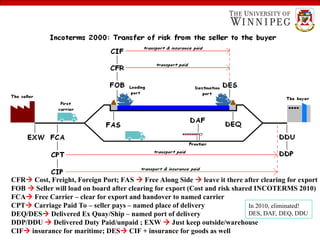
CFR Cost, Freight, Foreign Port; FAS  Free Along Side  leave it there after clearing for export
FOB  Seller will load on board after clearing for export (Cost and risk shared INCOTERMS 2010)
FCA Free Carrier – clear for export and handover to named carrier
CPT Carriage Paid To – seller pays – named place of delivery
DEQ/DES Delivered Ex Quay/Ship – named port of delivery
DDP/DDU  Delivered Duty Paid/unpaid ; EXW  Just keep outside/warehouse
CIF insurance for maritime; DES CIF + insurance for goods as well
In 2010, eliminated!
DES, DAF, DEQ, DDU
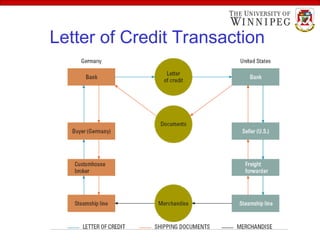
Letter of Credit Transaction
Documents
• Air Waybill
– A bill of lading issued by an air carrier
• Pro Forma Invoice
– Exporter’s formal quotation: description of the
merchandise, price, delivery time, method of shipment,
ports of exit and entry, and terms of sale
Export Financing…
• Private Source – Commercial Banks
– Banker’s acceptance
• Time draft with maturity of less than 270 days that has been
accepted by the bank on which the draft was drawn, thus
becoming the accepting bank’s obligation; may be bought and sold
at a discount in the financial markets like other commercial paper
– Factoring
• Discounting an account receivable without recourse
Export Financing…
– Forfeiting
• Purchasing without recourse an account receivable
whose credit terms are longer than the 90 to 180 days
usual in factoring; unlike factoring, political and transfer
risks are borne by the forfeiter
Export Financing
• Public Sources
– Export-Import Bank (Ex-Imbank)
• Principal government agency that aids American exporters by means of
loans, guarantees, and insurance programs
– Overseas Private Investment Corporation (OPIC)
• U.S. government corporation that offers American investors in
developing countries insurance against expropriation, currency
inconvertibility, and damages from wars and revolutions
Other Public Incentives
• Foreign Trade Zone
– Duty-free area designed to facilitate trade by reducing the effect
of customs restrictions
• Free Trade Zone
– An area designated by the government as outside its customs
territory
• Customs drawback
– Rebate on customs duties
Export Procedures
• Foreign freight forwarders act as agents for exporters
– Prepare documents
– Book space
– Offer advice about
• Markets
• Regulations
• Transportation
• Packing
– Supply cargo insurance
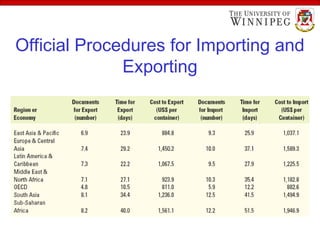
Official Procedures for Importing and
Exporting
Shipping Documents…
• Shipper’s Export Declaration
– U.S. Department of Commerce form to control
export shipments and record export statistics
• Validated export license
– Document issued by the U.S. government
authorizing export of strategic commodity or
shipment to unfriendly country
• General Export License
– Covers export commodities for which validated
license not required; no formal application required
Shipping Documents
• Export Bill of Lading
– Contract of carriage between shipper and carrier:
straight bill of lading is nonnegotiable; endorsed “to
order” bill gives holder claim on merchandise
• Insurance Certificate
Collection Documents
• Commercial invoice
• Include origin of goods, export packing marks, and clause stating goods will not be
transshipped
– Consular invoice
• Purchased from the consul and prepared in local language
– Certificate of origin
• Issued by local Chamber of Commerce
– Inspection certificate
• Frequently required for grain, food, live animals
Export Shipments…
 Containers
 Reduce theft and handling costs
 LASH (lighter aboard ship)
 Barges for shallow inland waterways
 RO-RO (roll on-roll off)
 Can drive onto vessel
 Air Freight
 Can arrive in one day
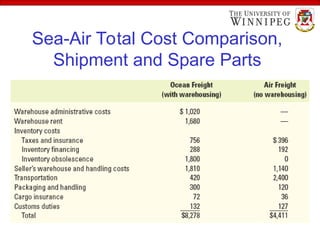
Sea-Air Total Cost Comparison,
Shipment and Spare Parts
Air Freight
• Total cost may decrease
• Either the firm or the product may be air-
dependent
• The market may be perishable
• Competitive position may be strengthened
Importing
• Ways to identify import sources
– If similar imported products are already in the market, visit a
retailer and examine the product label
– If the product is not being imported, call the nearest consul or
embassy of that country
– Use the electronic bulletin boards of the World Trade Centers
Customhouse Broker
• Independent business that handles import shipments
• Acts as agent for importer
– Customhouse broker brings goods through customs
– May arrange transportation for goods after they leave
customs
– Need to know when imports are subject to import quotas
and how much of the quota has been filled
Importing
• Bonded warehouse
– Area authorized by customs for storage of goods on which
payment of import duties is deferred until goods are removed
• Automated Commercial System (ACS)
– Used to track, control, and process all commercial goods
imported into U.S.
• Import Duties
– Importer must know how U.S./Canada calculates import duties
• The Harmonized Tariff Schedule of U.S.
(HTSUSA)
– American version of the Harmonized System used worldwide to
classify imported products

ib-export-import strategy for implmenting what we need

  • 1.
  • 2.
    Learning Objectives  Identifysome sources of export financing  Describe the activities of a foreign freight forwarder  Understand the kinds of export documents required  Identify import sources  Explain why firms export and problem areas of exporting  Identify the sources of export counseling and support  Discuss the meaning of the various terms of sale Objectives:
  • 3.
    Why Export? • Reasonsto export – To serve markets where the firm has no or limited production facilities – To satisfy a host government’s requirement that the local subsidiary have exports – To remain price-competitive in the home market – To test foreign markets and foreign competition inexpensively
  • 4.
    Reasons to export? –To offset domestic market’s cyclical sales – To achieve additional sales – To extend a product’s life cycle – To respond strategically to foreign competitors – To achieve the success the firm’s management has seen others achieve – To improve the efficiency of manufacturing equipment
  • 5.
    Reasons not toExport • Two major reasons – Preoccupation with the vast American market – Reluctance to become involved in a new, unknown and therefore risky operation • Not active in international markets due to – Lack of knowledge • Locating foreign markets • Payment and financing procedures • Export procedures
  • 6.
    Sources of ExportCounseling • Trade Information Center (TIC) – The federal government has to set this up as a first stop for information – Visit http://www.edc.ca • International Trade Administration (ITA) – Offers a wide range of export promotion activities that include • Market Access and Compliance (MAC) • Trade Development • U.S. and Foreign Commercial Services (US&FCS)
  • 7.
    Sources of ExportCounseling • Small Business Administration (SBA) – The office of International Trade of the SBA works through • Small Business Administration offices • Score Program • Small Business Development Centers • Centers for International Business Education and Research (CIBERs)
  • 8.
    Show and Sell •Trade events to facilitate international trade – U.S. pavilions – Trade missions – Product literature center – Reverse trade missions
  • 9.
    Export Marketing Plan •Essentially same as domestic marketing plan • Specific about – Markets to be developed – Marketing strategy for serving them – Tactics to make the strategy operational
  • 10.
    Terms of Sale… •INCOTERMS – Universal trade terminology developed by the International Chamber of Commerce – Ex-Works • Risk passes at factory door • US equivalent: FOB (free on board)
  • 11.
    Terms of Sale –FAS • Free alongside ship, port of call – CIF • Cost, insurance, freight, foreign port – CFR • cost and freight, foreign port – DAF • Delivered at frontier
  • 12.
    Payment Procedures… • Paymentterms offered by exporters to foreign buyers – Cash in advance • When credit standing of the buyer unknown or uncertain – Open account • When sale is made on open account – Seller assumes payment risk – Offered to reliable customers in economically stable countries
  • 13.
    Payment Procedures… – Consignment •Goods shipped to buyer; payment made when sold • Payment risk assumed by seller – Letter of credit (L/C) • Document issued by buyer’s bank – Promise to pay seller specified amount when bank has received documents stipulated in letter of credit
  • 14.
    Payment Procedures • Letterof credit • Confirmed L/C – Correspondent bank in seller’s country agrees to honor issuing bank’s L/C • Irrevocable L/C – Once the seller has accepted L/C, buyer cannot alter or cancel it without seller’s consent
  • 15.
    CFR Cost, Freight,Foreign Port; FAS  Free Along Side  leave it there after clearing for export FOB  Seller will load on board after clearing for export (Cost and risk shared INCOTERMS 2010) FCA Free Carrier – clear for export and handover to named carrier CPT Carriage Paid To – seller pays – named place of delivery DEQ/DES Delivered Ex Quay/Ship – named port of delivery DDP/DDU  Delivered Duty Paid/unpaid ; EXW  Just keep outside/warehouse CIF insurance for maritime; DES CIF + insurance for goods as well In 2010, eliminated! DES, DAF, DEQ, DDU
  • 16.
    Letter of CreditTransaction
  • 17.
    Documents • Air Waybill –A bill of lading issued by an air carrier • Pro Forma Invoice – Exporter’s formal quotation: description of the merchandise, price, delivery time, method of shipment, ports of exit and entry, and terms of sale
  • 18.
    Export Financing… • PrivateSource – Commercial Banks – Banker’s acceptance • Time draft with maturity of less than 270 days that has been accepted by the bank on which the draft was drawn, thus becoming the accepting bank’s obligation; may be bought and sold at a discount in the financial markets like other commercial paper – Factoring • Discounting an account receivable without recourse
  • 19.
    Export Financing… – Forfeiting •Purchasing without recourse an account receivable whose credit terms are longer than the 90 to 180 days usual in factoring; unlike factoring, political and transfer risks are borne by the forfeiter
  • 20.
    Export Financing • PublicSources – Export-Import Bank (Ex-Imbank) • Principal government agency that aids American exporters by means of loans, guarantees, and insurance programs – Overseas Private Investment Corporation (OPIC) • U.S. government corporation that offers American investors in developing countries insurance against expropriation, currency inconvertibility, and damages from wars and revolutions
  • 21.
    Other Public Incentives •Foreign Trade Zone – Duty-free area designed to facilitate trade by reducing the effect of customs restrictions • Free Trade Zone – An area designated by the government as outside its customs territory • Customs drawback – Rebate on customs duties
  • 22.
    Export Procedures • Foreignfreight forwarders act as agents for exporters – Prepare documents – Book space – Offer advice about • Markets • Regulations • Transportation • Packing – Supply cargo insurance
  • 23.
    Official Procedures forImporting and Exporting
  • 24.
    Shipping Documents… • Shipper’sExport Declaration – U.S. Department of Commerce form to control export shipments and record export statistics • Validated export license – Document issued by the U.S. government authorizing export of strategic commodity or shipment to unfriendly country • General Export License – Covers export commodities for which validated license not required; no formal application required
  • 25.
    Shipping Documents • ExportBill of Lading – Contract of carriage between shipper and carrier: straight bill of lading is nonnegotiable; endorsed “to order” bill gives holder claim on merchandise • Insurance Certificate
  • 26.
    Collection Documents • Commercialinvoice • Include origin of goods, export packing marks, and clause stating goods will not be transshipped – Consular invoice • Purchased from the consul and prepared in local language – Certificate of origin • Issued by local Chamber of Commerce – Inspection certificate • Frequently required for grain, food, live animals
  • 27.
    Export Shipments…  Containers Reduce theft and handling costs  LASH (lighter aboard ship)  Barges for shallow inland waterways  RO-RO (roll on-roll off)  Can drive onto vessel  Air Freight  Can arrive in one day
  • 28.
    Sea-Air Total CostComparison, Shipment and Spare Parts
  • 29.
    Air Freight • Totalcost may decrease • Either the firm or the product may be air- dependent • The market may be perishable • Competitive position may be strengthened
  • 30.
    Importing • Ways toidentify import sources – If similar imported products are already in the market, visit a retailer and examine the product label – If the product is not being imported, call the nearest consul or embassy of that country – Use the electronic bulletin boards of the World Trade Centers
  • 31.
    Customhouse Broker • Independentbusiness that handles import shipments • Acts as agent for importer – Customhouse broker brings goods through customs – May arrange transportation for goods after they leave customs – Need to know when imports are subject to import quotas and how much of the quota has been filled
  • 32.
    Importing • Bonded warehouse –Area authorized by customs for storage of goods on which payment of import duties is deferred until goods are removed • Automated Commercial System (ACS) – Used to track, control, and process all commercial goods imported into U.S. • Import Duties – Importer must know how U.S./Canada calculates import duties • The Harmonized Tariff Schedule of U.S. (HTSUSA) – American version of the Harmonized System used worldwide to classify imported products