EVS.
ASIGNMENT
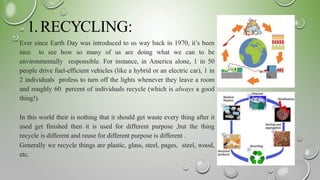
1.RECYCLING:
Ever since Earth Day was introduced to us way back in 1970, it’s been
nice to see how so many of us are doing what we can to be
environmentally responsible. For instance, in America alone, 1 in 50
people drive fuel-efficient vehicles (like a hybrid or an electric car), 1 in
2 individuals profess to turn off the lights whenever they leave a room
and roughly 60 percent of individuals recycle (which is always a good
thing!).
In this world their is nothing that it should get waste every thing after it
used get finished then it is used for different purpose ,but the thing
recycle is different and reuse for different purpose is different .
Generally we recycle things are plastic, glass, steel, pages, steel, wood,
etc.
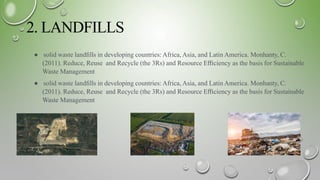
2. LANDFILLS
● solid waste landfills in developing countries: Africa, Asia, and Latin America. Monhanty, C.
(2011). Reduce, Reuse and Recycle (the 3Rs) and Resource Efficiency as the basis for Sustainable
Waste Management
● solid waste landfills in developing countries: Africa, Asia, and Latin America. Monhanty, C.
(2011). Reduce, Reuse and Recycle (the 3Rs) and Resource Efficiency as the basis for Sustainable
Waste Management
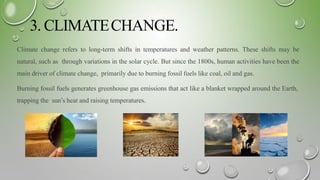
3. CLIMATECHANGE.
Climate change refers to long-term shifts in temperatures and weather patterns. These shifts may be
natural, such as through variations in the solar cycle. But since the 1800s, human activities have been the
main driver of climate change, primarily due to burning fossil fuels like coal, oil and gas.
Burning fossil fuels generates greenhouse gas emissions that act like a blanket wrapped around the Earth,
trapping the sun’s heat and raising temperatures.
4. LIFE CYCLEANALYSIS.
So what is a life cycle analysis (LCA), what do they tell us and why are they so important? In short, a
life cycle analysis is the act of measuring the environmental impact of a product or service
throughout its life cycle, from the resources used to create the product or service, across its use by the
user, to it's final end of life destination.
Life Cycle Perspective
1.In theory boundaries start from earth as the source, and return to earth as the sink.
2.Focus is on a product or service
3.Impact is evaluated at the receiver
4.Tracking is of materials
5.Time stands still 6. But this is hard to do
5. ECOSYSTEM
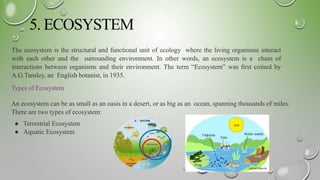
The ecosystem is the structural and functional unit of ecology where the living organisms interact
with each other and the surrounding environment. In other words, an ecosystem is a chain of
interactions between organisms and their environment. The term “Ecosystem” was first coined by
A.G.Tansley, an English botanist, in 1935.
Types of Ecosystem
An ecosystem can be as small as an oasis in a desert, or as big as an ocean, spanning thousands of miles.
There are two types of ecosystem:
● Terrestrial Ecosystem
● Aquatic Ecosystem
6. BIODIVERSITY.
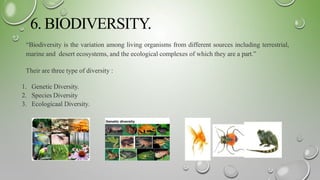
“Biodiversity is the variation among living organisms from different sources including terrestrial,
marine and desert ecosystems, and the ecological complexes of which they are a part.”
Their are three type of diversity :
1. Genetic Diversity.
2. Species Diversity
3. Ecologicaal Diversity.
7. GLOBALWARMING
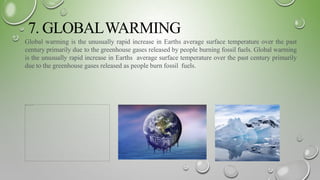
Global warming is the unusually rapid increase in Earths average surface temperature over the past
century primarily due to the greenhouse gases released by people burning fossil fuels. Global warming
is the unusually rapid increase in Earths average surface temperature over the past century primarily
due to the greenhouse gases released as people burn fossil fuels.
8. RESOURCEDEPLITION
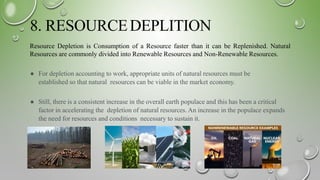
Resource Depletion is Consumption of a Resource faster than it can be Replenished. Natural
Resources are commonly divided into Renewable Resources and Non-Renewable Resources.
● For depletion accounting to work, appropriate units of natural resources must be
established so that natural resources can be viable in the market economy.
● Still, there is a consistent increase in the overall earth populace and this has been a critical
factor in accelerating the depletion of natural resources. An increase in the populace expands
the need for resources and conditions necessary to sustain it.
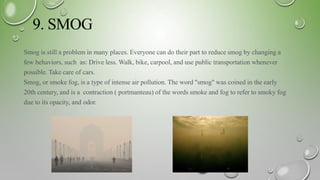
9. SMOG
Smog is still a problem in many places. Everyone can do their part to reduce smog by changing a
few behaviors, such as: Drive less. Walk, bike, carpool, and use public transportation whenever
possible. Take care of cars.
Smog, or smoke fog, is a type of intense air pollution. The word "smog" was coined in the early
20th century, and is a contraction ( portmanteau) of the words smoke and fog to refer to smoky fog
due to its opacity, and odor.
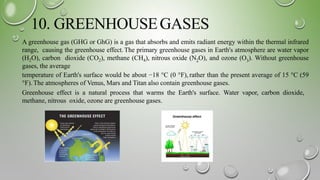
10. GREENHOUSEGASES
A greenhouse gas (GHG or GhG) is a gas that absorbs and emits radiant energy within the thermal infrared
range, causing the greenhouse effect. The primary greenhouse gases in Earth's atmosphere are water vapor
(H2O), carbon dioxide (CO2), methane (CH4), nitrous oxide (N2O), and ozone (O3). Without greenhouse
gases, the average
temperature of Earth's surface would be about −18 °C (0 °F), rather than the present average of 15 °C (59
°F).The atmospheres of Venus, Mars and Titan also contain greenhouse gases.
Greenhouse effect is a natural process that warms the Earth's surface. Water vapor, carbon dioxide,
methane, nitrous oxide, ozone are greenhouse gases.
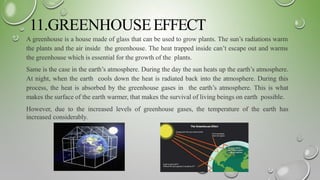
11.GREENHOUSEEFFECT
A greenhouse is a house made of glass that can be used to grow plants. The sun’s radiations warm
the plants and the air inside the greenhouse. The heat trapped inside can’t escape out and warms
the greenhouse which is essential for the growth of the plants.
Same is the case in the earth’s atmosphere. During the day the sun heats up the earth’s atmosphere.
At night, when the earth cools down the heat is radiated back into the atmosphere. During this
process, the heat is absorbed by the greenhouse gases in the earth’s atmosphere. This is what
makes the surface of the earth warmer, that makes the survival of living beings on earth possible.
However, due to the increased levels of greenhouse gases, the temperature of the earth has
increased considerably.
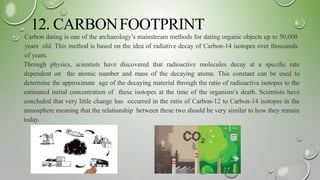
12. CARBONFOOTPRINT
Carbon dating is one of the archaeology’s mainstream methods for dating organic objects up to 50,000
years old. This method is based on the idea of radiative decay of Carbon-14 isotopes over thousands
of years.
Through physics, scientists have discovered that radioactive molecules decay at a specific rate
dependent on the atomic number and mass of the decaying atoms. This constant can be used to
determine the approximate age of the decaying material through the ratio of radioactive isotopes to the
estimated initial concentration of these isotopes at the time of the organism’s death. Scientists have
concluded that very little change has occurred in the ratio of Carbon-12 to Carbon-14 isotopes in the
atmosphere meaning that the relationship between these two should be very similar to how they remain
today.
13.WETLANDS
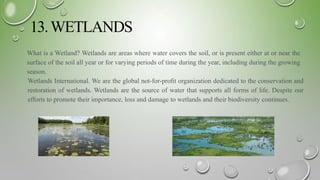
What is a Wetland? Wetlands are areas where water covers the soil, or is present either at or near the
surface of the soil all year or for varying periods of time during the year, including during the growing
season.
Wetlands International. We are the global not-for-profit organization dedicated to the conservation and
restoration of wetlands. Wetlands are the source of water that supports all forms of life. Despite our
efforts to promote their importance, loss and damage to wetlands and their biodiversity continues.
14.ECOLOGY
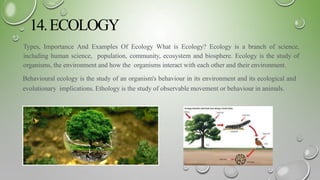
Types, Importance And Examples Of Ecology What is Ecology? Ecology is a branch of science,
including human science, population, community, ecosystem and biosphere. Ecology is the study of
organisms, the environment and how the organisms interact with each other and their environment.
Behavioural ecology is the study of an organism's behaviour in its environment and its ecological and
evolutionary implications. Ethology is the study of observable movement or behaviour in animals.
15.BIOMASS
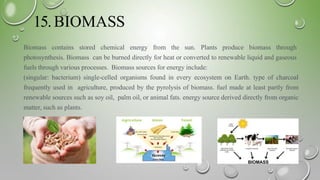
Biomass contains stored chemical energy from the sun. Plants produce biomass through
photosynthesis. Biomass can be burned directly for heat or converted to renewable liquid and gaseous
fuels through various processes. Biomass sources for energy include:
(singular: bacterium) single-celled organisms found in every ecosystem on Earth. type of charcoal
frequently used in agriculture, produced by the pyrolysis of biomass. fuel made at least partly from
renewable sources such as soy oil, palm oil, or animal fats. energy source derived directly from organic
matter, such as plants.
16. FOSSILFUELS
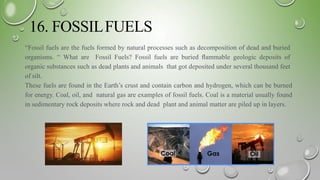
“Fossil fuels are the fuels formed by natural processes such as decomposition of dead and buried
organisms. “ What are Fossil Fuels? Fossil fuels are buried flammable geologic deposits of
organic substances such as dead plants and animals that got deposited under several thousand feet
of silt.
These fuels are found in the Earth’s crust and contain carbon and hydrogen, which can be burned
for energy. Coal, oil, and natural gas are examples of fossil fuels. Coal is a material usually found
in sedimentary rock deposits where rock and dead plant and animal matter are piled up in layers.
17. BIODEGRADABLEMATERIAL
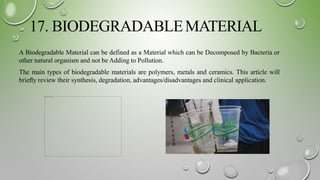
A Biodegradable Material can be defined as a Material which can be Decomposed by Bacteria or
other natural organism and not be Adding to Pollution.
The main types of biodegradable materials are polymers, metals and ceramics. This article will
briefly review their synthesis, degradation, advantages/disadvantages and clinical application.
18. HOWCAN WE PRESERVE
BIODIVERSITY?
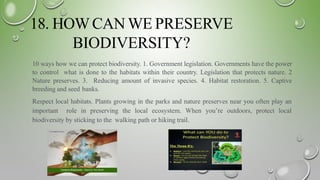
10 ways how we can protect biodiversity. 1. Government legislation. Governments have the power
to control what is done to the habitats within their country. Legislation that protects nature. 2
Nature preserves. 3. Reducing amount of invasive species. 4. Habitat restoration. 5. Captive
breeding and seed banks.
Respect local habitats. Plants growing in the parks and nature preserves near you often play an
important role in preserving the local ecosystem. When you’re outdoors, protect local
biodiversity by sticking to the walking path or hiking trail.
19. HOWCANWE SAVE ENVIRONMENT?
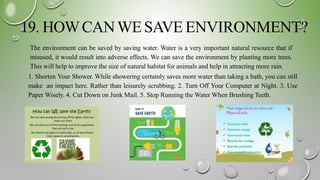
The environment can be saved by saving water. Water is a very important natural resource that if
misused, it would result into adverse effects. We can save the environment by planting more trees.
This will help to improve the size of natural habitat for animals and help in attracting more rain.
1. Shorten Your Shower. While showering certainly saves more water than taking a bath, you can still
make an impact here. Rather than leisurely scrubbing. 2. Turn Off Your Computer at Night. 3. Use
Paper Wisely. 4. Cut Down on Junk Mail. 5. Stop Running the Water When Brushing Teeth.
COMPONENTS
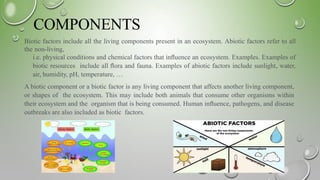
Biotic factors include all the living components present in an ecosystem. Abiotic factors refer to all
the non-living,
i.e. physical conditions and chemical factors that influence an ecosystem. Examples. Examples of
biotic resources include all flora and fauna. Examples of abiotic factors include sunlight, water,
air, humidity, pH, temperature, …
A biotic component or a biotic factor is any living component that affects another living component,
or shapes of the ecosystem. This may include both animals that consume other organisms within
their ecosystem and the organism that is being consumed. Human influence, pathogens, and disease
outbreaks are also included as biotic factors.

EVS.pptx

  • 1.
  • 2.
    1.RECYCLING: Ever since EarthDay was introduced to us way back in 1970, it’s been nice to see how so many of us are doing what we can to be environmentally responsible. For instance, in America alone, 1 in 50 people drive fuel-efficient vehicles (like a hybrid or an electric car), 1 in 2 individuals profess to turn off the lights whenever they leave a room and roughly 60 percent of individuals recycle (which is always a good thing!). In this world their is nothing that it should get waste every thing after it used get finished then it is used for different purpose ,but the thing recycle is different and reuse for different purpose is different . Generally we recycle things are plastic, glass, steel, pages, steel, wood, etc.
  • 3.
    2. LANDFILLS ● solidwaste landfills in developing countries: Africa, Asia, and Latin America. Monhanty, C. (2011). Reduce, Reuse and Recycle (the 3Rs) and Resource Efficiency as the basis for Sustainable Waste Management ● solid waste landfills in developing countries: Africa, Asia, and Latin America. Monhanty, C. (2011). Reduce, Reuse and Recycle (the 3Rs) and Resource Efficiency as the basis for Sustainable Waste Management
  • 4.
    3. CLIMATECHANGE. Climate changerefers to long-term shifts in temperatures and weather patterns. These shifts may be natural, such as through variations in the solar cycle. But since the 1800s, human activities have been the main driver of climate change, primarily due to burning fossil fuels like coal, oil and gas. Burning fossil fuels generates greenhouse gas emissions that act like a blanket wrapped around the Earth, trapping the sun’s heat and raising temperatures.
  • 5.
    4. LIFE CYCLEANALYSIS. Sowhat is a life cycle analysis (LCA), what do they tell us and why are they so important? In short, a life cycle analysis is the act of measuring the environmental impact of a product or service throughout its life cycle, from the resources used to create the product or service, across its use by the user, to it's final end of life destination. Life Cycle Perspective 1.In theory boundaries start from earth as the source, and return to earth as the sink. 2.Focus is on a product or service 3.Impact is evaluated at the receiver 4.Tracking is of materials 5.Time stands still 6. But this is hard to do
  • 6.
    5. ECOSYSTEM The ecosystemis the structural and functional unit of ecology where the living organisms interact with each other and the surrounding environment. In other words, an ecosystem is a chain of interactions between organisms and their environment. The term “Ecosystem” was first coined by A.G.Tansley, an English botanist, in 1935. Types of Ecosystem An ecosystem can be as small as an oasis in a desert, or as big as an ocean, spanning thousands of miles. There are two types of ecosystem: ● Terrestrial Ecosystem ● Aquatic Ecosystem
  • 7.
    6. BIODIVERSITY. “Biodiversity isthe variation among living organisms from different sources including terrestrial, marine and desert ecosystems, and the ecological complexes of which they are a part.” Their are three type of diversity : 1. Genetic Diversity. 2. Species Diversity 3. Ecologicaal Diversity.
  • 8.
    7. GLOBALWARMING Global warmingis the unusually rapid increase in Earths average surface temperature over the past century primarily due to the greenhouse gases released by people burning fossil fuels. Global warming is the unusually rapid increase in Earths average surface temperature over the past century primarily due to the greenhouse gases released as people burn fossil fuels.
  • 9.
    8. RESOURCEDEPLITION Resource Depletionis Consumption of a Resource faster than it can be Replenished. Natural Resources are commonly divided into Renewable Resources and Non-Renewable Resources. ● For depletion accounting to work, appropriate units of natural resources must be established so that natural resources can be viable in the market economy. ● Still, there is a consistent increase in the overall earth populace and this has been a critical factor in accelerating the depletion of natural resources. An increase in the populace expands the need for resources and conditions necessary to sustain it.
  • 10.
    9. SMOG Smog isstill a problem in many places. Everyone can do their part to reduce smog by changing a few behaviors, such as: Drive less. Walk, bike, carpool, and use public transportation whenever possible. Take care of cars. Smog, or smoke fog, is a type of intense air pollution. The word "smog" was coined in the early 20th century, and is a contraction ( portmanteau) of the words smoke and fog to refer to smoky fog due to its opacity, and odor.
  • 11.
    10. GREENHOUSEGASES A greenhousegas (GHG or GhG) is a gas that absorbs and emits radiant energy within the thermal infrared range, causing the greenhouse effect. The primary greenhouse gases in Earth's atmosphere are water vapor (H2O), carbon dioxide (CO2), methane (CH4), nitrous oxide (N2O), and ozone (O3). Without greenhouse gases, the average temperature of Earth's surface would be about −18 °C (0 °F), rather than the present average of 15 °C (59 °F).The atmospheres of Venus, Mars and Titan also contain greenhouse gases. Greenhouse effect is a natural process that warms the Earth's surface. Water vapor, carbon dioxide, methane, nitrous oxide, ozone are greenhouse gases.
  • 12.
    11.GREENHOUSEEFFECT A greenhouse isa house made of glass that can be used to grow plants. The sun’s radiations warm the plants and the air inside the greenhouse. The heat trapped inside can’t escape out and warms the greenhouse which is essential for the growth of the plants. Same is the case in the earth’s atmosphere. During the day the sun heats up the earth’s atmosphere. At night, when the earth cools down the heat is radiated back into the atmosphere. During this process, the heat is absorbed by the greenhouse gases in the earth’s atmosphere. This is what makes the surface of the earth warmer, that makes the survival of living beings on earth possible. However, due to the increased levels of greenhouse gases, the temperature of the earth has increased considerably.
  • 13.
    12. CARBONFOOTPRINT Carbon datingis one of the archaeology’s mainstream methods for dating organic objects up to 50,000 years old. This method is based on the idea of radiative decay of Carbon-14 isotopes over thousands of years. Through physics, scientists have discovered that radioactive molecules decay at a specific rate dependent on the atomic number and mass of the decaying atoms. This constant can be used to determine the approximate age of the decaying material through the ratio of radioactive isotopes to the estimated initial concentration of these isotopes at the time of the organism’s death. Scientists have concluded that very little change has occurred in the ratio of Carbon-12 to Carbon-14 isotopes in the atmosphere meaning that the relationship between these two should be very similar to how they remain today.
  • 14.
    13.WETLANDS What is aWetland? Wetlands are areas where water covers the soil, or is present either at or near the surface of the soil all year or for varying periods of time during the year, including during the growing season. Wetlands International. We are the global not-for-profit organization dedicated to the conservation and restoration of wetlands. Wetlands are the source of water that supports all forms of life. Despite our efforts to promote their importance, loss and damage to wetlands and their biodiversity continues.
  • 15.
    14.ECOLOGY Types, Importance AndExamples Of Ecology What is Ecology? Ecology is a branch of science, including human science, population, community, ecosystem and biosphere. Ecology is the study of organisms, the environment and how the organisms interact with each other and their environment. Behavioural ecology is the study of an organism's behaviour in its environment and its ecological and evolutionary implications. Ethology is the study of observable movement or behaviour in animals.
  • 16.
    15.BIOMASS Biomass contains storedchemical energy from the sun. Plants produce biomass through photosynthesis. Biomass can be burned directly for heat or converted to renewable liquid and gaseous fuels through various processes. Biomass sources for energy include: (singular: bacterium) single-celled organisms found in every ecosystem on Earth. type of charcoal frequently used in agriculture, produced by the pyrolysis of biomass. fuel made at least partly from renewable sources such as soy oil, palm oil, or animal fats. energy source derived directly from organic matter, such as plants.
  • 17.
    16. FOSSILFUELS “Fossil fuelsare the fuels formed by natural processes such as decomposition of dead and buried organisms. “ What are Fossil Fuels? Fossil fuels are buried flammable geologic deposits of organic substances such as dead plants and animals that got deposited under several thousand feet of silt. These fuels are found in the Earth’s crust and contain carbon and hydrogen, which can be burned for energy. Coal, oil, and natural gas are examples of fossil fuels. Coal is a material usually found in sedimentary rock deposits where rock and dead plant and animal matter are piled up in layers.
  • 18.
    17. BIODEGRADABLEMATERIAL A BiodegradableMaterial can be defined as a Material which can be Decomposed by Bacteria or other natural organism and not be Adding to Pollution. The main types of biodegradable materials are polymers, metals and ceramics. This article will briefly review their synthesis, degradation, advantages/disadvantages and clinical application.
  • 19.
    18. HOWCAN WEPRESERVE BIODIVERSITY? 10 ways how we can protect biodiversity. 1. Government legislation. Governments have the power to control what is done to the habitats within their country. Legislation that protects nature. 2 Nature preserves. 3. Reducing amount of invasive species. 4. Habitat restoration. 5. Captive breeding and seed banks. Respect local habitats. Plants growing in the parks and nature preserves near you often play an important role in preserving the local ecosystem. When you’re outdoors, protect local biodiversity by sticking to the walking path or hiking trail.
  • 20.
    19. HOWCANWE SAVEENVIRONMENT? The environment can be saved by saving water. Water is a very important natural resource that if misused, it would result into adverse effects. We can save the environment by planting more trees. This will help to improve the size of natural habitat for animals and help in attracting more rain. 1. Shorten Your Shower. While showering certainly saves more water than taking a bath, you can still make an impact here. Rather than leisurely scrubbing. 2. Turn Off Your Computer at Night. 3. Use Paper Wisely. 4. Cut Down on Junk Mail. 5. Stop Running the Water When Brushing Teeth.
  • 21.
    COMPONENTS Biotic factors includeall the living components present in an ecosystem. Abiotic factors refer to all the non-living, i.e. physical conditions and chemical factors that influence an ecosystem. Examples. Examples of biotic resources include all flora and fauna. Examples of abiotic factors include sunlight, water, air, humidity, pH, temperature, … A biotic component or a biotic factor is any living component that affects another living component, or shapes of the ecosystem. This may include both animals that consume other organisms within their ecosystem and the organism that is being consumed. Human influence, pathogens, and disease outbreaks are also included as biotic factors.