CHAPTER 7
PUBLICITY AND MEDIA
RELATIONS
1
Learning Objectives
2
1. Explain the definition of publicity
2. Discuss some publicity tools and the media
outlets used
3. Discuss the importance of media relations and
rules of good media relations
4. Explain the criteria needed when choosing
your company’s spokeperson(s) and training
them their role
5. Explain the guidelines on how to handle media
interviews.
Definition
3
 Publicity is information about an event, an
individual or group or a product, disseminated
through the news media and other channels to
attract favorable public notice
Wilcox et. al. (1995)
Other Definition of Publicity
4
 Publicity, through news releases and other
methods, is design to broaden knowledge and
positive recognition of an organization, its
personnel and its activities.
 Publicity is information about an organization
that is carried as editorial (not advertising)
content in publication or news medium.
How to gain Publicity
5
Publicity is gained by dealing directly with media ,either
by initiating the communication or by reacting to inquiries.
 Publicity tells your organization’s story through some
form of media.
 Messages about product, service, person or idea is
prepared strictly within parameters of broadcast news
 This messages is distributed to news department
without any form of payment.
 Publicity is uncontrolled information that is subject to
the new editors’ review and change
How to gain Publicity
6
 PR deals with editorial department not advertising
department.
 PR story is published because it is worth printing.
 Reporters rely on Public Relations personnel to get news
because they don’t have access to top executives of an
organization.
 Successful publicity events have real news value; appeal
to media gatekeepers, offer photo, video or sound
recording opportunities and communicate the source’s
intended message.
Two overriding factors of
publicity7
1. Minimal cost
Publicity cost only the time and effort
expanded by public relations personnel and
management in the media placement’s
attempt.
2. Endorsement value
Perceived to carry the endorsement of the
publication in which it appears. This translate
to credibility of the organization.
Publicity Tools
8
Information release
News/press/publicity releases
• Format is build around information drawn from situation that
already exist therefore it is inexpensive and widely used.
• Story include new products/services, products/services
improvements, favorable test result, significant contract awards,
innovation, case history of successful usage situation.
• In news release, several key points need to be incorporated
such as:
• (1) Subject / Audience, (2) Organizations, (3) Locations, (4)
Advantages & (5) Source
Publicity Tools
9
Special/ Staged Events/ Publicity stunts.
Press tours, plants tours, newsworthy company projects,
commercially sponsored news happenings and etc.
• Newsworthy situation created to generate press, radio or T.V.
coverage.
• i.e.of news happening- publicizing ‘mascot’ or ‘ambassador’
for an event or organization, contests, movie premiere
• i.e. of Press tour- Putrajaya Government Administration site,
Commonwealth Games site at Bukit Jalil
• i.e. of Newsworthy Company Projects- Humanitarian Fund,
Tabung Barisan Bertindak Kosovo, Tabung Palestin
Publicity Tools
10
Participation
• Promotional opportunity
residing in an event or
setting that presumably
does not inherent to your
brand but possess high
audience appeal.
• e.g. a clip of product in a
movie
Press Reception.
• An organized social
event with mini bar,
buffet, or lunch and a
program of talks,
demonstrations and
audio visuals
presentations.
Publicity Tools
11
Press/ News Conferences.
• Offer news and forum for exchange of information.
• Used only if information cannot be disseminated through
some other mechanism like publicity release.
• E.g. Major product announcement, a complex issue
demands forum for question and answer.
Publicity Tools
12
Media Interviews / Talk Shows
• Whether one-on-one or part of panel of experts.
• Opportunity for media to have good stories, and for
organization to convey key messages
• Spokesperson need to be coached on interview
techniques to face some times combative style of
journalist.
• i.e. The exchange, Money Matters
13
MEDIA CATEGORIES
&
MEDIA RELATION
Media Categories / Outlets
14
NEWSPAPER
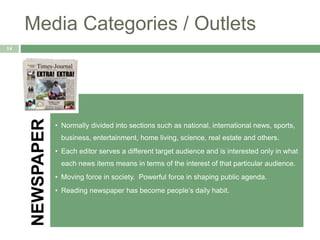
• Normally divided into sections such as national, international news, sports,
business, entertainment, home living, science, real estate and others.
• Each editor serves a different target audience and is interested only in what
each news items means in terms of the interest of that particular audience.
• Moving force in society. Powerful force in shaping public agenda.
• Reading newspaper has become people’s daily habit.
Media Categories / Outlets
15
NEWSPAPER
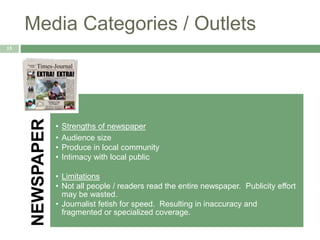
• Strengths of newspaper
• Audience size
• Produce in local community
• Intimacy with local public
• Limitations
• Not all people / readers read the entire newspaper. Publicity effort
may be wasted.
• Journalist fetish for speed. Resulting in inaccuracy and
fragmented or specialized coverage.
Media Categories / Outlets
16
NEWSLETT
ER
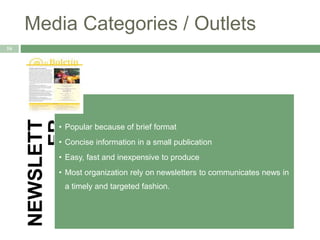
• Popular because of brief format
• Concise information in a small publication
• Easy, fast and inexpensive to produce
• Most organization rely on newsletters to communicates news in
a timely and targeted fashion.
Media categories
17
MAGAZINES
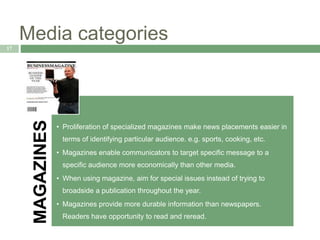
• Proliferation of specialized magazines make news placements easier in
terms of identifying particular audience. e.g. sports, cooking, etc.
• Magazines enable communicators to target specific message to a
specific audience more economically than other media.
• When using magazine, aim for special issues instead of trying to
broadside a publication throughout the year.
• Magazines provide more durable information than newspapers.
Readers have opportunity to read and reread.
Media categories
18
RADIO
• The broadcast range is important factor in deciding your news
placements
• Understand the product line of each station in deciding which
station to use
• Use ‘call-in-talk-show’ to explain issues to public
• Specialized radio-program. Opportunities to present subject
matter or expert talking about consumer items, technology or farm
related topics.
Media categories19
TELEVISIO
N
• Great force and scope as a publicity medium.
• Provide window to the world. Live coverage.
• The prime source of news and entertainment.
• TV’s influence is pervasive because time spent on watching
TV is more compare to other medium.
• Talk-show provide an excellent medium for subject matter
experts if they are well trained to talk about, demonstrate and
respond to an issue.
Media Communication
Channels20
 Internal media for internal audiences
 Special magazines, newsletter, power-point
presentations, meetings, in-house displays and
exhibits, posters, flyers, memos.
 External media for external audiences
 Newspaper, magazines, TV, radio, billboards,
trade show exhibits
Publication Categories
21
 3 categories of publications that carry publicity
directly to audiences
 Organizational publications
 Organizational magazines, house publications
 Industry publications
 Periodicals
 Trade or Association publication
 Labor union newspaper, religious magazines,
professional publication
Media Relations
22
From publicity definitions, it is clear that the media
are
important tools for disseminating information about
an
organization. How do organizations get the media
to
cooperate with and assist them in achieving their
publicity goals?
Have knowledge about the media
 How to work with each medium
 Producing content for each medium while always
keeping in mind their deadlines
Media Relations
23
Peter Seldom Green (1994) gives two starting
points for
public relations professionals involved in media
relations
works:
1. You must recognize that media have their own
needs and doing a favor for PR people is not
one of them. They will use information that is
provided because they want to, not because we
want them to.
2. We should try putting ourselves in the position
of the journalist who will consider if our news
story, feature article, etc will have any interest
Media Relations
24
Several key tasks for media relations people:
1. To source information on media and maintain up-to-date
files / subscribe to media information service.
2. To maintain personal contact with editors relevant to your
work.
3. Up-to-date with new media and developments. Aware of
all useful reference materials on media.
4. Maintain updated information on key contacts in the
media through personal liaison.
5. Keep abreast with the new channel of communication
and evaluate the relevance for public relations
practitioner.
6. Coordinate advance editorial schedules for print media
and broadcast media.
Importance of Media Relations
25
Good media partnership can do the followings:
1. Build confidence in your organization integrity.
2. Build recognition factor so that press release will
be given the attention.
3. Establish personal relationship. Editor or reporter
willingness to present your side of the story.
Rules of Good Media Relations
26
SHOOT SQUARELY
• Be honest when dealing with the media.
• Never deceive, speak the truth.
• If practitioners are honest with bad news,
they are more likely to be trusted with
good news.
• Do not favor one news outlet over the
other.
Rules of Good Media Relations
27
GIVE SERVICE
• Provide newsworthy, interesting and
timely stories that the media want when
they want them and in the form they can
readily used.
• Practitioners must know and adhere to
media requirements
Rules of Good Media Relations
28
DO NOT BEG OR CARP
• Do not beg to have stories used or
complaint about story treatment.
• Do not pressure the editorial side by
holding hostage the organization’s
advertising business.
Rules of Good Media Relations
29
DO NOT ASK FOR KILLS
• Do not ask media to suppress or kill a
story. It seldom work, unprofessional
and brings only ill will.
• Ask for delay in publication, or ask for a
correction if the situation has merit.
Rules of Good Media Relations
30
DO NOT FLOOD THE
MEDIA
• Be more selective with news offerings
• Keep your mailing list current.
• Send to only one journalist at each news
medium.
Basic assumption for working with the
media (12 assumptions)
31
1. Always tell the truth. Information about your product is always
accurate.
2. Know your outlet before you call. Knowing the newspaper or
magazine or the reporter’s beat.
3. Attitude-wise. Be warm, polite, professional and clear in your
communication.
4. Believe in your story. See yourself as a resource for news and
information.
5. Do not waste their time. Keep it brief, respect the deadlines.
6. Personalize. Send brief cover notes not photocopied pitch letters.
Basic assumption for working with the
media32
7. Listen to the editor. Be sensitive to any verbal feedback, cues and
clues so that you can fine tuned your pitch.
8. Respect the no and prepare for it. If your story is rejected, find out why
and try to present from different angle.
9. When you get the final ‘no’, let it go. Do not take it personally.
10. Be someone who is not always out there to get something.
11. Get out from behind your desk. Know your journalist.
12. Get beyond voice mail. Leave a succinct, proactive and targeted
message.
Choosing and training a
spokesperson33
CHARACTERISTICS of a spokesperson:
1. Knowledge of the topic to be discussed with the reporter.
2. Understand the organizations overall objectives and strategies. Be
prepared for unpredictable questions from the reporter. Need someone
who can think quickly and gracefully and being responsive to the
reporters need.
3. Ability to tell what he or she knows. Proficient in language used and
able to present ideas that is understood by the reporters and stations
audience.
4. Have the confidence of top management. Must be well respected by
those within the organization.
Preparing spokesperson for
interview34
Spokesperson needs to be brief on the following information before
the interviewing session (9 tips) :
1. Date, time, place and length of interview.
2. Type of story the reporter is working on. Is it in depth feature of your
organization or a piece of survey on your industry?
3. What the reporter wants from the interview? e.g. quotation on corporate
objectives, general sales plan for new product or organization’s opinion of
a new community developments.
4. What information you have provided to the reporter? e.g. annual report, list
of product and services and etc. Let the spokesperson expand on what
has been said rather than repeating it.
Preparing spokesperson for
interview35
5. Background of the reporter.
- does the reporter regularly write about organization?
- does he or she understand your business?
- what is his or her interviewing style?
6. Special arrangement if photography session is involved.
7. Suggestions of 2-3point the s/person should raise in the interview.
8. Advice on handling the media interview (next subtopic)
9. Insist the need to get together to review on anticipated questions and
possible answers before the interview.
Handling Media Interview (22
tips)36
1. Remember, you are always on the defensive side but if properly
handled, you will score/do fine.
2. Never go into media interview unprepared. Have discussion with PR
professional, media trainer or trusted counsel.
3. Have an agenda to raise during the interview. Raise the point at
appropriate time even it was not ask by the reporter.
4. The medium determines the message. Take your time to answer
newspaper interviews and answer promptly for radio or television
interview.
Handling Media Interview
37
5. Never assume that your agenda and the reporter’s agenda are alike.
Reporter’s question may have a wider scope. Try to build a bridge
between two agenda.
6. You are not obliged to reveal confidential information but do not
answer with ‘no comment’.
7. Be friendly, be brief and be positive.
8. Avoid jargon, speak plainly and use examples and illustrations
expressed in simple terms.
9. Stay composed at all times. Stick to your point of view with short and
clear answer.
Handling Media Interview
38
10. Say what you have to say, then stop. Let the reporters come up with
the next question.
11. Dress conservatively. Do not let your wardrobe overwhelm your
words.
12. Always reply with a brief answer and then add a point preferably from
your prepared agenda.
13. You can ask the reporter to review his text of interview but not the
writing styles.
14. Stay cool and never follow the journalist inflammatory mood or
approach.
Handling Media Interview
39
15. If reporters uses negative, hypothetical or incorrect words , don’t
legitimize them by repeating in your answer
16. Develop three levels of ‘tiers’ of an answer to the most difficult
question.
i. Short summary
ii. Concrete example
iii. Further elaboration
17. Audience have short attention span, so simplify for the media.
Handling Media Interview
40
18. Do not give in to pressure to go beyond the bounds of your stated
position.
19. Do not make ‘off the record’ statements.
20. Control your wisecracking instincts.
21. Do not be concerned into meeting a reporter’s deadline if it forces you
to provide incomplete or unsubstantiated facts.
22. Be extra careful with media request over the phone. Check out the
reporter, what he wants and why he might want it.
11 extra Tips for Handling Media
Interview
41
1. Breath.
2. Be concrete.
3. Don’t lie, if you don’t know, say so.
4. Avoid making negative comparison to others.
5. If you don’t present the other side of the story, someone else will.
6. Know yourself.
7. Listen carefully before you talk.
8. Passion is contagious and smiling is underused.
9. Talk only about what you know. Be an expert.
10. This is a business transaction, not a conversation.
11. You are responsible for the answers, not the questions.
Additional hints for Radio
42
 Have your points written out and handy where you can see them be
careful not to crackle the pages.
 Shorten your sentences and eliminate difficult phrases to avoid situation
like reading prepared response.
 Speak in a conversational tone as you would with a friend on the phone.
Gesture as you are having a normal conversation.
 Be cautious with the microphone. Do not tap the microphones as there
are audio crew who is going to handle it.
Additional hints for News
Conference43
 Familiarize yourself with the set up. Come to the room several hours
before the conference. Work out signals with media relations people as
cues to check on your performance in handling the session.
 Do not mingle with reporters before the news conference begin.
 Ignore many microphone, do not ask if everyone can hear you.
 Begin with formal remarks, follow media kit materials and do not become
‘long-winded’.
Additional hints for News
Conference44
 Open up session to questions. Invite questions. Point to reporters known
to you.
 Establish eye contact while answering question.
 Do not hesitate to repeat your answers
 Thanks the reporters
 Mingle with the reporters after the interview in case they want further
clarification or on-camera shots.
Interview No-nos
45
 Don’t ask if you can review the story in advance or change the way it is
treated.
 Don’t try to threaten the media by stressing that your organization give
good advertising business to them.
 Don’t tell the broadcast people that time is limited for you to give a good
response to their questions.
46
An effective interview will enhance
media contact, develop / solidify an
“expert” image, increase visibility and
promote your practice.

Chapter 7 PUBLIC RELATION

  • 1.
    CHAPTER 7 PUBLICITY ANDMEDIA RELATIONS 1
  • 2.
    Learning Objectives 2 1. Explainthe definition of publicity 2. Discuss some publicity tools and the media outlets used 3. Discuss the importance of media relations and rules of good media relations 4. Explain the criteria needed when choosing your company’s spokeperson(s) and training them their role 5. Explain the guidelines on how to handle media interviews.
  • 3.
    Definition 3  Publicity isinformation about an event, an individual or group or a product, disseminated through the news media and other channels to attract favorable public notice Wilcox et. al. (1995)
  • 4.
    Other Definition ofPublicity 4  Publicity, through news releases and other methods, is design to broaden knowledge and positive recognition of an organization, its personnel and its activities.  Publicity is information about an organization that is carried as editorial (not advertising) content in publication or news medium.
  • 5.
    How to gainPublicity 5 Publicity is gained by dealing directly with media ,either by initiating the communication or by reacting to inquiries.  Publicity tells your organization’s story through some form of media.  Messages about product, service, person or idea is prepared strictly within parameters of broadcast news  This messages is distributed to news department without any form of payment.  Publicity is uncontrolled information that is subject to the new editors’ review and change
  • 6.
    How to gainPublicity 6  PR deals with editorial department not advertising department.  PR story is published because it is worth printing.  Reporters rely on Public Relations personnel to get news because they don’t have access to top executives of an organization.  Successful publicity events have real news value; appeal to media gatekeepers, offer photo, video or sound recording opportunities and communicate the source’s intended message.
  • 7.
    Two overriding factorsof publicity7 1. Minimal cost Publicity cost only the time and effort expanded by public relations personnel and management in the media placement’s attempt. 2. Endorsement value Perceived to carry the endorsement of the publication in which it appears. This translate to credibility of the organization.
  • 8.
    Publicity Tools 8 Information release News/press/publicityreleases • Format is build around information drawn from situation that already exist therefore it is inexpensive and widely used. • Story include new products/services, products/services improvements, favorable test result, significant contract awards, innovation, case history of successful usage situation. • In news release, several key points need to be incorporated such as: • (1) Subject / Audience, (2) Organizations, (3) Locations, (4) Advantages & (5) Source
  • 9.
    Publicity Tools 9 Special/ StagedEvents/ Publicity stunts. Press tours, plants tours, newsworthy company projects, commercially sponsored news happenings and etc. • Newsworthy situation created to generate press, radio or T.V. coverage. • i.e.of news happening- publicizing ‘mascot’ or ‘ambassador’ for an event or organization, contests, movie premiere • i.e. of Press tour- Putrajaya Government Administration site, Commonwealth Games site at Bukit Jalil • i.e. of Newsworthy Company Projects- Humanitarian Fund, Tabung Barisan Bertindak Kosovo, Tabung Palestin
  • 10.
    Publicity Tools 10 Participation • Promotionalopportunity residing in an event or setting that presumably does not inherent to your brand but possess high audience appeal. • e.g. a clip of product in a movie Press Reception. • An organized social event with mini bar, buffet, or lunch and a program of talks, demonstrations and audio visuals presentations.
  • 11.
    Publicity Tools 11 Press/ NewsConferences. • Offer news and forum for exchange of information. • Used only if information cannot be disseminated through some other mechanism like publicity release. • E.g. Major product announcement, a complex issue demands forum for question and answer.
  • 12.
    Publicity Tools 12 Media Interviews/ Talk Shows • Whether one-on-one or part of panel of experts. • Opportunity for media to have good stories, and for organization to convey key messages • Spokesperson need to be coached on interview techniques to face some times combative style of journalist. • i.e. The exchange, Money Matters
  • 13.
  • 14.
    Media Categories /Outlets 14 NEWSPAPER • Normally divided into sections such as national, international news, sports, business, entertainment, home living, science, real estate and others. • Each editor serves a different target audience and is interested only in what each news items means in terms of the interest of that particular audience. • Moving force in society. Powerful force in shaping public agenda. • Reading newspaper has become people’s daily habit.
  • 15.
    Media Categories /Outlets 15 NEWSPAPER • Strengths of newspaper • Audience size • Produce in local community • Intimacy with local public • Limitations • Not all people / readers read the entire newspaper. Publicity effort may be wasted. • Journalist fetish for speed. Resulting in inaccuracy and fragmented or specialized coverage.
  • 16.
    Media Categories /Outlets 16 NEWSLETT ER • Popular because of brief format • Concise information in a small publication • Easy, fast and inexpensive to produce • Most organization rely on newsletters to communicates news in a timely and targeted fashion.
  • 17.
    Media categories 17 MAGAZINES • Proliferationof specialized magazines make news placements easier in terms of identifying particular audience. e.g. sports, cooking, etc. • Magazines enable communicators to target specific message to a specific audience more economically than other media. • When using magazine, aim for special issues instead of trying to broadside a publication throughout the year. • Magazines provide more durable information than newspapers. Readers have opportunity to read and reread.
  • 18.
    Media categories 18 RADIO • Thebroadcast range is important factor in deciding your news placements • Understand the product line of each station in deciding which station to use • Use ‘call-in-talk-show’ to explain issues to public • Specialized radio-program. Opportunities to present subject matter or expert talking about consumer items, technology or farm related topics.
  • 19.
    Media categories19 TELEVISIO N • Greatforce and scope as a publicity medium. • Provide window to the world. Live coverage. • The prime source of news and entertainment. • TV’s influence is pervasive because time spent on watching TV is more compare to other medium. • Talk-show provide an excellent medium for subject matter experts if they are well trained to talk about, demonstrate and respond to an issue.
  • 20.
    Media Communication Channels20  Internalmedia for internal audiences  Special magazines, newsletter, power-point presentations, meetings, in-house displays and exhibits, posters, flyers, memos.  External media for external audiences  Newspaper, magazines, TV, radio, billboards, trade show exhibits
  • 21.
    Publication Categories 21  3categories of publications that carry publicity directly to audiences  Organizational publications  Organizational magazines, house publications  Industry publications  Periodicals  Trade or Association publication  Labor union newspaper, religious magazines, professional publication
  • 22.
    Media Relations 22 From publicitydefinitions, it is clear that the media are important tools for disseminating information about an organization. How do organizations get the media to cooperate with and assist them in achieving their publicity goals? Have knowledge about the media  How to work with each medium  Producing content for each medium while always keeping in mind their deadlines
  • 23.
    Media Relations 23 Peter SeldomGreen (1994) gives two starting points for public relations professionals involved in media relations works: 1. You must recognize that media have their own needs and doing a favor for PR people is not one of them. They will use information that is provided because they want to, not because we want them to. 2. We should try putting ourselves in the position of the journalist who will consider if our news story, feature article, etc will have any interest
  • 24.
    Media Relations 24 Several keytasks for media relations people: 1. To source information on media and maintain up-to-date files / subscribe to media information service. 2. To maintain personal contact with editors relevant to your work. 3. Up-to-date with new media and developments. Aware of all useful reference materials on media. 4. Maintain updated information on key contacts in the media through personal liaison. 5. Keep abreast with the new channel of communication and evaluate the relevance for public relations practitioner. 6. Coordinate advance editorial schedules for print media and broadcast media.
  • 25.
    Importance of MediaRelations 25 Good media partnership can do the followings: 1. Build confidence in your organization integrity. 2. Build recognition factor so that press release will be given the attention. 3. Establish personal relationship. Editor or reporter willingness to present your side of the story.
  • 26.
    Rules of GoodMedia Relations 26 SHOOT SQUARELY • Be honest when dealing with the media. • Never deceive, speak the truth. • If practitioners are honest with bad news, they are more likely to be trusted with good news. • Do not favor one news outlet over the other.
  • 27.
    Rules of GoodMedia Relations 27 GIVE SERVICE • Provide newsworthy, interesting and timely stories that the media want when they want them and in the form they can readily used. • Practitioners must know and adhere to media requirements
  • 28.
    Rules of GoodMedia Relations 28 DO NOT BEG OR CARP • Do not beg to have stories used or complaint about story treatment. • Do not pressure the editorial side by holding hostage the organization’s advertising business.
  • 29.
    Rules of GoodMedia Relations 29 DO NOT ASK FOR KILLS • Do not ask media to suppress or kill a story. It seldom work, unprofessional and brings only ill will. • Ask for delay in publication, or ask for a correction if the situation has merit.
  • 30.
    Rules of GoodMedia Relations 30 DO NOT FLOOD THE MEDIA • Be more selective with news offerings • Keep your mailing list current. • Send to only one journalist at each news medium.
  • 31.
    Basic assumption forworking with the media (12 assumptions) 31 1. Always tell the truth. Information about your product is always accurate. 2. Know your outlet before you call. Knowing the newspaper or magazine or the reporter’s beat. 3. Attitude-wise. Be warm, polite, professional and clear in your communication. 4. Believe in your story. See yourself as a resource for news and information. 5. Do not waste their time. Keep it brief, respect the deadlines. 6. Personalize. Send brief cover notes not photocopied pitch letters.
  • 32.
    Basic assumption forworking with the media32 7. Listen to the editor. Be sensitive to any verbal feedback, cues and clues so that you can fine tuned your pitch. 8. Respect the no and prepare for it. If your story is rejected, find out why and try to present from different angle. 9. When you get the final ‘no’, let it go. Do not take it personally. 10. Be someone who is not always out there to get something. 11. Get out from behind your desk. Know your journalist. 12. Get beyond voice mail. Leave a succinct, proactive and targeted message.
  • 33.
    Choosing and traininga spokesperson33 CHARACTERISTICS of a spokesperson: 1. Knowledge of the topic to be discussed with the reporter. 2. Understand the organizations overall objectives and strategies. Be prepared for unpredictable questions from the reporter. Need someone who can think quickly and gracefully and being responsive to the reporters need. 3. Ability to tell what he or she knows. Proficient in language used and able to present ideas that is understood by the reporters and stations audience. 4. Have the confidence of top management. Must be well respected by those within the organization.
  • 34.
    Preparing spokesperson for interview34 Spokespersonneeds to be brief on the following information before the interviewing session (9 tips) : 1. Date, time, place and length of interview. 2. Type of story the reporter is working on. Is it in depth feature of your organization or a piece of survey on your industry? 3. What the reporter wants from the interview? e.g. quotation on corporate objectives, general sales plan for new product or organization’s opinion of a new community developments. 4. What information you have provided to the reporter? e.g. annual report, list of product and services and etc. Let the spokesperson expand on what has been said rather than repeating it.
  • 35.
    Preparing spokesperson for interview35 5.Background of the reporter. - does the reporter regularly write about organization? - does he or she understand your business? - what is his or her interviewing style? 6. Special arrangement if photography session is involved. 7. Suggestions of 2-3point the s/person should raise in the interview. 8. Advice on handling the media interview (next subtopic) 9. Insist the need to get together to review on anticipated questions and possible answers before the interview.
  • 36.
    Handling Media Interview(22 tips)36 1. Remember, you are always on the defensive side but if properly handled, you will score/do fine. 2. Never go into media interview unprepared. Have discussion with PR professional, media trainer or trusted counsel. 3. Have an agenda to raise during the interview. Raise the point at appropriate time even it was not ask by the reporter. 4. The medium determines the message. Take your time to answer newspaper interviews and answer promptly for radio or television interview.
  • 37.
    Handling Media Interview 37 5.Never assume that your agenda and the reporter’s agenda are alike. Reporter’s question may have a wider scope. Try to build a bridge between two agenda. 6. You are not obliged to reveal confidential information but do not answer with ‘no comment’. 7. Be friendly, be brief and be positive. 8. Avoid jargon, speak plainly and use examples and illustrations expressed in simple terms. 9. Stay composed at all times. Stick to your point of view with short and clear answer.
  • 38.
    Handling Media Interview 38 10.Say what you have to say, then stop. Let the reporters come up with the next question. 11. Dress conservatively. Do not let your wardrobe overwhelm your words. 12. Always reply with a brief answer and then add a point preferably from your prepared agenda. 13. You can ask the reporter to review his text of interview but not the writing styles. 14. Stay cool and never follow the journalist inflammatory mood or approach.
  • 39.
    Handling Media Interview 39 15.If reporters uses negative, hypothetical or incorrect words , don’t legitimize them by repeating in your answer 16. Develop three levels of ‘tiers’ of an answer to the most difficult question. i. Short summary ii. Concrete example iii. Further elaboration 17. Audience have short attention span, so simplify for the media.
  • 40.
    Handling Media Interview 40 18.Do not give in to pressure to go beyond the bounds of your stated position. 19. Do not make ‘off the record’ statements. 20. Control your wisecracking instincts. 21. Do not be concerned into meeting a reporter’s deadline if it forces you to provide incomplete or unsubstantiated facts. 22. Be extra careful with media request over the phone. Check out the reporter, what he wants and why he might want it.
  • 41.
    11 extra Tipsfor Handling Media Interview 41 1. Breath. 2. Be concrete. 3. Don’t lie, if you don’t know, say so. 4. Avoid making negative comparison to others. 5. If you don’t present the other side of the story, someone else will. 6. Know yourself. 7. Listen carefully before you talk. 8. Passion is contagious and smiling is underused. 9. Talk only about what you know. Be an expert. 10. This is a business transaction, not a conversation. 11. You are responsible for the answers, not the questions.
  • 42.
    Additional hints forRadio 42  Have your points written out and handy where you can see them be careful not to crackle the pages.  Shorten your sentences and eliminate difficult phrases to avoid situation like reading prepared response.  Speak in a conversational tone as you would with a friend on the phone. Gesture as you are having a normal conversation.  Be cautious with the microphone. Do not tap the microphones as there are audio crew who is going to handle it.
  • 43.
    Additional hints forNews Conference43  Familiarize yourself with the set up. Come to the room several hours before the conference. Work out signals with media relations people as cues to check on your performance in handling the session.  Do not mingle with reporters before the news conference begin.  Ignore many microphone, do not ask if everyone can hear you.  Begin with formal remarks, follow media kit materials and do not become ‘long-winded’.
  • 44.
    Additional hints forNews Conference44  Open up session to questions. Invite questions. Point to reporters known to you.  Establish eye contact while answering question.  Do not hesitate to repeat your answers  Thanks the reporters  Mingle with the reporters after the interview in case they want further clarification or on-camera shots.
  • 45.
    Interview No-nos 45  Don’task if you can review the story in advance or change the way it is treated.  Don’t try to threaten the media by stressing that your organization give good advertising business to them.  Don’t tell the broadcast people that time is limited for you to give a good response to their questions.
  • 46.
    46 An effective interviewwill enhance media contact, develop / solidify an “expert” image, increase visibility and promote your practice.