1
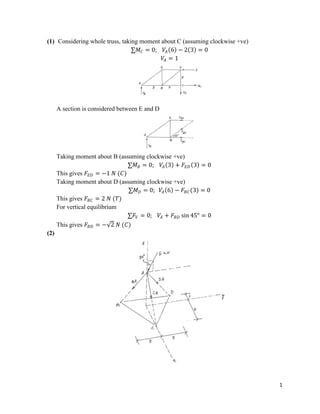
(1) Considering whole truss, taking moment about C (assuming clockwise +ve)
∑𝑀𝐶 = 0; 𝑉𝐴 6 − 2 3 = 0
𝑉𝐴 = 1
A section is considered between E and D
Taking moment about B (assuming clockwise +ve)
∑𝑀𝐵 = 0; 𝑉𝐴 3 + 𝐹𝐸𝐷 3 = 0
This gives 𝐹𝐸𝐷 = −1 𝑁 (𝐶)
Taking moment about D (assuming clockwise +ve)
∑𝑀𝐷 = 0; 𝑉𝐴 6 − 𝐹𝐵𝐶(3) = 0
This gives 𝐹𝐵𝐶 = 2 𝑁 (𝑇)
For vertical equilibrium
∑𝐹𝑉 = 0; 𝑉𝐴 + 𝐹𝐵𝐷 sin 45° = 0
This gives 𝐹𝐵𝐷 = − 2 𝑁 (𝐶)
(2)
2
BA = BA
−𝑖−3𝑗−6𝑘
12+33+62
= BA
−𝑖−3𝑗−6𝑘
46
CA = CA
2𝑖−6𝑘
22+62
= CA
2𝑖−6𝑘
40
DA = DA
−𝑖+3𝑗−6𝑘
12+3262
= DA
−𝑖+3𝑗−6𝑘
46
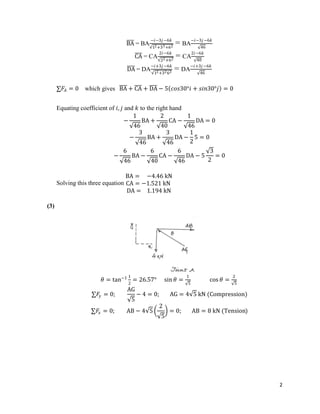
∑𝐹𝐴 = 0 which gives BA + CA + DA − 5 𝑐𝑜𝑠30°𝑖 + 𝑠𝑖𝑛30°𝑗 = 0
Equating coefficient of 𝑖, 𝑗 and 𝑘 to the right hand
−
1
46
BA +
2
40
CA −
1
46
DA = 0
−
3
46
BA +
3
46
DA −
1
2
5 = 0
−
6
46
BA −
6
40
CA −
6
46
DA − 5
3
2
= 0
Solving this three equation
BA = −4.46 kN
CA = −1.521 kN
DA = 1.194 kN
(3)
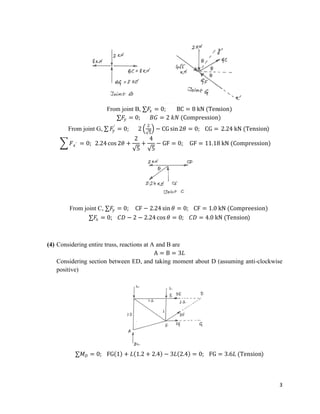
𝜃 = tan−1 1
2
= 26.57° sin 𝜃 =
1
5
cos 𝜃 =
2
5
∑𝐹
𝑦 = 0;
AG
5
− 4 = 0; AG = 4 5 kN (Compression)
∑𝐹
𝑥 = 0; AB − 4 5
2
5
= 0; AB = 8 kN (Tension)
3
From joint B, ∑𝐹
𝑥 = 0; BC = 8 kN (Tension)
∑𝐹
𝑦 = 0; 𝐵𝐺 = 2 𝑘𝑁 (Compression)
From joint G, ∑ 𝐹
𝑦
′
= 0; 2
2
5
− CG sin 2𝜃 = 0; CG = 2.24 kN (Tension)
𝐹𝑥′ = 0; 2.24 cos 2𝜃 +
2
5
+
4
5
− GF = 0; GF = 11.18 kN (Compression)
From joint C, ∑𝐹
𝑦 = 0; CF − 2.24 sin 𝜃 = 0; CF = 1.0 kN (Compreesion)
∑𝐹𝑥 = 0; 𝐶𝐷 − 2 − 2.24 cos 𝜃 = 0; 𝐶𝐷 = 4.0 kN (Tension)
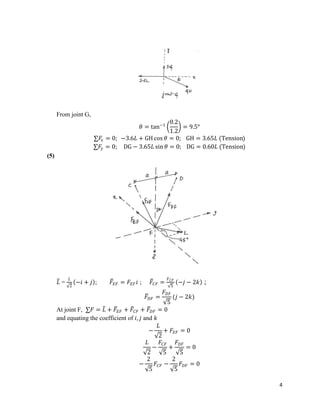
(4) Considering entire truss, reactions at A and B are
A = B = 3𝐿
Considering section between ED, and taking moment about D (assuming anti-clockwise
positive)
∑𝑀𝐷 = 0; FG 1 + 𝐿 1.2 + 2.4 − 3𝐿 2.4 = 0; FG = 3.6𝐿 (Tension)
4
From joint G,
𝜃 = tan−1
0.2
1.2
= 9.5°
∑𝐹
𝑥 = 0; −3.6𝐿 + GH cos 𝜃 = 0; GH = 3.65𝐿 (Tension)
∑𝐹
𝑦 = 0; DG − 3.65𝐿 sin 𝜃 = 0; DG = 0.60𝐿 (Tension)
(5)
𝐿 =
𝐿
2
−𝑖 + 𝑗 ; 𝐹𝐸𝐹 = 𝐹𝐸𝐹𝑖 ; 𝐹𝐶𝐹 =
𝐹𝐶𝐹
5
−𝑗 − 2𝑘 ;
𝐹𝐷𝐹 =
𝐹𝐷𝐹
5
(𝑗 − 2𝑘)
At joint F, ∑𝐹 = 𝐿 + 𝐹𝐸𝐹 + 𝐹𝐶𝐹 + 𝐹𝐷𝐹 = 0
and equating the coefficient of 𝑖, 𝑗 and 𝑘
−
𝐿
2
+ 𝐹𝐸𝐹 = 0
𝐿
2
−
𝐹𝐶𝐹
5
+
𝐹𝐷𝐹
5
= 0
−
2
5
𝐹𝐶𝐹 −
2
5
𝐹𝐷𝐹 = 0
5
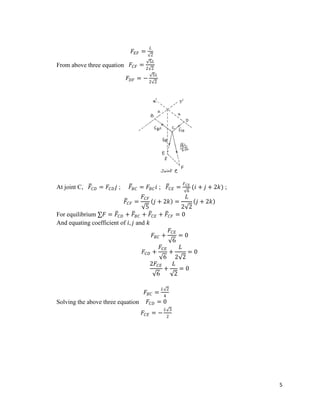
From above three equation
𝐹𝐸𝐹 =
𝐿
2
𝐹𝐶𝐹 =
5𝐿
2 2
𝐹𝐷𝐹 = −
5𝐿
2 2
At joint C, 𝐹𝐶𝐷 = 𝐹𝐶𝐷𝑗 ; 𝐹𝐵𝐶 = 𝐹𝐵𝐶𝑖 ; 𝐹𝐶𝐸 =
𝐹𝐶𝐸
6
(𝑖 + 𝑗 + 2𝑘) ;
𝐹𝐶𝐹 =
𝐹𝐶𝐹
5
𝑗 + 2𝑘 =
𝐿
2 2
𝑗 + 2𝑘
For equilibrium ∑𝐹 = 𝐹𝐶𝐷 + 𝐹𝐵𝐶 + 𝐹𝐶𝐸 + 𝐹𝐶𝐹 = 0
And equating coefficient of 𝑖, 𝑗 and 𝑘
𝐹𝐵𝐶 +
𝐹𝐶𝐸
6
= 0
𝐹𝐶𝐷 +
𝐹𝐶𝐸
6
+
𝐿
2 2
= 0
2𝐹𝐶𝐸
6
+
𝐿
2
= 0
Solving the above three equation
𝐹𝐵𝐶 =
𝐿 2
4
𝐹𝐶𝐷 = 0
𝐹𝐶𝐸 = −
𝐿 3
2
6
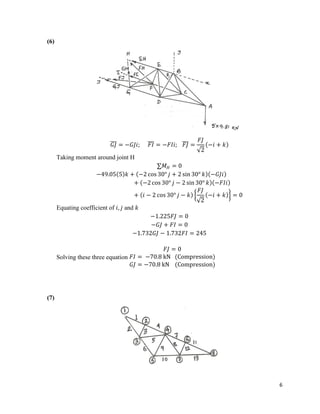
(6)
𝐺𝐽 = −𝐺𝐽𝑖; 𝐹𝐼 = −𝐹𝐼𝑖; 𝐹𝐽 =
𝐹𝐽
2
−𝑖 + 𝑘
Taking moment around joint H
∑𝑀𝐻 = 0
−49.05 5 𝑘 + −2 cos 30° 𝑗 + 2 sin 30° 𝑘 −𝐺𝐽𝑖
+ −2 cos 30° 𝑗 − 2 sin 30° 𝑘 −𝐹𝐼𝑖
+ 𝑖 − 2 cos 30° 𝑗 − 𝑘
𝐹𝐽
2
−𝑖 + 𝑘 = 0
Equating coefficient of 𝑖, 𝑗 and 𝑘
−1.225𝐹𝐽 = 0
−𝐺𝐽 + 𝐹𝐼 = 0
−1.732𝐺𝐽 − 1.732𝐹𝐼 = 245
Solving these three equation
𝐹𝐽 = 0
𝐹𝐼 = −70.8 kN (Compression)
𝐺𝐽 = −70.8 kN (Compression)
(7)
GH
7
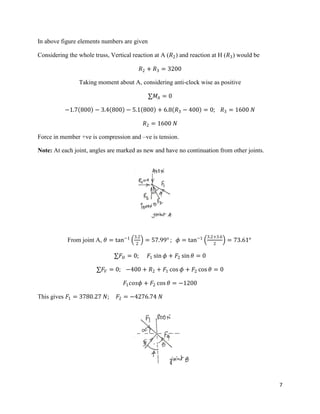
In above figure elements numbers are given
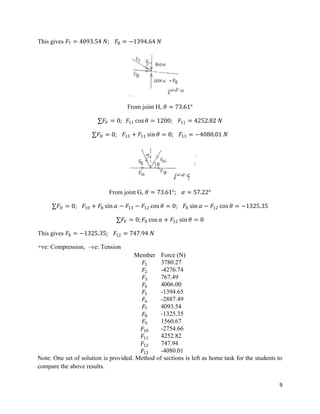
Considering the whole truss, Vertical reaction at A (𝑅2) and reaction at H (𝑅3) would be
𝑅2 + 𝑅3 = 3200
Taking moment about A, considering anti-clock wise as positive
∑𝑀𝐴 = 0
−1.7 800 − 3.4 800 − 5.1 800 + 6.8 𝑅3 − 400 = 0; 𝑅3 = 1600 𝑁
𝑅2 = 1600 𝑁
Force in member +ve is compression and –ve is tension.
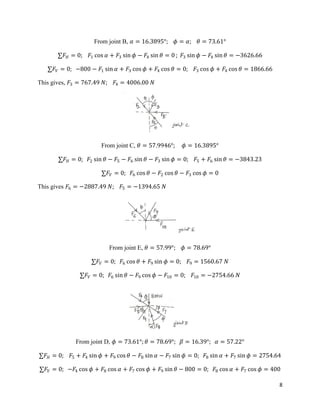
Note: At each joint, angles are marked as new and have no continuation from other joints.
From joint A, 𝜃 = tan−1 3.2
2
= 57.99° ; 𝜙 = tan−1 3.2+3.6
2
= 73.61°
∑𝐹𝐻 = 0; 𝐹1 sin 𝜙 + 𝐹2 sin 𝜃 = 0
∑𝐹𝑉 = 0; −400 + 𝑅2 + 𝐹1 cos 𝜙 + 𝐹2 cos 𝜃 = 0
𝐹1𝑐𝑜𝑠𝜙 + 𝐹2 cos 𝜃 = −1200
This gives 𝐹1 = 3780.27 𝑁; 𝐹2 = −4276.74 𝑁
8
From joint B, 𝛼 = 16.3895°; 𝜙 = 𝛼; 𝜃 = 73.61°
∑𝐹𝐻 = 0; 𝐹1 cos 𝛼 + 𝐹3 sin 𝜙 − 𝐹4 sin 𝜃 = 0 ; 𝐹3 sin 𝜙 − 𝐹4 sin 𝜃 = −3626.66
∑𝐹𝑉 = 0; −800 − 𝐹1 sin 𝛼 + 𝐹3 cos 𝜙 + 𝐹4 cos 𝜃 = 0; 𝐹3 cos 𝜙 + 𝐹4 cos 𝜃 = 1866.66
This gives, 𝐹3 = 767.49 𝑁; 𝐹4 = 4006.00 𝑁
From joint C, 𝜃 = 57.9946°; 𝜙 = 16.3895°
∑𝐹𝐻 = 0; 𝐹2 sin 𝜃 − 𝐹5 − 𝐹6 sin 𝜃 − 𝐹3 sin 𝜙 = 0; 𝐹5 + 𝐹6 sin 𝜃 = −3843.23
∑𝐹𝑉 = 0; 𝐹6 cos 𝜃 − 𝐹2 cos 𝜃 − 𝐹3 cos 𝜙 = 0
This gives 𝐹6 = −2887.49 𝑁; 𝐹5 = −1394.65 𝑁
From joint E, 𝜃 = 57.99°; 𝜙 = 78.69°
∑𝐹𝑉 = 0; 𝐹6 cos 𝜃 + 𝐹9 sin 𝜙 = 0; 𝐹9 = 1560.67 𝑁
∑𝐹𝑉 = 0; 𝐹6 sin 𝜃 − 𝐹9 cos 𝜙 − 𝐹10 = 0; 𝐹10 = −2754.66 𝑁
From joint D, 𝜙 = 73.61°; 𝜃 = 78.69°; 𝛽 = 16.39°; 𝛼 = 57.22°
∑𝐹𝐻 = 0; 𝐹5 + 𝐹4 sin 𝜙 + 𝐹9 cos 𝜃 − 𝐹8 sin 𝛼 − 𝐹7 sin 𝜙 = 0; 𝐹8 sin 𝛼 + 𝐹7 sin 𝜙 = 2754.64
∑𝐹𝑉 = 0; −𝐹4 cos 𝜙 + 𝐹8 cos 𝛼 + 𝐹7 cos 𝜙 + 𝐹9 sin 𝜃 − 800 = 0; 𝐹8 cos 𝛼 + 𝐹7 cos 𝜙 = 400
9
This gives 𝐹7 = 4093.54 𝑁; 𝐹8 = −1394.64 𝑁
From joint H, 𝜃 = 73.61°
∑𝐹𝑉 = 0; 𝐹11 cos 𝜃 = 1200; 𝐹11 = 4252.82 𝑁
∑𝐹𝐻 = 0; 𝐹13 + 𝐹11 sin 𝜃 = 0; 𝐹13 = −4080.01 𝑁
From joint G, 𝜃 = 73.61°; 𝛼 = 57.22°
∑𝐹𝐻 = 0; 𝐹10 + 𝐹8 sin 𝛼 − 𝐹13 − 𝐹12 cos 𝜃 = 0; 𝐹8 sin 𝛼 − 𝐹12 cos 𝜃 = −1325.35
∑𝐹𝑉 = 0; 𝐹8 cos 𝛼 + 𝐹12 sin 𝜃 = 0
This gives 𝐹8 = −1325.35; 𝐹12 = 747.94 𝑁
+ve: Compression, –ve: Tension
Member Force (N)
𝐹1 3780.27
𝐹2 -4276.74
𝐹3 767.49
𝐹4 4006.00
𝐹5 -1394.65
𝐹6 -2887.49
𝐹7 4093.54
𝐹8 -1325.35
𝐹9 1560.67
𝐹10 -2754.66
𝐹11 4252.82
𝐹12 747.94
𝐹13 -4080.01
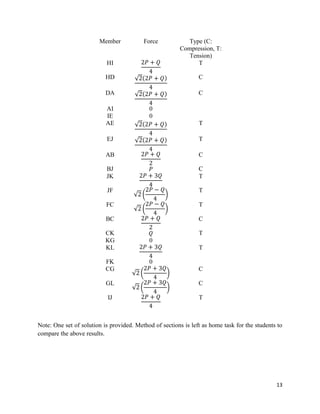
Note: One set of solution is provided. Method of sections is left as home task for the students to
compare the above results.
10
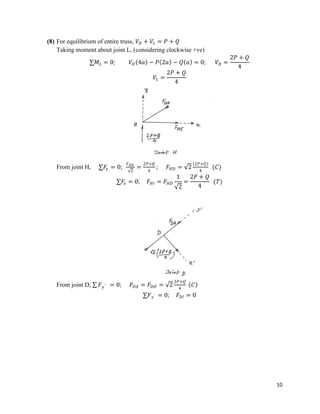
(8) For equilibrium of entire truss, 𝑉𝐻 + 𝑉𝐿 = 𝑃 + 𝑄
Taking moment about joint L, (considering clockwise +ve)
∑𝑀𝐿 = 0; 𝑉𝐻 4𝑎 − 𝑃 2𝑎 − 𝑄 𝑎 = 0; 𝑉𝐻 =
2𝑃 + 𝑄
4
𝑉𝐿 =
2𝑃 + 𝑄
4
From joint H, ∑𝐹
𝑦 = 0;
𝐹𝐻𝐷
2
=
2𝑃+𝑄
4
; 𝐹𝐻𝐷 = 2
2𝑃+𝑄
4
(𝐶)
∑𝐹
𝑥 = 0; 𝐹𝐻𝐼 = 𝐹𝐻𝐷
1
2
=
2𝑃 + 𝑄
4
(𝑇)
From joint D, ∑ 𝐹𝑦′ = 0; 𝐹𝐷𝐴 = 𝐹𝐷𝐻 = 2
2𝑃+𝑄
4
𝐶
∑𝐹𝑥′ = 0; 𝐹𝐷𝐼 = 0
11
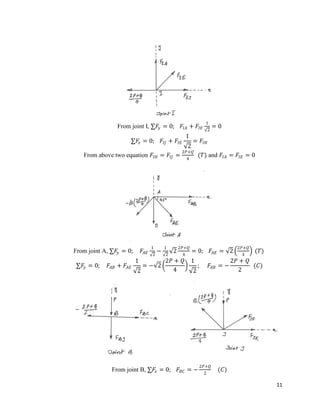
From joint I, ∑𝐹𝑦 = 0; 𝐹𝐼𝐴 + 𝐹𝐼𝐸
1
2
= 0
∑𝐹
𝑥 = 0; 𝐹𝐼𝐽 + 𝐹𝐼𝐸
1
2
= 𝐹𝐼𝐻
From above two equation 𝐹𝐼𝐻 = 𝐹𝐼𝐽 =
2𝑃+𝑄
4
(𝑇) and 𝐹𝐼𝐴 = 𝐹𝐼𝐸 = 0
From joint A, ∑𝐹
𝑦 = 0; 𝐹𝐴𝐸
1
2
−
1
2
2
2𝑃+𝑄
4
= 0; 𝐹𝐴𝐸 = 2
2𝑃+𝑄
4
(𝑇)
∑𝐹
𝑦 = 0; 𝐹𝐴𝐵 + 𝐹𝐴𝐸
1
2
= − 2
2𝑃 + 𝑄
4
1
2
; 𝐹𝐴𝐵 = −
2𝑃 + 𝑄
2
(𝐶)
From joint B, ∑𝐹
𝑥 = 0; 𝐹𝐵𝐶 = −
2𝑃+𝑄
2
(𝐶)
12
∑𝐹
𝑦 = 0; 𝐹𝐵𝐽 = −𝑃 (𝐶)
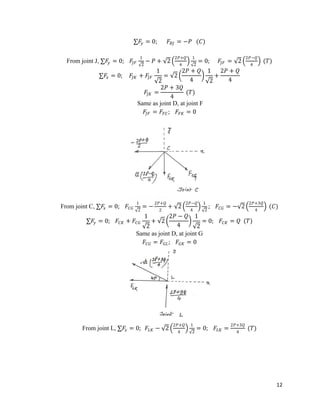
From joint J, ∑𝐹
𝑦 = 0; 𝐹𝐽𝐹
1
2
− 𝑃 + 2
2𝑃+𝑄
4
1
2
= 0; 𝐹𝐽𝐹 = 2
2𝑃−𝑄
4
(𝑇)
∑𝐹
𝑥 = 0; 𝐹𝐽𝐾 + 𝐹𝐽𝐹
1
2
= 2
2𝑃 + 𝑄
4
1
2
+
2𝑃 + 𝑄
4
𝐹𝐽𝐾 =
2𝑃 + 3𝑄
4
(𝑇)
Same as joint D, at joint F
𝐹𝐽𝐹 = 𝐹𝐹𝐶; 𝐹𝐹𝐾 = 0
From joint C, ∑𝐹
𝑥 = 0; 𝐹𝐶𝐺
1
2
= −
2𝑃+𝑄
2
+ 2
2𝑃−𝑄
4
1
2
; 𝐹𝐶𝐺 = − 2
2𝑃+3𝑄
4
(𝐶)
∑𝐹
𝑦 = 0; 𝐹𝐶𝐾 + 𝐹𝐶𝐺
1
2
+ 2
2𝑃 − 𝑄
4
1
2
= 0; 𝐹𝐶𝐾 = 𝑄 (𝑇)
Same as joint D, at joint G
𝐹𝐶𝐺 = 𝐹𝐺𝐿; 𝐹𝐺𝐾 = 0
From joint L, ∑𝐹
𝑥 = 0; 𝐹𝐿𝐾 − 2
2𝑃+𝑄
4
1
2
= 0; 𝐹𝐿𝐾 =
2𝑃+3𝑄
4
(𝑇)
13
Member Force Type (C:
Compression, T:
Tension)
HI 2𝑃 + 𝑄
4
T
HD 2 2𝑃 + 𝑄
4
C
DA 2 2𝑃 + 𝑄
4
C
AI 0
IE 0
AE 2 2𝑃 + 𝑄
4
T
EJ 2 2𝑃 + 𝑄
4
T
AB 2𝑃 + 𝑄
2
C
BJ 𝑃 C
JK 2𝑃 + 3𝑄
4
T
JF
2
2𝑃 − 𝑄
4
T
FC
2
2𝑃 − 𝑄
4
T
BC 2𝑃 + 𝑄
2
C
CK 𝑄 T
KG 0
KL 2𝑃 + 3𝑄
4
T
FK 0
CG
2
2𝑃 + 3𝑄
4
C
GL
2
2𝑃 + 3𝑄
4
C
IJ 2𝑃 + 𝑄
4
T
Note: One set of solution is provided. Method of sections is left as home task for the students to
compare the above results.
14
(9)
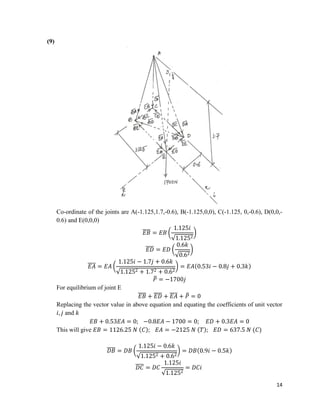
Co-ordinate of the joints are A(-1.125,1.7,-0.6), B(-1.125,0,0), C(-1.125, 0,-0.6), D(0,0,-
0.6) and E(0,0,0)
𝐸𝐵 = 𝐸𝐵
1.125𝑖
1.1252
𝐸𝐷 = 𝐸𝐷
0.6𝑘
0.62
𝐸𝐴 = 𝐸𝐴
1.125𝑖 − 1.7𝑗 + 0.6𝑘
1.1252 + 1.72 + 0.62
= 𝐸𝐴 0.53𝑖 − 0.8𝑗 + 0.3𝑘
𝑃 = −1700𝑗
For equilibrium of joint E
𝐸𝐵 + 𝐸𝐷 + 𝐸𝐴 + 𝑃 = 0
Replacing the vector value in above equation and equating the coefficients of unit vector
𝑖, 𝑗 and 𝑘
𝐸𝐵 + 0.53𝐸𝐴 = 0; −0.8𝐸𝐴 − 1700 = 0; 𝐸𝐷 + 0.3𝐸𝐴 = 0
This will give 𝐸𝐵 = 1126.25 𝑁 𝐶 ; 𝐸𝐴 = −2125 𝑁 𝑇 ; 𝐸𝐷 = 637.5 𝑁 (𝐶)
𝐷𝐵 = 𝐷𝐵
1.125𝑖 − 0.6𝑘
1.1252 + 0.62
= 𝐷𝐵 0.9𝑖 − 0.5𝑘
𝐷𝐶 = 𝐷𝐶
1.125𝑖
1.1252
= 𝐷𝐶𝑖
15
𝐷𝐴 = 𝐷𝐴
1.125𝑖 − 1.7𝑗
1.1252 + 1.72
= 𝐷𝐴 0.55𝑖 − 0.83𝑗
For equilibrium of joint D
𝐷𝐸 + 𝐷𝐵 + 𝐷𝐶 + 𝐷𝐴 = 0
Replacing the vector value in above equation and collecting the coefficient of unit vector
0.9𝐷𝐵 + 𝐷𝐶 + 0.55𝐷𝐴 = 0; −0.83𝐷𝐴 = 0; −0.5𝐷𝐵 − 𝐸𝐷 = 0
This will give 𝐷𝐶 = 1147.5 𝑁 𝐶 ; 𝐷𝐴 = 0; 𝐷𝐵 = −1275 𝑁 (𝑇)
𝐵𝐶 = 𝐵𝐶
0.6𝑘
0.62
= 𝐵𝐶𝑘
𝐵𝐴 = 𝐵𝐴
−1.7𝑗 + 0.6𝑘
1.72 + 0.62
= 𝐵𝐴(−0.94𝑗 + 0.33𝑘)
For equilibrium of joint B
𝐵𝐸 + 𝐵𝐷 + 𝐵𝐶 + 𝐵𝐴 = 0
Replacing the vector value in above equation and collection the coefficient of unit vector
0.94𝐵𝐴 = 0; −0.5 −1275 + 𝐵𝐶 + 0.33 𝐵𝐴 = 0
This will give 𝐵𝐴 = 0; 𝐵𝐶 = −637.5 𝑁 (𝑇)
For joint equilibrium of joint C
𝐶𝐴 + 𝐶𝐵 + 𝐶𝐷 = 0
Replacing the vector value in above equation and collection the coefficient of unit vector
𝐶𝐴 = 0
(10)
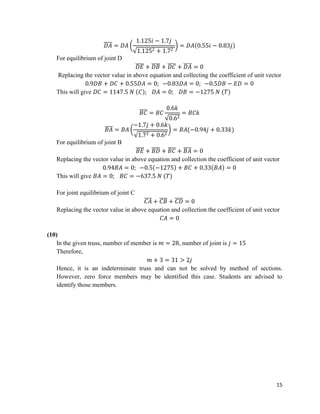
In the given truss, number of member is 𝑚 = 28, number of joint is 𝑗 = 15
Therefore,
𝑚 + 3 = 31 > 2𝑗
Hence, it is an indeterminate truss and can not be solved by method of sections.
However, zero force members may be identified this case. Students are advised to
identify those members.

EM_Tutorial_02_Solution.pdf

  • 1.
    1 (1) Considering wholetruss, taking moment about C (assuming clockwise +ve) ∑𝑀𝐶 = 0; 𝑉𝐴 6 − 2 3 = 0 𝑉𝐴 = 1 A section is considered between E and D Taking moment about B (assuming clockwise +ve) ∑𝑀𝐵 = 0; 𝑉𝐴 3 + 𝐹𝐸𝐷 3 = 0 This gives 𝐹𝐸𝐷 = −1 𝑁 (𝐶) Taking moment about D (assuming clockwise +ve) ∑𝑀𝐷 = 0; 𝑉𝐴 6 − 𝐹𝐵𝐶(3) = 0 This gives 𝐹𝐵𝐶 = 2 𝑁 (𝑇) For vertical equilibrium ∑𝐹𝑉 = 0; 𝑉𝐴 + 𝐹𝐵𝐷 sin 45° = 0 This gives 𝐹𝐵𝐷 = − 2 𝑁 (𝐶) (2)
  • 2.
    2 BA = BA −𝑖−3𝑗−6𝑘 12+33+62 =BA −𝑖−3𝑗−6𝑘 46 CA = CA 2𝑖−6𝑘 22+62 = CA 2𝑖−6𝑘 40 DA = DA −𝑖+3𝑗−6𝑘 12+3262 = DA −𝑖+3𝑗−6𝑘 46 ∑𝐹𝐴 = 0 which gives BA + CA + DA − 5 𝑐𝑜𝑠30°𝑖 + 𝑠𝑖𝑛30°𝑗 = 0 Equating coefficient of 𝑖, 𝑗 and 𝑘 to the right hand − 1 46 BA + 2 40 CA − 1 46 DA = 0 − 3 46 BA + 3 46 DA − 1 2 5 = 0 − 6 46 BA − 6 40 CA − 6 46 DA − 5 3 2 = 0 Solving this three equation BA = −4.46 kN CA = −1.521 kN DA = 1.194 kN (3) 𝜃 = tan−1 1 2 = 26.57° sin 𝜃 = 1 5 cos 𝜃 = 2 5 ∑𝐹 𝑦 = 0; AG 5 − 4 = 0; AG = 4 5 kN (Compression) ∑𝐹 𝑥 = 0; AB − 4 5 2 5 = 0; AB = 8 kN (Tension)
  • 3.
    3 From joint B,∑𝐹 𝑥 = 0; BC = 8 kN (Tension) ∑𝐹 𝑦 = 0; 𝐵𝐺 = 2 𝑘𝑁 (Compression) From joint G, ∑ 𝐹 𝑦 ′ = 0; 2 2 5 − CG sin 2𝜃 = 0; CG = 2.24 kN (Tension) 𝐹𝑥′ = 0; 2.24 cos 2𝜃 + 2 5 + 4 5 − GF = 0; GF = 11.18 kN (Compression) From joint C, ∑𝐹 𝑦 = 0; CF − 2.24 sin 𝜃 = 0; CF = 1.0 kN (Compreesion) ∑𝐹𝑥 = 0; 𝐶𝐷 − 2 − 2.24 cos 𝜃 = 0; 𝐶𝐷 = 4.0 kN (Tension) (4) Considering entire truss, reactions at A and B are A = B = 3𝐿 Considering section between ED, and taking moment about D (assuming anti-clockwise positive) ∑𝑀𝐷 = 0; FG 1 + 𝐿 1.2 + 2.4 − 3𝐿 2.4 = 0; FG = 3.6𝐿 (Tension)
  • 4.
    4 From joint G, 𝜃= tan−1 0.2 1.2 = 9.5° ∑𝐹 𝑥 = 0; −3.6𝐿 + GH cos 𝜃 = 0; GH = 3.65𝐿 (Tension) ∑𝐹 𝑦 = 0; DG − 3.65𝐿 sin 𝜃 = 0; DG = 0.60𝐿 (Tension) (5) 𝐿 = 𝐿 2 −𝑖 + 𝑗 ; 𝐹𝐸𝐹 = 𝐹𝐸𝐹𝑖 ; 𝐹𝐶𝐹 = 𝐹𝐶𝐹 5 −𝑗 − 2𝑘 ; 𝐹𝐷𝐹 = 𝐹𝐷𝐹 5 (𝑗 − 2𝑘) At joint F, ∑𝐹 = 𝐿 + 𝐹𝐸𝐹 + 𝐹𝐶𝐹 + 𝐹𝐷𝐹 = 0 and equating the coefficient of 𝑖, 𝑗 and 𝑘 − 𝐿 2 + 𝐹𝐸𝐹 = 0 𝐿 2 − 𝐹𝐶𝐹 5 + 𝐹𝐷𝐹 5 = 0 − 2 5 𝐹𝐶𝐹 − 2 5 𝐹𝐷𝐹 = 0
  • 5.
    5 From above threeequation 𝐹𝐸𝐹 = 𝐿 2 𝐹𝐶𝐹 = 5𝐿 2 2 𝐹𝐷𝐹 = − 5𝐿 2 2 At joint C, 𝐹𝐶𝐷 = 𝐹𝐶𝐷𝑗 ; 𝐹𝐵𝐶 = 𝐹𝐵𝐶𝑖 ; 𝐹𝐶𝐸 = 𝐹𝐶𝐸 6 (𝑖 + 𝑗 + 2𝑘) ; 𝐹𝐶𝐹 = 𝐹𝐶𝐹 5 𝑗 + 2𝑘 = 𝐿 2 2 𝑗 + 2𝑘 For equilibrium ∑𝐹 = 𝐹𝐶𝐷 + 𝐹𝐵𝐶 + 𝐹𝐶𝐸 + 𝐹𝐶𝐹 = 0 And equating coefficient of 𝑖, 𝑗 and 𝑘 𝐹𝐵𝐶 + 𝐹𝐶𝐸 6 = 0 𝐹𝐶𝐷 + 𝐹𝐶𝐸 6 + 𝐿 2 2 = 0 2𝐹𝐶𝐸 6 + 𝐿 2 = 0 Solving the above three equation 𝐹𝐵𝐶 = 𝐿 2 4 𝐹𝐶𝐷 = 0 𝐹𝐶𝐸 = − 𝐿 3 2
  • 6.
    6 (6) 𝐺𝐽 = −𝐺𝐽𝑖;𝐹𝐼 = −𝐹𝐼𝑖; 𝐹𝐽 = 𝐹𝐽 2 −𝑖 + 𝑘 Taking moment around joint H ∑𝑀𝐻 = 0 −49.05 5 𝑘 + −2 cos 30° 𝑗 + 2 sin 30° 𝑘 −𝐺𝐽𝑖 + −2 cos 30° 𝑗 − 2 sin 30° 𝑘 −𝐹𝐼𝑖 + 𝑖 − 2 cos 30° 𝑗 − 𝑘 𝐹𝐽 2 −𝑖 + 𝑘 = 0 Equating coefficient of 𝑖, 𝑗 and 𝑘 −1.225𝐹𝐽 = 0 −𝐺𝐽 + 𝐹𝐼 = 0 −1.732𝐺𝐽 − 1.732𝐹𝐼 = 245 Solving these three equation 𝐹𝐽 = 0 𝐹𝐼 = −70.8 kN (Compression) 𝐺𝐽 = −70.8 kN (Compression) (7) GH
  • 7.
    7 In above figureelements numbers are given Considering the whole truss, Vertical reaction at A (𝑅2) and reaction at H (𝑅3) would be 𝑅2 + 𝑅3 = 3200 Taking moment about A, considering anti-clock wise as positive ∑𝑀𝐴 = 0 −1.7 800 − 3.4 800 − 5.1 800 + 6.8 𝑅3 − 400 = 0; 𝑅3 = 1600 𝑁 𝑅2 = 1600 𝑁 Force in member +ve is compression and –ve is tension. Note: At each joint, angles are marked as new and have no continuation from other joints. From joint A, 𝜃 = tan−1 3.2 2 = 57.99° ; 𝜙 = tan−1 3.2+3.6 2 = 73.61° ∑𝐹𝐻 = 0; 𝐹1 sin 𝜙 + 𝐹2 sin 𝜃 = 0 ∑𝐹𝑉 = 0; −400 + 𝑅2 + 𝐹1 cos 𝜙 + 𝐹2 cos 𝜃 = 0 𝐹1𝑐𝑜𝑠𝜙 + 𝐹2 cos 𝜃 = −1200 This gives 𝐹1 = 3780.27 𝑁; 𝐹2 = −4276.74 𝑁
  • 8.
    8 From joint B,𝛼 = 16.3895°; 𝜙 = 𝛼; 𝜃 = 73.61° ∑𝐹𝐻 = 0; 𝐹1 cos 𝛼 + 𝐹3 sin 𝜙 − 𝐹4 sin 𝜃 = 0 ; 𝐹3 sin 𝜙 − 𝐹4 sin 𝜃 = −3626.66 ∑𝐹𝑉 = 0; −800 − 𝐹1 sin 𝛼 + 𝐹3 cos 𝜙 + 𝐹4 cos 𝜃 = 0; 𝐹3 cos 𝜙 + 𝐹4 cos 𝜃 = 1866.66 This gives, 𝐹3 = 767.49 𝑁; 𝐹4 = 4006.00 𝑁 From joint C, 𝜃 = 57.9946°; 𝜙 = 16.3895° ∑𝐹𝐻 = 0; 𝐹2 sin 𝜃 − 𝐹5 − 𝐹6 sin 𝜃 − 𝐹3 sin 𝜙 = 0; 𝐹5 + 𝐹6 sin 𝜃 = −3843.23 ∑𝐹𝑉 = 0; 𝐹6 cos 𝜃 − 𝐹2 cos 𝜃 − 𝐹3 cos 𝜙 = 0 This gives 𝐹6 = −2887.49 𝑁; 𝐹5 = −1394.65 𝑁 From joint E, 𝜃 = 57.99°; 𝜙 = 78.69° ∑𝐹𝑉 = 0; 𝐹6 cos 𝜃 + 𝐹9 sin 𝜙 = 0; 𝐹9 = 1560.67 𝑁 ∑𝐹𝑉 = 0; 𝐹6 sin 𝜃 − 𝐹9 cos 𝜙 − 𝐹10 = 0; 𝐹10 = −2754.66 𝑁 From joint D, 𝜙 = 73.61°; 𝜃 = 78.69°; 𝛽 = 16.39°; 𝛼 = 57.22° ∑𝐹𝐻 = 0; 𝐹5 + 𝐹4 sin 𝜙 + 𝐹9 cos 𝜃 − 𝐹8 sin 𝛼 − 𝐹7 sin 𝜙 = 0; 𝐹8 sin 𝛼 + 𝐹7 sin 𝜙 = 2754.64 ∑𝐹𝑉 = 0; −𝐹4 cos 𝜙 + 𝐹8 cos 𝛼 + 𝐹7 cos 𝜙 + 𝐹9 sin 𝜃 − 800 = 0; 𝐹8 cos 𝛼 + 𝐹7 cos 𝜙 = 400
  • 9.
    9 This gives 𝐹7= 4093.54 𝑁; 𝐹8 = −1394.64 𝑁 From joint H, 𝜃 = 73.61° ∑𝐹𝑉 = 0; 𝐹11 cos 𝜃 = 1200; 𝐹11 = 4252.82 𝑁 ∑𝐹𝐻 = 0; 𝐹13 + 𝐹11 sin 𝜃 = 0; 𝐹13 = −4080.01 𝑁 From joint G, 𝜃 = 73.61°; 𝛼 = 57.22° ∑𝐹𝐻 = 0; 𝐹10 + 𝐹8 sin 𝛼 − 𝐹13 − 𝐹12 cos 𝜃 = 0; 𝐹8 sin 𝛼 − 𝐹12 cos 𝜃 = −1325.35 ∑𝐹𝑉 = 0; 𝐹8 cos 𝛼 + 𝐹12 sin 𝜃 = 0 This gives 𝐹8 = −1325.35; 𝐹12 = 747.94 𝑁 +ve: Compression, –ve: Tension Member Force (N) 𝐹1 3780.27 𝐹2 -4276.74 𝐹3 767.49 𝐹4 4006.00 𝐹5 -1394.65 𝐹6 -2887.49 𝐹7 4093.54 𝐹8 -1325.35 𝐹9 1560.67 𝐹10 -2754.66 𝐹11 4252.82 𝐹12 747.94 𝐹13 -4080.01 Note: One set of solution is provided. Method of sections is left as home task for the students to compare the above results.
  • 10.
    10 (8) For equilibriumof entire truss, 𝑉𝐻 + 𝑉𝐿 = 𝑃 + 𝑄 Taking moment about joint L, (considering clockwise +ve) ∑𝑀𝐿 = 0; 𝑉𝐻 4𝑎 − 𝑃 2𝑎 − 𝑄 𝑎 = 0; 𝑉𝐻 = 2𝑃 + 𝑄 4 𝑉𝐿 = 2𝑃 + 𝑄 4 From joint H, ∑𝐹 𝑦 = 0; 𝐹𝐻𝐷 2 = 2𝑃+𝑄 4 ; 𝐹𝐻𝐷 = 2 2𝑃+𝑄 4 (𝐶) ∑𝐹 𝑥 = 0; 𝐹𝐻𝐼 = 𝐹𝐻𝐷 1 2 = 2𝑃 + 𝑄 4 (𝑇) From joint D, ∑ 𝐹𝑦′ = 0; 𝐹𝐷𝐴 = 𝐹𝐷𝐻 = 2 2𝑃+𝑄 4 𝐶 ∑𝐹𝑥′ = 0; 𝐹𝐷𝐼 = 0
  • 11.
    11 From joint I,∑𝐹𝑦 = 0; 𝐹𝐼𝐴 + 𝐹𝐼𝐸 1 2 = 0 ∑𝐹 𝑥 = 0; 𝐹𝐼𝐽 + 𝐹𝐼𝐸 1 2 = 𝐹𝐼𝐻 From above two equation 𝐹𝐼𝐻 = 𝐹𝐼𝐽 = 2𝑃+𝑄 4 (𝑇) and 𝐹𝐼𝐴 = 𝐹𝐼𝐸 = 0 From joint A, ∑𝐹 𝑦 = 0; 𝐹𝐴𝐸 1 2 − 1 2 2 2𝑃+𝑄 4 = 0; 𝐹𝐴𝐸 = 2 2𝑃+𝑄 4 (𝑇) ∑𝐹 𝑦 = 0; 𝐹𝐴𝐵 + 𝐹𝐴𝐸 1 2 = − 2 2𝑃 + 𝑄 4 1 2 ; 𝐹𝐴𝐵 = − 2𝑃 + 𝑄 2 (𝐶) From joint B, ∑𝐹 𝑥 = 0; 𝐹𝐵𝐶 = − 2𝑃+𝑄 2 (𝐶)
  • 12.
    12 ∑𝐹 𝑦 = 0;𝐹𝐵𝐽 = −𝑃 (𝐶) From joint J, ∑𝐹 𝑦 = 0; 𝐹𝐽𝐹 1 2 − 𝑃 + 2 2𝑃+𝑄 4 1 2 = 0; 𝐹𝐽𝐹 = 2 2𝑃−𝑄 4 (𝑇) ∑𝐹 𝑥 = 0; 𝐹𝐽𝐾 + 𝐹𝐽𝐹 1 2 = 2 2𝑃 + 𝑄 4 1 2 + 2𝑃 + 𝑄 4 𝐹𝐽𝐾 = 2𝑃 + 3𝑄 4 (𝑇) Same as joint D, at joint F 𝐹𝐽𝐹 = 𝐹𝐹𝐶; 𝐹𝐹𝐾 = 0 From joint C, ∑𝐹 𝑥 = 0; 𝐹𝐶𝐺 1 2 = − 2𝑃+𝑄 2 + 2 2𝑃−𝑄 4 1 2 ; 𝐹𝐶𝐺 = − 2 2𝑃+3𝑄 4 (𝐶) ∑𝐹 𝑦 = 0; 𝐹𝐶𝐾 + 𝐹𝐶𝐺 1 2 + 2 2𝑃 − 𝑄 4 1 2 = 0; 𝐹𝐶𝐾 = 𝑄 (𝑇) Same as joint D, at joint G 𝐹𝐶𝐺 = 𝐹𝐺𝐿; 𝐹𝐺𝐾 = 0 From joint L, ∑𝐹 𝑥 = 0; 𝐹𝐿𝐾 − 2 2𝑃+𝑄 4 1 2 = 0; 𝐹𝐿𝐾 = 2𝑃+3𝑄 4 (𝑇)
  • 13.
    13 Member Force Type(C: Compression, T: Tension) HI 2𝑃 + 𝑄 4 T HD 2 2𝑃 + 𝑄 4 C DA 2 2𝑃 + 𝑄 4 C AI 0 IE 0 AE 2 2𝑃 + 𝑄 4 T EJ 2 2𝑃 + 𝑄 4 T AB 2𝑃 + 𝑄 2 C BJ 𝑃 C JK 2𝑃 + 3𝑄 4 T JF 2 2𝑃 − 𝑄 4 T FC 2 2𝑃 − 𝑄 4 T BC 2𝑃 + 𝑄 2 C CK 𝑄 T KG 0 KL 2𝑃 + 3𝑄 4 T FK 0 CG 2 2𝑃 + 3𝑄 4 C GL 2 2𝑃 + 3𝑄 4 C IJ 2𝑃 + 𝑄 4 T Note: One set of solution is provided. Method of sections is left as home task for the students to compare the above results.
  • 14.
    14 (9) Co-ordinate of thejoints are A(-1.125,1.7,-0.6), B(-1.125,0,0), C(-1.125, 0,-0.6), D(0,0,- 0.6) and E(0,0,0) 𝐸𝐵 = 𝐸𝐵 1.125𝑖 1.1252 𝐸𝐷 = 𝐸𝐷 0.6𝑘 0.62 𝐸𝐴 = 𝐸𝐴 1.125𝑖 − 1.7𝑗 + 0.6𝑘 1.1252 + 1.72 + 0.62 = 𝐸𝐴 0.53𝑖 − 0.8𝑗 + 0.3𝑘 𝑃 = −1700𝑗 For equilibrium of joint E 𝐸𝐵 + 𝐸𝐷 + 𝐸𝐴 + 𝑃 = 0 Replacing the vector value in above equation and equating the coefficients of unit vector 𝑖, 𝑗 and 𝑘 𝐸𝐵 + 0.53𝐸𝐴 = 0; −0.8𝐸𝐴 − 1700 = 0; 𝐸𝐷 + 0.3𝐸𝐴 = 0 This will give 𝐸𝐵 = 1126.25 𝑁 𝐶 ; 𝐸𝐴 = −2125 𝑁 𝑇 ; 𝐸𝐷 = 637.5 𝑁 (𝐶) 𝐷𝐵 = 𝐷𝐵 1.125𝑖 − 0.6𝑘 1.1252 + 0.62 = 𝐷𝐵 0.9𝑖 − 0.5𝑘 𝐷𝐶 = 𝐷𝐶 1.125𝑖 1.1252 = 𝐷𝐶𝑖
  • 15.
    15 𝐷𝐴 = 𝐷𝐴 1.125𝑖− 1.7𝑗 1.1252 + 1.72 = 𝐷𝐴 0.55𝑖 − 0.83𝑗 For equilibrium of joint D 𝐷𝐸 + 𝐷𝐵 + 𝐷𝐶 + 𝐷𝐴 = 0 Replacing the vector value in above equation and collecting the coefficient of unit vector 0.9𝐷𝐵 + 𝐷𝐶 + 0.55𝐷𝐴 = 0; −0.83𝐷𝐴 = 0; −0.5𝐷𝐵 − 𝐸𝐷 = 0 This will give 𝐷𝐶 = 1147.5 𝑁 𝐶 ; 𝐷𝐴 = 0; 𝐷𝐵 = −1275 𝑁 (𝑇) 𝐵𝐶 = 𝐵𝐶 0.6𝑘 0.62 = 𝐵𝐶𝑘 𝐵𝐴 = 𝐵𝐴 −1.7𝑗 + 0.6𝑘 1.72 + 0.62 = 𝐵𝐴(−0.94𝑗 + 0.33𝑘) For equilibrium of joint B 𝐵𝐸 + 𝐵𝐷 + 𝐵𝐶 + 𝐵𝐴 = 0 Replacing the vector value in above equation and collection the coefficient of unit vector 0.94𝐵𝐴 = 0; −0.5 −1275 + 𝐵𝐶 + 0.33 𝐵𝐴 = 0 This will give 𝐵𝐴 = 0; 𝐵𝐶 = −637.5 𝑁 (𝑇) For joint equilibrium of joint C 𝐶𝐴 + 𝐶𝐵 + 𝐶𝐷 = 0 Replacing the vector value in above equation and collection the coefficient of unit vector 𝐶𝐴 = 0 (10) In the given truss, number of member is 𝑚 = 28, number of joint is 𝑗 = 15 Therefore, 𝑚 + 3 = 31 > 2𝑗 Hence, it is an indeterminate truss and can not be solved by method of sections. However, zero force members may be identified this case. Students are advised to identify those members.