© 2013 Springer Publishing Company, LLC.
Chapter 6
Short-Answer
(Fill-in-the-Blank)
and Essay
&Oermann Gaberson
Evaluation and Testing in Nursing Education
4th edition
© 2013 Springer Publishing Company, LLC.
Short-Answer (Fill-in-the-Blank)
♦ Answered by word, phrase, or number
♦ 2 types: question and completion
(fill-in-the-blank)
♦ Less affected by guessing than true-false
♦ Tests mainly for factual information
2
© 2013 Springer Publishing Company, LLC.
Writing Short-Answer Items
♦ Word the question to require a single
unique answer
♦ Think of intended answer first
♦ Avoid clues to correct answer
♦ Avoid verbatim statements from a text
♦ If using sentence-completion variety, place
blank at the end of the sentence
3
© 2013 Springer Publishing Company, LLC.
Completion Example
What congenital cardiac defect results in
communication between the pulmonary artery
and aorta? ____________
4
© 2013 Springer Publishing Company, LLC.
Completion Example
Three physiological changes that occur with
aging are:
1._________
2._________
3._________
5
© 2013 Springer Publishing Company, LLC.
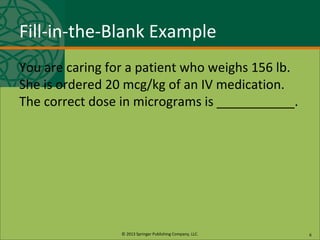
Fill-in-the-Blank Example
You are caring for a patient who weighs 156 lb.
She is ordered 20 mcg/kg of an IV medication.
The correct dose in micrograms is ___________.
6
© 2013 Springer Publishing Company, LLC.
Essay Items
♦ Requires students to develop their own
answers to questions
♦ Opportunity to:
– Select content to discuss
– Present ideas in own words
– Develop original and creative response to
question
7
© 2013 Springer Publishing Company, LLC.
Uses of Essay Items
♦ Testing
– Complex learning outcomes
– Higher-level learning, not recall
– Content not appropriate for objectively
scored items
8
© 2013 Springer Publishing Company, LLC.
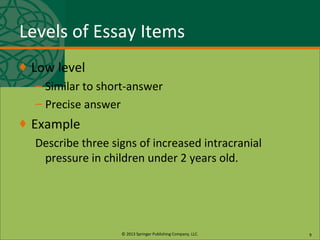
Levels of Essay Items
♦ Low level
– Similar to short-answer
– Precise answer
♦ Example
Describe three signs of increased intracranial
pressure in children under 2 years old.
9
© 2013 Springer Publishing Company, LLC.
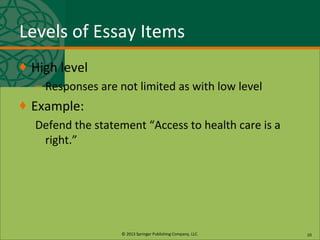
Levels of Essay Items
♦ High level
– Responses are not limited as with low level
♦ Example:
Defend the statement “Access to health care is a
right.”
10
© 2013 Springer Publishing Company, LLC.
Types of Essay Items
♦ Restricted response
♦ Extended response
→ Difference is based on extent of freedom in
responding to essay item
11
© 2013 Springer Publishing Company, LLC.
Restricted-Response Essay Item
♦ Limit answer by
– Specifying content to be discussed
– Restricting amount of discussion allowed
• “Answer in one paragraph” or “one page”
12
© 2013 Springer Publishing Company, LLC.
Examples
1. Define patient-centered care. Limit your
response to one paragraph.
2. Compare metabolic and respiratory
acidosis. Include the following in your
response: definitions, precipitating factors,
clinical manifestations, diagnostic tests, and
interventions.
13
© 2013 Springer Publishing Company, LLC.
Example
3. A patient is 76 years old and 1 day
postoperative femoral popliteal bypass graft.
Name a major complication the patient could
experience at this time. List two nursing
interventions for this patient during the
initial recovery period with related evidence.
14
© 2013 Springer Publishing Company, LLC.
Extended-Response Essay Items
♦ Less restrictive
♦ Opportunity for students to choose content
for answer, integrate learning from multiple
sources, organize ideas
♦ Assess higher-level learning
15
© 2013 Springer Publishing Company, LLC.
Writing Essay Items
♦ Assess knowledge of content, not writing
ability
♦ Frame the problem so that students know
what to write about
16
© 2013 Springer Publishing Company, LLC.
Example
1. Select an article describing a nursing
research study. Critique the study, specifying
the criteria used. Based on your evaluation,
describe how the research findings could be
used in clinical practice.
17
© 2013 Springer Publishing Company, LLC.
Example
2. In the clinic you note that patients who are
uninsured receive fewer diagnostic tests and
less comprehensive care than patients with
similar health problems who are insured.
Analyze these differences in care and related
issues.
18
© 2013 Springer Publishing Company, LLC.
Issues With Essay Tests
♦ Limited ability to sample course content
♦ Low reliability of scoring
♦ Item-to-item carryover effect
– Impression of quality of one response carries over
to next question
– Read all responses to one item before evaluating
next one
19
© 2013 Springer Publishing Company, LLC.
Issues With Essay Tests (cont’d)
♦ Test-to-test carryover effect
– Impression of student carried from one test to next
♦ Halo effect
– Teacher’s general impression of a student
influences scoring of test
♦ Essay tests should be scored anonymously
20
© 2013 Springer Publishing Company, LLC.
Issues With Essay Tests (cont’d)
♦ Effect of writing ability
– Rating influenced by sentence structure,
grammar, spelling, punctuation
– Longer answers often receive higher scores
regardless of content
21
© 2013 Springer Publishing Company, LLC.
Issues With Essay Tests (cont’d)
♦ Rater drift
– Essay tests read early may be scored higher than
those read near the end
– Rater drift: stray from scoring criteria
– Read papers in random order
– Read each answer twice before scoring
22
© 2013 Springer Publishing Company, LLC.
Issues With Essay Tests (cont’d)
♦ Usability
– Allow more time for students to answer and
teacher to score
♦ Student choice of essay items
– May affect measurement validity
• Students taking different tests
23
© 2013 Springer Publishing Company, LLC.
Scoring Essay Items
♦ Two methods
– Holistic (global-impression)
– Analytical
24
© 2013 Springer Publishing Company, LLC.
Holistic Scoring
♦ Read entire answer and evaluate its overall
quality
♦ Ways to score
– Relative standard
– Model answer
– Scoring rubric
25
© 2013 Springer Publishing Company, LLC.
Analytical Method
♦ Identify elements required in ideal answer
♦ Each element must be included in answer
♦ Evaluate and score each element separately
rather than overall response
– Scoring rubric
26
© 2013 Springer Publishing Company, LLC.
Scoring Essay Items
♦ Identify method of scoring
♦ Construct ideal answer and how to score it
♦ Evaluate:
– Content
– Organization
– Process
27
© 2013 Springer Publishing Company, LLC.
Ideal Answer
♦ Write ideal answer while drafting essay item
– Save for use in scoring
28
© 2013 Springer Publishing Company, LLC.
Scoring Essay Items
♦ Check your ideal answer
– Read random sample of papers
– Score answers to one item at a time
• Compare responses across students
♦ Alter ideal answer and scoring criteria if
needed
29
© 2013 Springer Publishing Company, LLC.
Scoring Essay Items (cont’d)
♦ Use same scoring system for all papers
♦ Read each answer twice before scoring
♦ Read students’ responses in random order
30
© 2013 Springer Publishing Company, LLC.
Scoring Essay Items (cont’d)
♦ Read anonymously
♦ Cover scores to previous answers
♦ If possible, have colleague read and score
– Improves reliability
♦ Adopt policy on scoring writing ability
31
© 2013 Springer Publishing Company, LLC.
Prepare Students for Essay Tests
♦ Ask thought-provoking questions
♦ Use sample essay items to review content
before test
– Discuss ideal answers with students
32
© 2013 Springer Publishing Company, LLC.
Prepare Students for
Essay Tests (cont’d)
♦ Students practice responding to sample items
in small groups
– Pass answers to next group to critique
– Have students score responses
33

Chapter 6 ppt eval & testing 4e formatted 01.10 mo edits

  • 1.
    © 2013 SpringerPublishing Company, LLC. Chapter 6 Short-Answer (Fill-in-the-Blank) and Essay &Oermann Gaberson Evaluation and Testing in Nursing Education 4th edition
  • 2.
    © 2013 SpringerPublishing Company, LLC. Short-Answer (Fill-in-the-Blank) ♦ Answered by word, phrase, or number ♦ 2 types: question and completion (fill-in-the-blank) ♦ Less affected by guessing than true-false ♦ Tests mainly for factual information 2
  • 3.
    © 2013 SpringerPublishing Company, LLC. Writing Short-Answer Items ♦ Word the question to require a single unique answer ♦ Think of intended answer first ♦ Avoid clues to correct answer ♦ Avoid verbatim statements from a text ♦ If using sentence-completion variety, place blank at the end of the sentence 3
  • 4.
    © 2013 SpringerPublishing Company, LLC. Completion Example What congenital cardiac defect results in communication between the pulmonary artery and aorta? ____________ 4
  • 5.
    © 2013 SpringerPublishing Company, LLC. Completion Example Three physiological changes that occur with aging are: 1._________ 2._________ 3._________ 5
  • 6.
    © 2013 SpringerPublishing Company, LLC. Fill-in-the-Blank Example You are caring for a patient who weighs 156 lb. She is ordered 20 mcg/kg of an IV medication. The correct dose in micrograms is ___________. 6
  • 7.
    © 2013 SpringerPublishing Company, LLC. Essay Items ♦ Requires students to develop their own answers to questions ♦ Opportunity to: – Select content to discuss – Present ideas in own words – Develop original and creative response to question 7
  • 8.
    © 2013 SpringerPublishing Company, LLC. Uses of Essay Items ♦ Testing – Complex learning outcomes – Higher-level learning, not recall – Content not appropriate for objectively scored items 8
  • 9.
    © 2013 SpringerPublishing Company, LLC. Levels of Essay Items ♦ Low level – Similar to short-answer – Precise answer ♦ Example Describe three signs of increased intracranial pressure in children under 2 years old. 9
  • 10.
    © 2013 SpringerPublishing Company, LLC. Levels of Essay Items ♦ High level – Responses are not limited as with low level ♦ Example: Defend the statement “Access to health care is a right.” 10
  • 11.
    © 2013 SpringerPublishing Company, LLC. Types of Essay Items ♦ Restricted response ♦ Extended response → Difference is based on extent of freedom in responding to essay item 11
  • 12.
    © 2013 SpringerPublishing Company, LLC. Restricted-Response Essay Item ♦ Limit answer by – Specifying content to be discussed – Restricting amount of discussion allowed • “Answer in one paragraph” or “one page” 12
  • 13.
    © 2013 SpringerPublishing Company, LLC. Examples 1. Define patient-centered care. Limit your response to one paragraph. 2. Compare metabolic and respiratory acidosis. Include the following in your response: definitions, precipitating factors, clinical manifestations, diagnostic tests, and interventions. 13
  • 14.
    © 2013 SpringerPublishing Company, LLC. Example 3. A patient is 76 years old and 1 day postoperative femoral popliteal bypass graft. Name a major complication the patient could experience at this time. List two nursing interventions for this patient during the initial recovery period with related evidence. 14
  • 15.
    © 2013 SpringerPublishing Company, LLC. Extended-Response Essay Items ♦ Less restrictive ♦ Opportunity for students to choose content for answer, integrate learning from multiple sources, organize ideas ♦ Assess higher-level learning 15
  • 16.
    © 2013 SpringerPublishing Company, LLC. Writing Essay Items ♦ Assess knowledge of content, not writing ability ♦ Frame the problem so that students know what to write about 16
  • 17.
    © 2013 SpringerPublishing Company, LLC. Example 1. Select an article describing a nursing research study. Critique the study, specifying the criteria used. Based on your evaluation, describe how the research findings could be used in clinical practice. 17
  • 18.
    © 2013 SpringerPublishing Company, LLC. Example 2. In the clinic you note that patients who are uninsured receive fewer diagnostic tests and less comprehensive care than patients with similar health problems who are insured. Analyze these differences in care and related issues. 18
  • 19.
    © 2013 SpringerPublishing Company, LLC. Issues With Essay Tests ♦ Limited ability to sample course content ♦ Low reliability of scoring ♦ Item-to-item carryover effect – Impression of quality of one response carries over to next question – Read all responses to one item before evaluating next one 19
  • 20.
    © 2013 SpringerPublishing Company, LLC. Issues With Essay Tests (cont’d) ♦ Test-to-test carryover effect – Impression of student carried from one test to next ♦ Halo effect – Teacher’s general impression of a student influences scoring of test ♦ Essay tests should be scored anonymously 20
  • 21.
    © 2013 SpringerPublishing Company, LLC. Issues With Essay Tests (cont’d) ♦ Effect of writing ability – Rating influenced by sentence structure, grammar, spelling, punctuation – Longer answers often receive higher scores regardless of content 21
  • 22.
    © 2013 SpringerPublishing Company, LLC. Issues With Essay Tests (cont’d) ♦ Rater drift – Essay tests read early may be scored higher than those read near the end – Rater drift: stray from scoring criteria – Read papers in random order – Read each answer twice before scoring 22
  • 23.
    © 2013 SpringerPublishing Company, LLC. Issues With Essay Tests (cont’d) ♦ Usability – Allow more time for students to answer and teacher to score ♦ Student choice of essay items – May affect measurement validity • Students taking different tests 23
  • 24.
    © 2013 SpringerPublishing Company, LLC. Scoring Essay Items ♦ Two methods – Holistic (global-impression) – Analytical 24
  • 25.
    © 2013 SpringerPublishing Company, LLC. Holistic Scoring ♦ Read entire answer and evaluate its overall quality ♦ Ways to score – Relative standard – Model answer – Scoring rubric 25
  • 26.
    © 2013 SpringerPublishing Company, LLC. Analytical Method ♦ Identify elements required in ideal answer ♦ Each element must be included in answer ♦ Evaluate and score each element separately rather than overall response – Scoring rubric 26
  • 27.
    © 2013 SpringerPublishing Company, LLC. Scoring Essay Items ♦ Identify method of scoring ♦ Construct ideal answer and how to score it ♦ Evaluate: – Content – Organization – Process 27
  • 28.
    © 2013 SpringerPublishing Company, LLC. Ideal Answer ♦ Write ideal answer while drafting essay item – Save for use in scoring 28
  • 29.
    © 2013 SpringerPublishing Company, LLC. Scoring Essay Items ♦ Check your ideal answer – Read random sample of papers – Score answers to one item at a time • Compare responses across students ♦ Alter ideal answer and scoring criteria if needed 29
  • 30.
    © 2013 SpringerPublishing Company, LLC. Scoring Essay Items (cont’d) ♦ Use same scoring system for all papers ♦ Read each answer twice before scoring ♦ Read students’ responses in random order 30
  • 31.
    © 2013 SpringerPublishing Company, LLC. Scoring Essay Items (cont’d) ♦ Read anonymously ♦ Cover scores to previous answers ♦ If possible, have colleague read and score – Improves reliability ♦ Adopt policy on scoring writing ability 31
  • 32.
    © 2013 SpringerPublishing Company, LLC. Prepare Students for Essay Tests ♦ Ask thought-provoking questions ♦ Use sample essay items to review content before test – Discuss ideal answers with students 32
  • 33.
    © 2013 SpringerPublishing Company, LLC. Prepare Students for Essay Tests (cont’d) ♦ Students practice responding to sample items in small groups – Pass answers to next group to critique – Have students score responses 33

Editor's Notes

  • #16 I hyphenated “higher-level”