P ICE AND T E
 OL         H
CONST UT
      IT ION:
T E RUL S OF L
 H     E      AW
E ORCE E
 NF     M NT
The fourth amendment contains two critical
legal concepts:
   Unreasonable searches and seizures
   The requirement of probable cause to issue a
    warrant
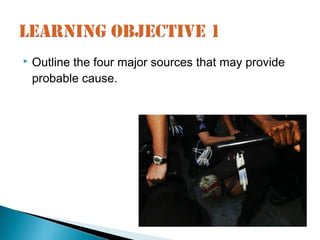
   Outline the four major sources that may provide
    probable cause.
Sources of Probable Cause:
   Personal observation
   Information
   Evidence
   Association
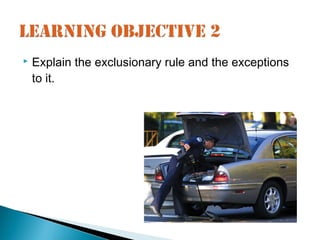
   Explain the exclusionary rule and the exceptions
    to it.
The Exclusionary Rule:
   Prohibits the use of illegally obtained evidence in
    court


The Fruit of the Poisoned Tree:
   Evidence obtained through illegally obtained
    evidence is also inadmissible
Exceptions to the exclusionary rule:
   Inevitable discovery
    ◦ Brewer v. Williams (1977)

    ◦ Nix v. Williams (1984)
   Good Faith
    ◦ United States v. Leon (1984)
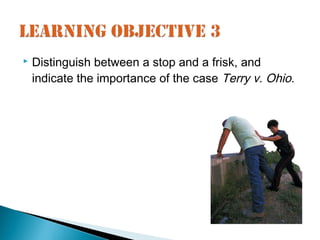
   Distinguish between a stop and a frisk, and
    indicate the importance of the case Terry v. Ohio.
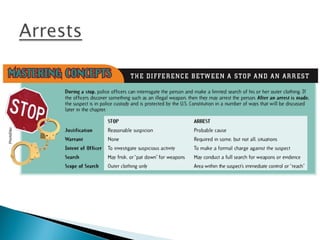
A stop is the brief detention of a person by
the police for questioning. A stop requires
reasonable suspicion.

A frisk is a pat-down or minimal search by
police to discover weapons. It is conducted
for the protection of the officer.
Stops and Frisks are governed by:
   Reasonable suspicion
   Terry v. Ohio (1968)
   The “totality of the circumstances”
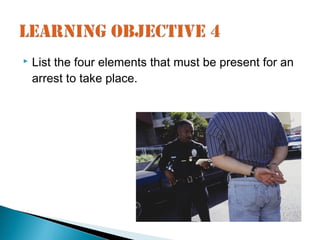
   List the four elements that must be present for an
    arrest to take place.
The elements of arrest:
   The intent to arrest
   The authority to arrest
   Seizure or detention
   The understanding of a person that they have
    been arrested
Arrests with a warrant:
   Officers are required to knock and announce their
    presence.
   Wilson v. Arkansas (1967).
   Under certain exigent circumstances officers do
    not need to announce themselves:
    ◦ The suspect is armed and dangerous.
    ◦ Evidence is being destroyed.
    ◦ A felony is in progress.
Arrests without a warrant:
   The arrest is committed in the presence of the
    officer.
   The officer has knowledge a crime was
    committed and probable cause to believe the
    crime was committed by a particular person.
 The   Role of Privacy in Searches
 ◦ Katz v. United States (1967)
    A person must show they have an expectation of privacy

    That expectation must be reasonable

 ◦ Greenwood v. California (1988)
 Search   warrants must demonstrate:
 ◦ Information showing probable cause that a crime has
   been or will be committed
 ◦ Specific information on the premises to be searched,
   the suspects to be found and the items to be seized
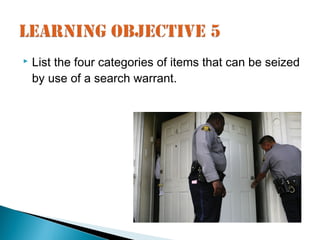
   List the four categories of items that can be seized
    by use of a search warrant.
Four categories of items that can be seized

by use of a search warrant:
   Items that resulted from a crime
   Items that are inherently illegal for anyone to
    possess
   Items that can be called “evidence” of a crime
   Items used in committing the crime
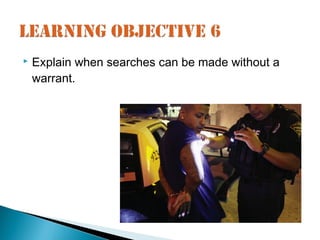
   Explain when searches can be made without a
    warrant.
   Searches incidental to arrest
    ◦ United States v. Robinson (1973)

      The officer’s need to confiscate any weapons the suspect
       may be carrying

      The need to protect any evidence on the suspect’s person
       from being destroyed

    ◦ Chimel v. California (1969)
   Searches with consent
    ◦ Schneckcloth v. Bustamonte (1973)
    ◦ Florida v. Bostick (1991)
   Searches of automobiles
    ◦ The Carroll Doctrine
    ◦ Whren v. United States (1996)
    ◦ Maryland v. Wilson (1997)
   Plain view doctrine
    ◦ New Hampshire v. Coolidge (1971)
      The item is positioned in the officer’s view

      The officer is legally in a position to notice the item

      The discovery of the item is inadvertent

      The officer immediately recognizes the illegal nature of the
       item
Electronic surveillance can only be used:
   If consent is given by one of the parties
   Or there is a warrant authorizing the activity and:
    ◦ Names the persons under surveillance
    ◦ Details the conversations to be recorded
    ◦ Shows probable cause that a crime has been committed
 The   Legal Basis for Miranda
 When   a Miranda Warning is Required
 ◦ When a suspect is under arrest

 ◦ And is being questioned about an ongoing investigation
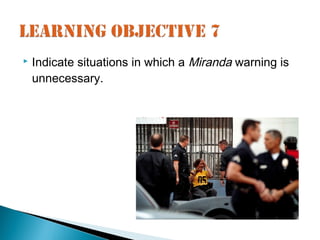
   Indicate situations in which a Miranda warning is
    unnecessary.
 When   Miranda is Not Required:
 ◦ When police do not ask suspect questions that are
   testimonial in nature
 ◦ When the police have not focused on a suspect and are
   questioning witnesses at the scene
 ◦ When a person volunteers information before being
   asked
 ◦ When the suspect has given a private statement
 ◦ During a stop and frisk when no arrest has been made
 ◦ During a traffic stop
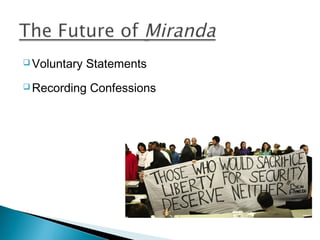
 Voluntary   Statements
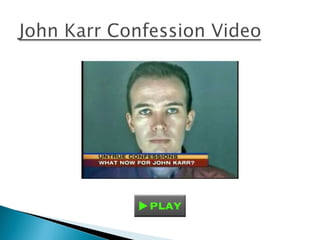
 Recording   Confessions
   Questions:
    ◦ Do you believe a Miranda warning is necessary to
      prevent individuals from falsely confessing?

    ◦ How may recent court decisions that erode Miranda
      impact the criminal justice system?
Chapter6

Chapter6

  • 1.
    P ICE ANDT E OL H CONST UT IT ION: T E RUL S OF L H E AW E ORCE E NF M NT
  • 2.
    The fourth amendmentcontains two critical legal concepts:  Unreasonable searches and seizures  The requirement of probable cause to issue a warrant
  • 3.
    Outline the four major sources that may provide probable cause.
  • 4.
    Sources of ProbableCause:  Personal observation  Information  Evidence  Association
  • 5.
    Explain the exclusionary rule and the exceptions to it.
  • 6.
    The Exclusionary Rule:  Prohibits the use of illegally obtained evidence in court The Fruit of the Poisoned Tree:  Evidence obtained through illegally obtained evidence is also inadmissible
  • 7.
    Exceptions to theexclusionary rule:  Inevitable discovery ◦ Brewer v. Williams (1977) ◦ Nix v. Williams (1984)  Good Faith ◦ United States v. Leon (1984)
  • 8.
    Distinguish between a stop and a frisk, and indicate the importance of the case Terry v. Ohio.
  • 9.
    A stop isthe brief detention of a person by the police for questioning. A stop requires reasonable suspicion. A frisk is a pat-down or minimal search by police to discover weapons. It is conducted for the protection of the officer.
  • 10.
    Stops and Frisksare governed by:  Reasonable suspicion  Terry v. Ohio (1968)  The “totality of the circumstances”
  • 11.
    List the four elements that must be present for an arrest to take place.
  • 12.
    The elements ofarrest:  The intent to arrest  The authority to arrest  Seizure or detention  The understanding of a person that they have been arrested
  • 14.
    Arrests with awarrant:  Officers are required to knock and announce their presence.  Wilson v. Arkansas (1967).  Under certain exigent circumstances officers do not need to announce themselves: ◦ The suspect is armed and dangerous. ◦ Evidence is being destroyed. ◦ A felony is in progress.
  • 15.
    Arrests without awarrant:  The arrest is committed in the presence of the officer.  The officer has knowledge a crime was committed and probable cause to believe the crime was committed by a particular person.
  • 16.
     The Role of Privacy in Searches ◦ Katz v. United States (1967)  A person must show they have an expectation of privacy  That expectation must be reasonable ◦ Greenwood v. California (1988)
  • 17.
     Search warrants must demonstrate: ◦ Information showing probable cause that a crime has been or will be committed ◦ Specific information on the premises to be searched, the suspects to be found and the items to be seized
  • 18.
    List the four categories of items that can be seized by use of a search warrant.
  • 19.
    Four categories ofitems that can be seized by use of a search warrant:  Items that resulted from a crime  Items that are inherently illegal for anyone to possess  Items that can be called “evidence” of a crime  Items used in committing the crime
  • 20.
    Explain when searches can be made without a warrant.
  • 21.
    Searches incidental to arrest ◦ United States v. Robinson (1973)  The officer’s need to confiscate any weapons the suspect may be carrying  The need to protect any evidence on the suspect’s person from being destroyed ◦ Chimel v. California (1969)
  • 22.
    Searches with consent ◦ Schneckcloth v. Bustamonte (1973) ◦ Florida v. Bostick (1991)  Searches of automobiles ◦ The Carroll Doctrine ◦ Whren v. United States (1996) ◦ Maryland v. Wilson (1997)
  • 23.
    Plain view doctrine ◦ New Hampshire v. Coolidge (1971)  The item is positioned in the officer’s view  The officer is legally in a position to notice the item  The discovery of the item is inadvertent  The officer immediately recognizes the illegal nature of the item
  • 25.
    Electronic surveillance canonly be used:  If consent is given by one of the parties  Or there is a warrant authorizing the activity and: ◦ Names the persons under surveillance ◦ Details the conversations to be recorded ◦ Shows probable cause that a crime has been committed
  • 26.
     The Legal Basis for Miranda  When a Miranda Warning is Required ◦ When a suspect is under arrest ◦ And is being questioned about an ongoing investigation
  • 27.
    Indicate situations in which a Miranda warning is unnecessary.
  • 28.
     When Miranda is Not Required: ◦ When police do not ask suspect questions that are testimonial in nature ◦ When the police have not focused on a suspect and are questioning witnesses at the scene ◦ When a person volunteers information before being asked ◦ When the suspect has given a private statement ◦ During a stop and frisk when no arrest has been made ◦ During a traffic stop
  • 29.
     Voluntary Statements  Recording Confessions
  • 31.
    Questions: ◦ Do you believe a Miranda warning is necessary to prevent individuals from falsely confessing? ◦ How may recent court decisions that erode Miranda impact the criminal justice system?