Fourth AmendmentSearch and SeizureThe Warrant Process
Analysis of search and seizure cases1. Was there government conduct?2.  Did  the defendant  have a reasonable expectation of    privacy?Was there a warrant?  Was it valid?Was there an exception to the search warrant  rule?
Reasonable expectation of privacySubjective  -  did the person an actual expectation of privacy?  (personal)Objective  -  is the expectation of privacy one that society is prepared to recognize.
Cases Progeny (precedence)Katz:  the reasonable expectation of privacy
Greenwood:  no REP in abandoned property
Oliver:  Open Fields Doctrine  and defines curtilage :  (criteria)
1.  the distance  the property is from the house
2.  the presence/absence of a fence around the area
3.  the purpose of the area
4.  the measures taken to prevent public view
The more closely related the property is related to domestic life, the more like it will be considered as curtilage.Case law continuedMapp:  holding that evidence obtained by an illegal search and seizure  (in violation of the 4th and 14th Amendments)  is inadmissible in a state court.This is known as the Exclusionary Rule.It is a judicially created remedy and not a personal constitutional right.
Case law continuedFruit of the Poisonous Tree Doctrine
Wong Sun  -  evidence obtained from illegally seized evidence must also be excluded.  This evidence is deemed “tainted.”  It is inadmissible in court.
Courts have narrowed the scope of the exclusionary rule and the fruit of the poisonous tree doctrine.
Balance the purpose (deterrence of police misconduct) against its cost (exclusion of evidence). Breaking the chain of tainted evidenceGenerally, the court will not apply the rule if it is unlikely to deter police misconduct.Three ways to break the chain of tainted evidence:1.  Independent source2.  Intervening act of free will by the defendant3.  Inevitable discovery
Search WarrantsWarrant requirements:1.  Must be based on probable cause.2.  Particularity  -  the warrant must describe with reasonable certainty the place to be searched and the item to be seized.3.  Disinterested magistrate (judicial officer)  -  a warrant must be issued by a neutral and detached magistrate.
SchoolsSchool officials are considered state officials.The 4th Amendment applies to their conduct.Lesser standard  -  Reasonable suspicionWhat is needed is a reasonable suspicion of a violation of law or school rules.Lockers may be searched without a warrant.Autos in school lots may be searched without a warrant.
Search Warrants Search warrants conducted without a warrant are unconstitutional unless there is a qualified exception to the warrant requirements.Violations of the Fourth and Fourteenth Amendments. Evidence obtained by warrantless searches is inadmissible in court.
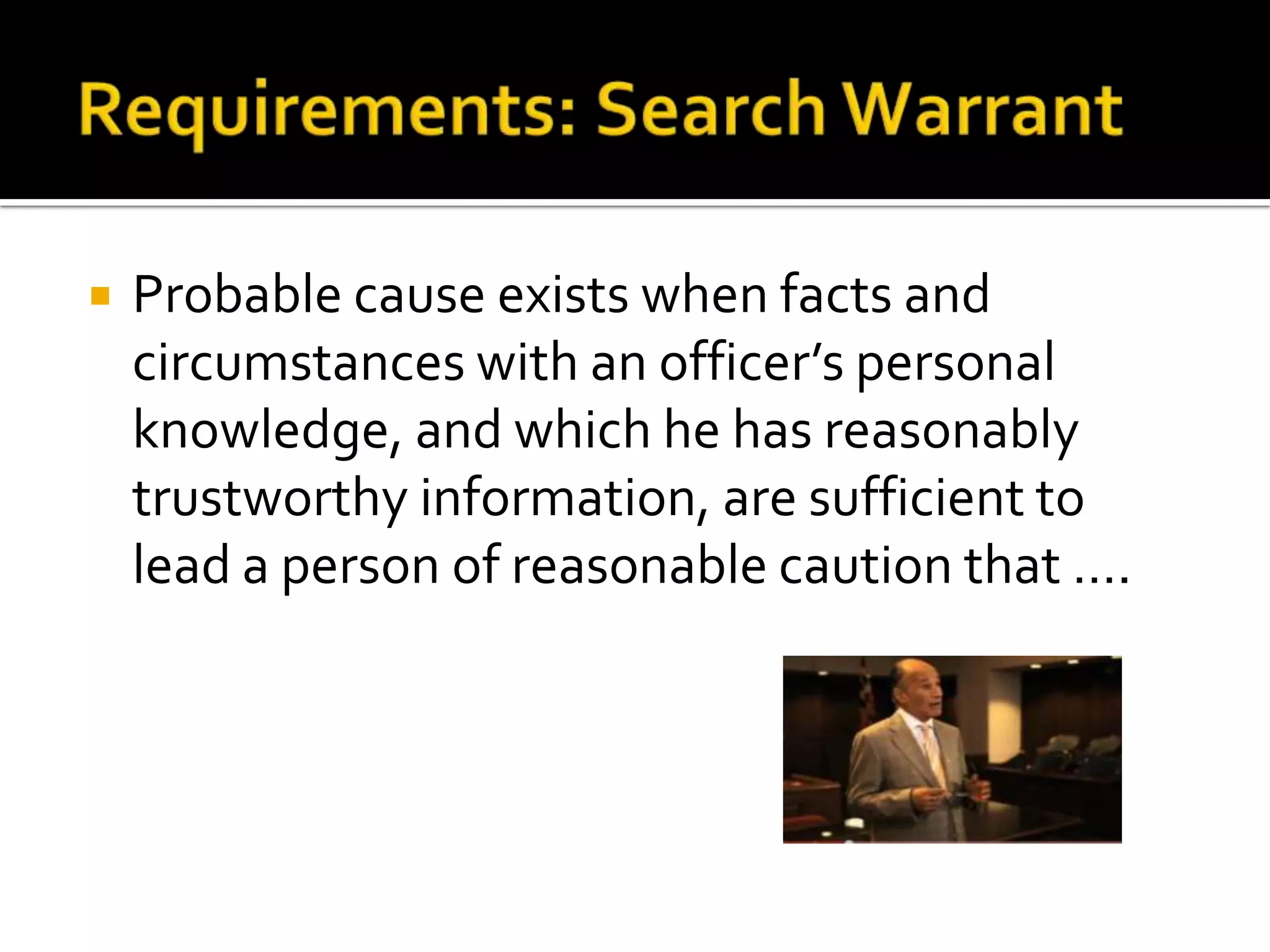
Requirements: Search WarrantProbable cause exists when facts and circumstances with an officer’s personal knowledge, and which he has reasonably trustworthy information, are sufficient to lead a person of reasonable caution that ….
In the case of an ArrestProbable cause:1.  an offense has been committed, and2 . the person to be arrested committed the    0ffense.This is similar to the probable cause standard for a “bind over” after a preliminary exam.
In the case of a SearchProbable cause:A specifically described item to be seized will be found in the place to be searched.Police officers may search for: prints, contraband, instrumentalities and other evidence.Anything for which there is a nexus between the item and criminal activity.
Types of InformationContained in the affidavit.Direct info – secured by personal observation.Hearsay info – received by the officer from another person (confidential informant) who is not present for questioning by the magistrate.Issue – determining the trustworthiness of the hearsay info provided by the CI.
Test in MichiganThere must be a basis to concluded:1.  the informant’s info was credible; OR2.  the informant’s info was reliable; AND3.  the affidavit contains affirmative    allegations the informant spoke with personal knowledge.
Supreme Court TestThe “Totality of Circumstances” test
A magistrate conducts “a balanced assessment of the relative weights of the indicia of reliability attending the informant’s tip.”
The Gates test (2 prongs):
1.  the basis of knowledge prong – the credibility of the informant, and
2.  the veracity prong – reliability of the informant.Requirements: Search WarrantParticularityA warrant must described with reasonably certainty:1. the place to be searched, and 2. the item to be seized.Should be executed without unreasonable delay (staleness).
Particularity (cont’d)Items not named in the search warrant maybe seized if:1.  it is “immediately apparent” they are evidence of other crimes, and 2.  probable cause exists to believe the item is connected to criminal activity.
Requirements: Search WarrantDisinterested magistrate (judicial officer)Warrant must be issued by a “neutral and detached” magistrate.Not a rubber stamp for the police.
Knock and Announce“Police!  Search Warrant!”
 Required by Michigan statute and the Fourth Amendment.
 Must wait a reasonable time for the door to be answered before making a forcible entry.
Apply on case by case basis (question of fact)
Inapplicable if: danger, frustration or futile. Detaining persons during searchPolice may detain those persons present while a search is conducted:1. to avoid the risk that occupants may leave with evidence.2. to reduce the risk of harm to officers.3. to encourage others to help in the search.
Modern TechnologyBeepers – Thermal  Imaging – Aerial Surveillance – DogsMovement and electronic detection in public areas is allowed without a search warrant.But once the surveillance is brought into the home, the Fourth Amendment requires a search warrant.
Pre-textural Police ConductIssue:  assessing the validity of a stop.
Conduct of the officer: (either)

Fourth amendment

  • 1.
    Fourth AmendmentSearch andSeizureThe Warrant Process
  • 2.
    Analysis of searchand seizure cases1. Was there government conduct?2. Did the defendant have a reasonable expectation of privacy?Was there a warrant? Was it valid?Was there an exception to the search warrant rule?
  • 3.
    Reasonable expectation ofprivacySubjective - did the person an actual expectation of privacy? (personal)Objective - is the expectation of privacy one that society is prepared to recognize.
  • 4.
    Cases Progeny (precedence)Katz: the reasonable expectation of privacy
  • 5.
    Greenwood: noREP in abandoned property
  • 6.
    Oliver: OpenFields Doctrine and defines curtilage : (criteria)
  • 7.
    1. thedistance the property is from the house
  • 8.
    2. thepresence/absence of a fence around the area
  • 9.
    3. thepurpose of the area
  • 10.
    4. themeasures taken to prevent public view
  • 11.
    The more closelyrelated the property is related to domestic life, the more like it will be considered as curtilage.Case law continuedMapp: holding that evidence obtained by an illegal search and seizure (in violation of the 4th and 14th Amendments) is inadmissible in a state court.This is known as the Exclusionary Rule.It is a judicially created remedy and not a personal constitutional right.
  • 12.
    Case law continuedFruitof the Poisonous Tree Doctrine
  • 13.
    Wong Sun - evidence obtained from illegally seized evidence must also be excluded. This evidence is deemed “tainted.” It is inadmissible in court.
  • 14.
    Courts have narrowedthe scope of the exclusionary rule and the fruit of the poisonous tree doctrine.
  • 15.
    Balance the purpose(deterrence of police misconduct) against its cost (exclusion of evidence). Breaking the chain of tainted evidenceGenerally, the court will not apply the rule if it is unlikely to deter police misconduct.Three ways to break the chain of tainted evidence:1. Independent source2. Intervening act of free will by the defendant3. Inevitable discovery
  • 16.
    Search WarrantsWarrant requirements:1. Must be based on probable cause.2. Particularity - the warrant must describe with reasonable certainty the place to be searched and the item to be seized.3. Disinterested magistrate (judicial officer) - a warrant must be issued by a neutral and detached magistrate.
  • 17.
    SchoolsSchool officials areconsidered state officials.The 4th Amendment applies to their conduct.Lesser standard - Reasonable suspicionWhat is needed is a reasonable suspicion of a violation of law or school rules.Lockers may be searched without a warrant.Autos in school lots may be searched without a warrant.
  • 18.
    Search Warrants Searchwarrants conducted without a warrant are unconstitutional unless there is a qualified exception to the warrant requirements.Violations of the Fourth and Fourteenth Amendments. Evidence obtained by warrantless searches is inadmissible in court.
  • 19.
    Requirements: Search WarrantProbablecause exists when facts and circumstances with an officer’s personal knowledge, and which he has reasonably trustworthy information, are sufficient to lead a person of reasonable caution that ….
  • 20.
    In the caseof an ArrestProbable cause:1. an offense has been committed, and2 . the person to be arrested committed the 0ffense.This is similar to the probable cause standard for a “bind over” after a preliminary exam.
  • 21.
    In the caseof a SearchProbable cause:A specifically described item to be seized will be found in the place to be searched.Police officers may search for: prints, contraband, instrumentalities and other evidence.Anything for which there is a nexus between the item and criminal activity.
  • 22.
    Types of InformationContainedin the affidavit.Direct info – secured by personal observation.Hearsay info – received by the officer from another person (confidential informant) who is not present for questioning by the magistrate.Issue – determining the trustworthiness of the hearsay info provided by the CI.
  • 23.
    Test in MichiganTheremust be a basis to concluded:1. the informant’s info was credible; OR2. the informant’s info was reliable; AND3. the affidavit contains affirmative allegations the informant spoke with personal knowledge.
  • 24.
    Supreme Court TestThe“Totality of Circumstances” test
  • 25.
    A magistrate conducts“a balanced assessment of the relative weights of the indicia of reliability attending the informant’s tip.”
  • 26.
    The Gates test(2 prongs):
  • 27.
    1. thebasis of knowledge prong – the credibility of the informant, and
  • 28.
    2. theveracity prong – reliability of the informant.Requirements: Search WarrantParticularityA warrant must described with reasonably certainty:1. the place to be searched, and 2. the item to be seized.Should be executed without unreasonable delay (staleness).
  • 29.
    Particularity (cont’d)Items notnamed in the search warrant maybe seized if:1. it is “immediately apparent” they are evidence of other crimes, and 2. probable cause exists to believe the item is connected to criminal activity.
  • 30.
    Requirements: Search WarrantDisinterestedmagistrate (judicial officer)Warrant must be issued by a “neutral and detached” magistrate.Not a rubber stamp for the police.
  • 31.
    Knock and Announce“Police! Search Warrant!”
  • 32.
    Required byMichigan statute and the Fourth Amendment.
  • 33.
    Must waita reasonable time for the door to be answered before making a forcible entry.
  • 34.
    Apply on caseby case basis (question of fact)
  • 35.
    Inapplicable if: danger,frustration or futile. Detaining persons during searchPolice may detain those persons present while a search is conducted:1. to avoid the risk that occupants may leave with evidence.2. to reduce the risk of harm to officers.3. to encourage others to help in the search.
  • 36.
    Modern TechnologyBeepers –Thermal Imaging – Aerial Surveillance – DogsMovement and electronic detection in public areas is allowed without a search warrant.But once the surveillance is brought into the home, the Fourth Amendment requires a search warrant.
  • 37.
    Pre-textural Police ConductIssue: assessing the validity of a stop.
  • 38.
    Conduct of theofficer: (either)
  • 39.
    1. objectively viewedvalid conduct.
  • 40.
    2. subjective motiveof the officer.
  • 41.
    The stop isreasonable where the officer has probable cause to believe the person has committed a crime for which the officer is authorized to investigated or arrest.ArrestsAn arrest occurs when a person is taken into custody for the purposes of criminal prosecution or interrogation.There must be an intentional acquisition of physical control.An arrest must be based on probable cause.
  • 42.
    DetentionsA detention occurswhen a reasonable person would believe he is not free to leave.The police may detain a person for investigatory purposes even though they lack probable cause. To make such a stop, the police must have reasonable suspicion of criminal activity.
  • 43.
    The Terry stopPromptedby three factors:
  • 44.
    1. observation ofunusual conduct;
  • 45.
    2. reasonable suspicionof criminal activity; and
  • 46.
    3. articulablefacts to justify that suspicion (the police must be able to say why they stopped you.
  • 47.
    The stop mustbe temporary and no longer than necessary to either verify or dispel the officer’s suspicion Informational EncountersA police officer may attempt to question a person in public to gather information.There is no coercion or detention.Falls outside Fourth Amendment concerns.
  • 48.
    Exceptions to theSearch Warrant RequirementsCircumstances make an immediate search preferable.
  • 49.
  • 50.
  • 51.
  • 52.
    3. protectingthe public.
  • 53.
    The court hascarved out exceptions to the warrant requirement (the search can be conducted without a warrant.Search Incident to Arrest ExceptionA police officer who makes a lawful arrest may conduct a contemporaneous warrantless search of:
  • 54.
    1. the arrestee’sperson and things immediately associated with that person.
  • 55.
    2. the areawithin the arrestee’s immediate control – the “grabbing, lunging or wingspan area.”
  • 56.
    3. if thearrest is at home, spaces immediately adjoining the place of arrest where an attack could be immediately launched. The Automobile ExceptionThe warrant requirement has been relaxed for car searches for two principle reasons:
  • 57.
    1. the inherentmobility of an auto, and
  • 58.
    2. the diminishedexpectation of privacy for autos.
  • 59.
    If the policehave probable cause to believe the auto contains evidence of a crime, they may search the vehicle without a warrant.Automobiles (cont’d)Things found in a car can be searched and seized.ContainersPassenger compartment, glove box, clothing (the Belton rule)Entire auto including the trunk upon reasonable suspicion the occupant of an auto is armed (Michigan v Long)Driver and passengers
  • 60.
    Plain View ExceptionAnobject of incriminating nature may be seized without a warrant and it is plain view of the officer if:
  • 61.
    1. the objectis viewed from a lawful vantage point;
  • 62.
    2. the officerhas a lawful right of access to the object; and
  • 63.
    3. it isimmediately apparent the object is subject to seizure. Plain View (cont’d)Typically four ways an object can come into plain view:
  • 64.
    1. the objectis discovered during the execution of a valid search warrant;
  • 65.
    2. the objectis discovered during the execution of a valid in home arrest;
  • 66.
    3. theobject is discovered during a search under an exception to the warrant requirement; or
  • 67.
    4. the objectis discovered during lawful police activity.Consent ExceptionThe police may conduct a warrantless search if they have voluntary and intelligent consent to do so.
  • 68.
    Consent is aquestion of voluntariness determined by the totality of circumstance.
  • 69.
    Any person withthe apparent right to use or occupy the property may consent to a search.
  • 70.
    Police must reasonablybelieve the person giving consent has the authority to do so.Hot Pursuit ExceptionThe following exigent circumstances justify the police following a person into a private dwelling without a warrant:
  • 71.
    1. hot pursuitof a felony;
  • 72.
  • 73.
    3. the needto prevent a suspect’s escape; or
  • 74.
    4. the riskof harm to police or others inside or outside the building. Inventory Search ExceptionThe police my search an arrestee’s personal belongings in order to inventory them before incarcerating that person (done during the booking process).The police may search an entire vehicle that has been impounded upon a finding there is probable cause the auto contains contraband or weapons.
  • 75.
    StandingClaims to enforceconstitutional right may only be raised by those who have “standing” to assert them.Fourth Amendment right are personal.They may not be vicariously asserted.
  • 76.
    Final NoteWhen indoubt, get a warrant.