CHAPTER 6 Interpersonal Communication
Strangers’ Conversations Briefly describe the people in the conversation?   What was the conversation about?   Was there any small talk?   Were any personal matters discussed? For example, attitudes, beliefs, goals? Describe one of them.   What questions were asked, and why? Two examples. Give two examples of nonverbal communication and describe its role in the conversation. What three suggestions would you make to the participants to help improve their conversation skills?
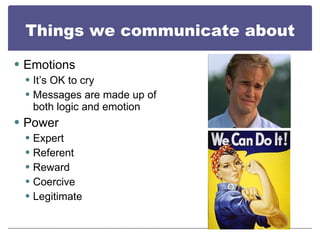
Things we communicate about Emotions It’s OK to cry Messages are made up of both logic and emotion Power Expert Referent Reward Coercive Legitimate
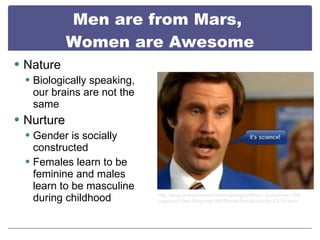
Men are from Mars,  Women are Awesome Nature Biologically speaking, our brains are not the same Nurture Gender is socially constructed Females learn to be feminine and males learn to be masculine during childhood http://www.entertonement.com/clips/cgnjzhbhpz--Anchorman-The-Legend-of-Ron-Burgundy-Will-Ferrell-Ron-Burgundy-It's-Science
Participating in Conversations Small Talk: Biographics Eventually, finding a common interest is key Listen! … to (and through) verbal and nonverbal cues People like to talk about  themselves Our names mean a lot to us Stay positive Compliment
Ask me a question Questions…  RESTATE, DEFINE and CLARIFY Encourage people  Help discover others’ attitudes Keep conversation on track Keep conversation going Help gain information and clarify meaning Require more than yes-no responses
How has the web changed our ability to communicate interpersonally?

Chapter 6: Concepts of Interpersonal Communication

  • 1.
  • 2.
    Strangers’ Conversations Brieflydescribe the people in the conversation?   What was the conversation about?   Was there any small talk?   Were any personal matters discussed? For example, attitudes, beliefs, goals? Describe one of them.   What questions were asked, and why? Two examples. Give two examples of nonverbal communication and describe its role in the conversation. What three suggestions would you make to the participants to help improve their conversation skills?
  • 3.
    Things we communicateabout Emotions It’s OK to cry Messages are made up of both logic and emotion Power Expert Referent Reward Coercive Legitimate
  • 4.
    Men are fromMars, Women are Awesome Nature Biologically speaking, our brains are not the same Nurture Gender is socially constructed Females learn to be feminine and males learn to be masculine during childhood http://www.entertonement.com/clips/cgnjzhbhpz--Anchorman-The-Legend-of-Ron-Burgundy-Will-Ferrell-Ron-Burgundy-It's-Science
  • 5.
    Participating in ConversationsSmall Talk: Biographics Eventually, finding a common interest is key Listen! … to (and through) verbal and nonverbal cues People like to talk about themselves Our names mean a lot to us Stay positive Compliment
  • 6.
    Ask me aquestion Questions… RESTATE, DEFINE and CLARIFY Encourage people Help discover others’ attitudes Keep conversation on track Keep conversation going Help gain information and clarify meaning Require more than yes-no responses
  • 7.
    How has theweb changed our ability to communicate interpersonally?